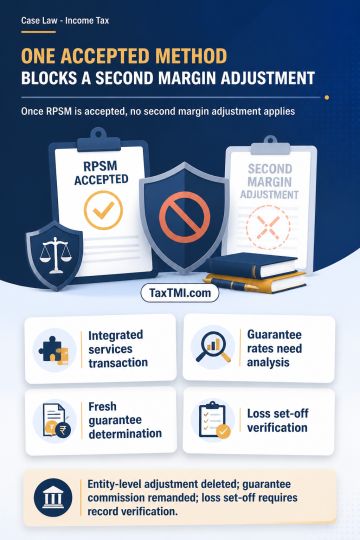
Form 26AS evidence requires successor-entity accounting verification after business transfer, while invoice-supported related-party advertising expend...
Money-laundering judgment timing requires awaiting the scheduled-offence decision despite continuation of the underlying trial where outcomes directly...
Accredited investor eligibility expands through securities-market exposure, while alternative investment fund disputes require prescribed resolution a...
Page of 4916
Press 'Enter' after typing page number.
41 to 60 of 98302 Results
❮
❯
❯❯
0 / 200
Expand Note
Add to Folder
No Folders have been created
+
Are you sure you want to delete "My most important" ?
The ITAT quashed the assessment framed under s. 143(3) as the statutory scrutiny notice under s. 143(2) was issued by a non-jurisdictional ITO instead of the DCIT who alone had jurisdiction given the assessee's return exceeded ₹20 lakh. The Tribunal held the assessment initiation was vitiated by jurisdictional defect, not curable, because the required jurisdictional officer did not issue the s. 143(2) notice nor complete the assessment. Having regard to settled coordinate bench rulings, the assessment was declared invalid and set aside, and the assessee's additional grounds challenging validity were allowed.
The ITAT quashed the assessment framed under s. 143(3) as the statutory scrutiny notice under s. 143(2) was issued by a non-jurisdictional ITO instead of the DCIT who alone had jurisdiction given the assessee's return exceeded ₹20 lakh. The Tribunal held the assessment initiation was vitiated by jurisdictional defect, not curable, because the required jurisdictional officer did not issue the s. 143(2) notice nor complete the assessment. Having regard to settled coordinate bench rulings, the assessment was declared invalid and set aside, and the assessee's additional grounds challenging validity were allowed.
Note: It is a system-generated summary and is for quick reference only.
 TaxTMI
 TaxTMI

 of 4916