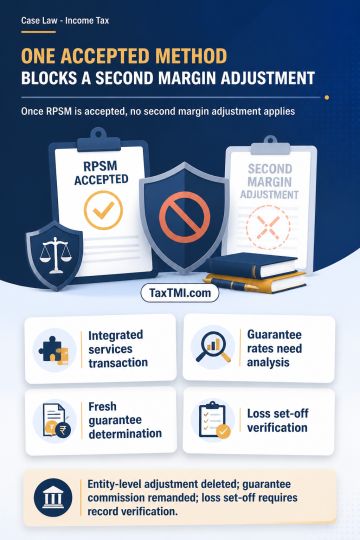
Form 26AS evidence requires successor-entity accounting verification after business transfer, while invoice-supported related-party advertising expend...
Money-laundering judgment timing requires awaiting the scheduled-offence decision despite continuation of the underlying trial where outcomes directly...
Accredited investor eligibility expands through securities-market exposure, while alternative investment fund disputes require prescribed resolution a...
Page of 4916
Press 'Enter' after typing page number.
41 to 60 of 98302 Results
❮
❯
❯❯
0 / 200
Expand Note
Add to Folder
No Folders have been created
+
Are you sure you want to delete "My most important" ?
The ITAT allowed the assessee's appeal, holding that the warranty provision constitutes an allowable deduction under section 37 of the Act. The tribunal found that the provision was systematically and consistently calculated based on a scientific methodology aligned with the company's business operations and turnover, rather than being arbitrary or a tax avoidance device. It rejected the lower authorities' characterization of the provision as contingent and disallowable, emphasizing that the liability was ascertained, expected to be utilized within a year, and complied with accrual accounting principles and relevant Accounting Standards under the Companies Act, 2013. The tribunal relied on established precedent affirming that such warranty provisions, when reasonably estimated and grounded in business reality, qualify as deductible business expenses. Consequently, the disallowance by the CIT(A) was set aside and the warranty provision was held deductible.
The ITAT allowed the assessee's appeal, holding that the warranty provision constitutes an allowable deduction under section 37 of the Act. The tribunal found that the provision was systematically and consistently calculated based on a scientific methodology aligned with the company's business operations and turnover, rather than being arbitrary or a tax avoidance device. It rejected the lower authorities' characterization of the provision as contingent and disallowable, emphasizing that the liability was ascertained, expected to be utilized within a year, and complied with accrual accounting principles and relevant Accounting Standards under the Companies Act, 2013. The tribunal relied on established precedent affirming that such warranty provisions, when reasonably estimated and grounded in business reality, qualify as deductible business expenses. Consequently, the disallowance by the CIT(A) was set aside and the warranty provision was held deductible.
Note: It is a system-generated summary and is for quick reference only.
 TaxTMI
 TaxTMI

 of 4916