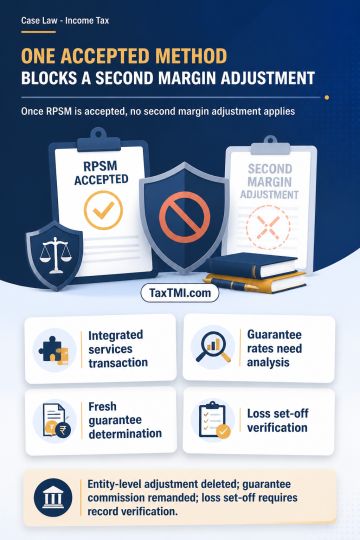
Form 26AS evidence requires successor-entity accounting verification after business transfer, while invoice-supported related-party advertising expend...
Money-laundering judgment timing requires awaiting the scheduled-offence decision despite continuation of the underlying trial where outcomes directly...
Accredited investor eligibility expands through securities-market exposure, while alternative investment fund disputes require prescribed resolution a...
Page of 4916
Press 'Enter' after typing page number.
41 to 60 of 98302 Results
❮
❯
❯❯
0 / 200
Expand Note
Add to Folder
No Folders have been created
+
Are you sure you want to delete "My most important" ?
ITAT adjudicated a tax dispute involving a Netherlands-based entity's income from satellite signal transmission. The tribunal ruled in favor of the assessee, determining that receipts from transponder leasing do not constitute royalty under the India-Netherlands tax treaty. The key holding affirmed that without a Permanent Establishment in India, the income is not taxable. The decision relied on prior judicial interpretations, specifically the Asia Satellite case, which established that transponder capacity lease revenues are not royalty. The tribunal rejected the revenue department's interpretation and answered the legal question against the tax authorities, maintaining the existing definitional understanding of royalty in international tax agreements.
ITAT adjudicated a tax dispute involving a Netherlands-based entity's income from satellite signal transmission. The tribunal ruled in favor of the assessee, determining that receipts from transponder leasing do not constitute royalty under the India-Netherlands tax treaty. The key holding affirmed that without a Permanent Establishment in India, the income is not taxable. The decision relied on prior judicial interpretations, specifically the Asia Satellite case, which established that transponder capacity lease revenues are not royalty. The tribunal rejected the revenue department's interpretation and answered the legal question against the tax authorities, maintaining the existing definitional understanding of royalty in international tax agreements.
Note: It is a system-generated summary and is for quick reference only.
 TaxTMI
 TaxTMI

 of 4916