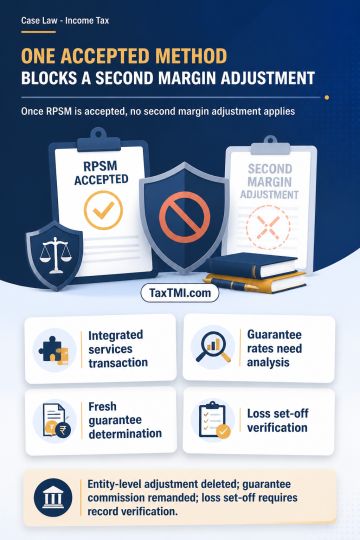
Form 26AS evidence requires successor-entity accounting verification after business transfer, while invoice-supported related-party advertising expend...
Money-laundering judgment timing requires awaiting the scheduled-offence decision despite continuation of the underlying trial where outcomes directly...
Accredited investor eligibility expands through securities-market exposure, while alternative investment fund disputes require prescribed resolution a...
Page of 4916
Press 'Enter' after typing page number.
41 to 60 of 98302 Results
❮
❯
❯❯
0 / 200
Expand Note
Add to Folder
No Folders have been created
+
Are you sure you want to delete "My most important" ?
In a case under Section 138 of the N.I. Act against partners of a firm, the HC held that compounding of the offense by one partner discharges the entire liability of the partnership firm and all partners. The court emphasized that while a firm is not a legal entity separate from its partners, Section 141 of the N.I. Act allows prosecution in the firm's name. Partners' liability is joint and several, meaning each partner is liable for the entire debt individually and collectively. The court rejected partial settlement with one partner, ruling that once a matter is compromised for any amount, the offense is compounded toward all existing liabilities of the firm. Consequently, the complaint was quashed as compounded and the petitioner was acquitted.
In a case under Section 138 of the N.I. Act against partners of a firm, the HC held that compounding of the offense by one partner discharges the entire liability of the partnership firm and all partners. The court emphasized that while a firm is not a legal entity separate from its partners, Section 141 of the N.I. Act allows prosecution in the firm's name. Partners' liability is joint and several, meaning each partner is liable for the entire debt individually and collectively. The court rejected partial settlement with one partner, ruling that once a matter is compromised for any amount, the offense is compounded toward all existing liabilities of the firm. Consequently, the complaint was quashed as compounded and the petitioner was acquitted.
Note: It is a system-generated summary and is for quick reference only.
 TaxTMI
 TaxTMI

 of 4916