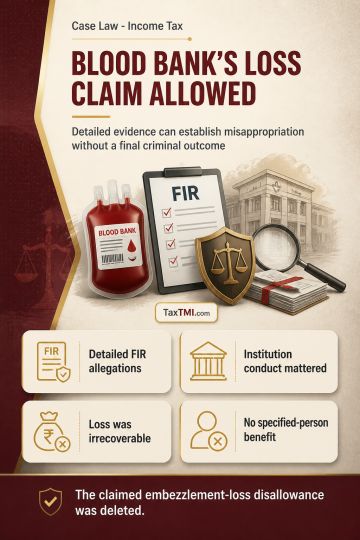
Embezzlement losses in charitable institutions remain allowable when misappropriation is established, irrecoverable, and not a specified-person benefi...
National long-distance undertaking status supports deduction where separately licensed infrastructure, resources, revenue, and expenditure establish c...
Agency reimbursement income follows contractual deposit-liability computation, while pending deposit collections do not constitute deemed-dividend loa...
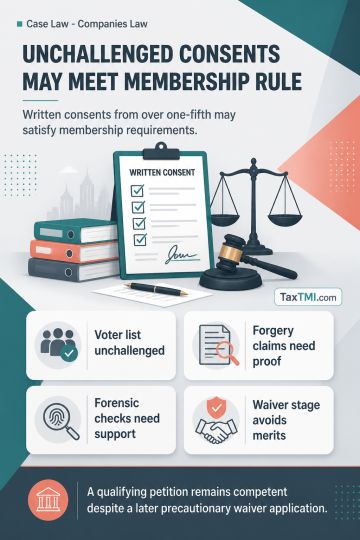
Membership-consent thresholds for oppression petitions are satisfied by unchallenged voter-list consents, while unsupported forgery claims require pro...
The assessment order was passed without verifying the allowability of the cost of improvement as per Section 55(1)(b)(2), rendering it erroneous and prejudicial to Revenue's interests. The assessee's claim for cost of improvement, comprising interior work, kitchen appliances, plywood flooring, and tiles, is allowable u/s 55(1)(b)(2) as the expenses were capital in nature, enhancing the property's value. The assessee submitted a valuation report and bank statements as evidence, which the AO examined and accepted. The CIT emphasized the need for a more in-depth inquiry, citing Explanation 2 to Section 263, but Section 263 cannot be invoked merely because the inquiry was not conducted as per the CIT's preference. The AO conducted adequate inquiries, and his acceptance of the cost of improvement was a plausible view. The revisionary proceedings u/s 263 were unjustified as the AO's order was neither erroneous nor prejudicial to Revenue's interests. Consequently, the revisionary order passed by the CIT u/s 263 is quashed, and the assessee's appeal is allowed.
The assessment order was passed without verifying the allowability of the cost of improvement as per Section 55(1)(b)(2), rendering it erroneous and prejudicial to Revenue's interests. The assessee's claim for cost of improvement, comprising interior work, kitchen appliances, plywood flooring, and tiles, is allowable u/s 55(1)(b)(2) as the expenses were capital in nature, enhancing the property's value. The assessee submitted a valuation report and bank statements as evidence, which the AO examined and accepted. The CIT emphasized the need for a more in-depth inquiry, citing Explanation 2 to Section 263, but Section 263 cannot be invoked merely because the inquiry was not conducted as per the CIT's preference. The AO conducted adequate inquiries, and his acceptance of the cost of improvement was a plausible view. The revisionary proceedings u/s 263 were unjustified as the AO's order was neither erroneous nor prejudicial to Revenue's interests. Consequently, the revisionary order passed by the CIT u/s 263 is quashed, and the assessee's appeal is allowed.
Note: It is a system-generated summary and is for quick reference only.
 TaxTMI
  TaxTMI
 of 4881