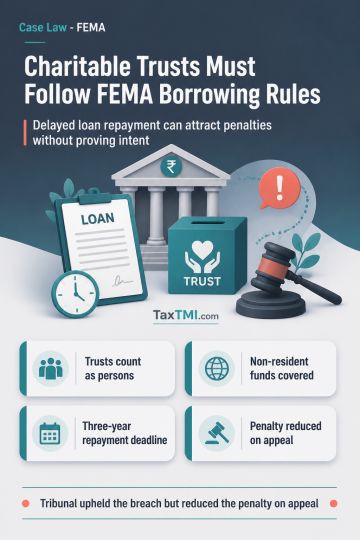
FEMA borrowing restrictions bind charitable trusts, and civil penalties apply without proving intent for delayed repayment of non-resident rupee loans...
The appellant imported goods declared as 'Low Aromatic White Spirit' classifiable under Customs Tariff Heading (CTH) 2710 1990, while the adjudicating authority reclassified them as 'Kerosene' under CTH 2710 1910, alleging mis-declaration. The goods were confiscated u/ss 111(m) and 111(d) of the Customs Act, 1962, for violating the Foreign Trade Policy and Petroleum Rules. The Tribunal observed that no test was conducted to determine if the goods met the requirements of 'Low Aromatic White Spirit'. It discussed the characteristics, manufacturing process, and international classification of such products under the Harmonized System Nomenclature. Based on the technical literature, the Tribunal held that the imported goods were rightly classifiable as 'Low Aromatic White Spirit' under CTH 2710 1990, not 'Kerosene'. Consequently, there was no violation of the Foreign Trade Policy or Petroleum Rules, and the goods were not liable for confiscation u/ss 111(m) and 111(d). The penalty imposed u/s 112(a)(i) was also set aside.
The appellant imported goods declared as 'Low Aromatic White Spirit' classifiable under Customs Tariff Heading (CTH) 2710 1990, while the adjudicating authority reclassified them as 'Kerosene' under CTH 2710 1910, alleging mis-declaration. The goods were confiscated u/ss 111(m) and 111(d) of the Customs Act, 1962, for violating the Foreign Trade Policy and Petroleum Rules. The Tribunal observed that no test was conducted to determine if the goods met the requirements of 'Low Aromatic White Spirit'. It discussed the characteristics, manufacturing process, and international classification of such products under the Harmonized System Nomenclature. Based on the technical literature, the Tribunal held that the imported goods were rightly classifiable as 'Low Aromatic White Spirit' under CTH 2710 1990, not 'Kerosene'. Consequently, there was no violation of the Foreign Trade Policy or Petroleum Rules, and the goods were not liable for confiscation u/ss 111(m) and 111(d). The penalty imposed u/s 112(a)(i) was also set aside.
Note: It is a system-generated summary and is for quick reference only.
 TaxTMI
  TaxTMI
 of 4888