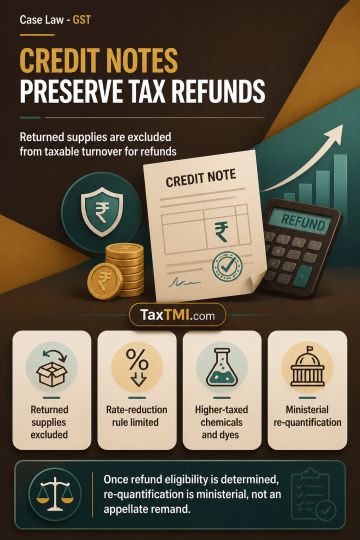
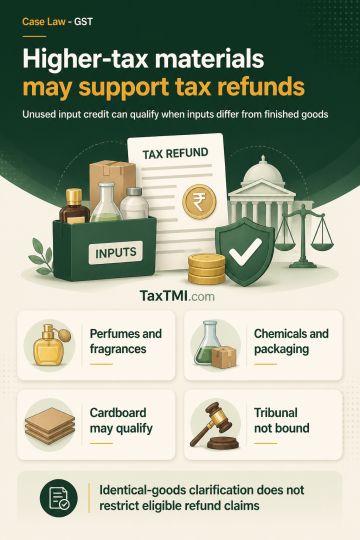
Credit-note turnover adjustments preserve inverted-duty refunds, while ministerial re-computation does not constitute an impermissible appellate reman...
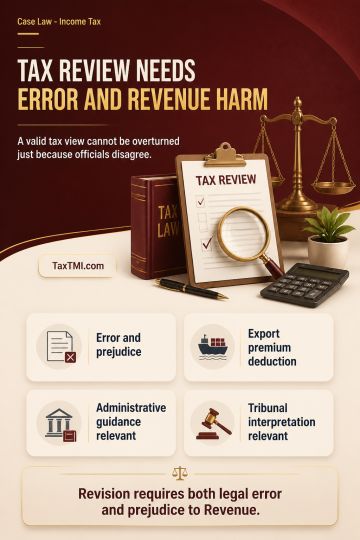
Revisional jurisdiction over export quota premium deductions requires both error and Revenue prejudice; a permissible assessment view cannot be displa...
The NCLAT held that the requirement of obtaining a No Objection Certificate (NOC) from stock exchanges under Regulation 37(1) and (2) of the LODR (Listing Obligations and Disclosure Requirements) is not applicable for schemes of arrangement for revival of companies undergoing liquidation under the Insolvency and Bankruptcy Code (IBC). SEBI's exemption for resolution plans u/s 31 of the IBC from seeking NOC from stock exchanges was intended to facilitate time-bound CIRP process under the Code's supervision. The scheme for revival, akin to a resolution plan, complies with Section 30(2) of the IBC and Regulations 37 and 38 of the IBBI (Insolvency Resolution Process for Corporate Persons) Regulations, 2016, including payment of CIRP and liquidation costs, workmen's dues, settlement value to creditors, extinguishment of liabilities, ouster of erstwhile promoters, and induction of acquirers as new promoters. Courts emphasize reviving the company's business in stakeholders' interest. The scheme offers a higher value than rejected resolution plans and liquidation value. Stock exchanges have the opportunity to raise objections before the NCLT during scheme approval.
The NCLAT held that the requirement of obtaining a No Objection Certificate (NOC) from stock exchanges under Regulation 37(1) and (2) of the LODR (Listing Obligations and Disclosure Requirements) is not applicable for schemes of arrangement for revival of companies undergoing liquidation under the Insolvency and Bankruptcy Code (IBC). SEBI's exemption for resolution plans u/s 31 of the IBC from seeking NOC from stock exchanges was intended to facilitate time-bound CIRP process under the Code's supervision. The scheme for revival, akin to a resolution plan, complies with Section 30(2) of the IBC and Regulations 37 and 38 of the IBBI (Insolvency Resolution Process for Corporate Persons) Regulations, 2016, including payment of CIRP and liquidation costs, workmen's dues, settlement value to creditors, extinguishment of liabilities, ouster of erstwhile promoters, and induction of acquirers as new promoters. Courts emphasize reviving the company's business in stakeholders' interest. The scheme offers a higher value than rejected resolution plans and liquidation value. Stock exchanges have the opportunity to raise objections before the NCLT during scheme approval.
Note: It is a system-generated summary and is for quick reference only.
 TaxTMI
  TaxTMI