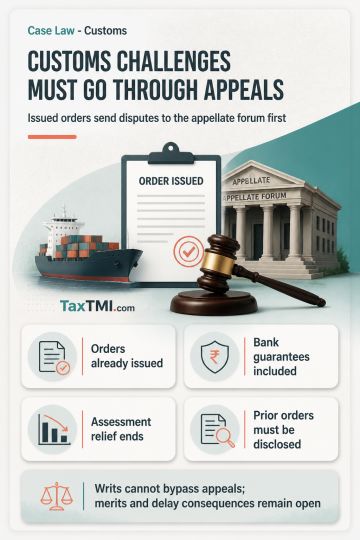
Appellate jurisdiction over baggage imports is excluded, requiring confiscation challenges involving passenger-carried gold to proceed by statutory re...
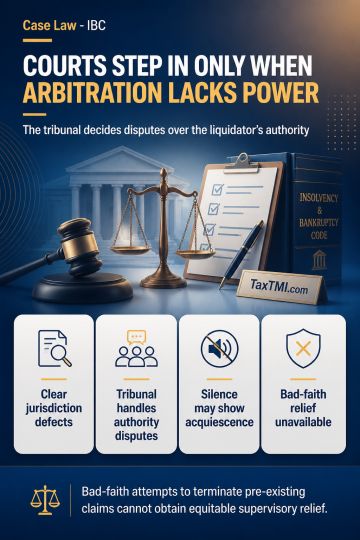
Article 227 review permits intervention in arbitration only for manifest, patent inherent jurisdictional defects, not representational authority dispu...
The legality and validity of the termination of arbitral proceedings u/s 32(2)(c) of the Arbitration and Conciliation Act, 1996 - The Supreme Court found no evidence of Sheil's abandonment of the claim. Regular participation in Marico's proceedings and absence of simultaneous scheduling were noted. - The Tribunal's duty to schedule hearings and manage proceedings was highlighted, and the mere absence of a party from a hearing does not imply abandonment or justify termination of proceedings. - The Supreme Court upheld the High Court's decision, reinstating the arbitration proceedings and emphasizing the need for an active role by the Arbitral Tribunal in managing the process.
The legality and validity of the termination of arbitral proceedings u/s 32(2)(c) of the Arbitration and Conciliation Act, 1996 - The Supreme Court found no evidence of Sheil's abandonment of the claim. Regular participation in Marico's proceedings and absence of simultaneous scheduling were noted. - The Tribunal's duty to schedule hearings and manage proceedings was highlighted, and the mere absence of a party from a hearing does not imply abandonment or justify termination of proceedings. - The Supreme Court upheld the High Court's decision, reinstating the arbitration proceedings and emphasizing the need for an active role by the Arbitral Tribunal in managing the process.
Note: It is a system-generated summary and is for quick reference only.
 TaxTMI
  TaxTMI