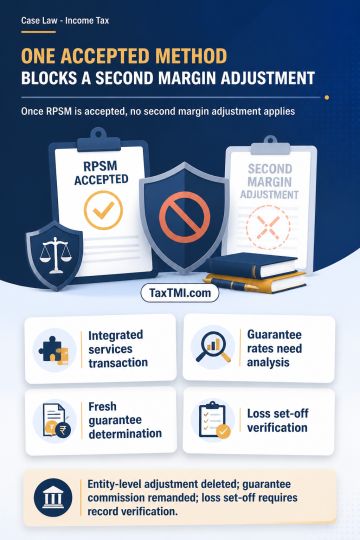
Form 26AS evidence requires successor-entity accounting verification after business transfer, while invoice-supported related-party advertising expend...
Money-laundering judgment timing requires awaiting the scheduled-offence decision despite continuation of the underlying trial where outcomes directly...
Accredited investor eligibility expands through securities-market exposure, while alternative investment fund disputes require prescribed resolution a...
Page of 4916
Press 'Enter' after typing page number.
41 to 60 of 98302 Results
❮
❯
❯❯
0 / 200
Expand Note
Add to Folder
No Folders have been created
+
Are you sure you want to delete "My most important" ?
TDS u/s 195 - payments made to its Non-Resident Telecom Operators (NTOs) for provision of bandwidth capacity and provision of interconnect services - The Tribunal referred to previous proceedings involving the payer (the domestic entity making the payments), where it was initially held that the payments constituted Royalty/FTS and were taxable under section 9 of the Act. However, this decision was later overturned by the jurisdictional High Court, which ruled that the payments were not Royalty/FTS. Relying on the High Court's judgment, the Tribunal concluded that the payments could not be taxed in the hands of the assessee under section 9 of the Act or the relevant DTAA. Therefore, the CIT(A)’s decision to allow the appeal of the assessee was upheld.
TDS u/s 195 - payments made to its Non-Resident Telecom Operators (NTOs) for provision of bandwidth capacity and provision of interconnect services - The Tribunal referred to previous proceedings involving the payer (the domestic entity making the payments), where it was initially held that the payments constituted Royalty/FTS and were taxable under section 9 of the Act. However, this decision was later overturned by the jurisdictional High Court, which ruled that the payments were not Royalty/FTS. Relying on the High Court's judgment, the Tribunal concluded that the payments could not be taxed in the hands of the assessee under section 9 of the Act or the relevant DTAA. Therefore, the CIT(A)’s decision to allow the appeal of the assessee was upheld.
Note: It is a system-generated summary and is for quick reference only.
 TaxTMI
 TaxTMI

 of 4916