Clubbing of income from gifted property failed where the claim surfaced after reassessment limitation, sustaining capital-gains assessment in spouse's...
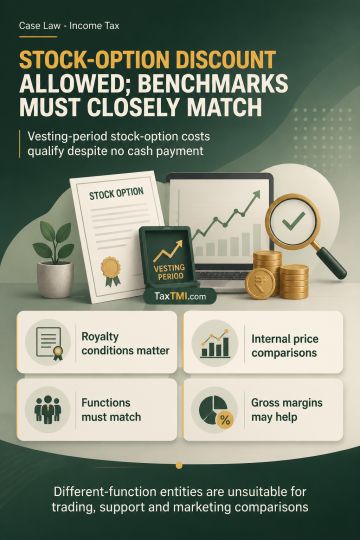
Employee stock-option discount qualifies as revenue expenditure, while royalty and service comparables require reliable functional and transactional b...
Special insurance income computation preserves statutory deductions while limiting transfer-pricing, withholding and disallowance adjustments for gene...
Section 115BBE applies only after income is validly classified...
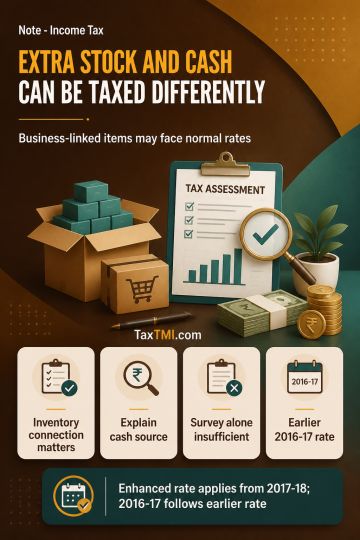
Survey surrender characterisation determines whether mixed excess stock and business-linked cash face normal taxation or special deemed-income taxation.
Contents
Summary
Note
Bookmark
Share
✓ Copied successfully !
Print
Print Options
For full text, please login
Login to TaxTMI
Verification Pending
The Email Id has not been verified. Click on the link we have sent on
Section 115BBE applies only after income is validly classified under the specified deeming provisions; a survey surrender alone is insufficient. Excess stock inseparable from regular inventory and credibly linked to unrecorded business receipts may be assessed as business income under Section 28 at normal rates. Excess cash may receive the same treatment where its business source is satisfactorily explained; otherwise, the statutory conditions for deemed income must be met. Classification requires a holistic assessment of statements and contemporaneous evidence. The substituted enhanced rate applies prospectively from financial year 2017-18, while financial year 2016-17 is governed by the earlier rate.
Section 115BBE applies only after income is validly classified under the specified deeming provisions; a survey surrender alone is insufficient. Excess stock inseparable from regular inventory and credibly linked to unrecorded business receipts may be assessed as business income under Section 28 at normal rates. Excess cash may receive the same treatment where its business source is satisfactorily explained; otherwise, the statutory conditions for deemed income must be met. Classification requires a holistic assessment of statements and contemporaneous evidence. The substituted enhanced rate applies prospectively from financial year 2017-18, while financial year 2016-17 is governed by the earlier rate.
Note: It is a system-generated summary and is for quick reference only.
 TaxTMI
  TaxTMI
 of 4897