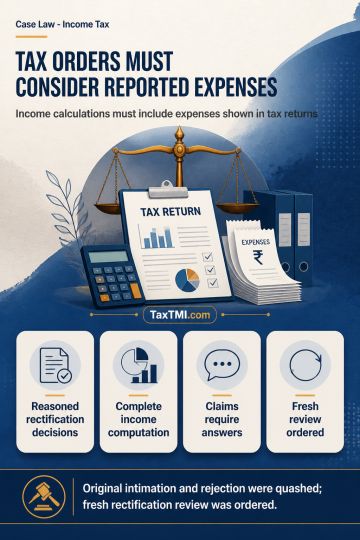
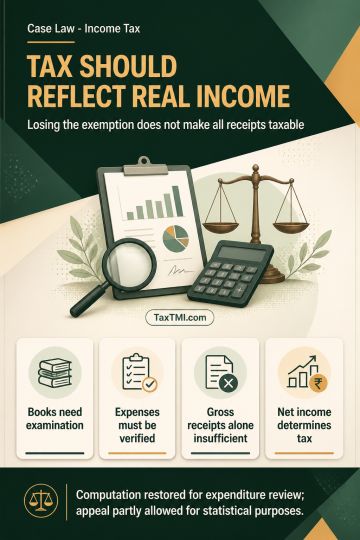
Reasoned rectification orders require consideration of expenditure disclosed in income-tax returns, preventing revision based on incomplete income com...
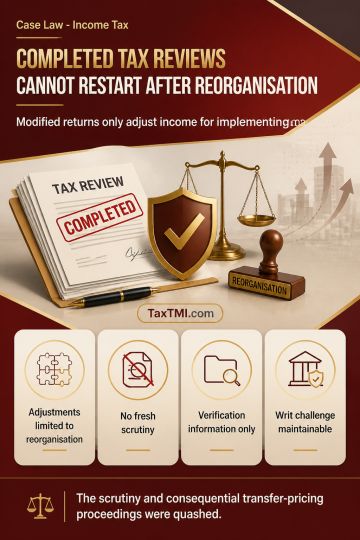
Modified returns after business reorganisations cannot trigger fresh scrutiny once the original assessment was complete, invalidating related transfer...
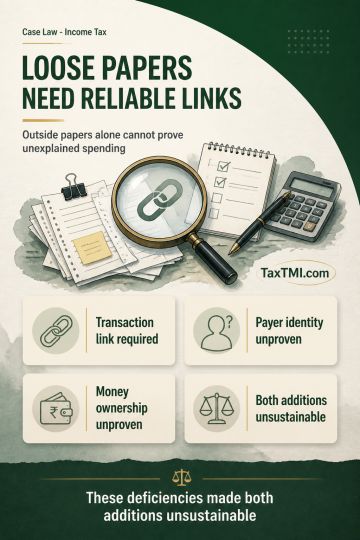
Third-party loose sheets require reliable nexus before supporting unexplained expenditure additions; presumptions do not establish payer identity or o...
TNMM comparability using audited accounts and working-capital adjustments can eliminate unwarranted transfer-pricing additions where verified margins ...
Gross-profit additions on disputed purchases require reasoned appellate determination; disclosed claims alone do not support inaccurate-particulars pe...
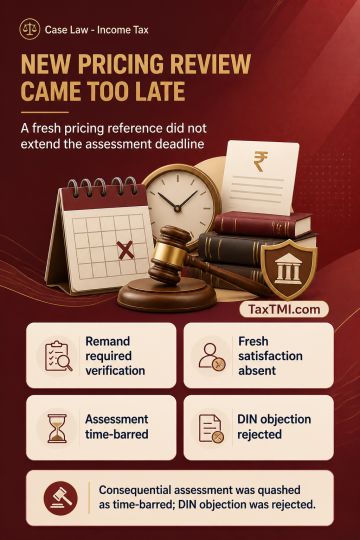
Limitation after transfer-pricing remand: fresh TPO reference did not extend the assessment deadline, rendering the consequential assessment time-barr...
Interim judicial restraint on tax deduction prevents default, while supporting reasonable cause and penalty deletion for foreign-leg LFC reimbursement...
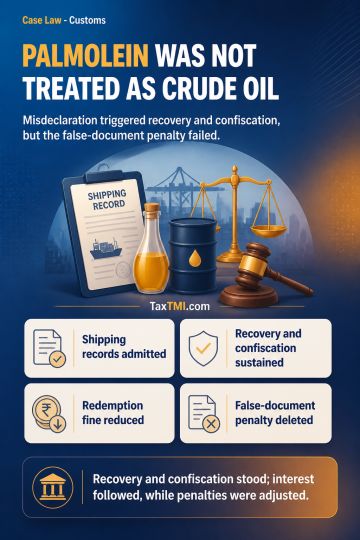
Palmolein classification defeated the crude-oil concession; material misdeclaration sustained recovery and confiscation, while separate false-document...
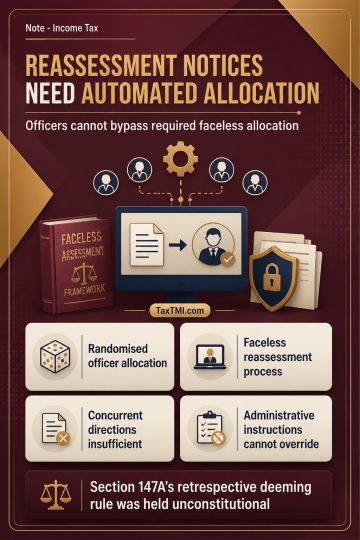
Section 151A and the e-Assessment of Income Escaping Assessment Scheme, 2022 require randomised automated allocation for reassessment functions, including the section 148A process and issuance of section 148 notices. General concurrent-jurisdiction directions cannot permit a jurisdictional Assessing Officer to bypass the prescribed faceless allocation, because allocation determines the officer's statutory competence. Risk-based selection of a matter is distinct from algorithmic allocation of the officer. Section 147A's retrospective deeming rule was held unconstitutional because it did not amend the continuing statutory and scheme-based requirements for automated allocation, and therefore did not remove the legal foundation of prior jurisdictional rulings. Administrative instructions cannot override the Act or a valid notified scheme.
Section 151A and the e-Assessment of Income Escaping Assessment Scheme, 2022 require randomised automated allocation for reassessment functions, including the section 148A process and issuance of section 148 notices. General concurrent-jurisdiction directions cannot permit a jurisdictional Assessing Officer to bypass the prescribed faceless allocation, because allocation determines the officer's statutory competence. Risk-based selection of a matter is distinct from algorithmic allocation of the officer. Section 147A's retrospective deeming rule was held unconstitutional because it did not amend the continuing statutory and scheme-based requirements for automated allocation, and therefore did not remove the legal foundation of prior jurisdictional rulings. Administrative instructions cannot override the Act or a valid notified scheme.
Note: It is a system-generated summary and is for quick reference only.
 TaxTMI
  TaxTMI
 of 4897