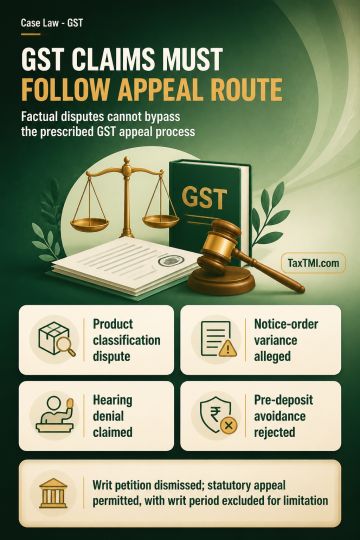
Alternative statutory remedy under GST bars writ challenge where classification, notice variance, and hearing disputes require factual appellate revie...
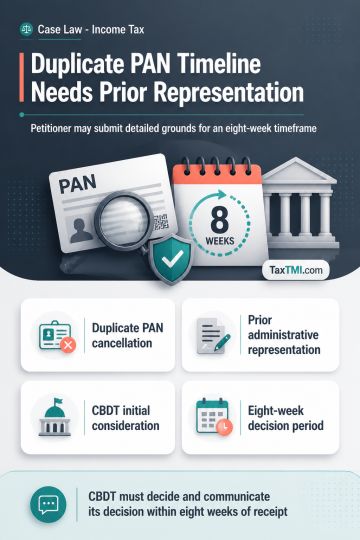
Duplicate PAN cancellation timeframe requires prior administrative representation before judicial intervention, ensuring a time-bound decision on the ...
Natural justice and pre-CIRP labour awards protect termination compensation, permitting withdrawal of court deposits despite later insolvency resoluti...
Arbitration of SEZ sub-lease monetary claims preserves rent, maintenance, termination, improvements and damages disputes while unused premises are vac...
Scientific research approval grants a research association tax recognition, subject to annual donor reporting, certification, and regulatory complianc...
Page of 4891
Press 'Enter' after typing page number.
141 to 160 of 97820 Results
❮
❯
❯❯
0 / 200
Expand Note
Add to Folder
No Folders have been created
+
Are you sure you want to delete "My most important" ?
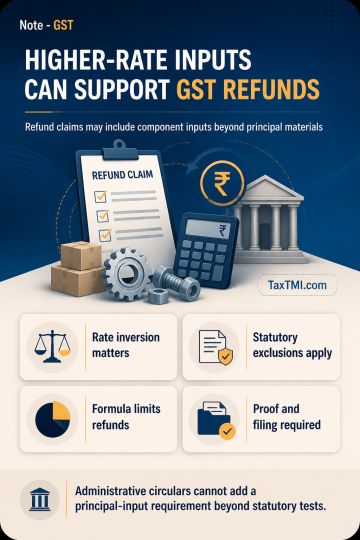
Refund of accumulated ITC under an inverted duty structure depends on whether higher-rated input goods cause credit accumulation relative to output supplies, not solely on whether the principal raw material and output carry the same rate. Section 54(3)(ii) permits the claim subject to notified exclusions, credit eligibility, and proof of a causal nexus between qualifying inputs and accumulation. Input services and capital goods are excluded from Net ITC for the Rule 89(5) calculation. Rule 89(5) limits refundable quantum, while the prescribed process requires electronic filing, invoice details, ledger debit and verification. Administrative circulars cannot add a principal-input condition beyond the statutory test; claimants must substantiate rate inversion, manufacturing nexus, computation and procedural compliance.
Refund of accumulated ITC under an inverted duty structure depends on whether higher-rated input goods cause credit accumulation relative to output supplies, not solely on whether the principal raw material and output carry the same rate. Section 54(3)(ii) permits the claim subject to notified exclusions, credit eligibility, and proof of a causal nexus between qualifying inputs and accumulation. Input services and capital goods are excluded from Net ITC for the Rule 89(5) calculation. Rule 89(5) limits refundable quantum, while the prescribed process requires electronic filing, invoice details, ledger debit and verification. Administrative circulars cannot add a principal-input condition beyond the statutory test; claimants must substantiate rate inversion, manufacturing nexus, computation and procedural compliance.
Note: It is a system-generated summary and is for quick reference only.
 TaxTMI
  TaxTMI
 of 4891