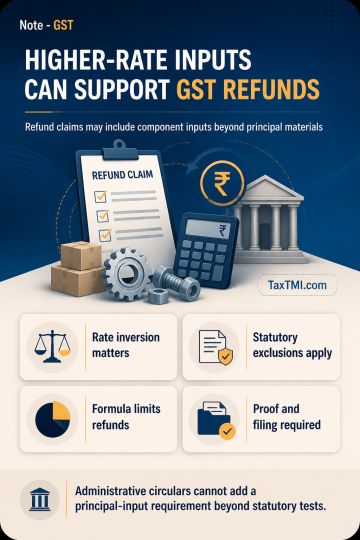
Refund of accumulated ITC under an inverted duty structure depends on whether higher-rated input goods cause credit accumulation relative to output supplies, not solely on whether the principal raw material and output carry the same rate. Section 54(3)(ii) permits the claim subject to notified exclusions, credit eligibility, and proof of a causal nexus between qualifying inputs and accumulation. Input services and capital goods are excluded from Net ITC for the Rule 89(5) calculation. Rule 89(5) limits refundable quantum, while the prescribed process requires electronic filing, invoice details, ledger debit and verification. Administrative circulars cannot add a principal-input condition beyond the statutory test; claimants must substantiate rate inversion, manufacturing nexus, computation and procedural compliance.
Refund of accumulated ITC under an inverted duty structure depends on whether higher-rated input goods cause credit accumulation relative to output supplies, not solely on whether the principal raw material and output carry the same rate. Section 54(3)(ii) permits the claim subject to notified exclusions, credit eligibility, and proof of a causal nexus between qualifying inputs and accumulation. Input services and capital goods are excluded from Net ITC for the Rule 89(5) calculation. Rule 89(5) limits refundable quantum, while the prescribed process requires electronic filing, invoice details, ledger debit and verification. Administrative circulars cannot add a principal-input condition beyond the statutory test; claimants must substantiate rate inversion, manufacturing nexus, computation and procedural compliance.
Note: It is a system-generated summary and is for quick reference only.
 TaxTMI
  TaxTMI
 of 4888