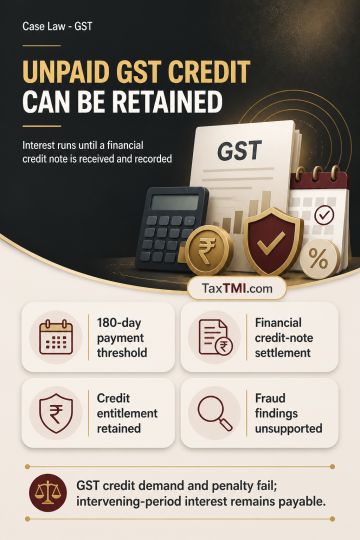
Blocked input tax credit for resort construction remains unavailable; interest follows actual utilisation, while delayed payment attracts statutory pe...
Duplicate PAN allocation requires record verification and deactivation reasons before assessment-related transactions can be attributed to an assessee...
Faceless assessment safeguards require requested personal hearings and adequate final show-cause response time, failing which reassessment is required...
Page of 4891
Press 'Enter' after typing page number.
201 to 220 of 97820 Results
❮
❯
❯❯
0 / 200
Expand Note
Add to Folder
No Folders have been created
+
Are you sure you want to delete "My most important" ?
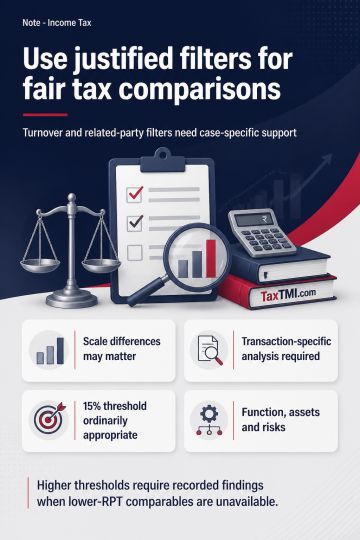
Transfer-pricing comparability under the transactional net margin method requires economically reliable uncontrolled benchmarks under Section 92C and Rule 10B. Turnover is not a standalone statutory bar, but material scale differences may justify excluding enterprises where brand value, intangibles, bargaining power, assets, risks or market conditions could affect margins. A turnover threshold must therefore be supported by transaction-specific comparability analysis rather than applied as a universal rule. Related-party transaction filters seek to reduce the influence of controlled dealings on comparable profitability. A 15% threshold is ordinarily appropriate where sufficient reliable comparables exist; a higher threshold requires a recorded finding that lower-RPT comparables are unavailable. Functional, asset and risk analysis remains essential, and appellate review may address disregard of statutory criteria or perverse findings.
Transfer-pricing comparability under the transactional net margin method requires economically reliable uncontrolled benchmarks under Section 92C and Rule 10B. Turnover is not a standalone statutory bar, but material scale differences may justify excluding enterprises where brand value, intangibles, bargaining power, assets, risks or market conditions could affect margins. A turnover threshold must therefore be supported by transaction-specific comparability analysis rather than applied as a universal rule. Related-party transaction filters seek to reduce the influence of controlled dealings on comparable profitability. A 15% threshold is ordinarily appropriate where sufficient reliable comparables exist; a higher threshold requires a recorded finding that lower-RPT comparables are unavailable. Functional, asset and risk analysis remains essential, and appellate review may address disregard of statutory criteria or perverse findings.
Note: It is a system-generated summary and is for quick reference only.
 TaxTMI
  TaxTMI
 of 4891