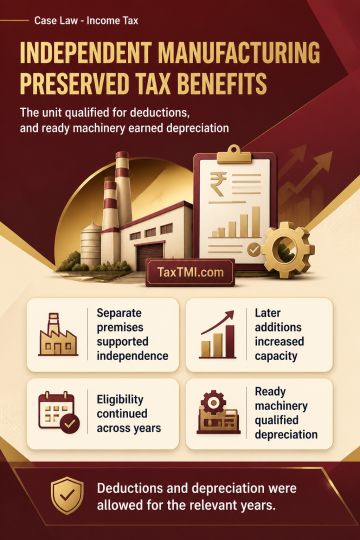
Independent manufacturing undertaking eligibility preserves Section 80IA/80IB deductions, while machinery kept ready for use qualifies for depreciatio...
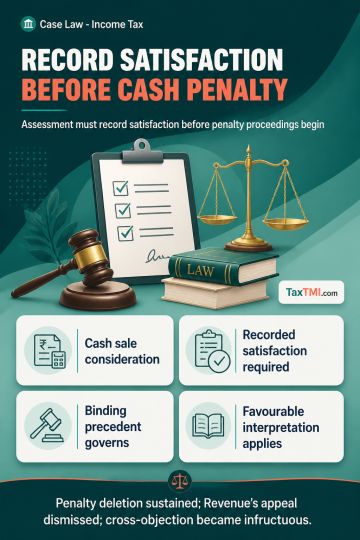
Assessing Officer Satisfaction Requirement Bars Penalty for Cash Receipt in Immovable-Property Sale Cases Where Initiation Lacks Recorded Satisfaction...
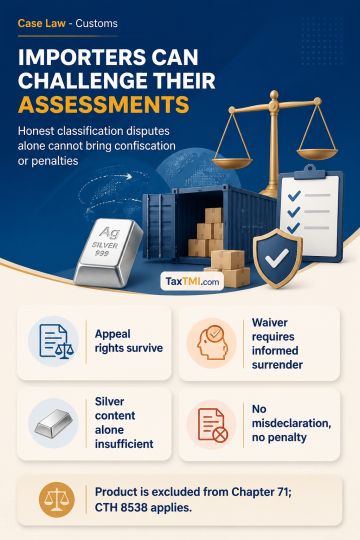
Self-assessed import entries remain appealable, while bona fide classification disputes without misdeclaration cannot justify confiscation or penaltie...
Actual-user customs exemption conditions permit turnkey project transfers when imported windmill components are exclusively used for installation and ...
Customs offence disqualification excludes civil contraventions, preventing refusal of a private bonded warehouse licence based solely on monetary pena...
Dependent-agent permanent establishment under Article 5(5)(i) of the India-Switzerland DTAA requires evidence that the Indian associated enterprise had, and habitually exercised, authority to negotiate or conclude contracts on behalf of the foreign enterprise. Group affiliation, dependency and arm's-length remuneration do not independently establish that status. Contemporaneous emails, approval matrices and supplier contracts indicated that Indian personnel communicated pre-approved terms, performed liaison, account-management and administrative functions, and escalated non-approved proposals overseas. Essential commercial approvals remained outside India. The Indian enterprise therefore did not constitute a dependent agent permanent establishment, making proposed profit attribution academic; the appeal was partly allowed.
Dependent-agent permanent establishment under Article 5(5)(i) of the India-Switzerland DTAA requires evidence that the Indian associated enterprise had, and habitually exercised, authority to negotiate or conclude contracts on behalf of the foreign enterprise. Group affiliation, dependency and arm's-length remuneration do not independently establish that status. Contemporaneous emails, approval matrices and supplier contracts indicated that Indian personnel communicated pre-approved terms, performed liaison, account-management and administrative functions, and escalated non-approved proposals overseas. Essential commercial approvals remained outside India. The Indian enterprise therefore did not constitute a dependent agent permanent establishment, making proposed profit attribution academic; the appeal was partly allowed.
Note: It is a system-generated summary and is for quick reference only.
 TaxTMI
  TaxTMI
 of 4881