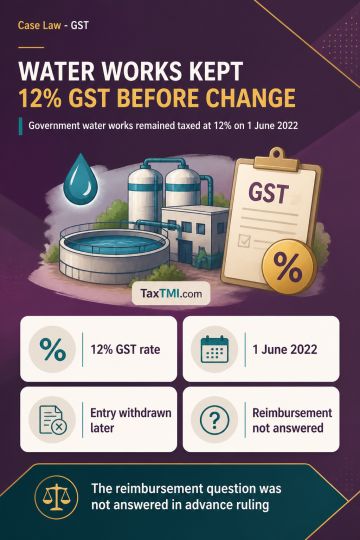
Government water works contract GST concession applied before its withdrawal, while contractual tax reimbursement claims lay outside advance-ruling sc...
Stamp valuation increases after registration-fee payment led to deletion of property-purchase addition within tolerance and without valuation referral...
Capital Asset Conversion Requires Proven Business Stock Treatment; Paper Consideration in Spousal Flat Transfers Does Not Create Taxable Business Inco...
Page of 4881
Press 'Enter' after typing page number.
341 to 360 of 97618 Results
❮
❯
❯❯
0 / 200
Expand Note
Add to Folder
No Folders have been created
+
Are you sure you want to delete "My most important" ?
Dependent-agent permanent establishment under Article 5(5)(i) of the India-Switzerland DTAA requires evidence that the Indian associated enterprise had, and habitually exercised, authority to negotiate or conclude contracts on behalf of the foreign enterprise. Group affiliation, dependency and arm's-length remuneration do not independently establish that status. Contemporaneous emails, approval matrices and supplier contracts indicated that Indian personnel communicated pre-approved terms, performed liaison, account-management and administrative functions, and escalated non-approved proposals overseas. Essential commercial approvals remained outside India. The Indian enterprise therefore did not constitute a dependent agent permanent establishment, making proposed profit attribution academic; the appeal was partly allowed.
Dependent-agent permanent establishment under Article 5(5)(i) of the India-Switzerland DTAA requires evidence that the Indian associated enterprise had, and habitually exercised, authority to negotiate or conclude contracts on behalf of the foreign enterprise. Group affiliation, dependency and arm's-length remuneration do not independently establish that status. Contemporaneous emails, approval matrices and supplier contracts indicated that Indian personnel communicated pre-approved terms, performed liaison, account-management and administrative functions, and escalated non-approved proposals overseas. Essential commercial approvals remained outside India. The Indian enterprise therefore did not constitute a dependent agent permanent establishment, making proposed profit attribution academic; the appeal was partly allowed.
Note: It is a system-generated summary and is for quick reference only.
 TaxTMI
  TaxTMI
 of 4881