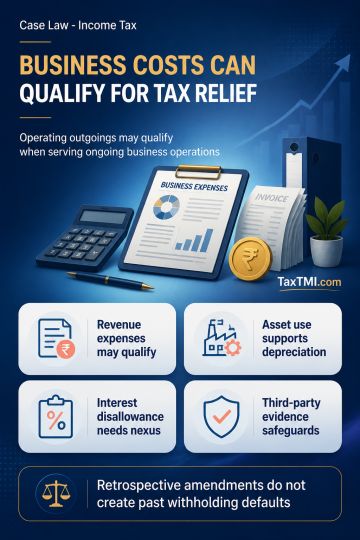
Business expenditure and depreciation rules allow operational outgoings while limiting disallowances for personal elements and unsupported third-party...
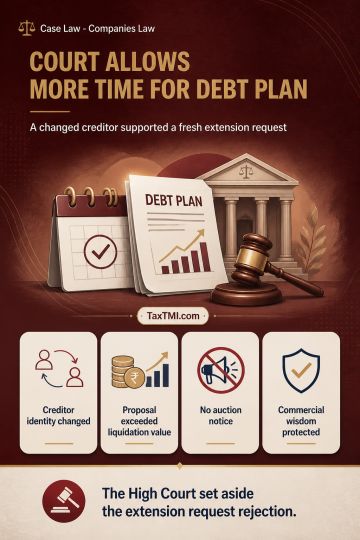
Compromise-and-arrangement extensions may accommodate debt assignment where creditor commercial judgment supports value maximisation and avoids proced...
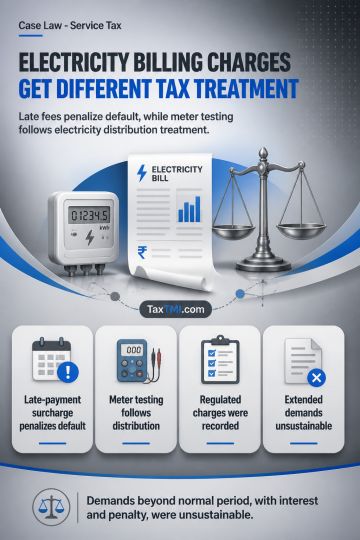
Delayed-payment surcharge is not taxable tolerance consideration where it penalises default, while meter testing follows electricity distribution trea...
Sufficient cause for delayed revenue income-tax appeals requires bona fides, due diligence and a credible explanation; otherwise limitation bars appea...
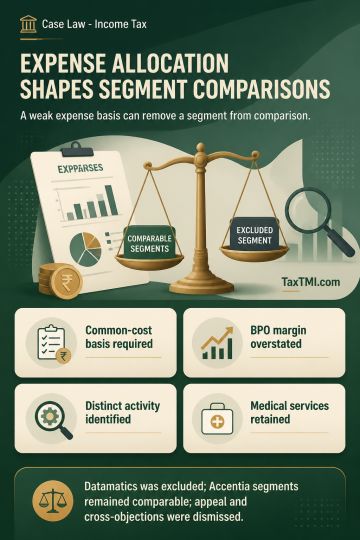
TNMM segmental comparability requires a reliable allocation of common operating expenses when OP/OC is used as the profit-level indicator. Information obtained from a proposed comparable does not itself establish the reliability of its segmental data. Because material entity-level expenses were not allocated to Datamatics Financial Services Ltd.'s BPO segment and no verifiable allocation basis was shown, its margin overstated profitability and the segment was excluded as an uncontrolled benchmark. Conversely, separately reported medical transcription, billing, coding and related IT-enabled service segments of Accentia Technologies Ltd. remained comparable: its distinct software development activity was identified and excluded, and no functional dissimilarity in the retained segments was established. Revenue's appeal and the assessee's cross-objections were dismissed.
TNMM segmental comparability requires a reliable allocation of common operating expenses when OP/OC is used as the profit-level indicator. Information obtained from a proposed comparable does not itself establish the reliability of its segmental data. Because material entity-level expenses were not allocated to Datamatics Financial Services Ltd.'s BPO segment and no verifiable allocation basis was shown, its margin overstated profitability and the segment was excluded as an uncontrolled benchmark. Conversely, separately reported medical transcription, billing, coding and related IT-enabled service segments of Accentia Technologies Ltd. remained comparable: its distinct software development activity was identified and excluded, and no functional dissimilarity in the retained segments was established. Revenue's appeal and the assessee's cross-objections were dismissed.
Note: It is a system-generated summary and is for quick reference only.
 TaxTMI
  TaxTMI
 of 4884