Preferential tariff claims under trade agreements require agreement-consistent origin checks, with safeguards against automatic denial for subsequent ...
Suppressed outward supplies require transaction-wise verification and reasoned findings before diary entries can support tax and penalty determination...
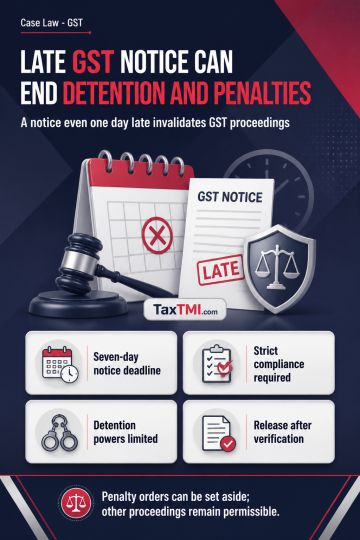
Section 129(3)'s seven-day deadline for issuing notice after detention of goods and conveyance under GST is mandatory. The timeline limits coercive detention and seizure powers, protects against arbitrary or prolonged detention, and requires strict compliance because the provision uses "shall" and affects taxpayer rights. A delay of even one day in issuing the notice vitiates the resulting detention and penalty proceedings. Penalty orders issued or affirmed despite breach of this timeline are liable to be set aside, without preventing other proceedings permissible under the Act. Deposited penalty may be released following due verification.
Section 129(3)'s seven-day deadline for issuing notice after detention of goods and conveyance under GST is mandatory. The timeline limits coercive detention and seizure powers, protects against arbitrary or prolonged detention, and requires strict compliance because the provision uses "shall" and affects taxpayer rights. A delay of even one day in issuing the notice vitiates the resulting detention and penalty proceedings. Penalty orders issued or affirmed despite breach of this timeline are liable to be set aside, without preventing other proceedings permissible under the Act. Deposited penalty may be released following due verification.
Note: It is a system-generated summary and is for quick reference only.
 TaxTMI
 TaxTMI


 Get Daily Updates