Unverified judicial precedents cannot sustain customs reassessment treating the speaking-order deadline as directory when cited decisions are disclaim...
Struck-off companies cannot pursue declarations or injunctions over contractual rights without restoration, despite the statutory saving for recoverie...
Departmental appeal limits permit discretionary exceptions, while penalties for technical e-way bill lapses in genuine transactions require evasion in...
GST exemptions for government-facing incubation services depend on recipient status, while enterprise-support funds and incubator recognition affect t...
Transfer pricing comparability excludes functionally different providers and companies whose abnormal profits from extraordinary circumstances distort...
Tax-inclusive valuation of purchases and inventory remains mandatory despite separate accounting, while revision requires an erroneous and prejudicial...
Strict interpretation of the customs exemption required Disc...
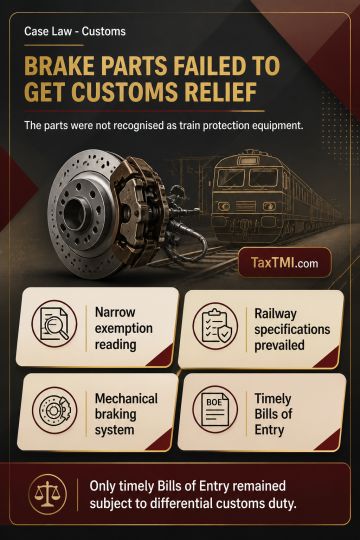
Strict construction of customs exemptions denied concession for brake components, while limitation restricted differential duty to timely Bills of Entry.
Contents
Summary
Note
Bookmark
Share
✓ Copied successfully !
Print
Print Options
For full text, please login
Login to TaxTMI
Verification Pending
The Email Id has not been verified. Click on the link we have sent on
Strict interpretation of the customs exemption required Disc Brake Units and Pole Wheels to fall clearly within the recognised railway-engineering meaning of a Train Protection and Warning System (TPWS). As components of a mechanical or pneumatic axle-mounted braking system, rather than signal-based TPWS equipment, they did not qualify for concessional duty. Official railway specifications prevailed over contrary technical opinions. Differential customs duty could be demanded only for Bills of Entry within the normal limitation period invoked under section 28(1); extending the demand beyond that period under section 28(4) exceeded the show cause notice. The exemption claim failed, while the demand was restricted accordingly.
Strict interpretation of the customs exemption required Disc Brake Units and Pole Wheels to fall clearly within the recognised railway-engineering meaning of a Train Protection and Warning System (TPWS). As components of a mechanical or pneumatic axle-mounted braking system, rather than signal-based TPWS equipment, they did not qualify for concessional duty. Official railway specifications prevailed over contrary technical opinions. Differential customs duty could be demanded only for Bills of Entry within the normal limitation period invoked under section 28(1); extending the demand beyond that period under section 28(4) exceeded the show cause notice. The exemption claim failed, while the demand was restricted accordingly.
Note: It is a system-generated summary and is for quick reference only.
 TaxTMI
 TaxTMI

 of 4945


 Get Daily Updates