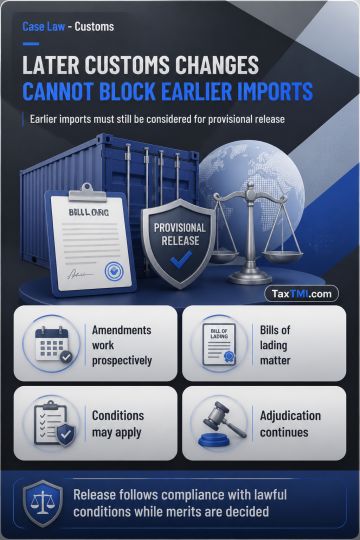
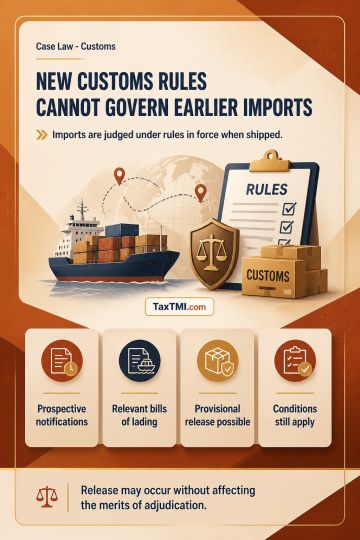
Prospective customs notification amendments cannot bar provisional release consideration for earlier imports when bills of lading predate their commen...
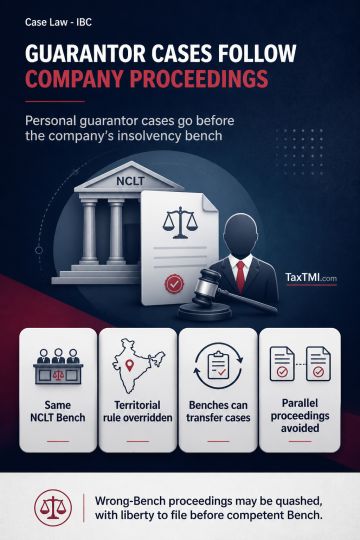
Personal guarantor insolvency jurisdiction follows the corporate debtor's CIRP Bench, enabling inter-territorial transfer and preventing parallel proc...
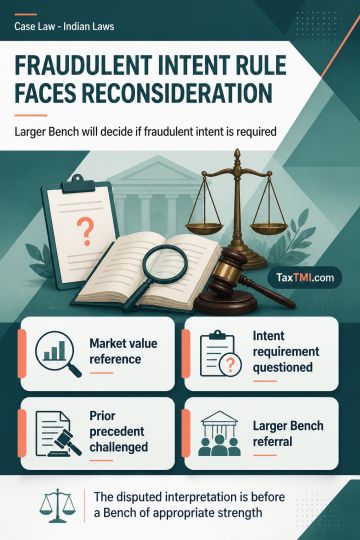
Section 47-A undervaluation threshold: fraudulent intent requirement faces reconsideration after referral to a larger Bench for authoritative resoluti...
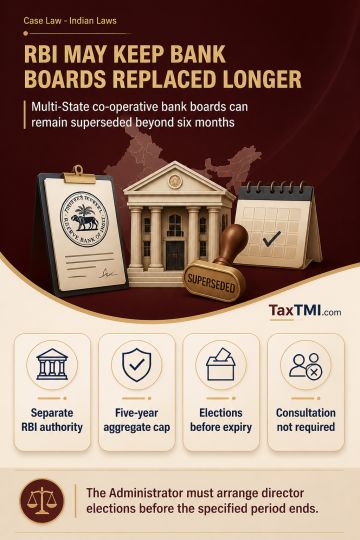
RBI supersession powers over multi-State co-operative banks operate independently of the constitutional six-month ceiling and permit statutory extensi...
Valid e-way bill compliance requires Part B to identify the vehicle actually transporting goods. Where a vehicle breaks down and goods are transferred, the movement must be supported by contemporaneous evidence and the e-way bill must be updated or freshly generated before transit. A later e-way bill issued by the purchaser does not cure a vehicle mismatch where the driver holds the supplier's invoice and no contemporaneous material establishes purchaser-led transport. Such discrepancies are not merely technical and can support an inference of intent to evade tax. Penalty proceedings under Section 129 for transport without a valid e-way bill were confirmed.
Valid e-way bill compliance requires Part B to identify the vehicle actually transporting goods. Where a vehicle breaks down and goods are transferred, the movement must be supported by contemporaneous evidence and the e-way bill must be updated or freshly generated before transit. A later e-way bill issued by the purchaser does not cure a vehicle mismatch where the driver holds the supplier's invoice and no contemporaneous material establishes purchaser-led transport. Such discrepancies are not merely technical and can support an inference of intent to evade tax. Penalty proceedings under Section 129 for transport without a valid e-way bill were confirmed.
Note: It is a system-generated summary and is for quick reference only.
 TaxTMI
  TaxTMI
 of 4884