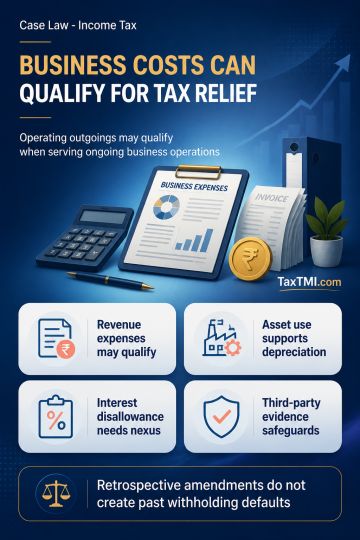
Business expenditure and depreciation rules allow operational outgoings while limiting disallowances for personal elements and unsupported third-party...
Compromise-and-arrangement extensions may accommodate debt assignment where creditor commercial judgment supports value maximisation and avoids proced...
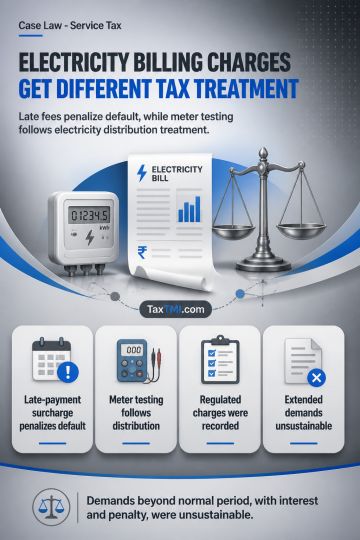
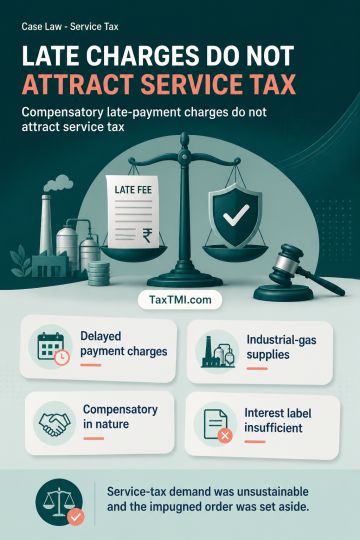
Delayed-payment surcharge is not taxable tolerance consideration where it penalises default, while meter testing follows electricity distribution trea...
Sufficient cause for delayed revenue income-tax appeals requires bona fides, due diligence and a credible explanation; otherwise limitation bars appea...
Inverted-duty-structure refunds remain available for unchanged-rate apparel supplies despite trader status and require tax-period-specific computation...
Page of 4881
Press 'Enter' after typing page number.
781 to 800 of 97618 Results
❮
❯
❯❯
0 / 200
Expand Note
Add to Folder
No Folders have been created
+
Are you sure you want to delete "My most important" ?
Conditional customs duty exemption for an imported aircraft requires use solely for authorised non-scheduled charter services. Commercial operation without the required regulatory approval breaches the post-import exemption condition, making the aircraft liable to confiscation, redemption fine, consequential customs duty and penalties on the importer and responsible managing personnel. Duty following redemption of confiscated goods arises as a consequence of confiscation proceedings rather than as a non-levy or short-levy demand, so the limitation framework for such demands does not apply. Where actual freight and transit-insurance costs are available, customs valuation must use those costs rather than notional additions; duty requires recomputation on that basis.
Conditional customs duty exemption for an imported aircraft requires use solely for authorised non-scheduled charter services. Commercial operation without the required regulatory approval breaches the post-import exemption condition, making the aircraft liable to confiscation, redemption fine, consequential customs duty and penalties on the importer and responsible managing personnel. Duty following redemption of confiscated goods arises as a consequence of confiscation proceedings rather than as a non-levy or short-levy demand, so the limitation framework for such demands does not apply. Where actual freight and transit-insurance costs are available, customs valuation must use those costs rather than notional additions; duty requires recomputation on that basis.
Note: It is a system-generated summary and is for quick reference only.
 TaxTMI
  TaxTMI
 of 4881