Section 153C requires person-specific search authority and year-specific incriminating material for unabated assessments while preventing unsupported ...
Equivalent-value attachment can reach pre-existing assets, but jointly owned property remains protected beyond the accused's attributable proceeds of ...
Page of 4891
Press 'Enter' after typing page number.
941 to 960 of 97820 Results
❮
❯
❯❯
0 / 200
Expand Note
Add to Folder
No Folders have been created
+
Are you sure you want to delete "My most important" ?
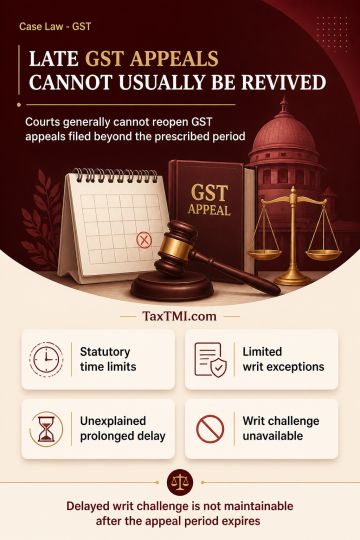
Statutory appellate limitation under the BGST Act forms part of the legislative scheme for prompt GST dispute resolution. Writ jurisdiction may be available exceptionally for fundamental-rights violations, breach of natural justice, jurisdictional excess or a vires challenge, but not routinely to revive an expired appellate remedy. The prescribed extension period for a GST appeal constrains the appellate authority, and Article 226 cannot be used to disregard that substantive limitation or condone delay beyond it. An unexplained prolonged delay in approaching the High Court after an appeal is rejected as time-barred undermines the limitation regime; a writ challenge in those circumstances is not maintainable.
Statutory appellate limitation under the BGST Act forms part of the legislative scheme for prompt GST dispute resolution. Writ jurisdiction may be available exceptionally for fundamental-rights violations, breach of natural justice, jurisdictional excess or a vires challenge, but not routinely to revive an expired appellate remedy. The prescribed extension period for a GST appeal constrains the appellate authority, and Article 226 cannot be used to disregard that substantive limitation or condone delay beyond it. An unexplained prolonged delay in approaching the High Court after an appeal is rejected as time-barred undermines the limitation regime; a writ challenge in those circumstances is not maintainable.
Note: It is a system-generated summary and is for quick reference only.
 TaxTMI
  TaxTMI
 of 4891