Political contribution deductions require genuine transactions; banking records and party registration alone cannot defeat evidence of accommodation e...
Post-death GST liability permits fresh proceedings against legal representatives, while discontinued-business recovery remains limited to the inherite...
Non-confirmation of FEMA seizure prevents adjudicators from overriding pending appellate findings on recorded reasons and suspected foreign asset hold...
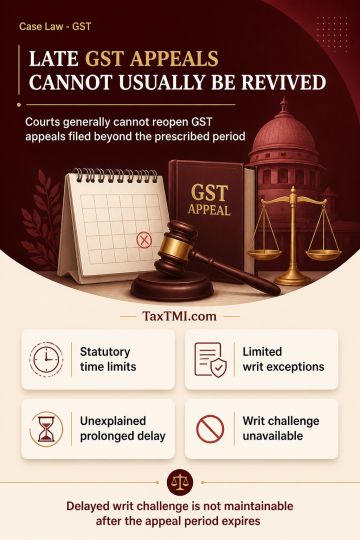
Statutory appellate limitation under the BGST Act forms part of the legislative scheme for prompt GST dispute resolution. Writ jurisdiction may be available exceptionally for fundamental-rights violations, breach of natural justice, jurisdictional excess or a vires challenge, but not routinely to revive an expired appellate remedy. The prescribed extension period for a GST appeal constrains the appellate authority, and Article 226 cannot be used to disregard that substantive limitation or condone delay beyond it. An unexplained prolonged delay in approaching the High Court after an appeal is rejected as time-barred undermines the limitation regime; a writ challenge in those circumstances is not maintainable.
Statutory appellate limitation under the BGST Act forms part of the legislative scheme for prompt GST dispute resolution. Writ jurisdiction may be available exceptionally for fundamental-rights violations, breach of natural justice, jurisdictional excess or a vires challenge, but not routinely to revive an expired appellate remedy. The prescribed extension period for a GST appeal constrains the appellate authority, and Article 226 cannot be used to disregard that substantive limitation or condone delay beyond it. An unexplained prolonged delay in approaching the High Court after an appeal is rejected as time-barred undermines the limitation regime; a writ challenge in those circumstances is not maintainable.
Note: It is a system-generated summary and is for quick reference only.
 TaxTMI
 TaxTMI