Compromise-and-arrangement extensions may accommodate debt assignment where creditor commercial judgment supports value maximisation and avoids proced...
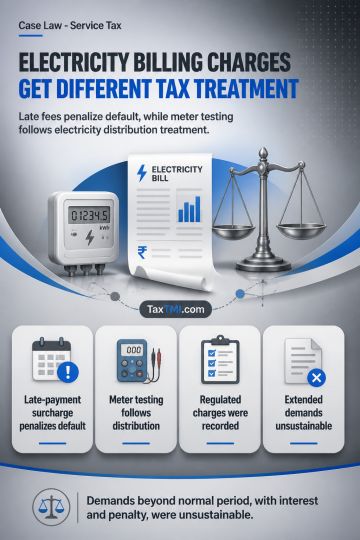
Delayed-payment surcharge is not taxable tolerance consideration where it penalises default, while meter testing follows electricity distribution trea...
Sufficient cause for delayed revenue income-tax appeals requires bona fides, due diligence and a credible explanation; otherwise limitation bars appea...
Inverted-duty-structure refunds remain available for unchanged-rate apparel supplies despite trader status and require tax-period-specific computation...
Foundational assessment satisfaction is essential before initiating penalty for cash receipt of immovable-property sale consideration under section 27...
Transfer-pricing benchmarking requires exclusion of comparables...
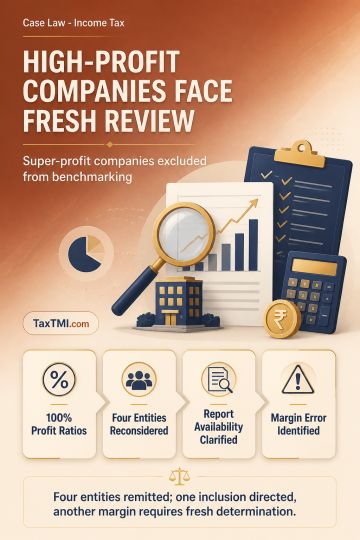
Transfer-pricing comparability requires exclusion of financially illogical super-profit comparables and correction of unsupported annual-report and margin findings.
Contents
Summary
Note
Bookmark
Share
✓ Copied successfully !
Print
Print Options
For full text, please login
Login to TaxTMI
Verification Pending
The Email Id has not been verified. Click on the link we have sent on
Transfer-pricing benchmarking requires exclusion of comparables with financially illogical gross-profit-to-sales ratios of 100 per cent or more, applying the principle that super-profit-making companies should not be retained for comparability analysis. The inclusion of four such entities was set aside and remitted to the TPO for fresh consideration after hearing the assessee. A comparable could not be rejected for non-availability of its annual report where that report had been furnished to the TPO; its inclusion in the benchmarking exercise was directed. The TPO's positive gross-profit-margin computation for another comparable was also found erroneous because the record showed a negative margin, requiring fresh determination.
Transfer-pricing benchmarking requires exclusion of comparables with financially illogical gross-profit-to-sales ratios of 100 per cent or more, applying the principle that super-profit-making companies should not be retained for comparability analysis. The inclusion of four such entities was set aside and remitted to the TPO for fresh consideration after hearing the assessee. A comparable could not be rejected for non-availability of its annual report where that report had been furnished to the TPO; its inclusion in the benchmarking exercise was directed. The TPO's positive gross-profit-margin computation for another comparable was also found erroneous because the record showed a negative margin, requiring fresh determination.
Note: It is a system-generated summary and is for quick reference only.
 TaxTMI
  TaxTMI
 of 4894