Loading...

Top
Help
×

By creating an account you can:

Logo TaxTMI
Call Us / Help / Feedback

Contact Us At :

E-mail: [email protected]

Call / WhatsApp at: +91 99117 96707

For more information, Check Contact Us

FAQs :

To know Frequently Asked Questions, Check FAQs

Most Asked Video Tutorials :

For more tutorials, Check Video Tutorials

Submit Feedback/Suggestion :

Email :
Please provide your email address so we can follow up on your feedback.
Category :
Description :
Min 15 characters 0/2000
Make Most of Text Search
  1. Checkout this video tutorial: How to search effectively on TaxTMI.
  2. Put words in double quotes for exact word search, eg: "income tax"
  3. Avoid noise words such as : 'and, of, the, a'
  4. Sort by Relevance to get the most relevant document.
  5. Press Enter to add multiple terms/multiple phrases, and then click on Search to Search.
  6. Text Search
  7. The system will try to fetch results that contains ALL your words.
  8. Once you add keywords, you'll see a new 'Search In' filter that makes your results even more precise.
  9. Text Search
Add to...
You have not created any category. Kindly create one to bookmark this item!
Create New Category
Hide
Title :
Description :
❮❮ Hide
Default View
Expand ❯❯
Close ✕
🔎 Highlights - Adv. Search
TEXT SEARCH:

Press 'Enter' to add multiple search terms. Rules for Better Search

Search In:
Main Text + AI Text
  • Main Text
  • Main Text + AI Text
  • AI Text
Law:
---- All Laws----
  • ---- All Laws----
  • Income Tax
  • Direct Taxes
  • Benami Property
  • Central GST Laws
  • SGST - State GST Laws
  • Customs
  • FTP - Foreign Trade Policy
  • SEZ - Special Economic Zone
  • FEMA - Foreign Exchange Management
  • Companies Law
  • SEBI - Securities & Exchange Board of India
  • IBC - Insolvency and Bankruptcy
  • Law of Competition
  • PMLA - Money-Laundering
  • Indian Laws
  • Bill / Finance Bills
  • Wealth Tax
  • Service Tax
  • Central Excise
  • VAT / Sales Tax
Month:
---- All Months ----
  • ---- All Months ----
  • January
  • February
  • March
  • April
  • May
  • June
  • July
  • August
  • September
  • October
  • November
  • December
Year:
---- All Years ----
  • ---- All Years ----
  • 2026
  • 2025
  • 2024
  • 2023
  • 2022
  • 2021
  • 2020
  • 2019
  • 2018
  • 2017
  • 2016
  • 2015
  • 2014
  • 2013
  • 2012
  • 2011
Sort By: ?
In Sort By 'Default', exact matches for text search are shown at the top, followed by the remaining results in their regular order.
Relevance Default Date
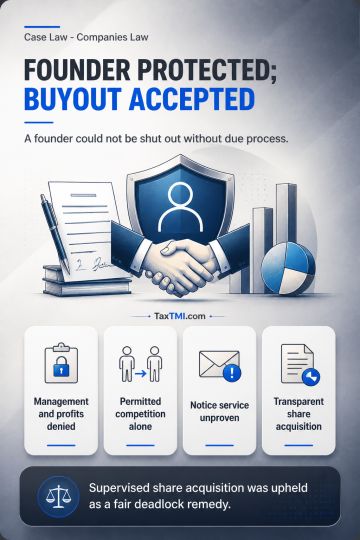
    Oppression in quasi-partnership companies protects excluded founders, while Swiss Challenge buyouts can validly resolve irretrievable shareholder dead...
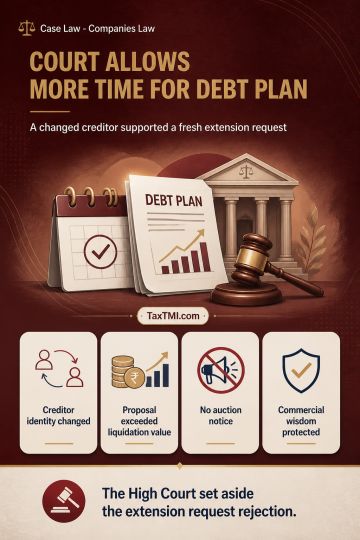
    Compromise-and-arrangement extensions may accommodate debt assignment where creditor commercial judgment supports value maximisation and avoids proced...
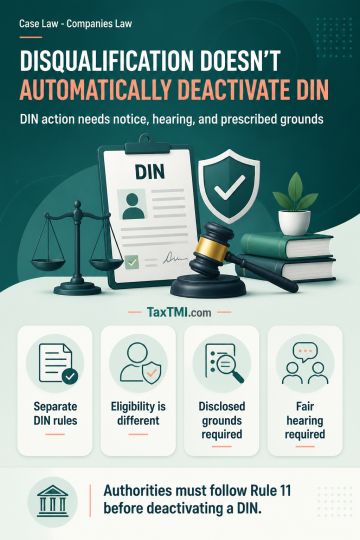
    DIN deactivation requires notice, hearing and prescribed grounds; director disqualification alone does not automatically deactivate a DIN.
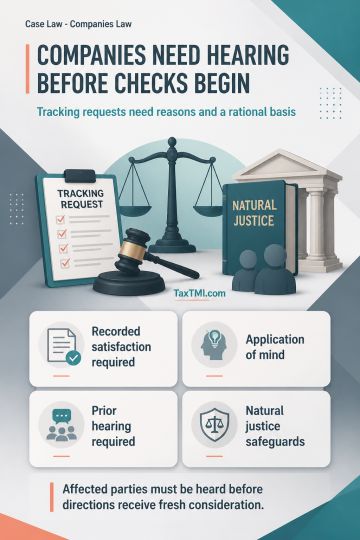
    Section 213(b) investigation safeguards require recorded satisfaction and prior hearing before agencies are asked for tracking information.
    Corporate revival permits changed business objects and land redevelopment where creditor and workmen settlements support public interest.
    Contempt undertakings require clear commitments, while foreign money decrees may warrant security pending execution proceedings.
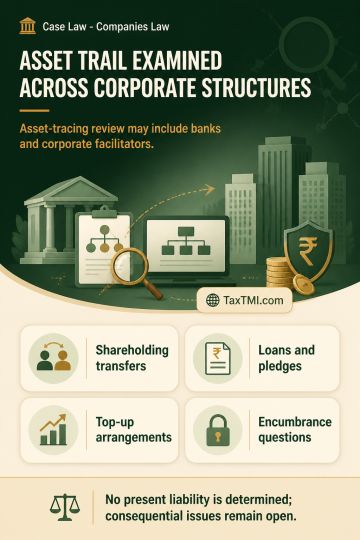
    Forensic audit of asset dissipation permits scrutiny of banks and corporate facilitators in foreign-award execution.
    Pending statutory filings under CCFS-2026 may be completed until 15 September 2026, with all other scheme conditions unchanged.
    Limitation for official liquidator claims extends through excluded winding-up time, preserving claims filed within the aggregate statutory period.
    Annual accounts for companies in liquidation remain mandatory despite filed half-yearly audited accounts, preserving accurate financial disclosure.
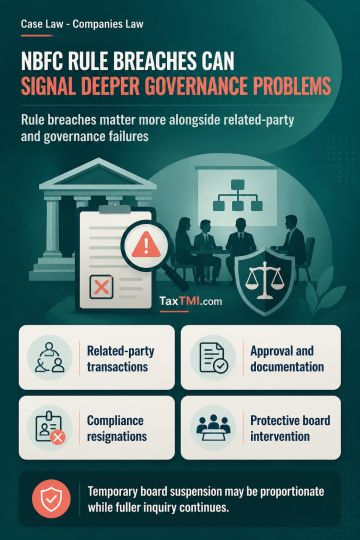
    NBFC prudential-norm breaches may support oppression and mismanagement claims when combined with related-party dealings and governance failures.
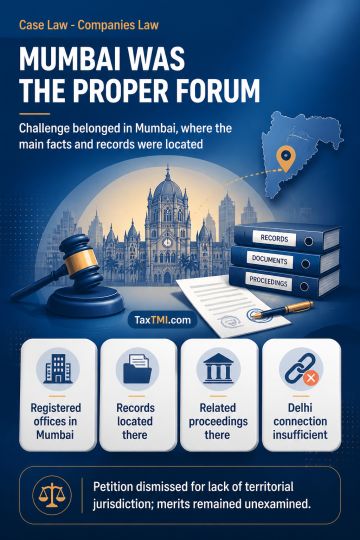
    Territorial jurisdiction under Article 226(2) requires substantial nexus and forum convenience, directing the investigation challenge to Mumbai.
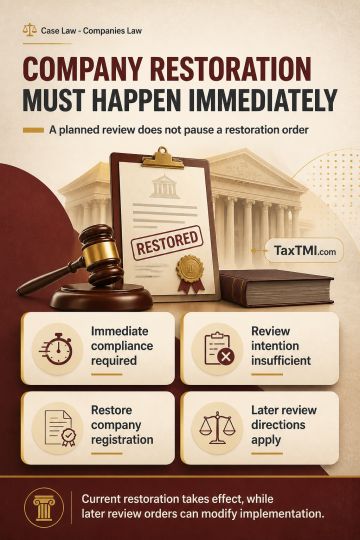
    Subsisting judicial orders require immediate company restoration despite a proposed review, subject to any later review direction.
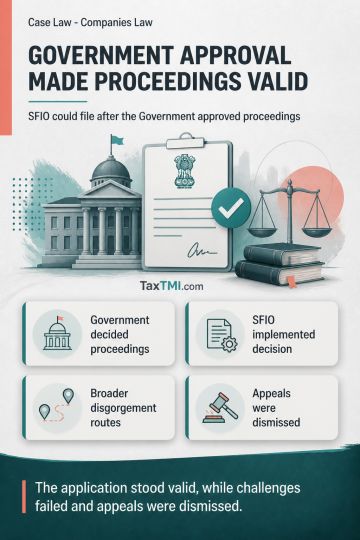
    Authorization to institute disgorgement proceedings need not delegate statutory power where SFIO only implements the Government's decision.
    Approved resolution plan primacy bars rectification claims seeking revival of extinguished equity and consequential monetary or share-based reliefs.
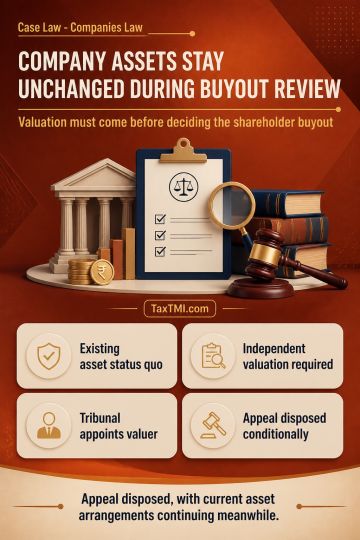
    Status quo over company assets continues until independent valuation determines the proposed shareholder buyout relief.
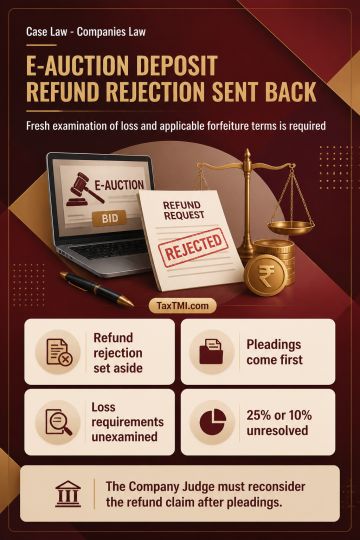
    Earnest money forfeiture in e-auctions requires examination of contractual loss and applicable forfeiture terms before refund rejection.
    Tribunal intervention in requisitioned meetings requires proven impracticability, despite independent statutory remedies for members to convene them.
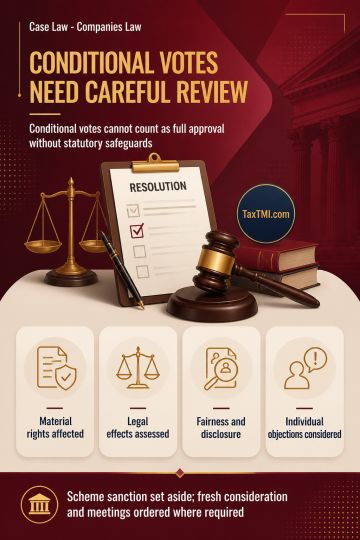
    Conditional votes in revival schemes require scrutiny before statutory majority assent can support court sanction and stakeholder rights.
    Nature-dependent electricity contracts receive new Ind AS accounting, hedge designation, transition and financial-statement disclosure requirements fr...
❯❯
Maximize Maximize Maximize
0 / 200
Expand Note
Add to Folder

No Folders have been created

+

Are you sure you want to delete "My most important" ?

NOTE:

Highlights
Showing Results for :
Reset Filters
Results Found:
Show All Summaries Hide All Summaries

Highlights

Back

All Highlights

Showing Results for :
Reset Filters
No Records Found

Highlights

Back

All Highlights

Showing Results for : Reset Filters

Tribunal jurisdiction to convene a requisitioned extraordinary...

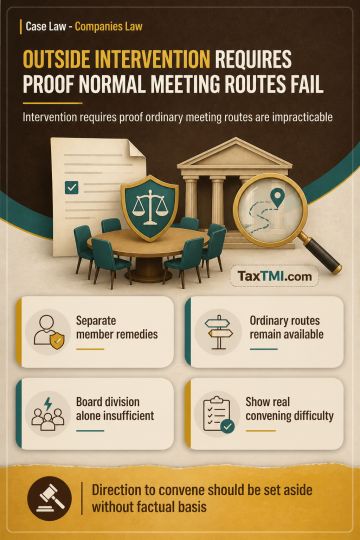
Tribunal intervention in requisitioned meetings requires proven impracticability, despite independent statutory remedies for members to convene them.

Contents
Summary
Note

Note

-

Bookmark

Print

Print

Companies Law August 19, 2026 Case Laws AT
Tribunal jurisdiction to convene a requisitioned extraordinary general meeting is not conditional on the requisitioning member first using its statutory power to call the meeting after Board default; those remedies operate independently. However, intervention in corporate internal management remains exceptional and requires a reasonable factual basis showing that convening the meeting through ordinary statutory or articles-based mechanisms is impracticable. Board division or rejection of a requisition alone does not establish impracticability. Where the requisitioning member neither demonstrates difficulty in convening shareholders nor uses the available statutory mechanism, a direction to convene the meeting lacks the required factual basis and should be set aside.

Topics

Acts Income Tax