Coercive recovery during GST searches is restrained pending scrutiny, preserving normal business operations and requiring adherence to investigation g...
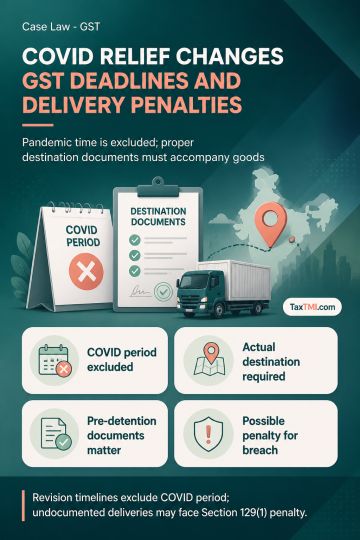
COVID-19 limitation exclusion and destination-specific e-way bills govern revisional timelines and penalties for undocumented third-party plywood deli...
Questions arising from miscellaneous application orders cannot challenge unaltered Tribunal findings, leaving the original order separately challengea...
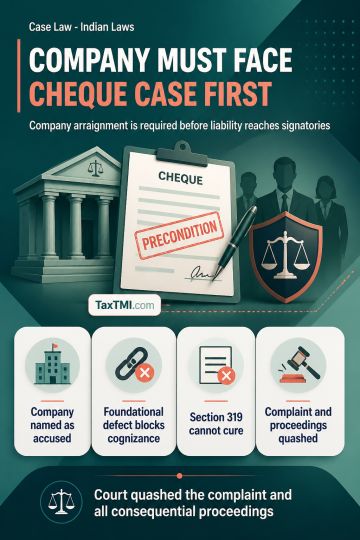
For dishonour of a cheque drawn on a company account, the company must be arraigned as an accused before vicarious liability can attach to an authorised signatory or other persons responsible for its business. Omission of the company is a foundational defect that prevents valid cognizance under the Negotiable Instruments Act. Section 319 CrPC cannot be used to cure that defect by subsequently impleading the company after the statutory limitation period; any fresh complaint remains subject to limitation and delayed cognizance requires sufficient cause. The Supreme Court quashed the complaint and consequential proceedings, and held that the direction to suo motu arraign the company exceeded jurisdiction.
For dishonour of a cheque drawn on a company account, the company must be arraigned as an accused before vicarious liability can attach to an authorised signatory or other persons responsible for its business. Omission of the company is a foundational defect that prevents valid cognizance under the Negotiable Instruments Act. Section 319 CrPC cannot be used to cure that defect by subsequently impleading the company after the statutory limitation period; any fresh complaint remains subject to limitation and delayed cognizance requires sufficient cause. The Supreme Court quashed the complaint and consequential proceedings, and held that the direction to suo motu arraign the company exceeded jurisdiction.
Note: It is a system-generated summary and is for quick reference only.
 TaxTMI
  TaxTMI