Loading...

Top
Help
×

By creating an account you can:

Logo TaxTMI
Call Us / Help / Feedback

Contact Us At :

E-mail: [email protected]

Call / WhatsApp at: +91 99117 96707

For more information, Check Contact Us

FAQs :

To know Frequently Asked Questions, Check FAQs

Most Asked Video Tutorials :

For more tutorials, Check Video Tutorials

Submit Feedback/Suggestion :

Email :
Please provide your email address so we can follow up on your feedback.
Category :
Description :
Min 15 characters 0/2000
Make Most of Text Search
  1. Checkout this video tutorial: How to search effectively on TaxTMI.
  2. Put words in double quotes for exact word search, eg: "income tax"
  3. Avoid noise words such as : 'and, of, the, a'
  4. Sort by Relevance to get the most relevant document.
  5. Press Enter to add multiple terms/multiple phrases, and then click on Search to Search.
  6. Text Search
  7. The system will try to fetch results that contains ALL your words.
  8. Once you add keywords, you'll see a new 'Search In' filter that makes your results even more precise.
  9. Text Search
Add to...
You have not created any category. Kindly create one to bookmark this item!
Create New Category
Hide
Title :
Description :
❮❮ Hide
Default View
Expand ❯❯
Close ✕
🔎 Highlights - Adv. Search
TEXT SEARCH:

Press 'Enter' to add multiple search terms. Rules for Better Search

Search In:
Main Text + AI Text
  • Main Text
  • Main Text + AI Text
  • AI Text
Law:
---- All Laws----
  • ---- All Laws----
  • Income Tax
  • Direct Taxes
  • Benami Property
  • Central GST Laws
  • SGST - State GST Laws
  • Customs
  • FTP - Foreign Trade Policy
  • SEZ - Special Economic Zone
  • FEMA - Foreign Exchange Management
  • Companies Law
  • SEBI - Securities & Exchange Board of India
  • IBC - Insolvency and Bankruptcy
  • Law of Competition
  • PMLA - Money-Laundering
  • Indian Laws
  • Bill / Finance Bills
  • Wealth Tax
  • Service Tax
  • Central Excise
  • VAT / Sales Tax
Month:
---- All Months ----
  • ---- All Months ----
  • January
  • February
  • March
  • April
  • May
  • June
  • July
  • August
  • September
  • October
  • November
  • December
Year:
---- All Years ----
  • ---- All Years ----
  • 2026
  • 2025
  • 2024
  • 2023
  • 2022
  • 2021
  • 2020
  • 2019
  • 2018
  • 2017
  • 2016
  • 2015
  • 2014
  • 2013
  • 2012
  • 2011
Sort By: ?
In Sort By 'Default', exact matches for text search are shown at the top, followed by the remaining results in their regular order.
Relevance Default Date
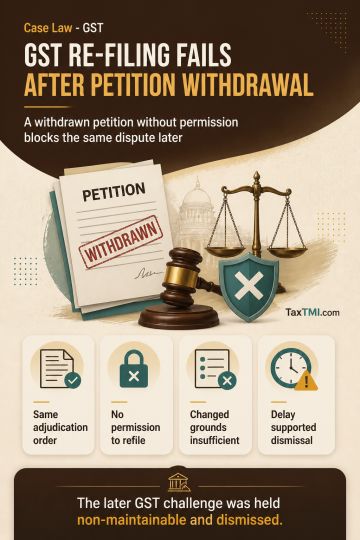
    Successive GST writ petitions fail when an earlier challenge was withdrawn without liberty to refile the same adjudication dispute.
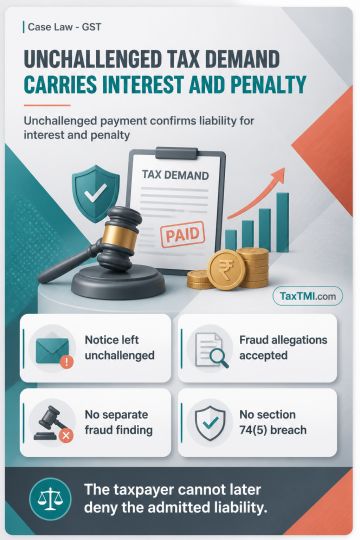
    Acquiescence to a tax demand makes voluntarily admitted liability subject to consequential interest and penalty.
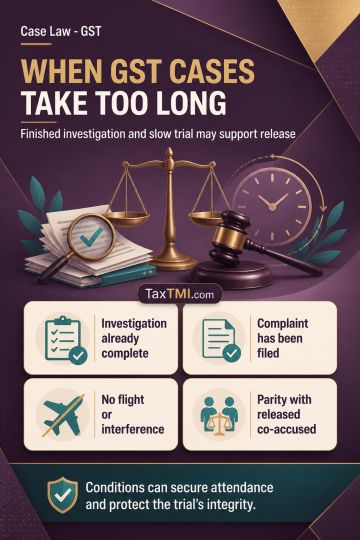
    Pre-trial detention in CGST prosecutions remains non-punitive, supporting bail where investigation is complete and trial is delayed.
    E-way bill reuse allegations require cogent proof, not vehicle-movement suspicion, invalidating detention-based tax and penalties.
    Coercive recovery during GST searches is restrained pending scrutiny, preserving normal business operations and requiring adherence to investigation g...
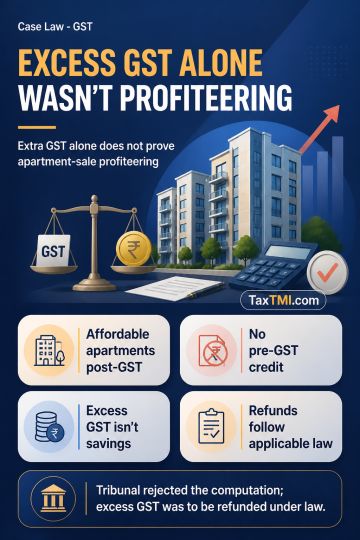
    Excess GST realisation alone cannot establish apartment-sale profiteering where no GST rate reduction or input tax credit benefit exists.
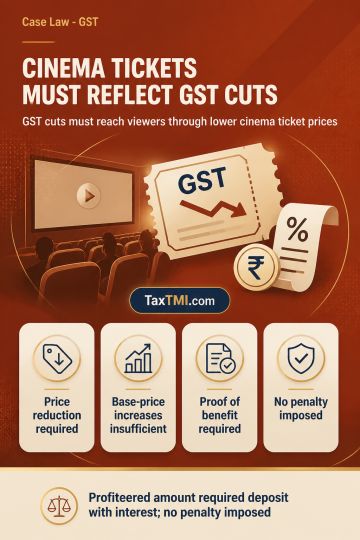
    GST rate reduction on cinema tickets must reach consumers despite maximum-price caps; retrospective anti-profiteering penalties cannot apply.
    Commensurate GST price reduction for cinema tickets overrides base-price increases where suppliers cannot prove benefits reached viewers.
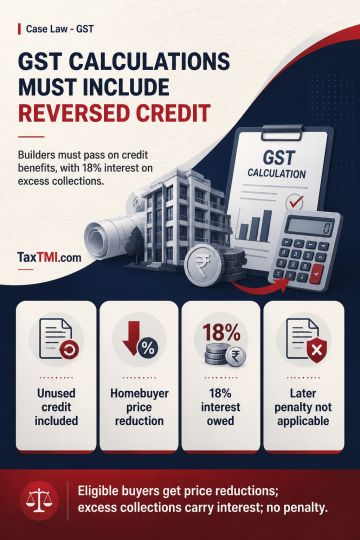
    Anti-profiteering computation must reflect reversed unutilised tax credit, while later-enacted penalties cannot apply to earlier non-passing periods.
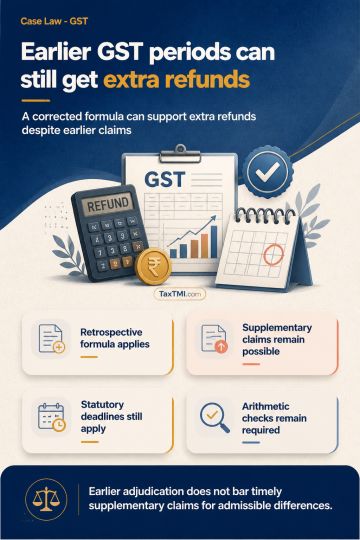
    Curative refund-formula amendments can support differential input-tax-credit refunds despite earlier claims and conflicting administrative circulars.
    Unaccounted stock taxation displaces confiscation where assessment provisions apply, leaving no standalone basis to restore a fine.
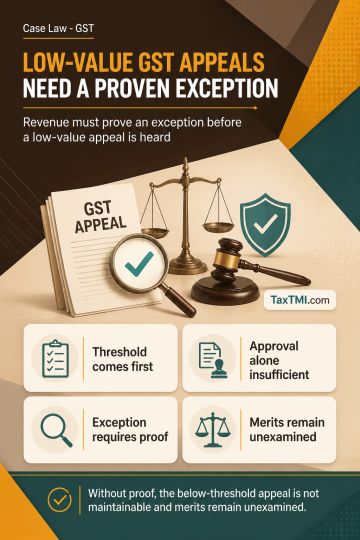
    Monetary-limit policy requires departmental GST appeals below threshold to establish a specified exception before merits review.
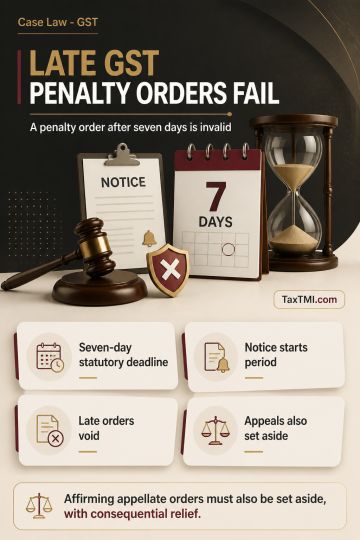
    Mandatory detention penalty timelines invalidate delayed orders, requiring consequential relief and reversal of affirming appellate orders.
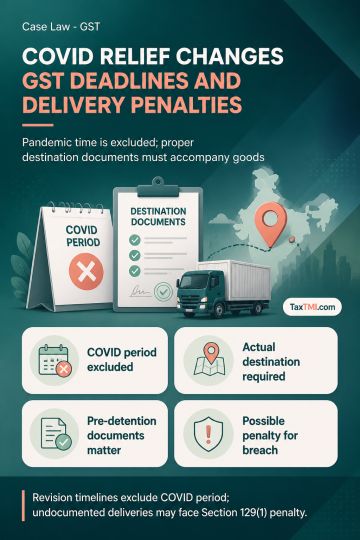
    COVID-19 limitation exclusion and destination-specific e-way bills govern revisional timelines and penalties for undocumented third-party plywood deli...
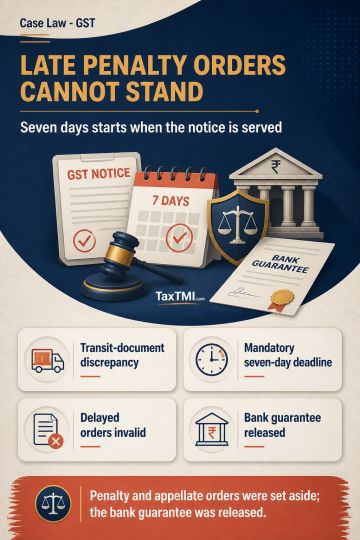
    Mandatory detention-penalty time limits invalidate delayed orders and require release of security in transit-document discrepancy proceedings.
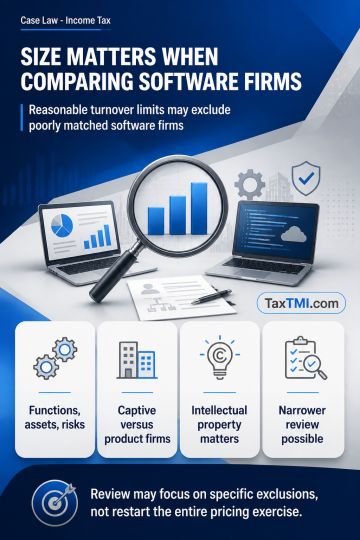
    Transfer-pricing comparability under TNMM permits rational turnover filters and excludes software-product developers from captive software-services be...
    Internal comparables under TNMM take priority when audited segmental accounts reliably distinguish AE and non-AE transactions.
    Transitional reassessment savings permit direct reassessment notices after third-party searches conducted during the protected statutory period.
    Questions arising from miscellaneous application orders cannot challenge unaltered Tribunal findings, leaving the original order separately challengea...
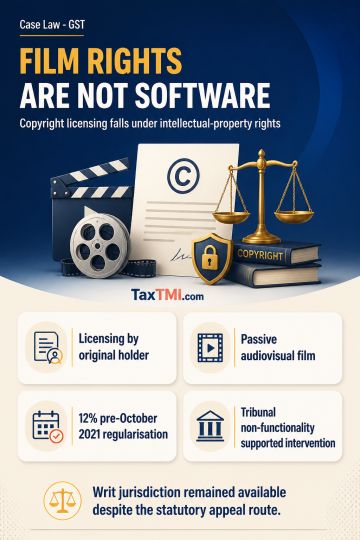
    Cinematographic-film copyright licensing: GST classification excludes information technology software, preserving regularisation and writ review for j...
❯❯
Maximize Maximize Maximize
0 / 200
Expand Note
Add to Folder

No Folders have been created

+

Are you sure you want to delete "My most important" ?

NOTE:

Highlights
Showing Results for :
Reset Filters
Results Found:
Show All Summaries Hide All Summaries

Highlights

Back

All Highlights

Showing Results for :
Reset Filters
No Records Found

Highlights

Back

All Highlights

Showing Results for : Reset Filters

Section 153A's extended ten-year reassessment period is...

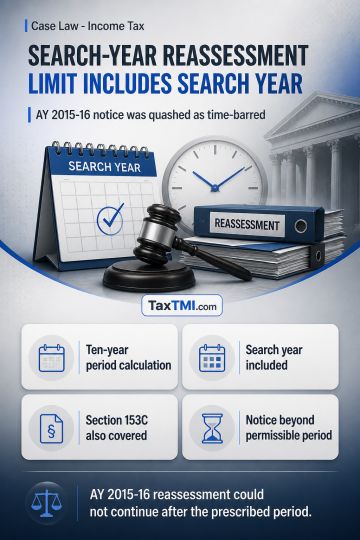
Ten-year reassessment limitation includes the search assessment year in search cases, rendering notices beyond the period time-barred.

Contents
Summary
Note

Note

-

Bookmark

Print

Print

Income Tax July 23, 2026 Case Laws HC
Section 153A's extended ten-year reassessment period is described as being computed differently from the six-year period. The six assessment years immediately precede the assessment year relevant to the search year, whereas the ten-year period runs from the end of that assessment year and includes the search assessment year as its first year. The note states that this interpretation also applies where seized material is received by the jurisdictional Assessing Officer under section 153C. On that computation, the reassessment notice for AY 2015-16 was treated as beyond the permissible period and quashed as time-barred.

Topics

Acts Income Tax