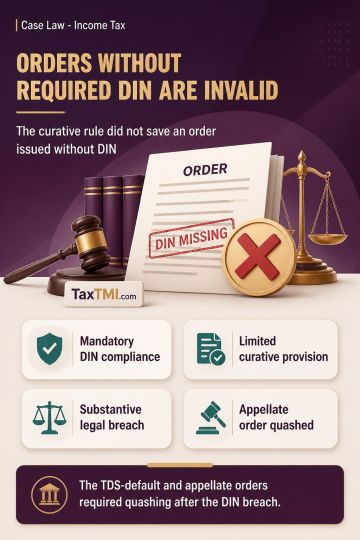
Document Identification Number compliance renders TDS-default orders invalid where mandatory DIN requirements are breached and curative provision does...
Preferential customs exemption based on a country-of-origin...
Mandatory verification procedure governs rejection of country-of-origin certificates before denying preferential customs exemption and related penalties.
Contents
Summary
Note
Bookmark
Share
✓ Copied successfully !
Print
Print Options
For full text, please login
Login to TaxTMI
Verification Pending
The Email Id has not been verified. Click on the link we have sent on
Preferential customs exemption based on a country-of-origin certificate cannot be denied by rejecting the certificate without following the prescribed verification procedure. The Tribunal held that where the law specifies a particular manner for disbelieving or rejecting such a certificate, that procedure alone must be followed, and investigative statements cannot override it. Because the certificate was rejected contrary to clauses 16 and 17 of Annexure-III to Rule 13 of Notification No. 189/2009-Cus (NT) read with Article 24 of the AIFTA Operational Certification Procedures, the consequential duty demand and penalties also failed and the impugned order was set aside.
Preferential customs exemption based on a country-of-origin certificate cannot be denied by rejecting the certificate without following the prescribed verification procedure. The Tribunal held that where the law specifies a particular manner for disbelieving or rejecting such a certificate, that procedure alone must be followed, and investigative statements cannot override it. Because the certificate was rejected contrary to clauses 16 and 17 of Annexure-III to Rule 13 of Notification No. 189/2009-Cus (NT) read with Article 24 of the AIFTA Operational Certification Procedures, the consequential duty demand and penalties also failed and the impugned order was set aside.
Note: It is a system-generated summary and is for quick reference only.
 TaxTMI
  TaxTMI
 of 4916