Loading...

⚠ ✕
❮ Top
☎ Help
☰
×

By creating an account you can:

Logo TaxTMI
Call Us / Help / Feedback✕

Contact Us At :

✉ E-mail: [email protected]

✆ To Call / Whatsapp, Check Contact Us

FAQs :

To know Frequently Asked Questions, Check FAQs

Most Asked Video Tutorials :

For more tutorials, Check Video Tutorials

Submit Feedback/Suggestion :

Email :
Please provide your email address so we can follow up on your feedback.
Category :
Description :
Min 15 characters 0/2000
Make Most of Text Search ✕
  1. Checkout this video tutorial: How to search effectively on TaxTMI.
  2. Put words in double quotes for exact word search, eg: "income tax"
  3. Avoid noise words such as : 'and, of, the, a'
  4. Sort by Relevance to get the most relevant document.
  5. Press Enter to add multiple terms/multiple phrases, and then click on Search to Search.
  6. Text Search
  7. The system will try to fetch results that contains ALL your words.
  8. Once you add keywords, you'll see a new 'Search In' filter that makes your results even more precise.
  9. Text Search
╳
Add to...
You have not created any category. Kindly create one to bookmark this item!
✕
Create New Category
Hide
Title :
Description :
❮❮ Hide
❮ Default View
Expand ❯❯
Close ✕
🔎 Filters / Advanced Search ❯
TEXT

Press 'Enter' to add multiple search terms. Rules for Better Search

Search In
Main Text + AI Text ❯
  • Main Text
  • Main Text + AI Text
  • AI Text
Law:
---- All Laws---- ❯
  • ---- All Laws----
  • Benami Property
  • Bill
  • Central Excise
  • Companies Law
  • Customs
  • DGFT
  • FEMA
  • GST
  • GST - States
  • IBC
  • Income Tax
  • Indian Laws
  • Money Laundering
  • SEBI
  • SEZ
  • Service Tax
  • VAT / Sales Tax
Types:
---- All Types ---- ❯
  • ---- All Types ----
  • Act Rules
  • Case Laws
  • Circulars
  • Manuals
  • News
  • Notifications
Sort By: ?
In Sort By 'Default', exact matches for text search are shown at the top, followed by the remaining results in their regular order.
Relevance Default Date
☰   Show Results ❯
    Post-Facto Shareholder Ratification of Diversion of Preferential Issue Proceeds under the PFUTP Regu...
    Cross-Segment Price Manipulation in Stock Derivatives under the SEBI Act and PFUTP Regulations
    Price Depression in Securities Markets: Evidentiary Requirements under the PFUTP Regulations
    Revisiting Shareholder Rights in Securities Law: Deciphering the Bounds of Confidentiality in Corpor...
    Comprehensive Legal Analysis of Jurisdictional Challenges and SEBI's Regulatory Framework in Securit...
    Empowering Investors: SEBI's New Framework for Enhanced Trading Account Security
    Revising Foreign Investment Norms in Alternative Investment Funds: A Critical Analysis of SEBI's Lat...
    SEBI's New Mandates for AIFs: Dematerialization of Investments and Custodian Appointment - Implicati...
    Renewal of Recognition for AMC Repo Clearing Limited: SEBI's Decision and its Implications
    Importance of transparency in corporate governance and the rights of minority shareholders
❮
❯
❯❯
Maximize Maximize Maximize
0 / 200
Expand Note
Add to Folder

No Folders have been created

+

Are you sure you want to delete "My most important" ?

NOTE:

Notes
Showing Results for :
Reset Filters
Results Found:
Show All Summaries Hide All Summaries
Case Laws SEBI
Show AI Summary
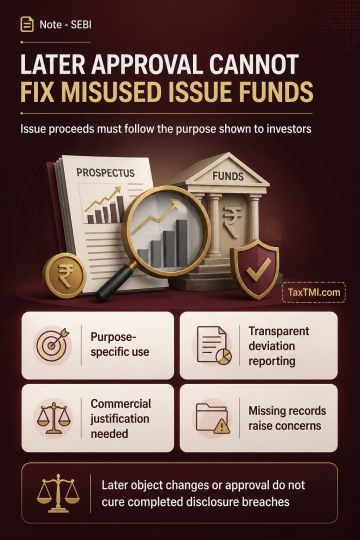
Shareholder ratification cannot cure preferential-issue fund diversion when disclosed objectives are abandoned, triggering securities-market fraud and disclosure concerns.
Post-facto shareholder approval cannot retrospectively validate diversion of preferential-issue proceeds contrary to issue-specific objects disclosed to shareholders and the market. A special resolution authorises the issue but does not permit unrestricted use of proceeds. Periodic deviation reporting, audit-committee review and utilisation disclosures promote transparency; they do not enable diversion followed by later regularisation. Immediate diversion, inadequate commercial justification and missing documentation may indicate that disclosed objects were not genuinely intended to be performed. Later amendment of corporate objects or shareholder ratification cannot cure a completed securities-market disclosure breach.
Case Laws SEBI
Show AI Summary
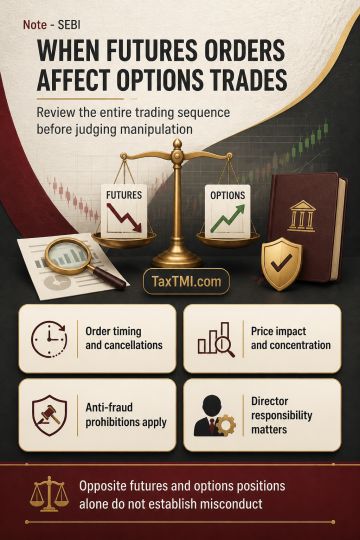
Cross-segment price manipulation examines whether futures orders artificially influence option executions, engaging anti-fraud rules, director responsibility, and interim safeguards.
Cross-segment price manipulation may arise where aggressive futures orders alter the last traded price or visible order-book conditions so that larger, sentimentally opposite options orders obtain favourable execution. The relevant inquiry considers the integrated sequence of resting orders, aggressive executions, cancellations, timing, concentration, price impact and delta-adjusted exposure. Anti-fraud prohibitions cover manipulative devices, false appearances of trading and price manipulation, while opposite futures and options positions alone do not establish misconduct. Director liability requires responsibility for business conduct, or consent, connivance or neglect.
Case Laws SEBI
Show AI Summary
Settlement-price depression allegations require cogent proof of manipulation, not merely short exposure, closing sales, or position-limit non-disclosure.
Settlement-price depression under the PFUTP framework requires cogent proof of a manipulative act, device, scheme or artifice, not merely a substantial short derivative position, closing-window sales, or an incentive to benefit from a lower settlement price. Position concentration and position-limit non-disclosure are distinct from PFUTP fraud. Sales below the last traded price require market-wide causal analysis of other trading activity, execution mechanics, benchmark methodology, commercial rationale, and actual price impact. A genuine hedge and agency-attributed exposure do not, without further proof, establish manipulation.
Case Laws SEBI
Show AI Summary
Shareholder access to confidential corporate documents affirmed where confidentiality is overstretched, strengthening minority investor protections.
Minority shareholders are entitled to access corporate documents where confidentiality claims are overstated; confidentiality and privilege cannot be used to withhold information necessary for assessing compliance with securities law. SEBI's settlement framework cannot shield material information from shareholder scrutiny; regulatory processes must balance investigatory integrity with transparency and natural justice. Non compliance with Minimum Public Shareholding norms undermines market integrity and minority rights, and settlements of serious violations require sufficient transparency to protect investor interests.
Case Laws SEBI
Show AI Summary
Territorial jurisdiction disputes in securities cases shape venue decisions and challenge regulatory settlement revocations and discretion.
Disputes over venue in securities enforcement pivot on territorial jurisdiction and forum non-conveniens, using cause of action and convenience factors to determine appropriate forum. SEBI's settlement regime under the SEBI (Settlement Proceedings) Regulation 2018 and the regulator's power to revoke settlements raise questions about regulatory discretion, enforceability of negotiated resolutions, and implications for corporate governance and market integrity, while High Courts' supervisory role under Article 226 intersects with statutory enforcement mechanisms.
Circulars SEBI
Show AI Summary
Voluntary trading account freeze empowers investors to request account blocking to prevent fraudulent trading under a regulatory framework.
The circular requires trading members to provide a voluntary freezing/blocking facility allowing clients to request account suspension, with specified request modes, acknowledgement procedures, processing timeframes, and mechanics for implementing and lifting freezes. Stock exchanges must ensure implementation, amend rules where necessary, establish reporting requirements for trading members, and report compliance to the regulator. The measure is issued under Section 11(1) of the Securities and Exchange Board of India Act and Regulation 30 of the SEBI (Stock Brokers) Regulations to enhance investor control and prevent fraudulent trading activity.
Circulars SEBI
Show AI Summary
Foreign investment restrictions in AIFs require exclusion of sanctioned or high AML risk beneficial owners, limiting further capital contributions.
The circular tightens investor eligibility for Alternative Investment Funds by redefining beneficial ownership thresholds and imposing disqualifications: investors or beneficial owners must not be on the United Nations Security Council Sanctions List and must not be residents of jurisdictions identified by the Financial Action Task Force as having strategic AML/CFT deficiencies. AIF managers are prohibited from accepting further capital contributions from investors who fail these conditions, with immediate effect, thereby necessitating enhanced due diligence and ongoing monitoring to ensure compliance.
Circulars SEBI
Show AI Summary
Dematerialization of AIF investments required, with custodians and standardized custody reporting to enhance transparency and oversight.
SEBI mandates dematerialization of AIF investments and the appointment of custodians, with specified conditions for associates acting as custodians, and requires standardized reporting of investments under custody to enhance transparency, reduce risks associated with physical securities, and strengthen oversight through operational and technological adjustments by AIFs and managers.
Notifications SEBI
Show AI Summary
Renewal of recognition secures conditional authorisation for clearing and settlement of repo and reverse repo transactions in debt securities.
Renewal of recognition is granted to AMC Repo Clearing Limited for a one year period, authorising it to clear and settle repo and reverse repo transactions in debt securities traded on a recognized stock exchange. The renewal is conditioned on compliance with regulatory rules and directions and restricts the Clearing Corporation to activities solely related to clearing and settlement of eligible repo and reverse repo transactions.
Case Laws SEBI
Show AI Summary
Shareholder access to investigation documents upheld, reinforcing transparency and minority investor rights in regulatory proceedings.
Minority shareholders challenged alleged securities-law violations and sought access to investigation and settlement-related documents; the court found that shareholders could not be treated as outsiders and were entitled to the requested materials despite confidentiality claims, while not definitively ruling on the legality of the settlement process, stressing transparency in corporate governance and implications for application of confidentiality provisions in regulatory proceedings.

TMI Notes

Back

All TMI Notes

Showing Results for :
Reset Filters
No Records Found

TMI Notes

Topics

Acts Income Tax