Loading...

⚠ ✕
❮ Top
☎ Help
☰
×

By creating an account you can:

Logo TaxTMI
Call Us / Help / Feedback✕

Contact Us At :

✉ E-mail: [email protected]

✆ Call / WhatsApp at: +91 99117 96707

For more information, Check Contact Us

FAQs :

To know Frequently Asked Questions, Check FAQs

Most Asked Video Tutorials :

For more tutorials, Check Video Tutorials

Submit Feedback/Suggestion :

Email :
Please provide your email address so we can follow up on your feedback.
Category :
Description :
Min 15 characters 0/2000
Make Most of Text Search ✕
  1. Checkout this video tutorial: How to search effectively on TaxTMI.
  2. Put words in double quotes for exact word search, eg: "income tax"
  3. Avoid noise words such as : 'and, of, the, a'
  4. Sort by Relevance to get the most relevant document.
  5. Press Enter to add multiple terms/multiple phrases, and then click on Search to Search.
  6. Text Search
  7. The system will try to fetch results that contains ALL your words.
  8. Once you add keywords, you'll see a new 'Search In' filter that makes your results even more precise.
  9. Text Search
╳
Add to...
You have not created any category. Kindly create one to bookmark this item!
✕
Create New Category
Hide
Title :
Description :
❮❮ Hide
❮ Default View
Expand ❯❯
Close ✕
🔎 Filters / Advanced Search ❯
TEXT

Press 'Enter' to add multiple search terms. Rules for Better Search

Search In
Main Text + AI Text ❯
  • Main Text
  • Main Text + AI Text
  • AI Text
Law:
---- All Laws---- ❯
  • ---- All Laws----
  • Benami Property
  • Bill
  • Central Excise
  • Companies Law
  • Customs
  • DGFT
  • FEMA
  • GST
  • GST - States
  • IBC
  • Income Tax
  • Indian Laws
  • Money Laundering
  • SEBI
  • SEZ
  • Service Tax
  • VAT / Sales Tax
Types:
---- All Types ---- ❯
  • ---- All Types ----
  • Act Rules
  • Case Laws
  • Circulars
  • Manuals
  • News
  • Notifications
Sort By: ?
In Sort By 'Default', exact matches for text search are shown at the top, followed by the remaining results in their regular order.
Relevance Default Date
☰   Show Results ❯
    Case Laws Companies Law
    Lifting the Corporate Veil Where Promoter Shareholding Is Allegedly Dissipated Despite Judicial Assu...
    Consolidated Show Cause Notices under Sections 73 and 74 and Taxability of School Affiliation Servic...
    Fraudulent Input Tax Credit from Non-Existent Suppliers: Application of Sections 16, 74 and 155 of t...
    Case Laws Money Laundering
    Prolonged Pre-Trial Incarceration and Bail under Section 45 of the Prevention of Money-Laundering Ac...
    Case Laws Income Tax
    Prospective Operation of Section 56(2)(x)(b) in Stamp-Value Difference Cases Involving Immovable Pro...
    Seizure of Cash under Section 67 of the CGST Act and Interest on Illegal Retention
    Case Laws Income Tax
    Disallowance of Salary Expenditure for Allegedly Non-Genuine Services under Section 37
    Case Laws Income Tax
    Fair Market Value of Unquoted Equity Shares Under Section 56(2)(viib) and Rule 11UA
    Refund of Excess IGST Paid on Exports Following Clerical Error in FORM GSTR-3B
    Revocation of Cancellation of GST Registration for Non-Filing of Returns under Section 30 and Rule 2...
    Case Laws Income Tax
    TOLA, Section 149 and the Surviving-Time Test for Reassessment Proceedings
    Case Laws Customs
    Provisional Release of Unseized Imported Food Consignments under the Customs Act, 1962
    Case Laws Customs
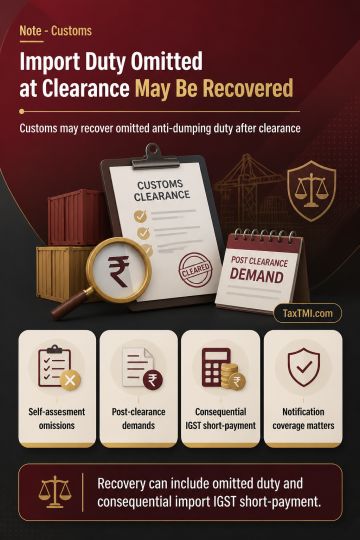
    Recovery of Unpaid Anti-Dumping Duty After Self-Assessment Under Section 28 of the Customs Act, 1962
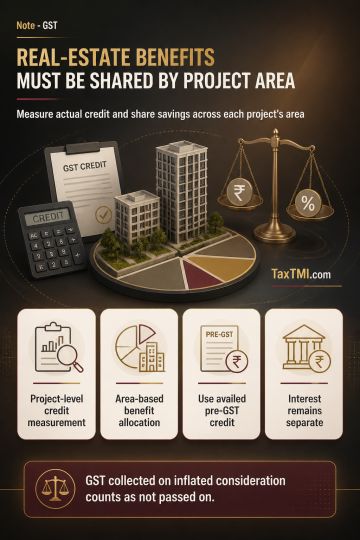
    Project-Wise Anti-Profiteering Methodology in Real Estate under Section 171 of the Central Goods and...
    Case Laws Income Tax
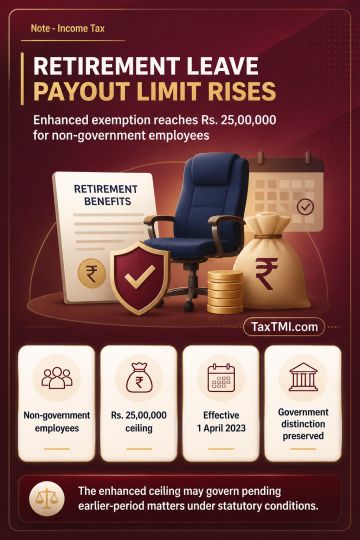
    Retirement Leave Encashment Exemption under Section 10(10AA)(ii) and Retrospective Application of No...
    Transit-State Jurisdiction under GST: Limits on Detention and Penalty in External Inter-State Suppli...
    Post-Facto Shareholder Ratification of Diversion of Preferential Issue Proceeds under the PFUTP Regu...
    Case Laws Income Tax
    Section 195 Withholding on Payments to Non-Residents: Royalty, Fees for Technical Services and Busin...
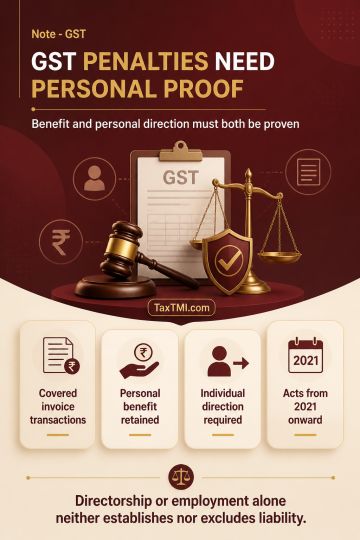
    Penalty: Scope of "Any Person" under Section 122(1A) of the Central Goods and Services Tax Act, 2017
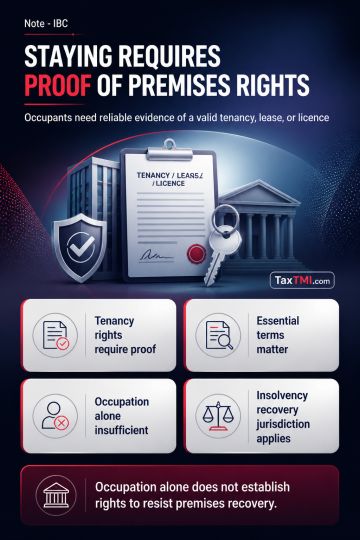
    Recovery of Corporate Debtor Premises and Proof of Tenancy, Lease or Licence Rights under the Insolv...
❮
❯
❯❯
Maximize Maximize Maximize
0 / 200
Expand Note
Add to Folder

No Folders have been created

+

Are you sure you want to delete "My most important" ?

NOTE:

Notes
Showing Results for :
Reset Filters
Results Found:
Show All Summaries Hide All Summaries
Case Laws Companies Law
Show AI Summary
Corporate veil-piercing permits forensic scrutiny in execution where promoter-controlled entities may dissipate shareholding despite judicial assurances.
Corporate veil-piercing in execution is an exceptional response where promoters allegedly use layered entities and securities transactions to deplete shareholding represented as security through judicial assurances. Separate personality remains the rule, and control or ownership alone does not suffice; there must be a nexus between control, misuse of the corporate form, and frustration of enforcement. A forensic audit reconstructs share movements, pledges, sales, financing, approvals, disclosures, and fund flows, distinguishing legitimate enforcement of pre-existing security from coordinated asset dissipation.
Case Laws GST
Show AI Summary
School affiliation services fall outside educational exemption without a direct nexus to admissions or examination conduct.
Consolidated show cause notices may combine financial years governed by Sections 73 and 74 where liabilities are segregated period-wise, each component independently meets limitation and notice requirements, the additional ingredients for fraud-based proceedings are satisfied, and no actual prejudice arises. School affiliation and affiliation-form processing charges are independent taxable supplies where they concern institutional eligibility and compliance, rather than directly and immediately relating to student admission or the conduct of examinations. A broad connection with education does not satisfy the educational-services exemption.
Case Laws GST
Show AI Summary
Fraudulent input tax credit requires proof of fictitious supplies, absent goods receipt, and fraud-linked self-assessment, not cancellation alone.
Input tax credit from allegedly non-existent suppliers depends on proof of genuine supply and actual receipt of goods or services, not merely invoices, accounting entries, or banking-channel payments. Section 155 places the burden of establishing ITC eligibility on the claimant. Section 74 requires more than ineligible credit: the wrongful availment must be linked to fraud, wilful misstatement, or suppression to evade tax. Retrospective supplier-registration cancellation is relevant evidence but is not conclusive. A fraud-based notice must disclose facts showing fictitious suppliers, absence of supply, and a basis for inferring the recipient's knowledge or participation.
Case Laws Money Laundering
Show AI Summary
Prolonged pre-trial incarceration may justify conditional PMLA bail when delayed trials make continued detention constitutionally disproportionate.
Section 45 of the Prevention of Money-Laundering Act remains the stringent ordinary bail threshold, requiring prosecutorial opportunity and, on opposition, reasonable grounds to believe that the accused is not guilty and unlikely to offend while on bail. Article 21 nevertheless requires a separate, fact-sensitive inquiry where prolonged pre-trial detention and an unrealistic trial timetable make custody disproportionate. Relevant factors include custody length, trial progress, remaining witnesses, secured documentary evidence, source of delay, predicate-case status, and risks of absconding or witness interference. Conditions such as passport surrender, attendance, non-contact directions, and residence disclosure may safeguard the trial.
Case Laws Income Tax
Show AI Summary
Prospective operation of stamp-value taxation prevents retrospective application where property agreements and substantial payments predate the charging provision.
Section 56(2)(x)(b) applies to immovable property received for inadequate consideration only where its temporal and valuation conditions are satisfied. A stamp-value difference alone does not establish taxability. Where consideration was fixed and substantial payments or contractual performance occurred before the charging provision commenced, later conveyance or registration does not by itself attract the later charge. Agreement-date valuation is available only for covered transactions where consideration was fixed and paid, wholly or partly, through prescribed banking or electronic modes on or before the agreement date. The tax authority must identify the correct statutory basis and provide a meaningful opportunity to respond.
Case Laws GST
Show AI Summary
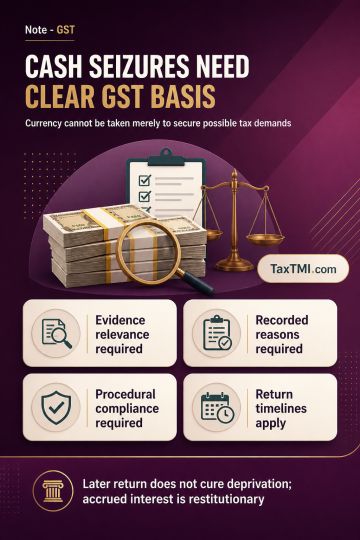
GST cash seizure limits require statutory relevance and restitutionary interest for unlawfully retained currency following searches.
GST seizure powers cannot be used to take cash as a general investigative measure or security for a possible tax demand. Currency is excluded from goods, and "things" is confined contextually to articles useful or relevant as evidence in GST proceedings. Valid seizure and retention require recorded statutory reasons, procedural compliance and observance of return timelines. Unauthorised retention engages property protections; later return does not cure the deprivation, and accrued interest is restitutionary rather than delayed-refund interest.
Case Laws Income Tax
Show AI Summary
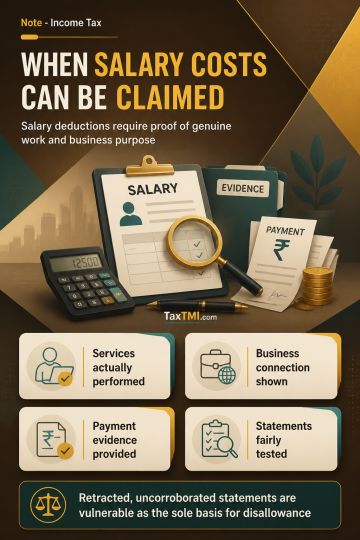
Salary expense genuineness requires proof of actual services, business purpose, and fair testing of adverse third-party statements.
Under Section 37(1), salary expenditure is deductible only where it is actually incurred wholly and exclusively for business purposes and is supported by proof of genuine employment, services rendered, business nexus, and payment. Bank transfers and accounting entries alone are not conclusive. Where a third-party statement is central to an allegation of non-genuine salary, the taxpayer should receive disclosure and a meaningful opportunity to rebut it, including cross-examination where appropriate. A retracted and uncorroborated statement is vulnerable as the sole basis for disallowance.
Case Laws Income Tax
Show AI Summary
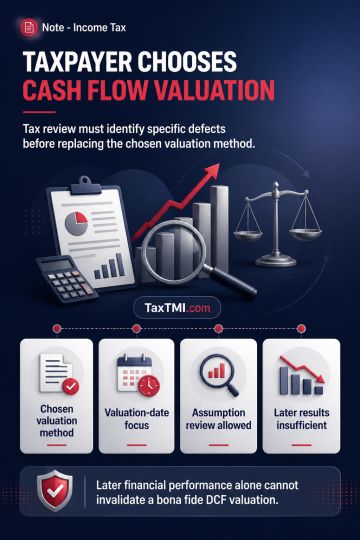
Discounted cash flow valuation remains taxpayer-selected under prescribed rules, while tax scrutiny must identify specific valuation-date defects.
The taxpayer may elect a prescribed DCF valuation for unquoted equity shares, and scrutiny of that method does not permit substitution with Net Asset Value merely because it produces a lower fair market value. The Assessing Officer may examine projections, discount rates, terminal assumptions, computations and source data, but rejection requires demonstrably wrong facts, material errors, a wholly erroneous basis or objectively unsupported assumptions. Subsequent financial performance cannot alone invalidate a bona fide DCF valuation; the relevant inquiry remains the reasonableness of valuation-date information.
Case Laws GST
Show AI Summary
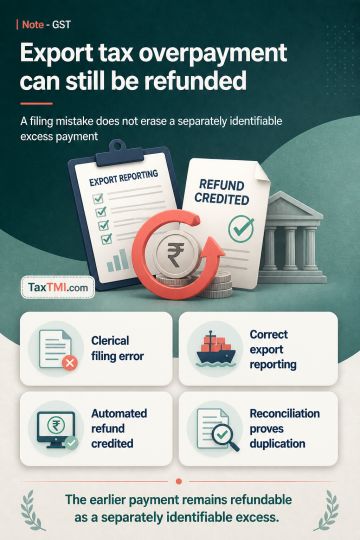
Excess IGST on exports remains refundable when later correction triggers automated refund and reconciliation proves duplicate payment.
Refund of excess IGST paid on zero-rated exports may arise where turnover and tax are mistakenly entered under non-zero-rated supplies in FORM GSTR-3B while export invoices and shipping bills are correctly reported in FORM GSTR-1. If the exporter then pays the same IGST in the correct zero-rated field and the automated refund is credited against that later payment, the earlier payment remains a separately identifiable potential excess; its claim is not a repeat request for the same export-tax refund.
Case Laws GST
Show AI Summary
GST registration revocation requires timely application, return compliance, payment of dues, and a reasoned statutory decision.
GST registration revocation after cancellation for return default is a conditional, time-bound process. An application under Section 30 and Rule 23 must ordinarily be filed within ninety days, subject to prescribed extension, and cannot be made until pending returns are filed and tax, interest, penalty and late fee are paid. Portal non-acceptance may permit online or physical submission where technically unavailable, but does not condone delay or ensure revocation. The competent authority must assess statutory eligibility, sufficient grounds and compliance while following notice and hearing requirements before rejection.
Case Laws Income Tax
Show AI Summary
Reassessment limitation under TOLA requires final notices to issue within surviving time and satisfy statutory safeguards.
Reassessment limitation under TOLA is a jurisdictional restraint. Transitional notices issued between 1 April 2021 and 30 June 2021 are treated as Section 148A(b) show-cause notices, but only the surviving time remaining until 30 June 2021 is available for completing the reassessment process. Periods for supply of material and the assessee's response are excluded, but the Section 148A(d) decision, statutory approval and final Section 148 notice must issue within the remaining period. For Assessment Year 2015-16, post-1 April 2021 notices are treated as time-barred.
Case Laws Customs
Show AI Summary
Unseized food consignments cannot face indefinite detention without lawful seizure, valid sampling, and prompt assessment.
Provisional release of an unseized imported food consignment is not mechanically governed by Section 110A, which applies to goods seized under Section 110. Customs may examine, test, verify and reassess imports, but indefinite retention without a seizure memorandum or disclosed reasons connecting the goods with confiscation is not justified. Food sampling should follow the specialised food-safety process through an authorised officer. A valid food-safety report may support conditional clearance, while classification, duty liability, confiscation and adjudication remain open. Revenue may be protected through proportionate security.
Case Laws Customs
Show AI Summary
Anti-dumping duty recovery permits post-clearance demands and consequential import IGST where self-assessment omitted an applicable levy.
Unpaid anti-dumping duty omitted during self-assessment may be pursued through the customs recovery procedure without prior appellate modification of the self-assessment. The recovery framework applies to anti-dumping duty through statutory incorporation of provisions concerning assessment, non-levy, short-levy, interest and recovery. Where anti-dumping duty is chargeable, it forms part of the aggregate value used to compute IGST on imports, potentially creating a consequential IGST short-payment. Recovery requires accurate assessment of notification coverage, product, origin, rate, valuation, limitation and procedural safeguards.
Case Laws GST
Show AI Summary
Project-wise anti-profiteering requires actual input tax credit measurement and area-based allocation of benefits to real-estate purchasers.
Real-estate anti-profiteering under Section 171 requires project-level identification of additional input tax credit and allocation of the saving across total project area on a per-square-foot basis. Purchase value may quantify credit attributable to project expenditure, but turnover or collections cannot serve as the allocation basis. The comparison must use pre-GST credit actually availed rather than merely available credit. GST collected on consideration inflated by an undistributed benefit forms part of the amount not passed on and remains distinct from statutory interest.
Case Laws Income Tax
Show AI Summary
Retirement leave encashment exemption applies under the enhanced notified ceiling while preserving non-government employee classification and statutory conditions.
Section 10(10AA)(ii) governs retirement leave-encashment exemption for non-Government employees, subject to the ten-month earned-leave measure, average-salary computation, and the notified monetary ceiling. Notification No. 31/2023 specifies an enhanced ceiling of Rs. 25,00,000, is deemed effective from 1 April 2023, and certifies that retrospective effect causes no adverse effect. The enhanced ceiling is treated as a remedial rationalisation of an existing exemption and may govern pending earlier-period matters, while preserving the distinction between Government and non-Government employees.
Case Laws GST
Show AI Summary
Transit GST jurisdiction limits detention penalties for documented inter-State supplies lacking a local taxable nexus.
Transit-State jurisdiction under GST permits interception, document production, e-way bill verification and authorised physical inspection of goods moving through an intermediate State. It does not, in a pure transit movement, support detention-related penalty for an external inter-State supply where origin and destination lie outside the intercepting State, no tax is payable there, and there is no evidence of diversion, local supply, fictitious or mismatched documents, or mismatch of goods. Cross-empowerment is administrative and does not create an independent territorial taxable nexus.
Case Laws SEBI
Show AI Summary
Shareholder ratification cannot cure preferential-issue fund diversion when disclosed objectives are abandoned, triggering securities-market fraud and disclosure concerns.
Post-facto shareholder approval cannot retrospectively validate diversion of preferential-issue proceeds contrary to issue-specific objects disclosed to shareholders and the market. A special resolution authorises the issue but does not permit unrestricted use of proceeds. Periodic deviation reporting, audit-committee review and utilisation disclosures promote transparency; they do not enable diversion followed by later regularisation. Immediate diversion, inadequate commercial justification and missing documentation may indicate that disclosed objects were not genuinely intended to be performed. Later amendment of corporate objects or shareholder ratification cannot cure a completed securities-market disclosure breach.
Case Laws Income Tax
Show AI Summary
Cross-border software payments require copyright-right, technical-service, and permanent-establishment analysis before withholding obligations are determined under applicable treaties.
Section 195 requires withholding only from a remittance to a non-resident that includes income chargeable in India. For software, royalty depends on transfer of copyright rights, not merely the right to install, access, use, or distribute a copyrighted article under restrictive terms. Where a DTAA is more beneficial, its royalty and FTS definitions control; treaty FTS may require technology to be made available. Amounts that are neither royalty nor FTS require consideration as business profits, ordinarily taxable only where profits are attributable to a permanent establishment. Composite payments require component-wise allocation and analysis.
Case Laws GST
Show AI Summary
Personal GST penalty requires proof that the beneficiary retained benefit and directed a covered invoice or credit transaction.
Section 122(1A) may impose personal GST penalty on a registered or unregistered person only for a covered invoice or input tax credit transaction. Liability requires cumulative proof that the individual retained an identifiable personal benefit and that the transaction was conducted at that person's instance. Directorship, employment, registration, signature authority, or association with the taxable entity neither independently establishes nor excludes liability. Proceedings require transaction-specific and person-specific allegations and findings. The provision operates prospectively for underlying acts or transactions occurring on or after 01.01.2021.
Case Laws IBC
Show AI Summary
Proof of tenancy rights governs insolvency recovery of corporate-debtor premises from occupants lacking enforceable possessory interests.
Where premises form part of the corporate debtor's assets, Sections 18 and 25 of the Insolvency and Bankruptcy Code, 2016 require the resolution professional to take custody, control, preservation and protection measures. An occupant resisting recovery must prove a subsisting tenancy, leasehold interest or enforceable licence through reliable evidence of the parties' intended relationship and its essential terms. Permission to stock goods or conduct limited business activity, prolonged occupation, and business or utility records do not independently create rights in the premises. Section 60(5)(c) supports insolvency jurisdiction over asset-recovery measures connected with the insolvency estate.

TMI Notes

Back

All TMI Notes

Showing Results for :
Reset Filters
No Records Found

TMI Notes

Back

All TMI Notes

Lifting the Corporate Veil Where Promoter Shareholding Is Allegedly Dissipated Despite Judicial Assurances

25 October, 2026

Contents
Acts
Rules & Regulations
Plus +
Summary
Note

Note

-

Bookmark

Print

Print

This commentary provides doctrinal analysis and practical insights on the legal issue discussed below. The judgment is analysed in the context of its factual background, issues framed, and conclusions reached by the Court.

2026 (9) TMI 207 - DELHI HIGH COURT

1. Introduction

The doctrine of lifting the corporate veil is an exceptional judicial technique by which a court looks beyond a company's separate legal personality to identify the persons who actually control, use or benefit from the corporate structure. Its purpose is not to erase the general rule of corporate separateness. Rather, it prevents that rule from becoming a device for fraud, evasion of an existing obligation, frustration of a decree, or obstruction of the administration of justice.

The decision reported as 2026 (9) TMI 207 - DELHI HIGH COURT places the doctrine in an execution setting involving a foreign arbitral award. The central question was whether a listed company, an intermediate promoter-holding company, the controlling judgment debtors and connected lenders could invoke separate legal personality to resist an inquiry into the alleged depletion of assets that had been represented as available to satisfy the award.

The court did not finally impose civil liability upon the listed company, the holding entity, lenders or their officers. It instead ordered a forensic audit. That distinction is decisive. The judgment treats veil-piercing, and potentially reverse veil-piercing, as an evidentiary and remedial question which must follow a rigorous reconstruction of control, share movements, pledges, approvals, disclosures, fund flows and knowledge of judicial restraints.

2. Legal & Statutory Context

Separate personality, control and promoter status

Indian company law begins with separate corporate personality: a company owns its own assets and ordinarily bears its own liabilities. A shareholder does not, merely by holding shares, acquire an interest in corporate property. Equally, the corporate form is not conclusive where the facts show that the entity is being used as a fac ade or instrumentality for improper conduct.

Section 2(27) of the Companies Act, 2013 defines "control" to include "the right to appoint majority of the directors or to control the management or policy decisions", directly or indirectly, including through shareholding, management rights, shareholders' agreements, voting agreements "or in any other manner". The inclusive formulation is significant: formal title to shares is not the exclusive test. Effective control over management and policy may reveal the real economic and decision-making relationship between individuals and entities.

The same provision also defines a "promoter" in Section 2(69) to include a person who has control over company affairs, directly or indirectly, as shareholder, director or otherwise, or one on whose directions the board is accustomed to act. These definitions supported the court's conclusion that interposing a wholly controlled promoter-holding entity could not, without further inquiry, isolate the individuals exercising ultimate control from the transactions concerning the listed company's shares.

Free transferability of public-company securities

Section 58(2) of the Companies Act, 2013 provides that "the securities or other interest of any member in a public company shall be freely transferable". Its proviso, however, states that "any contract or arrangement between two or more persons in respect of transfer of securities shall be enforceable as a contract."

The listed company relied on free transferability to contend that it could neither restrain nor control dealings in dematerialised shares held by its promoter entity. The court held that this proposition could not end the inquiry where repeated assurances to a constitutional court had been furnished to preserve the value of assets for execution. On the court's reasoning, an undertaking or assurance to the court cannot be treated as having less operative force than a private contractual arrangement. The conclusion is contextual: it is directed to the effect of judicial assurances and subsisting restraint orders, not to a general proposition that every listed issuer may independently stop every shareholder transfer.

Directors' duties and securities-law compliance

Section 166 of the Companies Act, 2013 requires a director to act in good faith for the company's objects and in the best interests of the company, its members, employees, shareholders, community and environment; to exercise "due and reasonable care, skill and diligence" and independent judgment; and not to obtain undue gain or advantage for himself, relatives, partners or associates.

The securities-law dimension was equally material. Regulation 9 of the SEBI (Prohibition of Insider Trading) Regulations, 2015 requires listed companies to formulate a code of conduct to regulate, monitor and report trading by designated persons and their immediate relatives, and to appoint a compliance officer. Regulation 9(4) expressly includes all promoters of listed companies within the designated-person framework. Under Schedule B, trading by designated persons may be subject to pre-clearance when the trading window is open, while the compliance officer may seek declarations concerning unpublished price sensitive information.

The court recognised the factual controversy over whether the intermediate promoter entity was itself a designated person during the relevant transactions. Yet it held that the issue could not be resolved by formal ownership alone. The controlling individuals were also directors and senior office-holders of the listed company. The forensic audit was therefore directed to examine whether the compliance architecture, approvals and disclosure mechanisms were used, bypassed or otherwise implicated in transactions that allegedly depleted the asset base.

3. Interpretative Issues

Control is not synonymous with ownership, but ownership may evidence control

Veil-piercing does not follow merely because one person owns most of a company's shares or occupies an executive office. The controlling inquiry is whether control was coupled with misuse of the corporate form. In the present execution proceedings, the court found a prima facie basis for inquiry because the judgment debtors were alleged to control the chain of entities that held the promoter interest, while simultaneously giving judicial assurances concerning the preservation of assets.

Thus, the relevant question is not simply whether the listed company and the promoter-holding entity were separate companies. They undoubtedly were. The question is whether that separateness was deployed to dissociate the legal undertaking from the very shareholding and asset base represented before the court as security for the award.

Traditional and reverse veil-piercing

Traditional veil-piercing attributes the acts or liabilities of a company to its controllers where the company is used as a fac ade for wrongdoing. Reverse veil-piercing raises a related but distinct issue: whether assets held through a company may be examined or made available for a controller's liability because the company has become the vehicle for placing assets beyond a creditor's reach.

The court expressly treated reverse corporate veil-piercing as a fact-specific exception. It did not hold that corporate assets automatically satisfy shareholders' personal obligations. It held only that, if forensic material establishes that the corporate structure was used to dissipate assets represented as available for satisfaction of the award, the court may consider whether the company or its assets can be made answerable to the extent necessary to remedy that specific wrong.

Execution cannot become a substitute for an unpleaded new claim

The doctrine must be reconciled with the settled limits of execution. A court cannot routinely travel beyond the decree and impose a fresh liability on strangers to it. The material distinction is between an impermissible attempt to convert a company's or director's separate assets into executable property without foundation, and a properly supported inquiry that the relevant corporate structure itself was used to defeat enforcement of the decree.

Accordingly, the forensic audit is doctrinally important. It is the mechanism directed at determining whether the alleged transaction trail reflects independent commercial enforcement of pre-existing security, or a coordinated arrangement involving promoters, companies, officers or lenders to place assets beyond the decree holder's reach.

4. Detailed Commentary & Analysis

The court identified a marked deterioration in the promoter-held shareholding that had earlier been presented as capable of securing the award. It noted that unencumbered shares had reduced from 5,29,31,574 to 6,01,607 during the relevant period. The competing explanations were materially different. The decree holder alleged improper sales of unencumbered shares and corporate complicity; the judgment debtors asserted lender-driven enforcement under earlier financing arrangements; and lenders maintained that they dealt only with already encumbered shares.

This conflict illustrates why labels such as "pledge", "top-up", "encumbrance", "release" and "invocation" cannot decide the matter by themselves. A valid pledge may be commercially legitimate. Yet a court must ascertain, transaction by transaction, whether additional shares were brought into the security pool after judicial assurances or status quo orders, whether those shares were previously unencumbered, who authorised the transactions, and whether the resulting depletion defeated the object of the restraint.

The audit directions are correspondingly broad. They cover the evolution of shareholding after the first assurance; fresh pledges, top-ups, invocations and sales; loan facilities and the purposes for which downstream entities borrowed; demat records; board and committee minutes; internal correspondence; compliance memoranda; statutory and stock-exchange filings; approvals by officers and intermediaries; and the trail of consideration received from the sale or transfer of shares.

The court's approach is particularly significant in treating knowledge as an evidentiary issue. A company may ordinarily contend that it is distinct from its shareholders. But where its managing decision-makers are also the alleged controllers of the promoter chain, knowledge of the judicial restraints, implementation of securities transactions, compliance oversight and corporate approvals become matters requiring examination. Separate personality cannot be assumed to negate knowledge where the alleged facts point to a common directing mind.

The judgment also preserves procedural fairness. A forensic audit is investigative, not adjudicatory. The court clarified that it neither enlarges the decree nor itself fastens liability. Any eventual relief against a company, officer, lender or intermediary must follow the audit, consideration of the material, and an appropriate determination in accordance with law.

5. Judicial / Administrative Perspective

The principal decision, 2026 (9) TMI 207 - DELHI HIGH COURT, adopts a calibrated approach. It holds that a corporate fac ade cannot foreclose an inquiry where the same controllers are alleged to have given assurances, retained effective control through layered entities, and caused the dissipation of the asset base. At the same time, it confines the immediate relief to a forensic audit and reserves all liability questions. The ratio is therefore investigative and remedial, rather than an automatic attribution of liability.

2014 (8) TMI 1084 - Supreme Court states the limiting test with precision. Ownership and control alone do not justify piercing. There must be impropriety linked to the use of the company structure to avoid or conceal liability, and the remedy must go no further than necessary to redress the particular wrong. This provides the principal safeguard against treating group-company structures or majority shareholding as sufficient in themselves.

2016 (9) TMI 967 - BOMBAY HIGH COURT is directly relevant to execution. It recognises that veil-piercing may be available in execution where the material demonstrates that corporate forms are being used as cloaks to defeat an award or decree. Common family control, overlapping management, financial interlinkages and the economic reality of the group were considered relevant to a finding of alter ego or single economic entity. It supports the proposition that execution proceedings are not categorically excluded from veil-piercing analysis.

The contrary caution appears in 2010 (2) TMI 1285 - DELHI HIGH COURT. That decision holds that a money decree against a company cannot be executed against directors merely because they manage the company. Fraud, impropriety, asset diversion or comparable grounds must be specifically pleaded and established. The decision does not deny the doctrine; it rejects its routine invocation. The present judgment is consistent with that caution because it does not presently execute the award against the listed company or its officers. It directs a factual investigation into whether a legally sufficient foundation exists.

2014 (2) TMI 1382 - BOMBAY HIGH COURT reinforces the pleading discipline. Common shareholders, common addresses, similar resolutions and common powers of attorney do not by themselves prove sham or fraud. Particulars must demonstrate that the relevant entities were formed or used to perpetrate fraud or conceal the real position. This authority is important where a decree holder seeks to infer collusion from group features alone.

2016 (1) TMI 1322 - PUNJAB AND HARYANA HIGH COURT supports the availability of veil-piercing at the execution stage where a closely held company is used as a cloak to evade satisfaction of a decree. Its relevance lies in recognising execution as a setting in which the court may examine misuse, rather than treating the corporate form as an absolute procedural barrier.

2000 (3) TMI 1075 - Supreme Court demonstrates the evidentiary dimension of the doctrine. The court looked to intrinsic documentary inconsistencies and surrounding circumstances to determine that an apparent transfer of company property was sham and collusive. It confirms that the real character of a transaction may be determined from contemporaneous records and conduct, not merely from its formal documentation.

2017 (5) TMI 1827 - DELHI HIGH COURT supplies a further safeguard: an arbitral tribunal cannot, merely on the basis of shareholding and managerial control, disregard corporate personality and impose personal liability on a non-signatory. Fraud, abuse or another recognised ground must be properly established, and jurisdictional limits must be respected. The present matter differs because the executing court has retained the issue for judicial determination after factual inquiry.

6. Implications & Observations

For decree holders, the decision shows that allegations of asset dissipation through group structures should be supported by a transaction matrix: shareholding pattern, demat movement, pledge documents, margin and top-up clauses, lender communications, board approvals, disclosure filings, consideration trail and proof of knowledge of court orders. General allegations of control are inadequate.

For companies and promoters, judicial assurances must be treated as operational restraints. A representation that assets will remain available for enforcement may expose subsequent encumbrances, transfers or restructurings to close scrutiny. The concern is amplified where the persons giving the assurance also exercise direct or indirect control over the entity holding the relevant assets.

For listed entities, the decision highlights the evidentiary importance of compliance records. The compliance officer's records, pre-clearance applications, restricted-list material, board reporting, promoter disclosures and correspondence with depositories may become critical in determining what the company knew, who approved a transaction and whether securities-law mechanisms were observed.

For lenders, the commercial character of a facility is not by itself conclusive where judicial restraints exist. A lender's rights under pre-existing security documents remain relevant, but the factual inquiry must determine whether the security was genuinely pre-existing, whether further shares were added later, and whether the enforcement action was consistent with the orders then in force.

The court directed the forensic auditor to issue requisitions within four weeks, required the concerned entities to respond within two weeks of receipt, and required completion of the audit within six months from receipt of the order. Non-compliance with audit requisitions was stated to invite contempt consequences. These directions demonstrate that a forensic audit in execution is not a speculative exercise; it is a court-supervised fact-finding process intended to preserve the efficacy of the decree.

7. Concluding Remarks

Lifting the corporate veil remains an exception to separate corporate personality, not an alternative rule of liability. Its application requires a clear nexus between control, improper use of the corporate structure, and the avoidance or frustration of a legal obligation. In execution proceedings, the inquiry is especially exacting because the court must protect both the decree holder's right to effective enforcement and the independent legal rights of companies, shareholders, creditors and third parties.

The present decision develops a measured model for that task. It refuses to allow complex corporate layering to terminate judicial scrutiny, while refusing also to impose liability without a reliable factual foundation. Where corporate structures, promoter shareholding, judicial undertakings, lender arrangements and securities-market transactions intersect, forensic reconstruction may be the necessary bridge between suspicion and a legally sustainable remedy.


Full Text:

2026 (9) TMI 207 - DELHI HIGH COURT

Topics

Acts Income Tax