 TaxTMI
Login
 TaxTMI

Login
Loading...
Press 'Enter' to add multiple search terms. Rules for Better Search

Press 'Enter' after typing page number.
Press 'Enter' after typing page number.


No Folders have been created
Are you sure you want to delete "My most important" ?
NOTE:
Press 'Enter' after typing page number.









Press 'Enter' after typing page number.

All TMI Notes
Press 'Enter' after typing page number.
Press 'Enter' after typing page number.
All TMI Notes

Note

Bookmark

Share


This is a neutral professional article. The judgment is analysed in the context of its factual background, issues framed, and conclusions reached by the Court.
2026 (7) TMI 1769 - JAMMU AND KASHMIR AND LADAKH HIGH COURT
Detention of goods and conveyances in transit has immediate commercial consequences. It may interrupt supply chains, immobilise the transport vehicle, expose goods to deterioration, and affect the working capital of the transporter and the owner. Section 129 is therefore structured not merely as an enabling provision for revenue enforcement, but also as a time-bound framework governing the exercise of a coercive statutory power.
In the decision reported as 2026 (7) TMI 1769 - JAMMU AND KASHMIR AND LADAKH HIGH COURT, goods and a conveyance were intercepted and a notice proposing penalty was served. The taxpayer responded to the proposal and sought reconsideration of valuation. During the process, another authority treated part of the seized goods as contraband, following which the tax authority excluded that component and passed a penalty order concerning the remaining goods. The final order was nevertheless issued on the eighth day from service of the notice.
The decisive question was narrow: whether the seven-day period for passing the order under Section 129(3) is mandatory, and whether a one-day delay invalidates the penalty order. The Court answered both questions in the affirmative and quashed the order passed beyond the stipulated period.
The ruling is significant because it separates the legality of a detention-and-penalty order from the perceived gravity of the underlying discrepancy. Where the statutory procedure prescribing the temporal limits of coercive action is not followed, the consequent order cannot be sustained under Section 129.
Section 129 applies where goods are transported or stored while in transit in contravention of the Act or rules. The corresponding Section 129 of the Central Goods and Services Tax Act, 2017 states that the goods, conveyance and related documents are liable to detention or seizure and may be released under the stipulated penalty or security mechanism.
Under Section 129(1)(a), where the owner comes forward, release is available on payment of penalty equal to 200 per cent of the tax payable; for exempt goods, the amount is 2 per cent of the value of goods or twenty-five thousand rupees, whichever is less. Under Section 129(1)(b), where the owner does not come forward, the penalty is 50 per cent of the value of goods or 200 per cent of the tax payable, whichever is higher; for exempt goods, it is 5 per cent of the value of goods or twenty-five thousand rupees, whichever is less. Clause (c) permits release on furnishing security equivalent to the amount payable under clause (a) or clause (b).
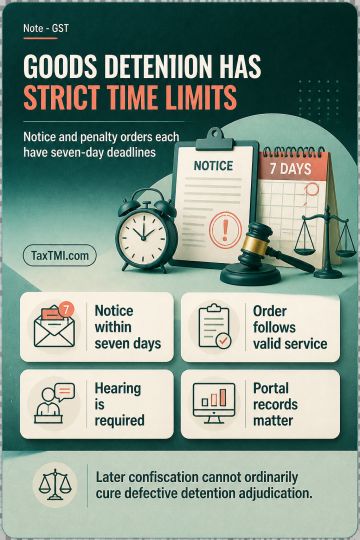
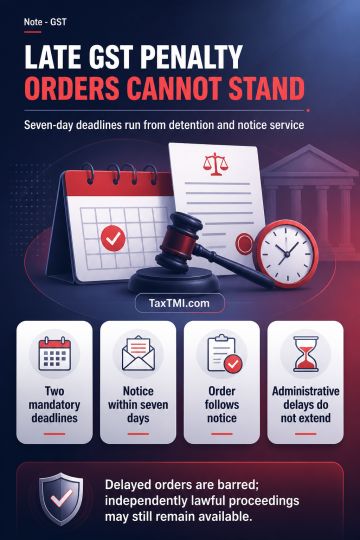
The time-bound command in Section 129(3) is central. It provides: "The proper officer detaining or seizing goods or conveyance shall issue a notice within seven days of such detention or seizure, specifying the penalty payable, and thereafter, pass an order within a period of seven days from the date of service of such notice, for payment of penalty under clause (a) or clause (b) of sub-section (1)."
The provision thus imposes two independent obligations. The first relates to commencement of the penalty process after detention or seizure. The second regulates final determination after the affected person has been served with the notice. The second period is not measured from detention, interception, reply, valuation exercise or any intervening event; it is measured from service of the notice.
Section 129(4) reinforces procedural fairness: "No penalty shall be determined under sub-section (3) without giving the person concerned an opportunity of being heard." Section 129(5) further provides that, upon payment of the amount referred to in sub-section (1), all proceedings in respect of the notice under sub-section (3) "shall be deemed to be concluded."
Where the penalty is not paid, Section 129(6) permits sale or other disposal of the detained goods or conveyance after fifteen days from receipt of the copy of the order under Section 129(3), subject to the stated qualifications for the conveyance and for perishable, hazardous or depreciating goods. The Rule 144A of the Central Goods and Services Tax Rules, 2017 lays down the associated procedure for inventory, auction, notice in FORM GST DRC-10, payment by the successful bidder and transfer of possession.
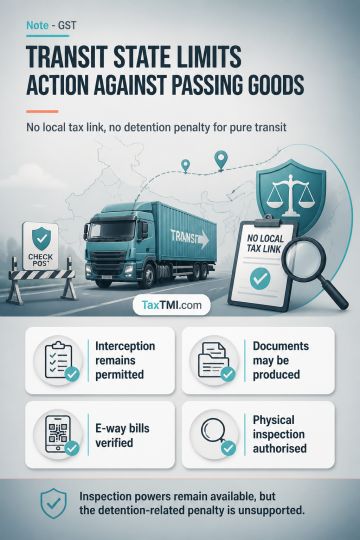
The detention framework is preceded by the inspection power under Section 68 of the Central Goods and Services Tax Act, 2017. On interception, the proper officer may require production of prescribed documents and devices and require inspection of goods. The person in charge is correspondingly obliged to produce them and permit inspection.
At the inspection stage, Rule 138C of the Central Goods and Services Tax Rules, 2017 requires a summary report in Part A of FORM GST EWB-03 within twenty-four hours and a final report in Part B within three days of inspection. The Commissioner or authorised officer may extend the latter period, on sufficient cause, by up to three days. These inspection timelines are distinct from, and do not dilute, the two statutory seven-day periods under Section 129(3).
The Court treated the word "shall" in Section 129(3) as materially significant. That conclusion, however, did not rest on language alone. The Court examined the context, object and consequences of the provision. Detention and seizure interfere directly with the taxpayer's ability to deal with goods and the transporter's use of the conveyance. The prescribed timeline accordingly regulates the exercise of coercive state power and protects valuable primary rights.
The absence of an express statutory consequence for delay was held not to be decisive. Whether a provision is mandatory depends on legislative intent, the nature of the power, the purpose of the procedure and the rights affected. Construing the deadline as merely directory would permit the very mischief the provision is designed to avoid: arbitrary or prolonged detention and seizure.
On the facts before the Court, the notice was served and the taxpayer filed its reply on that date. The outer limit for the order consequently fell on the seventh day from service. Since the penalty order was passed on the following day, it was beyond the statutory period. The Court held that the delay, though only of one day, vitiated the order.
The revenue authority attributed delay to circumstances arising from action by another regulatory body and the consequent need to segregate goods that could not be taxed as ordinary marketable goods. The Court accepted that these were intervening circumstances, but found that they did not permit departure from the express time limit. The officer remained obliged to finalise the Section 129 determination concerning the goods that continued to fall within the tax proceedings.
The point is one of statutory discipline. A court may distinguish between a procedural timeline intended to aid orderly administration and a timeline that restricts the duration of an ongoing coercive restraint. Section 129(3), as interpreted here, belongs to the latter category. Administrative convenience or unforeseen developments cannot enlarge the period in the absence of statutory authority.
In 2023 (1) TMI 1129 - MADRAS HIGH COURT, the notice was issued within seven days of detention, but the consequential penalty order was passed beyond seven days from service of that notice. The Court held that the clear mandate of Section 129(3) had been breached, quashed the detention and penalty orders, and directed release. This authority directly supports the proposition that compliance with the first seven-day period does not cure breach of the second.
In 2022 (9) TMI 314 - MADRAS HIGH COURT, the issue included the distinction between an inspection order in FORM GST MOV-02 and a formal detention order in FORM GST MOV-06. The Court held that an order requiring a vehicle to remain stationed for inspection cannot be equated with an order of detention. It further treated failure to issue the detention order and statutory notice within the prescribed time as a serious procedural defect that vitiated the proceedings. The ruling underscores that the statutory sequence cannot be reconstructed retrospectively by characterising inspection measures as detention.
In 2023 (1) TMI 378 - MADRAS HIGH COURT, the order under Section 129(3) was passed on the eighth day after service of notice. The Court held the order time-barred and invalid. It also rejected the proposition that a taxpayer's earlier withdrawal of a challenge or an opportunity to reply could amount to waiver of the statutory time limit. The obligation is imposed on the officer by statute and is not displaced by the taxpayer's procedural conduct.
In 2025 (10) TMI 1341 - GUJARAT HIGH COURT, the authority neither issued the Section 129(3) penalty notice within seven days of detention nor passed the consequential penalty order. A later notice under the confiscation provision did not cure the lapse. The detention order was quashed, although the authority's ability to pursue the separately initiated confiscation proceeding in accordance with law was preserved. This distinction is consistent with the present ruling, which also leaves open proceedings otherwise permissible under the Act.
In 2025 (12) TMI 1732 - GUJARAT HIGH COURT, the Court held that an order in FORM GST MOV-09 passed beyond seven days from the MOV-07 notice was unsustainable. The detention order, notice and final order were set aside on that sole ground. This illustrates that where breach of Section 129(3) is admitted, a court need not adjudicate other objections to the demand.
In 2026 (9) TMI 1196 - JAMMU AND KASHMIR AND LADAKH HIGH COURT, the defect concerned the first limb of Section 129(3): the notice itself was issued beyond seven days from detention. The Court held that even one day's delay vitiated the detention-and-penalty proceedings. The authority therefore confirms that each of the two seven-day obligations has independent mandatory force.
In 2019 (3) TMI 541 - GUJARAT HIGH COURT, the Court, at the interim stage, found a prima facie failure to follow the notice-and-hearing procedure under Section 129 before initiating confiscation proceedings. Given the procedural lapse and the nature of the goods, release was directed subject to an undertaking. While the decision arose in a different procedural setting, it demonstrates the importance attached to prior compliance with Section 129 safeguards before more serious coercive consequences are pursued.
In 2017 (9) TMI 1566 - Supreme Court, the Court held that certain timelines for rectification of defects and for an adjudicating authority to decide an insolvency application were directory. The reasoning turned on the procedural, pre-adjudicatory character of the particular deadlines and the risk that a rigid construction would defeat merits-based adjudication.
That authority provides the general interpretive principle that "shall" is not invariably conclusive. It does not, however, displace the Section 129(3) analysis. The present ruling distinguishes the nature of the power and the interest affected: Section 129(3) governs continuation and culmination of detention or seizure, not merely removal of filing defects. The statutory purpose is to prevent prolonged deprivation of goods and conveyances. Context therefore supports a mandatory construction.
Circular No. 41/15/2018-GST outlines the interception process through the GST MOV forms. It contemplates FORM GST MOV-02 for physical verification, FORM GST MOV-06 for detention, and a notice under Section 129(3) in FORM GST MOV-07. It also requires priority in finalising proceedings where release is obtained upon security. Circular No. 49/23/2018-GST clarifies that the inspection period is "three days", not "three working days", and states that detention or confiscation should concern only goods or conveyances in respect of which a violation is established.
These administrative instructions aid orderly implementation, but they cannot relax the operative command of Section 129(3). Where the statutory provision requires notice within seven days of detention or seizure and an order within seven days of service of notice, the prescribed forms and internal procedure must be administered consistently with that mandate.
Section 129(3) imposes a mandatory statutory timetable on detention-and-penalty proceedings. The proper officer must issue the notice specifying penalty within seven days of detention or seizure and must pass the penalty order within seven days of service of that notice. The time limit applies to the final order under Section 129(1)(a) or (b), and its breach vitiates the order even where the delay is minimal.
The mandatory character of the provision flows from its function: it restrains the duration of coercive executive action affecting goods, conveyances and commercial rights. The absence of an express statutory consequence, the complexity of intervening events, or a departmental explanation for delay does not convert the deadline into a directory one.
At the same time, quashing a time-barred order under Section 129 does not amount to a determination that no other proceeding can be taken under the GST law. The legal consequence is narrower but important: enforcement under Section 129 must conform strictly to the statutory sequence, hearing requirement and seven-day deadlines prescribed by the legislature.
Full Text:

