Loading...

⚠ ✕
❮ Top
☎ Help
☰
×

By creating an account you can:

Logo TaxTMI
Call Us / Help / Feedback✕

Contact Us At :

✉ E-mail: [email protected]

✆ To Call / Whatsapp, Check Contact Us

FAQs :

To know Frequently Asked Questions, Check FAQs

Most Asked Video Tutorials :

For more tutorials, Check Video Tutorials

Submit Feedback/Suggestion :

Email :
Please provide your email address so we can follow up on your feedback.
Category :
Description :
Min 15 characters 0/2000
Make Most of Text Search ✕
  1. Checkout this video tutorial: How to search effectively on TaxTMI.
  2. Put words in double quotes for exact word search, eg: "income tax"
  3. Avoid noise words such as : 'and, of, the, a'
  4. Sort by Relevance to get the most relevant document.
  5. Press Enter to add multiple terms/multiple phrases, and then click on Search to Search.
  6. Text Search
  7. The system will try to fetch results that contains ALL your words.
  8. Once you add keywords, you'll see a new 'Search In' filter that makes your results even more precise.
  9. Text Search
╳
Add to...
You have not created any category. Kindly create one to bookmark this item!
✕
Create New Category
Hide
Title :
Description :
❮❮ Hide
❮ Default View
Expand ❯❯
Close ✕
🔎 Filters / Advanced Search ❯
TEXT

Press 'Enter' to add multiple search terms. Rules for Better Search

Search In
Main Text + AI Text ❯
  • Main Text
  • Main Text + AI Text
  • AI Text
Law:
---- All Laws---- ❯
  • ---- All Laws----
  • Benami Property
  • Bill
  • Central Excise
  • Companies Law
  • Customs
  • DGFT
  • FEMA
  • GST
  • GST - States
  • IBC
  • Income Tax
  • Indian Laws
  • Money Laundering
  • SEBI
  • SEZ
  • Service Tax
  • VAT / Sales Tax
Types:
---- All Types ---- ❯
  • ---- All Types ----
  • Act Rules
  • Case Laws
  • Circulars
  • Manuals
  • News
  • Notifications
Sort By: ?
In Sort By 'Default', exact matches for text search are shown at the top, followed by the remaining results in their regular order.
Relevance Default Date
☰   Show Results ❯
    Refund of Accumulated Input Tax Credit on Packing Materials under Section 54(3)(ii) of the CGST Act
    Detention of Goods in Transit: Consequences of Delay in Notice under Section 129(3)
    Case Laws Income Tax
    Section 192 TDS on Leave Travel Concession and the Effect of Subsisting Judicial Restraint
    Cross-Segment Price Manipulation in Stock Derivatives under the SEBI Act and PFUTP Regulations
    Case Laws Income Tax
    Enhanced Rate of Tax u/s 115BBE: Survey Surrenders of Excess Stock and Cash: Business Income, Deemed...
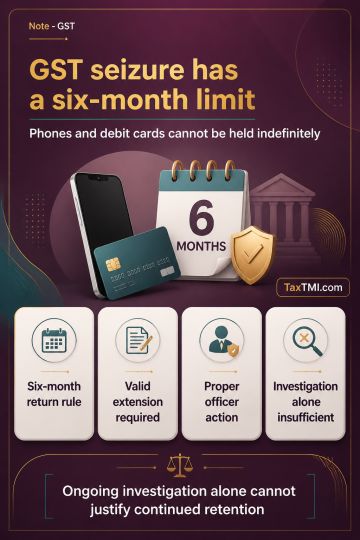
    Retention of Seized Mobile Phones and Bank Debit Cards Beyond the Section 67(7) Period
    Case Laws Customs
    Classification of Disposable Analytical Cartridges under Chapter 90 and Heading 3926
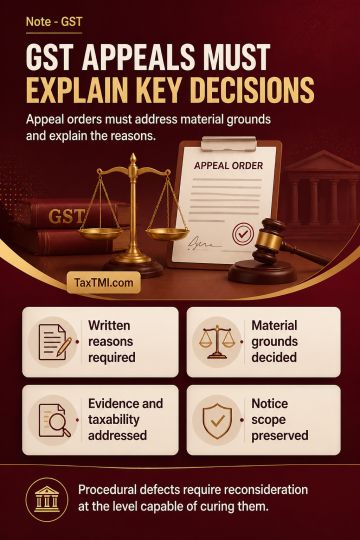
    Reasoned and Speaking Appellate Orders u/s 107 of the CGST Act: Duty to Decide Material Grounds of A...
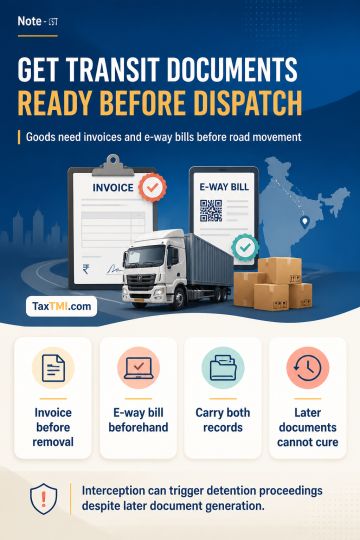
    Pre-Movement E-Way Bill Compliance and Section 129 Detention for Undocumented Goods in Transit
    Case Laws Income Tax
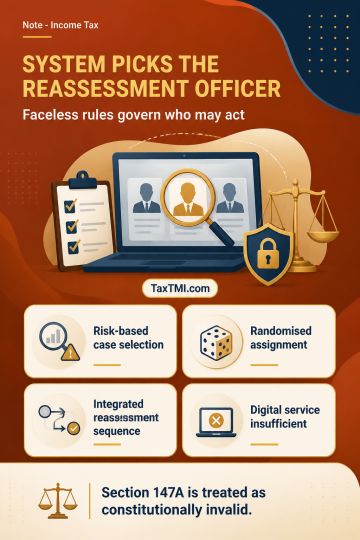
    Faceless Reassessment Jurisdiction: Retrospective Validation under Section 147A and Automated Alloca...
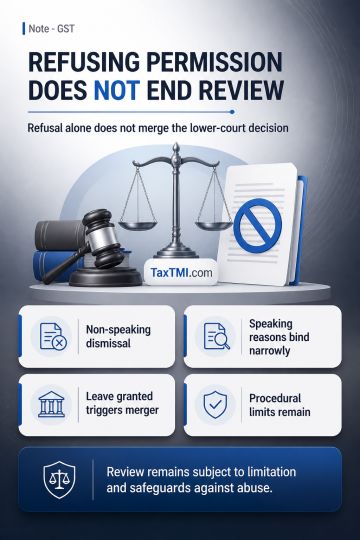
    Doctrine of Merger: Effect of Non-Speaking and Speaking Dismissal of Special Leave Petitions on Merg...
    Case Laws Indian Laws
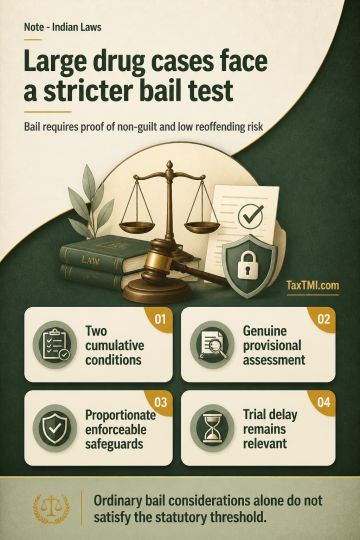
    Section 37 of the NDPS Act: Twin Conditions for Grant of Bail in Commercial Quantity Cases
    Case Laws Customs
    Pilferage of Imported Goods: Approval, Custody and Duty Liability under the Customs Act, 1962
    Case Laws Indian Laws
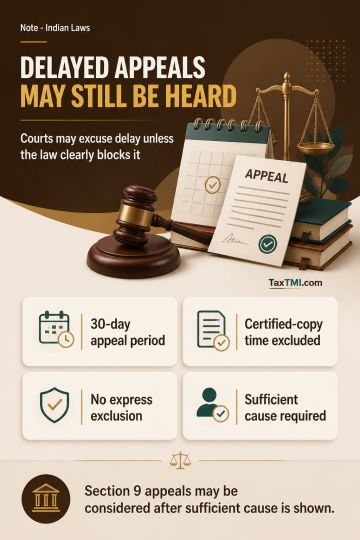
    Condonation of Delay in Statutory Appeals under Section 5 of the Limitation Act, 1963
    Case Laws Income Tax
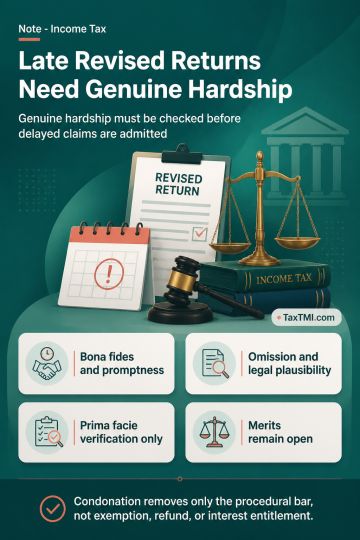
    Condonation of Delay for Filing Revised Returns under Section 119(2)(b): Genuine Hardship and Merits...
    Case Laws Income Tax
    TDS Credit Where the Deductor Defaults: Proof of Deduction Without Form 16 or Form 16A
    Case Laws Indian Laws
    Reserved High Court Judgments: Constitutional Timelines, Accountability and Litigant Remedies
    Price Depression in Securities Markets: Evidentiary Requirements under the PFUTP Regulations
    Case Laws Income Tax
    Foreign Leave Travel Concession and Tax Deduction at Source under Sections 10(5), 192 and 201
    Refund of Accumulated Input Tax Credit under Inverted Duty Structure: Section 54(3)(ii) and Rule 89(...
❮
❯
❯❯
Maximize Maximize Maximize
0 / 200
Expand Note
Add to Folder

No Folders have been created

+

Are you sure you want to delete "My most important" ?

NOTE:

Notes
Showing Results for :
Reset Filters
Results Found:
Show All Summaries Hide All Summaries
Case Laws GST
Show AI Summary
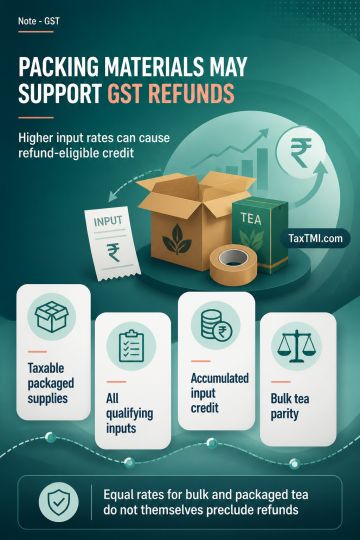
Packing-material input tax credit may support inverted-duty refunds when higher-rated inputs cause accumulation for taxable packaged supplies.
Refund of accumulated input tax credit under Section 54(3)(ii) may arise where packing materials used to make taxable packaged outward supplies bear a higher tax rate than the outward supply and generate the accumulation. The inquiry extends to all qualifying inputs and is not limited to a principal raw material. Parity between the rate on bulk tea and packaged tea does not itself preclude refund if higher-taxed packing materials used for the packaged supply are the cause of unutilised credit.
Case Laws GST
Show AI Summary
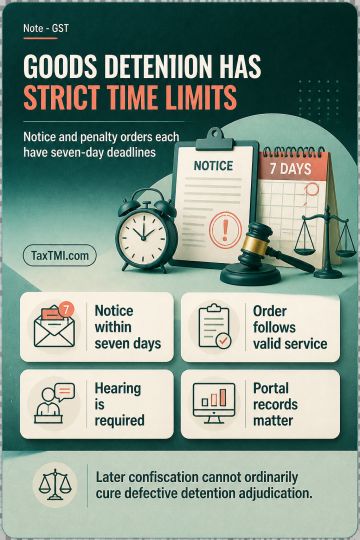
Mandatory detention timelines require timely notice, hearing and penalty order, preventing prolonged restraint of goods in transit.
Section 129(3) establishes a mandatory two-stage timeline: issuance of the penalty notice within seven days of formal detention or seizure, followed by a penalty order within seven days of legally effective service. The periods are independent, and compliance at one stage cannot cure delay at the other. Service, portal timestamps and the electronic records required under Rule 142 are material to chronology. Penalty requires a hearing, while payment under protest may still require a reasoned order to preserve appellate access. Later confiscation action cannot ordinarily cure a defective detention adjudication.
Case Laws Income Tax
Show AI Summary
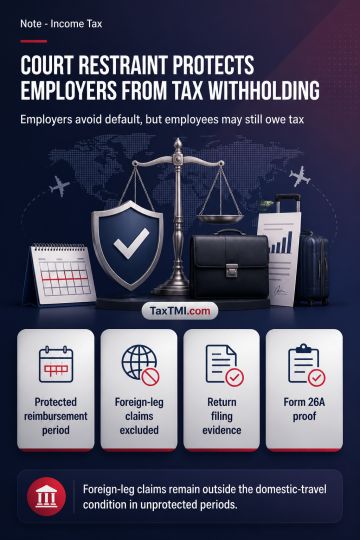
Subsisting judicial restraint on leave travel concession withholding prevents employer default while preserving employees' underlying tax liability.
A subsisting judicial restraint expressly prohibiting deduction from leave travel concession reimbursements governs the employer's withholding conduct for the covered period. Non-deduction in compliance with that restraint cannot constitute failure to discharge an enforceable duty under Sections 192 and 201, even if the underlying exemption claim is later found substantively unavailable. The restraint does not eliminate employee-level tax liability. For unprotected periods, foreign-leg or circuitous travel claims remain outside the domestic-travel condition, and payer protection may depend on proving employee return filing, income inclusion and tax payment through Form 26A.
Case Laws SEBI
Show AI Summary
Cross-segment price manipulation examines whether futures orders artificially influence option executions, engaging anti-fraud rules, director responsibility, and interim safeguards.
Cross-segment price manipulation may arise where aggressive futures orders alter the last traded price or visible order-book conditions so that larger, sentimentally opposite options orders obtain favourable execution. The relevant inquiry considers the integrated sequence of resting orders, aggressive executions, cancellations, timing, concentration, price impact and delta-adjusted exposure. Anti-fraud prohibitions cover manipulative devices, false appearances of trading and price manipulation, while opposite futures and options positions alone do not establish misconduct. Director liability requires responsibility for business conduct, or consent, connivance or neglect.
Case Laws Income Tax
Show AI Summary
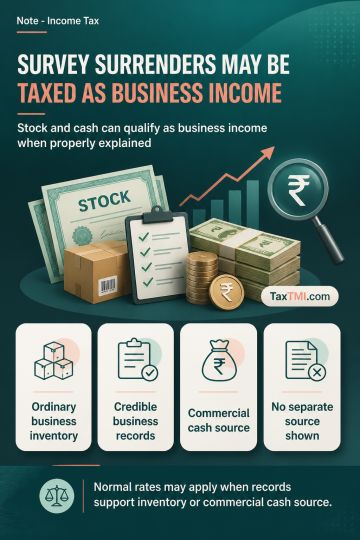
Survey surrender characterisation determines whether excess stock and cash are taxed as business income or under special deemed-income provisions.
The special regime in Section 115BBE is consequential: it applies only after the amount is properly brought within a specified deeming provision, and a survey surrender, book entry or return description cannot itself create that character. Mixed stock forming part of ordinary business inventory and credibly explained through business records may be assessed as business income at normal rates. Similarly, excess cash may be treated as business income where a commercial source is satisfactorily established and no separate or non-business source is shown.
Case Laws GST
Show AI Summary
Statutory limits on GST seizure require return of retained mobile phones and debit cards without a valid extension.
Section 67(7) establishes a six-month return rule where no notice in respect of seized goods is issued. Any further period requires sufficient cause, action by the proper officer, and a maximum further period of six months; ongoing investigation cannot replace an actual extension order. Although Section 67(7) uses "goods" while Section 67(2) also covers documents, books and things, its application to seized mobile phones and bank debit cards indicates that classification cannot be used to avoid the temporal restriction where articles are held under statutory seizure.
Case Laws Customs
Show AI Summary
Analytical cartridge classification follows functional integration and sole-use suitability, not plastic composition, disposability, or general consumable character.
STA micro-cuvettes containing an enclosed steel ball are assessed as complete functional components of a blood-coagulation analyser, rather than merely as plastic laboratory articles. Classification turns on their objective design, analytical role, exclusive or principal suitability and absence of practical general use. Chapter 90 Note 2 requires consideration of an independent specific heading first and then classification of other dedicated parts or accessories with the relevant instrument. Disposable or single-use status and plastic composition do not by themselves establish classification as residual plastic articles.
Case Laws GST
Show AI Summary
Speaking appellate orders require findings on material GST appeal grounds, ensuring fair hearings and meaningful higher review.
Section 107(12) requires a written appellate order identifying material points for determination, deciding them, and giving reasons. Formulaic confirmation of original assessment does not establish independent appellate consideration, particularly where jurisdiction, notice, evidence, quantification, taxability, section 74 conditions, interest, or penalty are contested. Sections 74 and 75 require a defined notice, disclosure of relied-upon material, effective hearing, and reasoned determination within the notice's scope. Where procedural defects arise at the original stage as well as on appeal, reconsideration must occur at the level capable of curing the foundational defect without expanding the show-cause case.
Case Laws GST
Show AI Summary
Pre-movement e-way bill compliance requires invoices and transport records before dispatch, while later documents cannot cure undocumented transit.
Pre-movement e-way bill compliance requires issuance of an invoice at or before removal, generation of the e-way bill before road movement, and carriage of both records during transit. Where goods are intercepted without either record, the contravention arises upon commencement of undocumented movement; documents generated only after interception cannot retrospectively establish compliance. Such documents may still be considered with other contemporaneous evidence when assessing bona fides or alleged intent to evade tax. Section 129 detention proceedings remain subject to notice, hearing, electronic-summary and statutory-timeline requirements.
Case Laws Income Tax
Show AI Summary
Automated allocation in reassessment determines officer jurisdiction, while retrospective validation cannot bypass continuing faceless-scheme requirements.
Section 151A and the e-Assessment of Income Escaping Assessment Scheme, 2022 require covered reassessment functions and section 148 notice issuance through automated allocation. Risk-based selection of cases is distinct from randomised allocation of the officer authorised to act. Sections 148A and 148 form an integrated reassessment sequence, so general concurrent jurisdiction, administrative instructions or digital service cannot substitute for the prescribed faceless allocation. Section 147A did not amend the continuing statutory and scheme-based allocation requirements and is treated as constitutionally invalid.
Case Laws GST
Show AI Summary
Doctrine of merger distinguishes refusal of special leave from appellate disposal, preserving review subject to independent procedural limits.
Under Article 136, a refusal of special leave remains a discretionary leave-stage determination. A non-speaking dismissal does not merge the challenged lower-court decision into a Supreme Court order, affirm its reasoning, or automatically create res judicata. A speaking refusal may bind only as to legal propositions expressly declared under Article 141, without producing merger. Merger arises when leave is granted and appellate jurisdiction is exercised. Review, writ, and remanded proceedings remain subject to independent procedural requirements, including limitation and safeguards against abuse.
Case Laws Indian Laws
Show AI Summary
NDPS commercial-quantity bail requires independent proof of non-guilt and low reoffending risk alongside proportionate safeguards.
Section 37 of the NDPS Act imposes cumulative bail conditions in commercial-quantity cases: the court must find reasonable grounds to believe the accused is not guilty and unlikely to reoffend while on bail. These requirements supplement ordinary bail factors and demand a genuine, provisional assessment of credible material. Personal liberty and trial delay remain relevant, but must be reconciled with the statutory threshold. Bail conditions, including verification safeguards for foreign nationals, must be proportionate, genuine and capable of enforcement.
Case Laws Customs
Show AI Summary
Approved customs custodians bear duty for proven pilferage during custody, but not for losses before their approval takes effect.
Customs-duty liability for pilfered imported goods arises only where pilferage occurs after unloading in a customs area while goods are held by an approved custodian. Approval is indispensable; factual control or statutory custody alone does not impose this liability for a period before approval. Importer duty exemption for pre-clearance pilferage operates alongside the custodian's revenue liability. Pilferage must be proved through contemporaneous records and cannot be presumed from every cargo discrepancy, shortage, or loss.
Case Laws Indian Laws
Show AI Summary
Condonation of delay under Section 5 remains available in special statutory appeals unless the governing scheme clearly excludes it.
Section 5 of the Limitation Act, 1963 applies to a special statutory appeal through Section 29(2) unless the governing enactment excludes it expressly or by necessary implication. A special limitation period alone is insufficient to exclude condonation. Restrictive language, a defined maximum condonable period, or a complete statutory limitation code may create a non-extendable outer limit. Section 9 of the Chhattisgarh Rajya Suraksha Adhiniyam contains a 30-day appeal period and excludes certified-copy time, but lacks an express bar or outer condonation ceiling; delay may therefore be considered upon proof of sufficient cause.
Case Laws Income Tax
Show AI Summary
Genuine hardship in delayed revised-return claims requires prima facie verification without converting condonation into final tax adjudication.
Section 119(2)(b) may permit admission of a delayed revised-return claim where expiry of the Section 139(5) period causes genuine hardship. Condonation removes only the procedural bar and does not establish exemption, refund, or interest entitlement. Genuine hardship requires assessment of bona fides, the nature of the omission, promptness after discovery, legal plausibility, and the consequence of refusal. Circular No. 9/2015 permits prima facie verification and inquiry, but substantive taxability and refund entitlement remain for merits examination.
Case Laws Income Tax
Show AI Summary
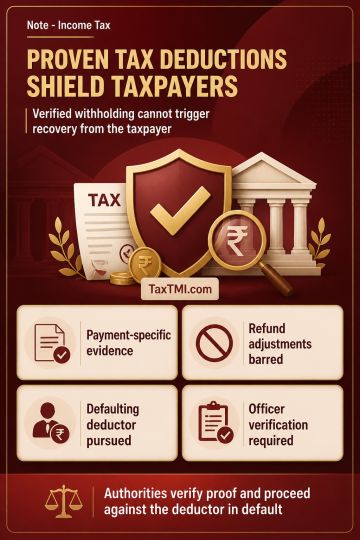
TDS credit after verified deduction protects taxpayers from demands and refund adjustments caused by deductor default.
TDS credit in domestic deductor-default cases depends on verified actual deduction from the taxpayer's income, not solely on deposit, TDS statements, Form 16 or Form 16A, or Form 26AS reflection. Section 205 bars direct or indirect recovery, including refund adjustment, to the extent tax was deducted. The taxpayer must provide reliable payment-specific evidence, and the Assessing Officer must verify the claim while the Department proceeds against the defaulting deductor.
Case Laws Indian Laws
Show AI Summary
Timely reserved judgments: a three-month framework, transparency, and staged remedies protect liberty and require reasoned decisions.
Reserved High Court judgments are subject to a three-month framework for a reasoned pronouncement, supported by monthly monitoring, status disclosures, date-recorded certified copies, and automated notice to advocates. Urgent matters may receive an operative-part pronouncement, but reasons must be uploaded within seven days or, where practical difficulties exist, within fifteen days. Parties may seek early pronouncement after the specified period and, after further delay, request withdrawal and assignment for a fresh hearing.
Case Laws SEBI
Show AI Summary
Settlement-price depression allegations require cogent proof of manipulation, not merely short exposure, closing sales, or position-limit non-disclosure.
Settlement-price depression under the PFUTP framework requires cogent proof of a manipulative act, device, scheme or artifice, not merely a substantial short derivative position, closing-window sales, or an incentive to benefit from a lower settlement price. Position concentration and position-limit non-disclosure are distinct from PFUTP fraud. Sales below the last traded price require market-wide causal analysis of other trading activity, execution mechanics, benchmark methodology, commercial rationale, and actual price impact. A genuine hedge and agency-attributed exposure do not, without further proof, establish manipulation.
Case Laws Income Tax
Show AI Summary
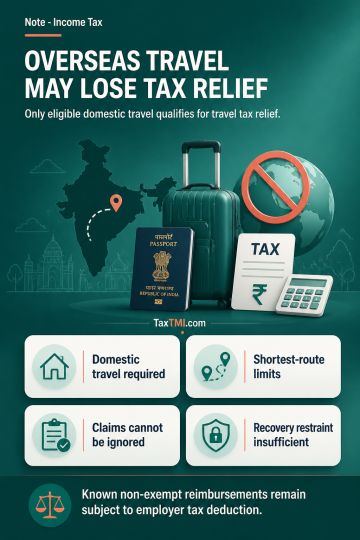
Foreign LTC tax exemption requires domestic travel; employers must deduct tax on known non-exempt travel reimbursements.
Foreign LTC/LFC payments for itineraries containing an overseas leg are outside the Section 10(5) exemption, which is confined to actual eligible domestic travel subject to Rule 2B shortest-route and fare conditions. Under Section 192, employers must include known non-exempt payments in estimated salary and deduct tax; they cannot disregard available claim records showing foreign or circuitous travel. A recovery restraint does not automatically suspend the deduction obligation. Section 201 recipient-compliance conditions, interest, and penalty based on reasonable cause require separate analysis.
Case Laws GST
Show AI Summary
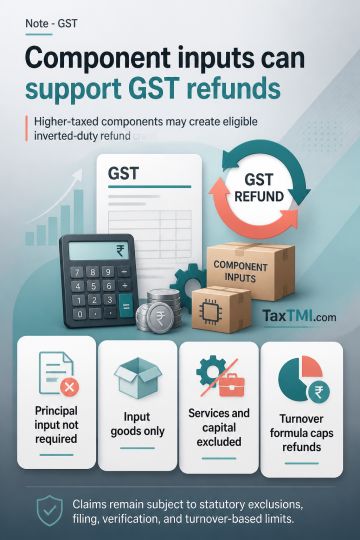
Inverted-duty GST refunds remain available where higher-taxed component inputs, rather than only principal inputs, cause accumulated eligible credit.
Refund of accumulated unutilised ITC under an inverted-duty structure depends on a causal link between higher-taxed input goods and lower-taxed output supplies. The test is not restricted to the principal raw material; higher-rated component inputs may support a claim despite parity between the principal input and output. Refund remains confined to credit on input goods, excluding input services and capital goods. Rule 89(5) separately determines the maximum refundable amount through its turnover-based formula, subject to statutory exclusions and prescribed filing and verification requirements.

TMI Notes

Back

All TMI Notes

Showing Results for :
Reset Filters
No Records Found

TMI Notes

Indirect Corporate Control and Related-Party Classification in the Corporate Insolvency Resolution Process

25 September, 2026

Contents
Acts
Plus +
Summary
Note

Note

-

Bookmark

(New) -

Download

Print

Print

This is a neutral professional article. The judgment is analysed in the context of its factual background, issues framed, and conclusions reached by the Court.

2026 (7) TMI 250 - NATIONAL COMPANY LAW APPELLATE TRIBUNAL PRINCIPAL BENCH, NEW DELHI

At a Glance

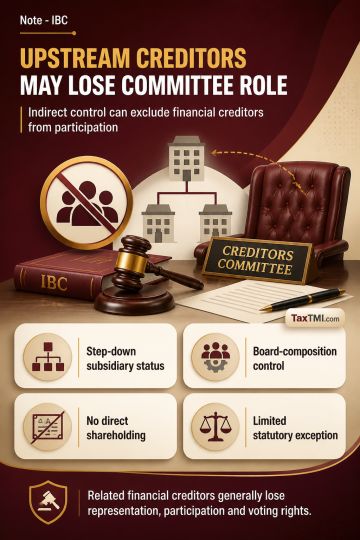
  • A body corporate may be a related party of a corporate debtor under Section 5(24)(i) of the Insolvency and Bankruptcy Code, 2016 even where it holds no shares directly in the corporate debtor.
  • The statutory inquiry is not confined to direct ownership. The subsidiary relationship recognised by Section 2(87) of the Companies Act, 2013 extends to control exercised through another subsidiary of the holding company.
  • Accordingly, a corporate debtor may be a step-down subsidiary of an upstream holding company. That relationship attracts Section 5(24)(i).
  • Board-composition control is an independent route to related-party status under Section 5(24)(l). Common beneficial ownership and a corporate structure evidencing control may be relevant to that inquiry.
  • A financial creditor which is a related party of the corporate debtor is excluded from representation, participation and voting in the Committee of Creditors under the first proviso to Section 21(2).

Background & Context

The related-party exclusion in the corporate insolvency resolution process is directed at preserving the independence of the Committee of Creditors. The first proviso to Section 21(2) of the IBC states that a financial creditor which "is a related party of the corporate debtor" shall not have any right of representation, participation or voting in a Committee of Creditors meeting, subject to the stated statutory exception for a regulated financial creditor whose related-party status arises solely from specified debt-to-equity events.

The issue becomes particularly significant in multi-layer corporate groups. A claimant may assert that it is neither a shareholder nor a direct holding company of the corporate debtor. That assertion, by itself, does not resolve the enquiry. The IBC incorporates company-law concepts of holding and subsidiary relationships, and therefore requires examination of the complete ownership and control chain.

In 2026 (7) TMI 250 - NATIONAL COMPANY LAW APPELLATE TRIBUNAL PRINCIPAL BENCH, NEW DELHI, the appellate tribunal considered whether an upstream entity, holding a majority interest in an intermediate entity which in turn held a majority interest in the corporate debtor, was a related party. The appellate tribunal held that the corporate debtor was the claimant's step-down subsidiary. It consequently upheld its classification as a related party under Section 5(24) of the IBC.

Key Issues / Provisions

Related party under the IBC

Section 5(24) of the IBC defines "related party", in relation to a corporate debtor. Two clauses were central to the determination:

  • Section 5(24)(i): "a body corporate which is a holding, subsidiary or an associate company of the corporate debtor, or a subsidiary of a holding company to which the corporate debtor is a subsidiary";
  • Section 5(24)(l): "any person who can control the composition of the board of directors or corresponding governing body of the corporate debtor".

The terms "holding company", "subsidiary" and "associate company" are not separately defined in the IBC. Section 3(37) of the IBC therefore applies: words and expressions used but not defined in the Code, and defined in the Companies Act, 2013, have the meanings assigned in that Act.

Holding company, subsidiary and indirect control

Section 2(46) of the Companies Act, 2013 defines a holding company as a company of which one or more other companies are subsidiary companies. Section 2(87) defines a subsidiary, in relation to its holding company, as a company in which the holding company either "controls the composition of the Board of Directors" or "exercises or controls more than one-half of the total voting power", either by itself or together with one or more subsidiaries.

Most importantly, Explanation (a) to Section 2(87) provides that a company is deemed to be a subsidiary of a holding company even where the requisite control is exercised "by another subsidiary company of the holding company". The statutory language expressly accommodates a layered corporate structure; it does not insist upon direct shareholding by the ultimate holding company in the corporate debtor.

Section 2(6) defines an associate company as one in which another company has significant influence but which is not its subsidiary. "Significant influence" means control of at least twenty per cent of total voting power, or control of or participation in business decisions under an agreement. Further, Section 2(27) provides that "control" includes the right to appoint a majority of directors or to control management or policy decisions, directly or indirectly, including through shareholding, management rights, shareholders' agreements, voting agreements or otherwise.

Detailed Analysis

Step-down subsidiary status is sufficient under Section 5(24)(i)

The appellate tribunal's principal conclusion was founded on the interlocking operation of Section 5(24)(i) of the IBC and Section 2(87) of the Companies Act. The claimant held 63% of an intermediate company, and that intermediate company held 51.2% of the corporate debtor. The tribunal held that the intermediate company was a subsidiary of the claimant and that the claimant, through that subsidiary, controlled the corporate debtor.

The absence of direct shareholding in the corporate debtor did not assist the claimant. Explanation (a) to Section 2(87) deems a company to be a subsidiary even if the relevant control is exercised through another subsidiary of the holding company. The appellate tribunal therefore held that the corporate debtor was a step-down subsidiary and that the claimant was a related party within Section 5(24)(i). The conclusion was not dependent upon treating the claimant merely as an associate company or on proving a separate factual case of significant influence.

This construction gives operative content to the phrase in Section 5(24)(i), "a subsidiary of a holding company to which the corporate debtor is a subsidiary". It also prevents the related-party exclusion from being defeated merely because control is arranged through one or more intermediate entities.

Board control remains an independent statutory basis

The appellate tribunal also found no error in treating the claimant as a related party under Section 5(24)(l). The relevant corporate chart showed a common beneficial owner across the entities in the ownership chain. The tribunal considered that this structure supported the conclusion that control over the boards of the group entities, including the corporate debtor, could be exercised through the chain.

The Section 5(24)(l) test is framed in terms of capacity: whether a person "can control the composition" of the board. It is therefore distinct from, and may coexist with, the holding-subsidiary test under Section 5(24)(i). In an appropriate case, evidence concerning appointment rights, removal rights, voting arrangements, management rights and the corporate chain may establish this capacity even if direct shareholding in the corporate debtor is absent.

The approach is consistent with 2022 (7) TMI 661 - NATIONAL COMPANY LAW APPELLATE TRIBUNAL, PRINCIPAL BENCH, NEW DELHI. That decision examined contractual and governance rights and held that being in a position to exercise positive control over management or policy decisions could attract related-party status. Actual exercise of the control was not treated as an indispensable requirement where the arrangements placed the person in a position to exercise it.

Control must be substantive, not merely formal

The inquiry remains one of statutory substance. 2018 (10) TMI 312 - Supreme Court, while considering control in a different IBC setting, describes control as positive and proactive control, whether de jure or de facto, over management or policy decisions. It distinguishes such control from mere negative or protective rights. The decision also recognises that corporate structures may be examined to identify the persons who, in substance, control or act in concert.

For the purpose of Section 5(24)(i), however, once the statutory subsidiary relationship is established through Section 2(87), the related-party conclusion follows from the statutory relationship itself. A separate factual contest over every instance of management intervention is not necessary. Section 5(24)(l) may nevertheless provide an additional and independent basis where board-composition control is demonstrable.

Relevant point of time and past regulatory supervision

The appellate tribunal rejected the contention that a prior period during which the corporate debtor was under a revival or regulatory regime negated the upstream entity's related-party status. It held that control and shareholding before commencement of the CIRP are relevant to determination of related-party status. A past period of external supervision did not displace the admitted ownership structure preceding the CIRP.

2021 (2) TMI 91 - Supreme Court provides the complementary principle that the related-party exclusion under Section 21(2) must be purposively applied to protect the creditor process from conflicts of interest. That authority recognises that a purported alteration of status cannot be used as a commercial contrivance to defeat the exclusion where the debt originated during a related-party relationship. The primary enquiry in a holding-company case remains the applicable statutory category and the factual corporate relationship; however, the CoC process must not be permitted to be manipulated through artificial restructuring.

The contrasting importance of evidence of continuing relationship

2023 (11) TMI 173 - NATIONAL COMPANY LAW APPELLATE TRIBUNAL, PRINCIPAL BENCH, NEW DELHI - LB illustrates that related-party classification is evidence-sensitive. In that matter, the tribunal upheld exclusion where the claimant's own claim form and corporate records continued to reflect related-party status, and the asserted share transfer had not been implemented or recorded. Conversely, it found that another entity could not be excluded merely on an alleged historical relationship where the record did not establish a continuing disqualifying relationship at the relevant point.

The practical lesson is that a bare assertion of separation from the corporate debtor will not suffice. Share registers, filings, claim forms, board rights, voting rights, agreements and the implementation of any alleged transfer or restructuring must be examined. In the case of an upstream holding entity, the statutory effect of the ownership chain must receive particular attention.

Practical Implications

  • Resolution professionals should obtain a complete group structure chart, identify direct and indirect voting rights, and trace each intermediate entity between the claimant and the corporate debtor.
  • The analysis should expressly apply Explanation (a) to Section 2(87) where control is exercised through a subsidiary. A direct-shareholding-only test is legally inadequate.
  • Where Section 5(24)(l) is invoked, the record should identify the source of board-composition control, including appointment or removal rights, voting arrangements, constitutional documents and management agreements.
  • Claimants asserting independence should furnish reliable evidence that any asserted share transfer, resignation, relinquishment of rights or restructuring was completed and legally effective before the relevant stage.
  • The Committee of Creditors should record the basis for exclusion carefully. Since Section 21(2) removes representation, participation and voting rights, the classification has direct consequences for CoC constitution and voting shares.
  • An entity may remain entitled to pursue the adjudication of its claim despite related-party classification; the immediate consequence considered here is exclusion from CoC participation under the first proviso to Section 21(2).

Key Takeaways

  • Section 5(24)(i) expressly reaches group-company relationships and must be read with the Companies Act definitions imported through Section 3(37) of the IBC.
  • Under Section 2(87), subsidiary status can arise through control held by another subsidiary of the holding company. This is the statutory basis for recognising a step-down subsidiary relationship.
  • Direct ownership of shares in the corporate debtor is not a precondition for related-party status where indirect majority control through a subsidiary is established.
  • Section 5(24)(l) independently covers a person capable of controlling board composition; common beneficial ownership and governance rights may be relevant evidentiary circumstances.
  • The related-party exclusion in Section 21(2) protects the integrity of the Committee of Creditors by denying a related financial creditor representation, participation and voting rights.


Full Text:

2026 (7) TMI 250 - NATIONAL COMPANY LAW APPELLATE TRIBUNAL PRINCIPAL BENCH, NEW DELHI

Topics

Acts Income Tax