Just a moment...

Top
Help
×

By creating an account you can:

Logo TaxTMI
Call Us / Help / Feedback

Contact Us At :

E-mail: [email protected]

Call / WhatsApp at: +91 99117 96707

For more information, Check Contact Us

FAQs :

To know Frequently Asked Questions, Check FAQs

Most Asked Video Tutorials :

For more tutorials, Check Video Tutorials

Submit Feedback/Suggestion :

Email :
Please provide your email address so we can follow up on your feedback.
Category :
Description :
Min 15 characters 0/2000
Make Most of Text Search
  1. Checkout this video tutorial: How to search effectively on TaxTMI.
  2. Put words in double quotes for exact word search, eg: "income tax"
  3. Avoid noise words such as : 'and, of, the, a'
  4. Sort by Relevance to get the most relevant document.
  5. Press Enter to add multiple terms/multiple phrases, and then click on Search to Search.
  6. Text Search
  7. The system will try to fetch results that contains ALL your words.
  8. Once you add keywords, you'll see a new 'Search In' filter that makes your results even more precise.
  9. Text Search
Add to...
You have not created any category. Kindly create one to bookmark this item!
Create New Category
Hide
Title :
Description :
❮❮ Hide
Default View
Expand ❯❯
Close ✕
🔎 News - Adv. Search
TEXT SEARCH:

Press 'Enter' to add multiple search terms. Rules for Better Search

Search In:
Main Text + AI Text
  • Main Text
  • Main Text + AI Text
  • AI Text
Category: ?
Categorized by AI
---- All Categories ----
  • ---- All Categories ----
  • Income Tax
  • GST
  • Customs, DGFT & SEZ
  • FEMA & RBI
  • Corp. Laws, SEBI & IBC
  • PMLA, Black Money & ED
  • Budget
  • News and Press Release
  • PTI News
Month:
---- All Months ----
  • ---- All Months ----
  • January
  • February
  • March
  • April
  • May
  • June
  • July
  • August
  • September
  • October
  • November
  • December
Year:
---- All Years ----
  • ---- All Years ----
  • 2026
  • 2025
  • 2024
  • 2023
  • 2022
  • 2021
  • 2020
  • 2019
  • 2018
  • 2017
  • 2016
  • 2015
  • 2014
  • 2013
  • 2012
  • 2011
Sort By: ?
In Sort By 'Default', exact matches for text search are shown at the top, followed by the remaining results in their regular order.
Relevance Default Date
    Economy shows resilience to global headwinds with buoyant domestic demand: RBI bulletin
    Goyal promises BIS certification relief for high-tech sector firms
    IICA Conducts inaugural session of 11th Batch of its Certified CSR Professional Programme
    Net Profit of Regional Rural Banks (RRBs) Rises to Record ₹10,176 Crore, Total Business Cross ₹13.5 Lakh Crore in FY 2025-26
    UP Cong chief writes to PM Modi on ethanol policy, sugar prices
    Economy shows notable resilience despite global headwinds: RBI bulletin
    Sugar prices rise by nearly Re 1 per kg to about Rs 64
    Trump says he's considering renaming Lake Ontario as 'Lake America' as trade war with escalates
    Flash Report on Central Sector Infrastructure Projects worth ₹150 crore and above
    HP minister warns orchardists against spurious PGRs sold in open market
    NEWS HIGHLIGHTS
    AERA cuts user development fee for domestic, int'l passengers at Hyderabad airport
    Rupee rises 24 paise to close at 95.46 against US dollar
    India pivots to US for LPG, LNG as West Asia crisis disrupts Gulf supplies
    Experts Call for Intelligence-Led Action to Break Cross-Border Illicit Trade Networks at ASIA Security Conference 2026
    How NRIs Can Structure Bank Accounts in India When They Have Both Indian and Overseas Financial Commitments
    Sugar ex-mill prices down 18 pc to Rs 55/kg after import move, curbs on hoarding: Food secretary
    SBI eyes USD 10 bln from NRIs, foreign investors ahead of RBI swap window closure
    Industrial power tariff hike: WBSEDCL says proposed rise capped to DVC area, rates still competitive
    India-Japan Investment Partnership Gains Momentum; Commerce and Industry Minister Shri Piyush Goyal Invites Greater Japanese Institutional Capital
❯❯
Maximize Maximize Maximize
0 / 200
Expand Note
Add to Folder

No Folders have been created

+

Are you sure you want to delete "My most important" ?

NOTE:

News
Showing Results for :
Reset Filters
Results Found:
Show All Summaries Hide All Summaries
August 25, 2026
Show AI Summary
BIS certification exemptions may be structured for high-tech manufacturers to ensure timely equipment imports and support domestic manufacturing operations.
Mandatory Bureau of Indian Standards (BIS) certification requirements for equipment and components used by high-technology manufacturers may be addressed through a proposed exemption framework. Possible exemptions may be structured at the company, industry, product, project or bulk level to support timely availability of imported equipment, goods and services for manufacturing operations. The approach is directed at high-technology industries generally, particularly semiconductor and artificial intelligence sectors, while addressing delays associated with mandatory certification and complex procedures for specialised imported parts and equipment.
August 25, 2026
Show AI Summary
Corporate social responsibility should prioritise measurable community outcomes, transparency, capable implementing agencies, and strategic integration with sustainability objectives.
Corporate social responsibility should prioritise measurable community outcomes rather than expenditure alone. Effective CSR depends on community-responsive design, capable implementing agencies, rigorous monitoring, social audits, and transparent use of technology and data. Public sector enterprises may use thematic priorities, convergence with government programmes, and institutional collaboration to replace isolated interventions with strategic CSR. CSR capacity building encompasses legal and regulatory frameworks, governance, project planning, impact assessment, reporting, ESG and the Social Stock Exchange.
August 25, 2026
Show AI Summary
Regional rural bank performance highlights improved profitability, asset quality, priority-sector lending, financial inclusion, and digital banking expansion.
Regional Rural Banks achieved prescribed priority-sector lending targets and sub-targets, expanded financial inclusion through new Pradhan Mantri Jan Dhan Yojana accounts, and recorded improvement in profitability, asset quality, and credit-deposit ratio. Digital banking adoption is to be accelerated to improve operational efficiency, customer experience, and banking access in rural and remote areas. Sponsor Banks are expected to strengthen information-technology infrastructure and support increased area-specific credit flows and innovative lending.
August 25, 2026
Show AI Summary
Ethanol-blended fuel policy faces calls for consumer-focused review amid sugar supply pressures and older-vehicle compatibility concerns.
Consumer-focused review of the ethanol-blended fuel policy is sought because higher ethanol diversion may affect domestic sugar availability and prices, potentially requiring sugar imports that could reduce claimed foreign-exchange savings from lower petroleum imports. The review should address ethanol and sugar production, domestic prices, imports, and consumer, environmental and economic concerns. Availability of lower-blend fuel alongside E20 is advocated for owners of older vehicles, with consumer choice between E10 and E20 supporting a comprehensive reassessment.
August 25, 2026
Show AI Summary
Economic resilience remains supported by domestic demand, manufacturing, liquidity and capital inflows despite external trade and geopolitical risks.
Economic resilience is attributed to buoyant domestic demand, sustained manufacturing and services activity, and double-digit merchandise trade growth. Improved southwest monsoon conditions supported kharif sowing and partly reduced agricultural risks, although geopolitical frictions and fresh United States tariffs remained external risks. Supply-side pressures raised consumer price inflation, while stable core inflation indicated limited cost pass-through. Easing liquidity, credit growth, investment activity and rebounding foreign capital inflows supported financial and external-sector conditions.
August 25, 2026
Show AI Summary
Sugar price controls combine raw sugar imports, stockholding limits, and export restrictions to curb retail inflation.
Sugar market intervention combines permitted imports of raw sugar, stockholding limits for dealers and bulk consumers, and an existing export ban to address sharp increases in retail and wholesale prices. Limits on inventories held by trade participants and large industrial consumers are intended to curb speculation and hoarding. Although ex-mill rates declined after the import decision and anti-hoarding measures, the reduction had not yet translated fully into retail prices. The measures seek to supplement domestic availability and restrain practices that may intensify consumer-price increases.
August 25, 2026
Show AI Summary
Tariff escalation drives retaliatory planning, industry protection measures, supply-chain uncertainty, and proposed symbolic geographic renaming amid cross-border trade tensions.
United States-Canada trade tensions have intensified after tariffs were imposed on Canadian goods following unsuccessful bilateral talks. Canada is expected to pursue retaliatory measures, potentially using targeted action to protect workers and businesses rather than matching tariffs directly. Further tariff threats concern vehicles, auto parts and steel. Integrated cross-border supply chains in automotive, energy, agriculture and manufacturing face increased costs and consumer-price uncertainty. Consideration of renaming Lake Ontario as "Lake America" has also been linked to the escalating dispute.
August 25, 2026
Show AI Summary
Central infrastructure monitoring through PAIMANA-PROJ tracks implementation progress, sectoral priorities, completed works, and integration of newly monitored projects.
PAIMANA-PROJ monitors Central Sector infrastructure projects costing Rs. 150 crore and above across 17 Ministries and Departments. As of July 2026, 1,775 projects with a revised cost of Rs. 37.11 lakh crore were under monitoring, with cumulative expenditure of Rs. 19.26 lakh crore. Transport and Logistics formed the largest monitored sector, followed by Energy. The portfolio included mega and major projects at varying physical and financial completion stages. PAIMANA-CRIP serves as the central infrastructure-project data repository, with most data updated through APIs.
August 25, 2026
Show AI Summary
Plant growth regulator quality controls require farmer awareness, licensed sales, quarantine compliance, and protection against uncertified orchard inputs.
Plant Growth Regulator quality control seeks to protect farmers and orchardists from spurious products sold in the open market. Licensed pesticide and fungicide outlets receive application schedules, while farmer awareness is stressed due to purchases of cheaper PGRs that may not achieve expected results. Rootstock imports require quarantine clearance, and uncertified rootstock purchased from the market is associated with disease spread in orchards. Regulatory measures include direct departmental sale of branded chemicals, promotion of weather-based crop insurance, and demands concerning minimum support pricing and Market Intervention Scheme documentation.
August 25, 2026
Show AI Summary
Anti-conversion compliance prompts voluntary prayer declarations, alongside food-safety oversight and enforcement against demolition, liquor, and cyber-fraud allegations.
Maharashtra's anti-conversion law has commenced, and churches across the Mumbai Metropolitan Region have sought written self-declarations confirming voluntary prayer attendance without pressure. Food-safety oversight requires cleaning of cricket association eateries before a further inspection. Enforcement matters include investigation into unauthorised shop demolitions allegedly involving misuse of a municipal corporation's name, arrests connected with spurious-liquor manufacture, and a cyber-fraud network allegedly using mule accounts to launder proceeds. A retired High Court judge has been appointed as Lokayukta.
August 25, 2026
Show AI Summary
User development fee rationalisation reduces departure charges and links airport cost recovery to commissioned capital projects during the tariff cycle.
Airport tariff regulation for Hyderabad airport fixes reduced User Development Fee for departing domestic and international passengers from 1 September 2026 through 31 March 2031, with rationalised landing charges. The tariff determination applies the incremental Aggregate Revenue Requirement framework, linking airport-charge cost recovery to completion, commissioning and use of identified high-value capital expenditure projects. A variable tariff plan provides landing-charge incentives upon prescribed qualifying conditions, supporting traffic development and route expansion while requiring cost-reflective, transparent and non-discriminatory aeronautical tariffs.
August 25, 2026
Show AI Summary
Rupee appreciation reflects weaker dollar, lower crude prices, positive equities, and foreign-exchange inflows through swap facilities.
Foreign-exchange market conditions supported the rupee's appreciation against the US dollar, driven by positive domestic equity markets, a weaker dollar, and declining crude-oil prices. The USD/INR pair remained within a narrow range, with oil-price movements and potential central-bank intervention identified as near-term determinants. A special USD-INR foreign-exchange swap facility covering FCNR(B) deposits, overseas foreign-currency borrowings and external commercial borrowings had mobilised foreign-exchange inflows relevant to currency liquidity.
August 25, 2026
Show AI Summary
Energy supply diversification reshapes India's LPG, LNG and crude sourcing amid constrained Gulf availability and higher logistics costs.
India's energy-import sourcing has shifted towards supply diversification as disruption in the Strait of Hormuz constrained traditional Gulf supplies. United States cargoes have become particularly important for LPG and LNG, while procurement has also broadened to Atlantic Basin and other non-traditional suppliers. Diversification increases costs through longer voyages, higher freight, insurance expenses, tighter availability and higher commodity prices, reflecting a premium for supply security. Crude sourcing continues to rely principally on Russia, alongside resilient UAE flows and increased Venezuelan heavy crude imports.
August 25, 2026
Show AI Summary
Intelligence-led enforcement against illicit trade requires coordinated data-sharing, risk profiling, digital accountability and disruption of organised supply networks.
Cross-border illicit trade enforcement should move beyond isolated seizures to intelligence-led disruption of organised criminal networks. Risk-based profiling, predictive analytics, container scanning and shipment-data analysis should support targeted action against misdeclaration, port-hopping, concealment and digital distribution. Right holders should share specific intelligence with customs targeting mechanisms, and goods entering Domestic Tariff Areas from warehousing and special economic zones require enhanced examination. Digital enforcement should trace suppliers, financial flows, data trails and small-parcel movements, supported by coordinated feedback between online marketplaces, police and customs.
August 25, 2026
Show AI Summary
NRI banking account segregation aligns overseas earnings, domestic income, foreign-currency savings, remittances, and borrowing with cross-border commitments.
NRI banking arrangements require segregation of overseas earnings, India-sourced income, savings, remittances and expenditure after residential status changes. An NRE account holds overseas income remitted to India, with interest exempt from income tax in India. An NRO account is intended for Indian income, including rent, dividends and pension, while FCNR deposits retain funds in a chosen foreign currency. A structured arrangement can align these accounts with domestic obligations, overseas spending, remittances, investments and compliant digital banking access.
August 25, 2026
Show AI Summary
Sugar import authorisation and anti-hoarding controls aim to moderate ex-mill prices amid adequate domestic stocks.
Raw sugar imports were permitted, while stock limits were imposed on bulk consumers. States were directed to strengthen inspections, and nationwide flying squads were deployed to identify hoarding and speculative conduct. These measures target sugar availability and distribution across wholesale and retail channels. Ex-mill prices declined following the measures, although wholesale and retail prices had not yet reflected the reduction.
August 25, 2026
Show AI Summary
Foreign-currency swap window closure focuses non-resident deposit mobilisation, while ECB hedging support continues for public-sector borrowers.
RBI's concessional Foreign Currency Non-Resident Bank deposit swap window closes on August 31, replacing the previous September 30 cut-off. Separately, the special US dollar-rupee foreign-exchange swap window remains available until December 31, 2026, providing concessional currency-hedging support to public sector undertakings raising external commercial borrowings. SBI expects to mobilise predominantly through deposits from non-resident Indians and foreign investors, with external commercial borrowings also visible.
August 25, 2026
Show AI Summary
Industrial power tariff revision applies only within the shared distribution area, while steel producers seek rollback and fuel supply support.
Industrial electricity tariff revision is proposed from 1 September for 33 KV and 11 KV consumers within the Damodar Valley Corporation command area. The increase is confined to the shared distribution-licence area, while a separate and higher tariff structure applies outside it. Steel and sponge-iron industry associations oppose the revision on the basis that it will raise energy costs and affect investment conditions. They seek withdrawal of the increase and request continuing supplies of high-grade coal and iron ore for sponge-iron production.
August 25, 2026
Show AI Summary
Institutional capital facilitation prioritises repatriation, market access, regulatory predictability, and cross-border partnerships supporting technology-led long-term investment.
India-Japan investment engagement focuses on increasing long-term Japanese institutional capital flows through an enabling business environment, intellectual property protection, policy reforms and integration with global value chains. Facilitation measures include simpler profit repatriation processes, improved access to Indian capital markets, greater regulatory predictability and a seamless cross-border investment environment. GIFT City is explored as a gateway for international capital and Japan-India investment flows.

News

Back

All News

Showing Results for :
Reset Filters
No Records Found

News

Showing Results for : Reset Filters
News and Press Release

Flash Report on Central Sector Infrastructure Projects worth ₹150 crore and above

August 25, 2026

Contents
Summary
Note

Note

-

Bookmark

Print

Print

PAIMANA Portal tracks 1,775 Infrastructure Projects worth ₹37.11 lakh crore as of July 2026

The Ministry of Statistics and Programme Implementation (MoSPI) continues to strengthen monitoring of Central Sector infrastructure projects through its PAIMANA platform, enabling improved tracking, timely reviews, and data-driven decision-making across Ministries. The portal tracks 1,775 Infrastructure Projects worth of ₹37.11 lakh crore as of July 2026.

Key Highlights

  • As of July 2026, 1,775 ongoing infrastructure projects, with a total revised cost of ₹37.11 lakh crore, are being monitored across 17 Central Ministries/Departments. The cumulative expenditure incurred on these projects stands at ₹19.26 lakh crore, accounting for approximately 51.91 per cent of the revised project cost, indicating steady progress in project implementation.
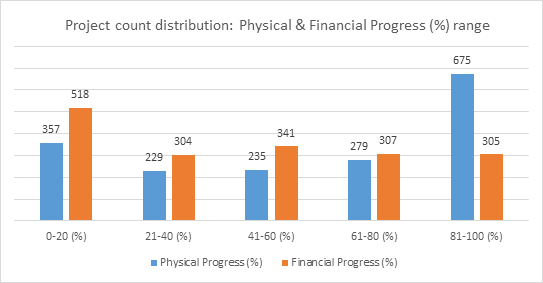
  • A significant proportion of projects are at advanced stages, with 675 projects (~38%) achieving over 80% physical progress, while 305 (~17%) have crossed 80% financial completion. The data also reflects a balanced pipeline, with projects distributed across early and advanced stages of implementation.
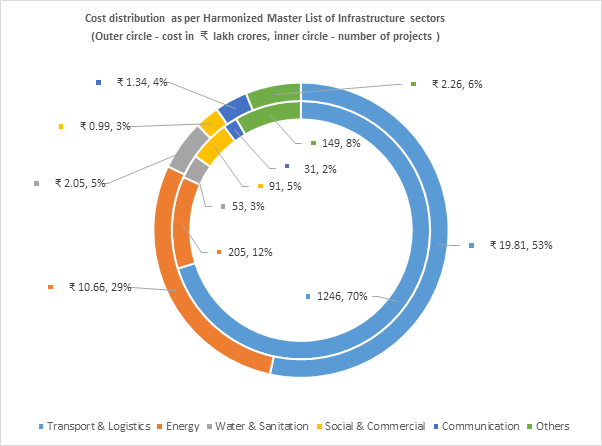
  • The Transport & Logistics sector (as per the DEA’s Harmonized Master List) accounts for the highest number of ongoing projects (1246 projects), with revised estimates of ₹19.81 lakh crore underscoring priority to connectivity-driven infrastructure growth.
  • 1,775 ongoing infrastructure projects include 735 Mega projects (project cost of ₹1,000 crore & above) with an original cost of ₹28.77 lakh crore, and 1,040 Major projects (project cost below ₹1,000 crore and up to ₹150 crore) amounting to ₹4.93 lakh crore.
  • Physical and financial progress broadly move in tandem, with a large number of projects clustered at the initial (0–20%) and advanced (81–100%) stages, indicating a pipeline of newly-started projects alongside many nearing completions. While physical progress exceeds financial progress in the 81–100% range, financial progress is relatively higher in the early stages, reflecting upfront expenditure patterns in project implementation.
2.   Ministry/ Departments-wise progress of Infrastructure Projects

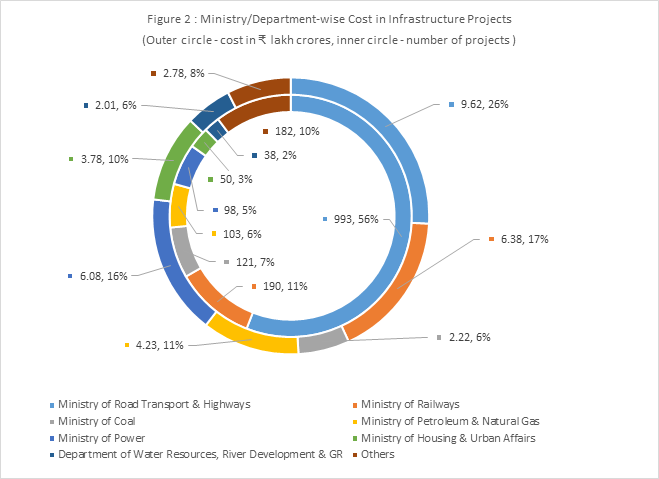
  • Ministry of Road Transport & Highways accounts for the highest number of projects, with 993 projects (56%), and a share of total revised project cost of ₹9.62 lakh crore (26%), highlighting its central role in national infrastructure development.
  • Ministry of Railways is implementing 190 projects (11%), with a total revised project cost of ₹6.38 lakh crore (17%).
  • Ministry of Coal accounts for implementing 121 projects (7%), with a total revised project cost of ₹2.22 lakh crore (6%).
  • The Ministry of Petroleum & Natural Gas, Ministry of Power, Ministry of Housing & Urban Affairs, and the Department of Water Resources, River Development & GR are implementing 103, 98, 50, and 38 projects, with associated revised costs of ₹4.23 lakh crore, ₹6.08 lakh crore, ₹3.78 lakh crore, and ₹2.01 lakh crore, respectively.
  • The remaining 182 projects (10%), with a total revised cost of ₹2.78 lakh crore (8%), are distributed across various Ministries/Departments including Higher Education, Civil Aviation, Steel, Telecommunications, Labour & Employment, Ports, Shipping & Waterways, Health & Family Welfare, Mines, DPIIT, and Sports. (Refer Annexure I)
3.   Sector-wise (as per DEA’s Harmonized Master List of Infrastructure) Progress of Infrastructure Projects

  • Transport & Logistics remains the dominant sector, accounting for 53% of total revised project cost (₹19.81 lakh crore) across 1,246 projects (70% of the total Projects), underscoring the central role of Roads & Highways, Railways, Aviation, Urban Public Transport, Shipping, and Inland Waterways in economic integration and logistics efficiency.
  • The Energy sector follows with 29% of aggregated revised cost (₹10.66 lakh crore) across 205 projects, reflecting sustained emphasis on Oil & Gas infrastructure, electricity generation, transmission and distribution networks, and energy storage systems.
  • Communication infrastructure, with a project cost of ₹1.34 lakh crore (4%) across 31 projects, represents targeted interventions aimed at strengthening digital connectivity.
  • Water & Sanitation projects account for ₹2.05 lakh crore (5%) across 53 projects, highlighting continued focus on essential urban services.
  • Social & Commercial infrastructure, comprising 91 projects with a revised project cost of ₹0.99 lakh crore (3%), reflects selective investments in education, healthcare, real estate, and tourism, hospitality and wellness.
  • Projects classified under ‘Others’, amounting to ₹2.26 lakh crore (6%) across 149 projects, indicate diversification across sectors such as coal, steel, metals, and mining.

(Refer Annexure II)
4.   Completed Projects and New Additions

  • During July 2026, notable commissioned projects include-
    • Project – “Srikakulam Angul Gas Pipeline Project” (₹2,810 crore) of Ministry of Petroleum & Natural Gas.
    • Project – “Aligarh-Kanpur Pkg I [Aligarh-Bhadwas]” (₹2,069.6) and “Dwarka Expressway Pkg-III Delhi/HR Border to Start of RoB Gurugram (₹2298.37)” of Ministry of Road Transport & Highways.
    • Project – “Transmission System for Evacuation of power from Potential RE Zone in Khavda Area of Gujarat under phase IV 7GW-Part E4” (₹ 224.41 crore) of Ministry of Power.
  • During July 2026, 36 additional projects were brought under the monitoring of PAIMANA. Of these 16 are from Department of Telecommunications, 9 are from Ministry of Steel, 6 are from the Ministry of Road Transport & Highway, 3 are from Department for Promotion of Industry & Internal Trade, 1 from Ministry of Housing & Urban Affairs and 1 from Ministry of Power. These include:
  • “Meja Thermal Power Project, Stage-II, (3x800 MW)” (₹ 38,358 crore)
  • Jaipur Metro Rail Project Phase 2 (Prahladpura to Todi Mod)” (₹ 13,037.66 crore).
  •  “6 Lane Greenfield Varanasi- Ranchi- Kolkata Highway from Chatra to junction with NH- 100 in Deoria village from km 222.000 to km 253.000 Pkg -9” (₹ 1,418.16 crore).

5.   Next date of Press Release: Flash Report for the month of August 2026 would be released on 25th September 2026.

Note

  1. The press release summarizes highlights from the MoSPI’s Flash Report (July 2026) on Central Sector Infrastructure Projects (₹150 crore and above), available at https://paimana-proj.mospi.gov.in/ or via the QR code(below).
  2. The project monitoring interface of PAIMANA is renamed as PAIMANA-PROJ (earlier called as PAIMANA). Further, the PAIMANA-CRIP (Central Repository of Infrastructure Projects), launched by MoSPI in July 2026, serves as the underlying data repository/input layer. Nearly 80% of data are updated via API’s on PAIMANA-CRIP portal that serves as a national central repository of infrastructure projects contributing towards standardized infrastructure monitoring and support informed decision-making for nation-building.

Annexure I

Ministry/ Departments-wise progress of Central Sector Infrastructure Projects

S. No

Ministry/ Department

Project Count (number)

Revised Cost

(₹ Lakh cr.)

Cumulative Expenditure           (₹ Lakh cr.)

1

Ministry of Road Transport & Highways

993

9.62

4.61

2

Ministry of Railways

190

6.38

4.59

3

Ministry of Coal

121

2.22

0.60

4

Ministry of Petroleum & Natural Gas

103

4.23

2.28

5

Ministry of Power

98

6.08

2.10

6

Ministry of Housing & Urban Affairs

50

3.78

1.97

7

Department of Water Resources, River Development & GR

38

2.01

1.42

8

Ministry of Health & Family Welfare

35

0.26

0.11

9

Department of Telecommunications

31

1.34

1.03

10

Department of Higher Education

30

0.15

0.09

11

Ministry of Steel

27

0.30

0.13

12

Ministry of Civil Aviation

25

0.23

0.12

13

Department for Promotion of Industry & Internal Trade

12

0.21

0.02

14

Ministry of Labour and Employment

9

0.02

0.01

15

Ministry of Ports, Shipping and Waterways

6

0.14

0.10

16

Ministry of Mines

6

0.12

0.07

17

Department of Sports

1

0.01

0.01


Grand Total

1775

37.11

19.26


Annexure II

Sector-wise (as per DEA’s Harmonized Master List of Infrastructure) progress of Central Sector Infrastructure Projects

S. No

HML Category

Project Count

(number)

Revised Cost      (₹ Lakh cr.)

Cumulative Expenditure      (₹ Lakh cr.)

1

Transport & Logistics

1246

₹ 19.81

11.23

2

Energy

205

₹ 10.66

4.43

3

Water & Sanitation

53

₹ 2.05

1.45

4

Social & Commercial

91

₹ 0.99

0.39

5

Communication

31

₹ 1.34

1.03

6

Others

149

₹ 2.26

0.73


Total

1775

37.11

19.26

***

Topics

Acts Income Tax

