

Loading...

Top
Help
×

By creating an account you can:

Logo TaxTMI
Call Us / Help / Feedback

Contact Us At :

E-mail: [email protected]

Call / WhatsApp at: +91 99117 96707

For more information, Check Contact Us

FAQs :

To know Frequently Asked Questions, Check FAQs

Most Asked Video Tutorials :

For more tutorials, Check Video Tutorials

Submit Feedback/Suggestion :

Email :
Please provide your email address so we can follow up on your feedback.
Category :
Description :
Min 15 characters 0/2000
Make Most of Text Search
  1. Checkout this video tutorial: How to search effectively on TaxTMI.
  2. Put words in double quotes for exact word search, eg: "income tax"
  3. Avoid noise words such as : 'and, of, the, a'
  4. Sort by Relevance to get the most relevant document.
  5. Press Enter to add multiple terms/multiple phrases, and then click on Search to Search.
  6. Text Search
  7. The system will try to fetch results that contains ALL your words.
  8. Once you add keywords, you'll see a new 'Search In' filter that makes your results even more precise.
  9. Text Search
Add to...
You have not created any category. Kindly create one to bookmark this item!
Create New Category
Hide
Title :
Description :
❮❮ Hide
Default View
Expand ❯❯
Close ✕
🔎 News - Adv. Search
TEXT SEARCH:

Press 'Enter' to add multiple search terms. Rules for Better Search

Search In:
Main Text + AI Text
  • Main Text
  • Main Text + AI Text
  • AI Text
Category: ?
Categorized by AI
---- All Categories ----
  • ---- All Categories ----
  • Income Tax
  • GST
  • Customs, DGFT & SEZ
  • FEMA & RBI
  • Corp. Laws, SEBI & IBC
  • PMLA, Black Money & ED
  • Budget
  • News and Press Release
  • PTI News
Month:
---- All Months ----
  • ---- All Months ----
  • January
  • February
  • March
  • April
  • May
  • June
  • July
  • August
  • September
  • October
  • November
  • December
Year:
---- All Years ----
  • ---- All Years ----
  • 2026
  • 2025
  • 2024
  • 2023
  • 2022
  • 2021
  • 2020
  • 2019
  • 2018
  • 2017
  • 2016
  • 2015
  • 2014
  • 2013
  • 2012
  • 2011
Sort By: ?
In Sort By 'Default', exact matches for text search are shown at the top, followed by the remaining results in their regular order.
Relevance Default Date
❯❯
Maximize Maximize Maximize
0 / 200
Expand Note
Add to Folder

No Folders have been created

+

Are you sure you want to delete "My most important" ?

NOTE:

News
Showing Results for :
Reset Filters
Results Found:
Show All Summaries Hide All Summaries
March 31, 2026
Show AI Summary
Accumulation or set-aside of income by non-profit organisations requires annual electronic disclosure in Form 109.
Form 109 is an annual electronic statement for a registered non-profit organisation to report regular income accumulated or set apart under section 342(1) of the Income Tax Act, 2025. It must be furnished on the e-filing portal before the due date for filing the return of income and includes details of the amount, purpose, period of accumulation, prior-year accumulations, and any non-application due to injunction or court order. The reported amount may be claimed in a subsequent return for application within five tax years.
March 31, 2026
Show AI Summary
Accumulation of income by non-profit organisations requires timely electronic filing of FN 109 with a valid PAN.
Registered non-profit organisations may furnish FN 109 electronically or digitally to indicate accumulation or setting apart of regular income under section 342(1) of the Income-tax Act, 2025, for application in subsequent tax years for a period not exceeding five tax years. The form is mandatory for claiming the accumulated or set-apart amount, must be filed by the return due date, requires a valid PAN, and is submitted online to the Commissioner of Income Tax (CPC) through the e-filing portal. It cannot be edited after submission or filed offline.
March 31, 2026
Show AI Summary
Deemed application for non-profit income requires electronic filing of Form 108 before the return due date.
Form 108 requires a registered non-profit organisation to electronically furnish a statement exercising the option under section 341(7) for treating regular income as deemed application under section 341(5). The annual filing is due before the return of income due date and covers computation of the shortfall in application and the reasons for that shortfall. A reported shortfall may be claimed as deemed application in the subsequent return of income.
March 31, 2026
Show AI Summary
Deemed application of income under FN 108 requires timely online filing by registered non-profit organisations.
Registered non-profit organisations may use FN 108 as the electronic statement for exercising the option to treat a shortfall in application of income as deemed application where income could not be applied because it was not received during the relevant tax year. The form is mandatory for such a claim, must be filed online by the return filing due date, requires a valid PAN, and cannot be edited after submission.
March 31, 2026
Show AI Summary
Registration and approval conditions under Form 107 govern validity, disclosure, commercial activity, and cancellation safeguards.
Form No. 107 is the written order passed by the jurisdictional Principal Commissioner or Commissioner on an application in Form No. 105 for regular registration or approval, rejection of the application, cancellation of registration or approval, or a mixed order granting one section code while rejecting another. It records applicant particulars, the unique registration or approval number, the section, date, nature of activity, validity period and relevant tax years, and where applicable the reasons for rejection or cancellation. The form also sets out conditions on application of income, commercial activities, books of account, compliance with law, and true and complete disclosure.
March 31, 2026
Show AI Summary
Registration and approval orders under Form 107 govern grant, rejection, cancellation, and validity periods for eligible applicants.
Form No. 107 is the written order by which the jurisdictional Principal Commissioner or Commissioner grants regular registration or approval, rejects the application, cancels registration or approval, or grants one section code while rejecting the other. It is passed on receipt of Form No. 105, ordinarily within six months from the end of the quarter in which the application is made. The order may issue a 16 digit alphanumeric Unique Registration Number, and the validity of regular registration or approval is generally five tax years, with stated exceptions extending validity in specified cases.
March 31, 2026
Show AI Summary
Provisional registration and approval conditions under Form 106 cover income use, commercial activity limits, and disclosure compliance.
Form No. 106 is the order through which the Commissioner of Income Tax (CPC) grants provisional registration or provisional approval, or rejects an application made in Form No. 104. It captures applicant details, the provisional registration or approval number, the period of validity, and the authority issuing the order. The form prescribes conditions on application of income, commercial activities, maintenance of separate books, compliance with law, and true disclosure, and it may be cancelled if false information is found or electronic filing requirements are not met.
March 31, 2026
Show AI Summary
Preferential allotment of equity shares under a resolution plan supports AI expansion, technology platforms, and working capital needs.
Preferential allotment of equity shares by a listed artificial intelligence and digital transformation company pursuant to a Resolution Plan approved by the National Company Law Tribunal and in compliance with applicable SEBI Regulations, the Companies Act, 2013 and stock exchange requirements. The allotment comprised equity shares issued to strategic investors in the public non-promoter category at a premium, with participation from alternative investment funds, strategic investors and high-net-worth individuals.
March 31, 2026
Show AI Summary
Provisional registration and approval under income tax rules require timely orders, a unique registration number, and compliance with filing requirements.
Provisional registration or provisional approval is granted through Form No. 106 after receipt of Form No. 104, with an order to be passed within one month from the end of the month of application. The provisional status remains valid for three tax years or up to six months from commencement of activities, whichever is earlier. The order issues a 16-digit Unique Registration Number and may later be cancelled after hearing if the application contains false or incorrect information or fails electronic filing and verification requirements.
March 31, 2026
Show AI Summary
Form 105 governs regular registration and approval of non-profit organisations, with filing, validity, documents, and re-application rules.
Form No. 105 is the electronic application for regular registration or regular approval of specified non-profit organisations and allied funds under the Income-tax Act, 2025. It covers applicants seeking registration to claim benefits available to registered non-profit organisations, and applicants seeking approval so that donations received may qualify for donor deduction. The form requires details of identity, formation, existing registration, income, office bearers, beneficial ownership, activities, assets, liabilities, and supporting documents. It also provides for filing timelines, validity periods, re-application, withdrawal, and correction of erroneous details before the order is passed.
March 31, 2026
Show AI Summary
EMI calculators support smarter personal loan planning by helping borrowers assess repayments, tenure, and borrowing capacity in advance.
Personal loan planning increasingly depends on EMI calculators that allow borrowers to estimate monthly instalments, compare loan scenarios, adjust tenure for affordability, and assess the total cost of borrowing before applying. By entering the loan amount, tenure, and interest rate, applicants can review repayment obligations in advance and align borrowing decisions with monthly income and budget capacity, thereby supporting more disciplined financial planning and reducing the risk of over-borrowing. The personal loan product is presented as a flexible digital lending option with an online application process, minimal documentation, and fast approval features.
March 31, 2026
Show AI Summary
Income tax return forms notified for assessment year 2026-27, setting filing eligibility across taxpayer categories and updated returns.
Income Tax Department notified all income tax return forms for assessment year 2026-27, enabling individuals, businesses and other entities to file returns for income earned in financial year 2025-26. The notification covers ITR forms 1 to 7 as well as ITR-U for updated returns, with the return-filing deadline for individuals and other non-audited taxpayers stated as 31 July. ITR-1 (Sahaj) is available to resident individuals with total annual income up to Rs 50 lakh deriving income from salary, one house property, other sources and agricultural income up to Rs 5,000. ITR-4 (Sugam) applies to individuals, Hindu Undivided Families and firms other than limited liability partnerships having total annual income up to Rs 50 lakh and income from business or profession. ITR-2 is for individuals and HUFs without business or professional income but having capital gains, while ITR-3 is for individuals and HUFs with income from proprietary business or profession.
March 31, 2026
Show AI Summary
Regular registration and approval for non-profit organisations through a common online form with event-based filing rules.
Form No. 105 is the common online application for regular registration of a non-profit organisation and for regular approval of a registered non-profit organisation or specified funds so that donor deductions may be available. It is mandatory only for applicants seeking these benefits, requires PAN, must be furnished electronically to the jurisdictional Principal Commissioner or Commissioner, and is filed within the prescribed time limits depending on commencement of activities, expiry of provisional status, expiry of existing registration or approval, inoperative registration, or modification of objects. The form is generally event-based, the regular registration or approval is ordinarily valid for five tax years, and a one-time re-application, withdrawal within seven days, correction before the order, and specified supporting documents are permitted.
March 31, 2026
Show AI Summary
Provisional registration and approval for non-profit organisations under Form 104 are granted through a simplified electronic application process.
Form No. 104 is the common electronic application for provisional registration or provisional approval for eligible non-profit organisations, registered non-profit organisations, regimental funds, and non-public funds established by the armed forces. It requires prescribed identification, incorporation, registration, ownership, return-filing, and supporting document details, and must be filed with the Commissioner of Income Tax (CPC) through the e-filing portal. Provisional registration or approval is granted through a written order with a Unique Registration Number, may be cancelled for false or non-compliant filings, may be surrendered if no exemption benefits were ever claimed, and may be withdrawn within seven days of filing.
March 31, 2026
Show AI Summary
Provisional registration and approval for non-profit organisations depend on online Form No. 104, mandatory PAN, and commenced activities rules.
Form No. 104 is the common electronic application for provisional registration under section 332(3) and provisional approval under section 354(2) for applicants whose activities have not commenced. It is filed online with the Commissioner of Income Tax (CPC), who must pass an order in Form No. 106 within one month from the end of the month of filing, unless the application is non-est. The provisional registration or approval is valid for three tax years or up to six months from commencement of activities, whichever is earlier, and may be cancelled for false information or defective filing. PAN is mandatory, offline filing is not permitted, and the form cannot be edited after submission.
March 31, 2026
Show AI Summary
PAN allotment forms simplified into category-specific applications with mandatory contact details, supporting documents and improved verification.
PAN allotment applications are to be made in revised Forms 93, 94, 95 and 96 for four applicant categories: individual citizens of India, Indian entities, individuals who are not citizens of India, and foreign entities. The forms are category-specific, self-explanatory and aligned with the Income-tax Act and rules, with online or physical filing through PAN service providers, document verification, transmission to the Income Tax Department, and PAN generation with dispatch of the physical card where opted.
March 31, 2026
Show AI Summary
Permanent Account Number application rules set forms, documents, fees, and correction procedures for Indian and foreign applicants.
Permanent Account Number (PAN) application is governed through prescribed forms for different applicant categories: Form 93 for individuals being citizens of India, Form 94 for non-individual Indian entities, Form 95 for individuals not being citizens of India, and Form 96 for non-individual foreign entities. PAN is a unique taxpayer identifier required for income-tax return filing and specified financial transactions. The application process requires prescribed supporting documents, incomplete or deficient applications are treated as invalid, and correction requests may be made separately after allotment.
March 31, 2026
Show AI Summary
Corporate governance through independent director appointment and audit committee leadership to improve oversight, controls and compliance.
Appointment of an independent director and audit committee chair to strengthen corporate governance, financial oversight and compliance mechanisms. The role is stated to include supervision of financial reporting integrity, internal controls, enterprise risk management, regulatory compliance and audit processes, with the appointment intended to deepen board oversight and support disciplined, responsible and sustainable growth.
March 31, 2026
Show AI Summary
Manufacturing activity rebounds as energy costs, supply-chain risks, and weak demand cloud China's growth outlook.
China's manufacturing activity returned to expansion in March as the official purchasing managers index rose above 50, ending two months of contraction. Analysts said the outlook remains vulnerable to higher energy costs, possible supply-chain disruption, a prolonged property-sector slump, and weaker global demand, while exports continue to play a key role in supporting growth.
March 30, 2026
Show AI Summary
Asset restitution under PMLA advances recovery for PACL investors after attachment of properties in alleged investment fraud.
Assets worth more than Rs 15,000 crore have been restored under the Prevention of Money Laundering Act to a Supreme Court-appointed committee for distribution to investors allegedly defrauded in the PACL collective investment scheme. A special PMLA court ordered restitution of 455 immovable properties to the Justice Lodha Committee, reflecting the statutory remedy of restoration of attached assets to victims of fraud and proceeds of crime. The ED's action is part of an investigation into allegations of an illegal collective investment scheme and the attachment of properties held by PACL entities, family members and associates.

News

Back

All News

Showing Results for :
Reset Filters
No Records Found

News

Back

All News

Showing Results for : Reset Filters

Monetary Policy Statement, 2026-27 Resolution of the Monetary Policy Committee April 6 to 8, 2026

April 8, 2026

Contents
Summary
Note

Note

-

Bookmark

Print

Print

Monetary Policy Decisions

The Monetary Policy Committee (MPC) held its 60th meeting from April 6 to 8, 2026, under the chairmanship of Shri Sanjay Malhotra, Governor, Reserve Bank of India. The MPC members Dr. Nagesh Kumar, Shri Saugata Bhattacharya, Prof. Ram Singh, Dr. Poonam Gupta and Shri Indranil Bhattacharyya attended the meeting.

2. After a detailed assessment of the evolving macroeconomic and financial developments and the outlook, the MPC voted unanimously to keep the policy repo rate under the liquidity adjustment facility (LAF) unchanged at 5.25 per cent. Consequently, the standing deposit facility (SDF) rate remains at 5.00 per cent and the marginal standing facility (MSF) rate and the Bank Rate remains at 5.50 per cent. The MPC also decided to continue with the neutral stance.

Growth and Inflation Outlook

Global Outlook

3. The outbreak of the conflict in West Asia has led to severe disruption of global supply chains. This poses an unprecedented challenge for the global economy – higher prices and lower global growth. In this environment, monetary policy faces a difficult trade-off – anchoring inflation expectations through policy tightening while minimising its impact on growth forgone. Sovereign bond yields, already high from long-run fiscal sustainability concerns across major economies, have further hardened, driven by inflation fears. Additionally, equity valuations have corrected. As a result of the turmoil in global financial markets, the US dollar has rallied, buoyed by safe‑haven demand that has exerted pressure on currencies of major economies. Further intensification of the conflict, its prolongation and widening geographical spread remain the key downside risks to the global outlook.

Domestic Outlook

4. On the domestic front, the Indian economy remained resilient in 2025-26. Real gross domestic product (GDP) is estimated to grow by 7.6 per cent (y-o-y) during the year, as per the Second Advance Estimates (SAE) of the new GDP series (base year 2022-23). Private consumption and fixed investment contributed significantly to overall growth, while net external demand remained soft. On the supply side, estimated real GVA growth of 7.7 per cent was driven by buoyant services sector and robust manufacturing activity.

5. Looking ahead, elevated energy and other commodity prices coupled with supply shock due to disruptions in the Strait of Hormuz would act as a drag on domestic production in 2026-27. Heightened volatility in global financial markets with its spillover on domestic financial conditions would weigh on growth prospects. On the external front, merchandise exports may be adversely impacted from disruptions to key shipping routes and the concomitant rise in freight and insurance costs in case the conflict is long-drawn. On the other hand, sustained momentum in services sector, persisting impact of GST rationalisation, rising capacity utilisation in manufacturing, and healthy balance sheets of financial institutions and corporates should continue to support domestic demand. In this milieu, the Government’s focus on scaling up domestic manufacturing in several strategic and frontier sectors announced in the Union Budget 2026-27 bodes well for India’s ensuing growth trajactory. Taking all these factors into consideration and on the assumption that the adverse impact of the conflict would remain contained in the near term, real GDP growth for 2026-27 is projected at 6.9 per cent, with Q1 at 6.8 per cent; Q2 at 6.7 per cent; Q3 at 7.0 per cent; and Q4 at 7.2 per cent (Chart 1). Further escalation of the conflict, its continuation over a wider geographical spread and uncertainty regarding the damage to the energy infrastructure, apart from weather related events, pose downside risks to the domestic growth outlook.

6. As per the new CPI series (2024=100), headline inflation increased to 3.2 per cent in February 2026 from 2.7 per cent in January. The uptick was primarily driven by unfavourable base effects even as the momentum remained muted. While food inflation increased in February, core (excluding food and fuel) inflation remained unchanged. Excluding precious metals, core inflation remained moderate at 2.1 per cent in January and February, suggesting subdued underlying inflation pressures.

7. The ongoing conflict has led to large volatility in international energy and other commodity prices imparting considerable uncertainty to the near-term inflation outlook. The pass-through of higher global energy prices has resulted in price increases in select fuels such as premium petrol and LPG and diesel for industrial use. On the other hand, the near-term food supply prospects have been boosted by robust rabi crop providing some comfort. Considering all these factors, CPI inflation for 2026-27 is projected to be at 4.6 per cent with Q1 at 4.0 per cent; Q2 at 4.4 per cent; Q3 at 5.2 per cent; and Q4 at 4.7 per cent. Persistently elevated energy prices due to the West Asia conflict and possible El Niño conditions (which could have a negative impact on southwest monsoon) pose upside risks to inflation (Chart 2). Core inflation is projected at 4.4 per cent for 2026-27 and, excluding precious metals, it is even lower indicating that underlying inflation pressures are expected to remain contained.
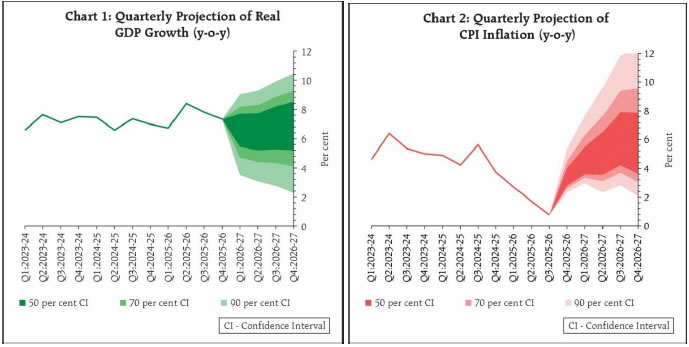
Chart 1 and 2

Rationale for Monetary Policy Decisions

8. Since the last policy meeting, geopolitical uncertainties have heightened significantly. Headline inflation remains contained and below the target, but upside risks to the inflation outlook have increased, driven by increased energy price pressures and probable weather disturbances affecting food prices. Core inflation pressures remain muted, although supply chain dislocations and the risk of second-round effects render the future inflation trajectory uncertain.

9. High frequency indicators till February 2026 suggest the continuation of strong momentum in economic activity. Growth impulses continue to be supported by robust private consumption and investment demand. However, the West Asia conflict will adversely impact growth. Higher input costs associated with increase in energy prices and international freight and insurance costs along with supply-chain disruptions could constrain availability of key inputs for downstream sectors, thus impairing growth. The Government has taken several measures targeted at supporting exports and protecting supply chains, which should mitigate the adverse impact of the conflict.

10. The MPC noted that the intensity and the duration of the conflict in West Asia and the resultant damage to the energy and other infrastructure add risk to the inflation and growth outlooks. However, the fundamentals of the Indian economy are on a stronger footing, providing it with greater resilience to withstand shocks now than in the past. The economy is confronted with a supply shock. It is prudent to wait and watch the changing circumstances and the evolving growth-inflation outlook. Accordingly, the MPC voted to keep the policy rate unchanged even as it remains vigilant, closely monitoring incoming information and assessing the balance of risks. The MPC also decided to continue with the neutral stance, retaining the flexibility to respond judiciously to incoming information.

11. The minutes of the MPC’s meeting will be published on April 22, 2026.

12. The next meeting of the MPC is scheduled for June 3 to 5, 2026.

(Brij Raj)           
Chief General Manager

Topics

Acts Income Tax