 TaxTMI
 Login
 TaxTMI
Login
Loading...
Press 'Enter' to add multiple search terms. Rules for Better Search

Press 'Enter' after typing page number.
Press 'Enter' after typing page number.


No Folders have been created
Are you sure you want to delete "My most important" ?
NOTE:
Press 'Enter' after typing page number.
Press 'Enter' after typing page number.

All News
Press 'Enter' after typing page number.
All News

Note

Bookmark

Share


Monetary Policy Decisions
The Monetary Policy Committee (MPC) held its 60th meeting from April 6 to 8, 2026, under the chairmanship of Shri Sanjay Malhotra, Governor, Reserve Bank of India. The MPC members Dr. Nagesh Kumar, Shri Saugata Bhattacharya, Prof. Ram Singh, Dr. Poonam Gupta and Shri Indranil Bhattacharyya attended the meeting.
2. After a detailed assessment of the evolving macroeconomic and financial developments and the outlook, the MPC voted unanimously to keep the policy repo rate under the liquidity adjustment facility (LAF) unchanged at 5.25 per cent. Consequently, the standing deposit facility (SDF) rate remains at 5.00 per cent and the marginal standing facility (MSF) rate and the Bank Rate remains at 5.50 per cent. The MPC also decided to continue with the neutral stance.
Growth and Inflation Outlook
Global Outlook
3. The outbreak of the conflict in West Asia has led to severe disruption of global supply chains. This poses an unprecedented challenge for the global economy – higher prices and lower global growth. In this environment, monetary policy faces a difficult trade-off – anchoring inflation expectations through policy tightening while minimising its impact on growth forgone. Sovereign bond yields, already high from long-run fiscal sustainability concerns across major economies, have further hardened, driven by inflation fears. Additionally, equity valuations have corrected. As a result of the turmoil in global financial markets, the US dollar has rallied, buoyed by safe‑haven demand that has exerted pressure on currencies of major economies. Further intensification of the conflict, its prolongation and widening geographical spread remain the key downside risks to the global outlook.
Domestic Outlook
4. On the domestic front, the Indian economy remained resilient in 2025-26. Real gross domestic product (GDP) is estimated to grow by 7.6 per cent (y-o-y) during the year, as per the Second Advance Estimates (SAE) of the new GDP series (base year 2022-23). Private consumption and fixed investment contributed significantly to overall growth, while net external demand remained soft. On the supply side, estimated real GVA growth of 7.7 per cent was driven by buoyant services sector and robust manufacturing activity.
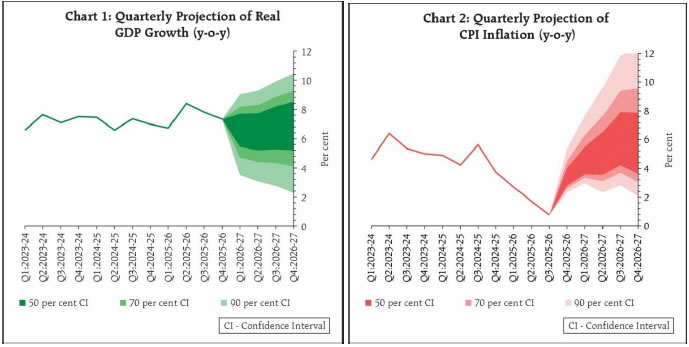
5. Looking ahead, elevated energy and other commodity prices coupled with supply shock due to disruptions in the Strait of Hormuz would act as a drag on domestic production in 2026-27. Heightened volatility in global financial markets with its spillover on domestic financial conditions would weigh on growth prospects. On the external front, merchandise exports may be adversely impacted from disruptions to key shipping routes and the concomitant rise in freight and insurance costs in case the conflict is long-drawn. On the other hand, sustained momentum in services sector, persisting impact of GST rationalisation, rising capacity utilisation in manufacturing, and healthy balance sheets of financial institutions and corporates should continue to support domestic demand. In this milieu, the Government’s focus on scaling up domestic manufacturing in several strategic and frontier sectors announced in the Union Budget 2026-27 bodes well for India’s ensuing growth trajactory. Taking all these factors into consideration and on the assumption that the adverse impact of the conflict would remain contained in the near term, real GDP growth for 2026-27 is projected at 6.9 per cent, with Q1 at 6.8 per cent; Q2 at 6.7 per cent; Q3 at 7.0 per cent; and Q4 at 7.2 per cent (Chart 1). Further escalation of the conflict, its continuation over a wider geographical spread and uncertainty regarding the damage to the energy infrastructure, apart from weather related events, pose downside risks to the domestic growth outlook.
6. As per the new CPI series (2024=100), headline inflation increased to 3.2 per cent in February 2026 from 2.7 per cent in January. The uptick was primarily driven by unfavourable base effects even as the momentum remained muted. While food inflation increased in February, core (excluding food and fuel) inflation remained unchanged. Excluding precious metals, core inflation remained moderate at 2.1 per cent in January and February, suggesting subdued underlying inflation pressures.
7. The ongoing conflict has led to large volatility in international energy and other commodity prices imparting considerable uncertainty to the near-term inflation outlook. The pass-through of higher global energy prices has resulted in price increases in select fuels such as premium petrol and LPG and diesel for industrial use. On the other hand, the near-term food supply prospects have been boosted by robust rabi crop providing some comfort. Considering all these factors, CPI inflation for 2026-27 is projected to be at 4.6 per cent with Q1 at 4.0 per cent; Q2 at 4.4 per cent; Q3 at 5.2 per cent; and Q4 at 4.7 per cent. Persistently elevated energy prices due to the West Asia conflict and possible El Niño conditions (which could have a negative impact on southwest monsoon) pose upside risks to inflation (Chart 2). Core inflation is projected at 4.4 per cent for 2026-27 and, excluding precious metals, it is even lower indicating that underlying inflation pressures are expected to remain contained.
Rationale for Monetary Policy Decisions
8. Since the last policy meeting, geopolitical uncertainties have heightened significantly. Headline inflation remains contained and below the target, but upside risks to the inflation outlook have increased, driven by increased energy price pressures and probable weather disturbances affecting food prices. Core inflation pressures remain muted, although supply chain dislocations and the risk of second-round effects render the future inflation trajectory uncertain.
9. High frequency indicators till February 2026 suggest the continuation of strong momentum in economic activity. Growth impulses continue to be supported by robust private consumption and investment demand. However, the West Asia conflict will adversely impact growth. Higher input costs associated with increase in energy prices and international freight and insurance costs along with supply-chain disruptions could constrain availability of key inputs for downstream sectors, thus impairing growth. The Government has taken several measures targeted at supporting exports and protecting supply chains, which should mitigate the adverse impact of the conflict.
10. The MPC noted that the intensity and the duration of the conflict in West Asia and the resultant damage to the energy and other infrastructure add risk to the inflation and growth outlooks. However, the fundamentals of the Indian economy are on a stronger footing, providing it with greater resilience to withstand shocks now than in the past. The economy is confronted with a supply shock. It is prudent to wait and watch the changing circumstances and the evolving growth-inflation outlook. Accordingly, the MPC voted to keep the policy rate unchanged even as it remains vigilant, closely monitoring incoming information and assessing the balance of risks. The MPC also decided to continue with the neutral stance, retaining the flexibility to respond judiciously to incoming information.
11. The minutes of the MPC’s meeting will be published on April 22, 2026.
12. The next meeting of the MPC is scheduled for June 3 to 5, 2026.
(Brij Raj)
Chief General Manager

