

Loading...

Top
Help
×

By creating an account you can:

Logo TaxTMI
Call Us / Help / Feedback

Contact Us At :

E-mail: [email protected]

Call / WhatsApp at: +91 99117 96707

For more information, Check Contact Us

FAQs :

To know Frequently Asked Questions, Check FAQs

Most Asked Video Tutorials :

For more tutorials, Check Video Tutorials

Submit Feedback/Suggestion :

Email :
Please provide your email address so we can follow up on your feedback.
Category :
Description :
Min 15 characters 0/2000
Make Most of Text Search
  1. Checkout this video tutorial: How to search effectively on TaxTMI.
  2. Put words in double quotes for exact word search, eg: "income tax"
  3. Avoid noise words such as : 'and, of, the, a'
  4. Sort by Relevance to get the most relevant document.
  5. Press Enter to add multiple terms/multiple phrases, and then click on Search to Search.
  6. Text Search
  7. The system will try to fetch results that contains ALL your words.
  8. Once you add keywords, you'll see a new 'Search In' filter that makes your results even more precise.
  9. Text Search
Add to...
You have not created any category. Kindly create one to bookmark this item!
Create New Category
Hide
Title :
Description :
❮❮ Hide
Default View
Expand ❯❯
Close ✕
🔎 News - Adv. Search
TEXT SEARCH:

Press 'Enter' to add multiple search terms. Rules for Better Search

Search In:
Main Text + AI Text
  • Main Text
  • Main Text + AI Text
  • AI Text
Category: ?
Categorized by AI
---- All Categories ----
  • ---- All Categories ----
  • Income Tax
  • GST
  • Customs, DGFT & SEZ
  • FEMA & RBI
  • Corp. Laws, SEBI & IBC
  • PMLA, Black Money & ED
  • Budget
  • News and Press Release
  • PTI News
Month:
---- All Months ----
  • ---- All Months ----
  • January
  • February
  • March
  • April
  • May
  • June
  • July
  • August
  • September
  • October
  • November
  • December
Year:
---- All Years ----
  • ---- All Years ----
  • 2026
  • 2025
  • 2024
  • 2023
  • 2022
  • 2021
  • 2020
  • 2019
  • 2018
  • 2017
  • 2016
  • 2015
  • 2014
  • 2013
  • 2012
  • 2011
Sort By: ?
In Sort By 'Default', exact matches for text search are shown at the top, followed by the remaining results in their regular order.
Relevance Default Date
    Freedom to Spend Smarter: AU Small Finance Bank Credit Cards Bring Rewards, EMI Flexibility and Lounge Access to India''s Biggest Shopping Month
    Rupee falls 8 paise to 95.25 against US dollar in early trade
    APEDA Facilitates First-Ever Export of GI-tagged Mithila Makhana by Sea Route from Bihar to Australia
    Government signs strategic MoUs with key industry leaders and ecosystems to strengthen support to StartUps
    No Charges for UPI Users
    Competition Commission of India (CCI) hosts BRICS Heads of Competition Authorities 2026 meeting
    ICoAS fraternity reaffirms commitment to cost optimisation for Atmanirbhar Bharat on ICoAS day 2026
    Govt to introduce bill in Lok Sabha to broaden NCDC's mandate for co-operative sector growth
    AAP govt indulged in large-scale financial irregularities, caused losses to exchequer: Delhi minister
    ED files chargesheets in 2 PMLA cases against Anil Ambani Group companies, ex-executives
    RJD criticises UDF govt's move not to disburse pensions through cooperative banks
    Raymond Limited reports a healthy Q1 FY27 performance
    Why Most People Choose the Wrong Savings Account And How Not to Be One of Them
    RBI has proactively helped UCBs; cooperatives should look at regulator differently: Shah
    Ministry of Agriculture, Food and Rural Affairs and aT Host '2026 K-Food Fair in New Delhi, India'
    No compromise on tackling illegal immigrants' issue: Minister Priyank Kharge
    Technology, transparency key for urban cooperative banks to stay competitive: Shah
    Paul Merchants Gets RBI Approval for Perpetual AD Category-II Licence Under Revised FEMA Framework
    IEPFA Organises Stakeholder Engagement with Nodal Officers of Companies on Integrated IEPFA Portal 2.0
    Rupee settles with 5 paise gain at 95.17 against US dollar
❯❯
Maximize Maximize Maximize
0 / 200
Expand Note
Add to Folder

No Folders have been created

+

Are you sure you want to delete "My most important" ?

NOTE:

News
Showing Results for :
Reset Filters
Results Found:
Show All Summaries Hide All Summaries
August 10, 2026
Show AI Summary
Credit card payment flexibility supports seasonal shopping and travel through eligible EMIs, rewards, tracking tools and conditional merchant benefits.
Credit-card spending features include conversion of eligible purchases into EMIs, selected no-cost EMI options, reward points, cashback, merchant discounts and payment flexibility. Travel-related benefits may include domestic airport lounge access, travel-booking discounts, fuel-surcharge waiver and anniversary-linked rewards. The AU 0101 application enables transaction tracking, balance and interest-rate monitoring, EMI conversion and bill-payment management. Features and offers are subject to change, customer eligibility, internal policies and partner-merchant terms.
August 10, 2026
Show AI Summary
Foreign-exchange market conditions weakened the rupee as stronger dollar and crude prices offset support from reserve growth and inflows.
Foreign-exchange market conditions saw the rupee weaken against the US dollar in early trading, influenced by a stronger dollar and higher global crude oil prices. Foreign institutional equity inflows and increased foreign-exchange reserves moderated pressure on the rupee. Market attention remained focused on developments in West Asia and the Reserve Bank of India, alongside movements in the dollar index, crude oil prices and domestic equity markets.
August 10, 2026
Show AI Summary
GI-tagged Mithila Makhana export facilitation expands sea-route market access while supporting quality compliance and farmer-linked value chains.
Export facilitation for GI-tagged Mithila Makhana enabled the first commercial sea-route shipment from Bihar to Australia. APEDA, in association with the Bihar agriculture department, supported market access, coordination, capacity building and stakeholder engagement. The export model is intended to improve farmer price realisation, require adherence to global quality standards, and strengthen growers, processors and exporters. A separate HS Code for Makhana has taken effect under the Finance Bill, 2025, supporting product-specific trade classification.
August 10, 2026
Show AI Summary
Startup ecosystem support expands through digital payments, cloud access, AI innovation, investment readiness, governance support and global market programmes.
DPIIT has entered into strategic MoUs to support DPIIT-recognised startups through payment infrastructure, entrepreneurship development, cloud technology, mobility innovation, investment readiness and global-market access. Eligible startups may receive payment and cloud support, technical training, mentorship, startup formalisation assistance, market and investor connections, AI and mobility enablement, and programmes addressing governance, financial readiness, compliance and international expansion. The collaborations promote innovation across digital payments, clean energy, artificial intelligence, climate technology, advanced manufacturing, mobility and automotive technology.
August 10, 2026
Show AI Summary
UPI transaction charges remain unavailable for consumers and person-to-person payments, while limited threshold-based merchant MDR may be considered.
Proposed amendment of section 10A of the Payment and Settlement Systems Act, 2007 is intended to support UPI sustainability, technological advancement and resilience. Consumer payments and person-to-person transactions are to remain free. Any future merchant discount rate would apply only to limited merchant transactions above a threshold, at a nominal rate, while most merchant transactions remain free. The framework supports investment in cybersecurity, fraud prevention and infrastructure, alongside a self-sustaining and inclusive digital-payment ecosystem.
August 10, 2026
Show AI Summary
Fair competition cooperation in renewable energy markets advances knowledge-sharing and evidence-based enforcement across interconnected digital and energy markets.
BRICS competition authorities adopted a Joint Statement strengthening cooperation to promote fair competition, including in renewable energy markets. Cooperation focuses on dialogue, knowledge-sharing and consideration of cross-border competition challenges in digital markets, emerging technologies and the energy transition. Competition enforcement is to remain principled and evidence-based, supporting efficiency, consumer welfare, innovation and merit-based competition. A collaborative renewable-energy competition study identified evolving market dynamics and areas for future cooperation.
August 10, 2026
Show AI Summary
Cost optimisation in public finance strengthens investment decisions, risk allocation, indigenous manufacturing and value-driven government expenditure through specialised financial expertise.
ICoAS cost optimisation supports public financial management through prudent resource utilisation, financial oversight and improved cost management across government. Its role includes supporting indigenous manufacturing, better investment decisions, efficient public expenditure and maximum value for public spending. With greater private-sector participation and Public-Private Partnerships, ICoAS officers are expected to promote cost efficiency, appropriate risk allocation and sound project structuring. Capacity building emphasises integrity, financial modelling, data visualisation, analytical frameworks and artificial intelligence for improved public-finance management.
August 9, 2026
Show AI Summary
Co-operative development financing would expand through direct assistance, share-capital participation and wider operational powers for sectoral support.
National Cooperative Development Corporation (Amendment) Bill, 2026 proposes to broaden the Corporation's mandate to promote co-operative development. It would permit direct loans and grants to co-operative societies and other entities engaged in co-operative development, where funds are used for co-operative purposes. With Central Government approval, the Corporation could participate in the share capital of such entities. The proposals also expand the meaning of foodstuffs, remove geographical restrictions for industrial-goods assistance, and provide additional functional powers.
August 9, 2026
Show AI Summary
GST compliance failures and electricity subsidy controls raise allegations of financial irregularities and potential losses to the public exchequer.
Allegations based on a Comptroller and Auditor General report identified purported GST compliance failures involving outstanding tax liabilities, e-way bills generated after cancellation of GST registrations, limited bill scrutiny, non-compliance, and turnover mismatches. The allegations also concerned electricity subsidies extended to consumers with prolonged zero bills or apparent non-residence, presenting these issues as possible financial irregularities and losses to the public exchequer.
August 9, 2026
Show AI Summary
Money-laundering prosecution complaints allege fund diversion through shell entities, credit-facility evergreening, layered transactions and fictitious project expenditure.
Money-laundering prosecution complaints allege that funds from toll-road projects and credit facilities were diverted through group companies, contractors, shell entities and conduit accounts. In the toll-road matter, allegedly sham or back-dated subcontracting arrangements and subsequent documentation were used to portray transfers as genuine project expenditure. In the credit-facilities matter, fresh facilities were allegedly used to repay, rotate and evergreen earlier liabilities rather than for sanctioned end-use, with funds layered and presented as legitimate business expenditure or receipts. Attached assets are sought to be confiscated as alleged proceeds of crime.
August 9, 2026
Show AI Summary
Direct Benefit Transfer pension disbursement replaces cooperative-bank doorstep delivery, while preserving home payments for beneficiaries unable to use bank accounts.
Direct Benefit Transfer of social security and welfare pensions to Aadhaar-linked bank accounts is intended to replace cooperative-bank doorstep delivery, except for bedridden and similarly situated beneficiaries. The change addresses delays in remitting undistributed pensions, deficient record updates and reconciliation, duplicate payments, delivery incentives, and compliance with Direct Benefit Transfer norms. Criticism focuses on beneficiary access to linked commercial-bank accounts, possible minimum-balance deductions, exclusion of cooperative banks, and the effect on doorstep-delivery workers.
August 8, 2026
Show AI Summary
Engineering business growth supported Raymond's first-quarter performance, with export expansion, capacity investment and net-debt-free financial flexibility.
Raymond Limited reported unaudited first-quarter FY27 growth in total income, EBITDA and profit before tax before exceptional items, while remaining net-debt-free with a net cash surplus. Its Engineering business comprises Precision Technology & Auto Components and Aerospace & Defence. Growth in the former was attributed to export expansion, operating leverage, product mix and cost reductions. Aerospace & Defence growth was linked to production for global OEMs, portfolio expansion and increased capacity, although margins were affected by targeted research and development investment. Forward-looking statements remain subject to regulatory, political, economic and technological risks.
August 8, 2026
Show AI Summary
Savings account selection requires comparison of effective interest, fees, digital service, access, and individual banking needs.
Savings-account selection should compare effective interest returns under slab-based rates, recurring operating charges and the customer's actual banking needs. Net value depends not only on advertised rates but also on relevant minimum-balance, card, ATM, alert and transfer fees. Digital reliability, customer support, branch availability and ATM access should be assessed according to the customer's average balance, cash use, transfer frequency, travel patterns and need for in-person assistance. The suitable account is one that matches real banking behaviour.
August 8, 2026
Show AI Summary
Urban cooperative bank regulation promotes licensing, governance, compliance support and cybersecurity measures to strengthen stability and depositor confidence.
Urban cooperative banks are encouraged to recognise regulatory support through liberalised branch opening, doorstep banking, demand drafts, life certificates, dedicated regulatory coordination, enhanced gold-loan limits, one-time settlements and progress towards on-tap licensing. Sound governance is material to sectoral stability, while small-borrower lending is presented as a comparatively safe lending segment. The umbrella body can support member banks through technical expertise, compliance assistance, cybersecurity solutions and participation in a security operations centre to strengthen depositor confidence.
August 8, 2026
Show AI Summary
Korean food export promotion combines buyer consultations, regulatory guidance and consumer experiences to support entry into Indian and South Asian markets.
Korean food export promotion in India and South Asia combined business consultations with consumer-facing activities. Individual meetings connected Korean exporters with regional buyers and generated memoranda of understanding for products including frozen gimbap, ginseng wine and kombucha. Exporters received on-site guidance concerning non-tariff barriers, including food import customs clearance and certification requirements. Preparatory online sessions addressed import procedures, regulatory matters and consumer trends, while consumer events promoted Korean food through tasting, retail and experiential activities.
August 8, 2026
Show AI Summary
Illegal immigration enforcement prioritises dismantling entry, documentation and employment networks while requiring citizens to report information through police channels.
Illegal immigration enforcement involves continuous identification and verification operations, coordination with relevant officials, and confidential investigation of networks facilitating entry, identity documentation, accommodation and employment. Enquiries extend to intermediaries, contractors, Aadhaar procurement and verification practices, rather than focusing only on apprehended individuals. Citizen vigilantism, moral policing and social-media targeting of suspected migrants are discouraged because they may compromise investigations; information should instead be given through proper police channels.
August 8, 2026
Show AI Summary
Technology, transparency and governance strengthen urban cooperative banks through modern customer services, depositor protection and cooperative-sector support.
Technology adoption, transparency, sound governance and modern customer services are identified as necessary for urban cooperative banks to remain competitive. Banks are encouraged to join the sector's umbrella organisation and self-regulatory body, which provides capital, information-technology infrastructure and liquidity support. Protection of depositors' money remains a regulatory responsibility, while banks are expected to improve governance, train staff, adopt technology and enhance customer-centric services. Customer prosperity and reduced perception gaps between the central bank and urban cooperative banks are emphasised as measures to strengthen the sector.
August 8, 2026
Show AI Summary
Authorised Dealer Category-II licensing expands permissible FEMA current account and foreign trade transaction services for cross-border payment customers.
An Authorised Dealer Category-II approval under the Foreign Exchange Management (Authorised Persons) Regulations, 2026 enables Paul Merchants to undertake additional permissible non-trade current account transactions under FEMA, excluding gifts and donations, and foreign trade transactions within the applicable per-transaction limit. The approval supports foreign exchange and cross-border payment services, including overseas remittances for education, medical treatment, travel, and conference or event participation.
August 8, 2026
Show AI Summary
Integrated investor claim portal modernisation advances digital KYC, streamlined verification, stakeholder-informed safeguards, and efficient investor claim settlement services.
Integrated IEPFA Portal 2.0 is proposed to modernise investor claim processing through digital KYC, pre-filled Form IEPF-5, entitlement search, and a simplified e-Verification Report filing workflow. Stakeholder feedback included Aadhaar eKYC address validation, KYC for authorised representatives, entitlement-letter validation checks, bulk DSC and eSign functionality, integration of approved IEPF Form-4 data, lower-value share valuation using NSE and BSE data, and alerts for frequent address changes to prevent fraud.
August 7, 2026
Show AI Summary
Foreign capital inflows supported the rupee despite geopolitical uncertainty, oil-price pressures, and volatile global market sentiment.
Foreign capital inflows supported a marginal strengthening of the rupee against the US dollar despite global risk aversion arising from uncertainty surrounding negotiations affecting the Strait of Hormuz. Higher crude oil prices and weak domestic equity sentiment remained relevant pressures. Near-term currency movement was expected to depend on developments in the negotiations, weekend decisions, US employment data, the dollar index, crude oil prices, and the reported increase in foreign exchange reserves.

News

Back

All News

Showing Results for :
Reset Filters
No Records Found

News

Back

All News

Showing Results for : Reset Filters
Customs, DGFT & SEZ

Directorate General of Commercial Intelligence and Statistics Revises Base Year of Merchandise Trade Indices to FY 2022–23 to Reflect Current Trade Structure and Global Patterns

February 21, 2026

Contents
Summary
Note

Note

-

Bookmark

Print

Print

Merchandise Trade Indices are compiled and published by the Directorate General of Commercial Intelligence and Statistics (DGCI&S), Ministry of Commerce & Industry, to measure changes in the unit values (prices) of India’s exports and imports over time. These indices serve as important indicators of external sector price movements and are widely used for economic analysis, including national accounts compilation and assessment of terms of trade. Over the years, the base year of the indices has been periodically revised to reflect structural changes in India’s trade composition and evolving global trade patterns. The most recent revision updates the base year to FY 2022–23 (2022–23 = 100), replacing the earlier base of FY 2012–13, thereby ensuring that the indices accurately represent the current structure of India’s merchandise trade.

Revision of Base Year of India’s Merchandise Trade Indices to FY 2022–23

The Directorate General of Commercial Intelligence and Statistics (DGCI&S), Ministry of Commerce & Industry, has revised the base year of India’s Merchandise Trade Indices from FY 2012–13 to FY 2022–23 (2022–23 = 100), in view of the structural changes in the economy, shifts in commodity composition, evolving trade patterns, and the need for improved alignment with contemporary macroeconomic indicators.

The revision has been undertaken on the recommendations of a committee constituted by DGCI&S under the Chairmanship of Prof. Nachiketa Chattopadhyay, Professor, Indian Statistical Institute, Kolkata. The Committee examined the existing methodology, data coverage, weighting structure, and compilation practices, and recommended suitable refinements in line with international best practices.

Key Features of the Revised Series (Base: FY 2022–23)

  1. Updated Base Year:
    The new base year FY 2022–23 makes the Indices reflect the current structure of India’s external trade more accurately.
  2. Revised Commodity Basket:
    The coverage and classification of commodities have been reviewed at the Principal Commodity level to better capture emerging and declining trade items.
  3. Revised Weighting Structure:
    Weights have been updated based on trade values of the new base year to reflect the latest value shares in exports and imports.
  4. Improved Methodology:
    Methodological refinements have been introduced in:
    1. Selection of common commodity basket for base year selection (procedure of selection for common commodity basket explained in detail report of the committee).
    2. Treatment of missing unit values (Imputation of missing unit values in base year selection have been explained in detail in the committee report).
  5. Indices Compiled:
    The revised series includes:
    1. Monthly, Quarterly and Annual Indices (Export Unit Value Index,Import Unit Value Index).
    2. Principal Commodity (PC) Classification wise Trade Indices (Export/Import).
    3. Standard International Trade Classification-wise (SITC) Trade Indices.
    4. Broad economic categories-wise (BEC) Trade Indices.
    5. Bilateral and Region-wise Trade Indices of Top 20 Export and Import partner nations of India.
    6. Terms of Trade (Gross terms of trade, Net terms of trade and Income terms of trade).

Rationale for Revision

Over the past decade, India’s trade basket has undergone substantial changes due to emergence of new commodities, technological advancements, Global supply chain restructuring and changes in relative price structures.

The earlier base year (FY 2012–13) no longer adequately reflected the prevailing trade structure. The revision ensures improved relevance, reliability, and analytical usefulness of the Merchandise Trade Indices for policymakers, researchers, and other stakeholders.

Use of the Revised Series

Merchandise Trade Indices compiled by the Directorate General of Commercial Intelligence and Statistics (DGCI&S) are extensively used by key government institutions for economic analysis and policy formulation. The National Accounts Division (NAD) of the Ministry of Statistics and Programme Implementation uses the Export and Import Unit Value Indices as deflators for estimating real exports and imports in GDP compilation. The Reserve Bank of India (RBI) relies on these indices for external sector assessment, balance of payments analysis, and evaluation of price competitiveness. Various Ministries and Government agencies also use them to frame and review trade-related policies and to assess movements in international prices. In addition, academic institutions, research organizations, and economic analysts utilize Merchandise Trade Indices for empirical research, modelling, and analysis of trade dynamics and terms of trade trendson and economic research.

Availability of Data

The revised Merchandise Trade Indices (Base: FY 2022–23) will be released on the official website of DGCI&S. Detailed methodological documentation is available in the Report of the Committee on Revision of Base Year for Merchandise Trade Indices.

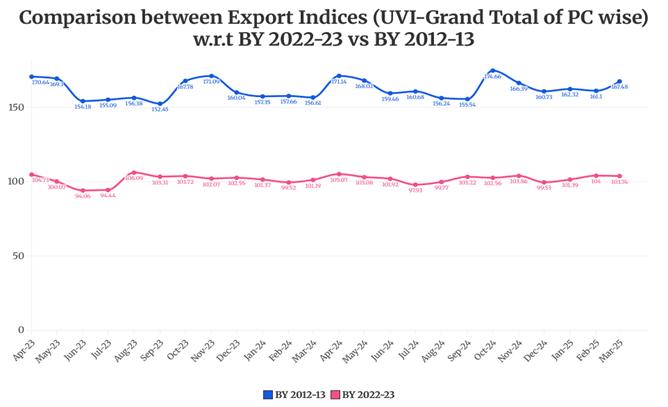
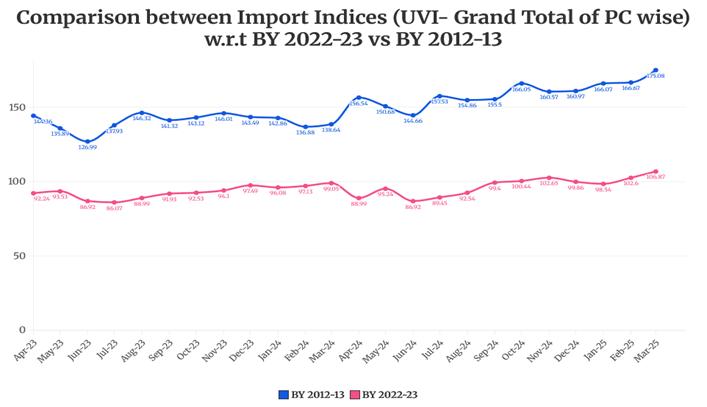
Comparison of the new revised Indices (Base Year: 2022-23) with the already released Indices (Base Year : 2012-13) for 2022-23 and 2023-24 is given below.
#BY means Base Year.
 

#BY means Base Year.

Table: Unit Value Index (UVI) and Quantity Index (QI) during FY 2025-26(Apr-Nov) using FY 2022-23 as base year


Month

Apr_25

May_25

Jun_25

1st Qtr 25-26

Jul_25

Aug_25

Sep_25

2nd Qtr 25-26

Oct_25

Nov_25

Unit Value Index

Export

105.31

99.73

96.31

100.33

99.31

100.55

104.08

101.23

103.78

105.32

Import

92.33

97.97

91.74

94.08

96.34

100.81

108.69

101.93

110.17

106.59

Quantity Index

Export

107.85

104.76

93.88

101.91

103.41

102.64

111.04

105.57

116.19

113.06

Import

138.16

126.61

112.58

125.17

122.47

124.06

126.45

124.32

137.04

121.75

Qtr  means Quarter.

Meaning and interpretation of the Indices

The Unit Value Indices and the Quantity Indices may be interpreted along the following lines.

The Unit Value Index answers the question: What is the growth in the average Unit Value of the items1 traded in the current month with respect to the same month in the Base Year?

So, an Unit Value Index of, say, 120 means that if the items that have been traded in the current month had been traded in the same month of the base year, and if the average price (or unit value) of those items had been Rs.100 in that month of the base year, then the average price (or unit value) of these items in the current month is Rs.120. Or that, there is a 20% increase in the average Unit Value, with respect to the Base Year, of the items that have been traded in the Current Month.

For example, let us suppose 30 items, 10 items each from 3 different Principal Commodities, have been traded in the current month. If these 30 items had been traded in the corresponding month of the base year at an average price of Rs.100, then the average price of these items in the current year is Rs.120.

It is to be noted that there are two successive steps of averaging done here. The first averaging is done over all the items (or ITCHS) of a PC group to arrive at the Index of that PC group. And the second averaging is done over all the PC groups to arrive at the Index at the Grand Total level for all commodities (which is the overall Index for India for a month). In both the stages, a weighted average is taken where the weights are proportional to the importance of the items and the PC groups respectively, and the Laspeyres Formula is used for averaging.

Quantity Indices, say, 200 means that if in the base year on an average 100 units were traded in India in the base year, then in the current year on an average 200 units were traded. However, it must be remembered that averaging quantities are different from averaging prices, since quantities in different units cannot be added directly.

So, the Quantity Indices are calculated by dividing the Value Indices by the Unit Value Indices. For example, if there is an increase in the Value of Export from Rs. 10,000 to Rs. 24,000, then the Value Index is 24000/10000 × 100 = 240. If the Unit Value Index is 120, then the Quantity Index comes to 240/120 × 100 = 200. So, loosely it can be said that, if the value of export has increased 2.4 times and the price of the commodities has increased 1.2 times, then the quantity must have doubled.

However, it may be noted that a very high or low Quantity Index may indicate the presence of Base Effect.

The Interpretation of the Bilateral and Regional Indices can be seen as an extension of the above.

A Unit Value Index of 120 with respect to a country, say Bangladesh, means that if all the items that have been traded with Bangladesh in the current month had been traded in the same month of the base year with the same country, and if the average price (or unit value) of those items had been Rs.100 in that month of the base year, then the average price (or unit value) of these items in the current month is Rs.120.

Similarly, a Quantity Index of 200 with respect to a country, say Bangladesh, means that if in the base year on an average 100 units were traded in India in the base year, then in the current year on an average 200 units were traded.

Comparability of the Indices across time

It is to be noted that the weights in the Index Number formula are fixed across time and there are twelve sets of weights for the twelve months. Hence, comparability of Indices is meaningful only when Indices of same month are compared across years. Different months may attach different weights to the same item, and hence comparing indices of two different months becomes vague and may have little applicability.

Further, the weights of the items that are not present in the trade basket of the current month are distributed to all the items that have been traded in the current month. This distribution is done in proportion to the weights of those items.

For example, let us suppose there are only 3 commodities for trade, say A, B and C. In month May of the Base year, let us suppose that the trade value of A was Rs. 50, B was Rs. 100 and C was Rs. 50. Then the weights assigned to A, B and C in the month of May of the following years would be in the ratio 50 :100 :50. However, in case, C is not traded in the current month, then the weight of C would be distributed proportionately among A and B, again in the ratio 1:2 (since in May the weights of A and B are in the ratio of 50 : 100, i.e., 1 : 2). So, in the current month the weights of A and B would be 3313  and 6623 .

As a result, the weights in any two given months are dependent on exactly the number of items (ITCHS codes) traded in those months. If the items traded are widely different, inference drawn from the comparison of the Indices may be done accordingly. On the other hand, more the similarity in the number of items traded more is the comparability of the two indices.

Net Terms of Trade:

Net Terms of Trade also called commodity Terms of Trade is defined as a ratio of export prices to import prices.

Let say 2022-23 be the base year and 2023-24 be the final year. We express both export and import prices in 2022-23 as 100. Now, suppose that at the end of 2023-24, it is found that the index of export prices decreased to 90 and index of import prices roses to 150. Then the Net Terms of Trade has changed to 90100150100=35 . Then terms of trade as index=35*100=60 . It implies that terms of trade of the country have decreased by about 40% in 2023-24 as compared with 2022-23. It thus shows a deterioration or a worsening of the terms of trade of the country.

If the index of export prices has risen to 150 and that of import prices had risen to 120, then the net terms of trade would have changed to 150120*100=125 . This implies an improvement in the net terms of trade of the country by 25% in 2023-24 over 2022-23.

Gross Terms of Trade:

Gross Terms of Trade is the ratio of physicalquantity of import to physical quantity of export.

Let say 2022-23 be the base year. In that year, the quantities export and import are denoted by 100. Now, suppose that in the year 2023-24, the index of quantity of import was 150 and that of quantity of export was 120. Then the gross terms of trade is given by 150100120100=54,  in terms of percentage =54*100=125 . This implies that there was an improvement of gross terms of trade by 25% in 2023-24 compared to 2022-23.

Income Terms of Trade: Income Terms of Trade is defined as- Net Terms of Trade multiplied by quantity of export.

Topics

Acts Income Tax