

Loading...

✕
Top
Help
×

By creating an account you can:

Logo TaxTMI
Call Us / Help / Feedback✕

Contact Us At :

E-mail: [email protected]

Call / WhatsApp at: +91 99117 96707

For more information, Check Contact Us

FAQs :

To know Frequently Asked Questions, Check FAQs

Most Asked Video Tutorials :

For more tutorials, Check Video Tutorials

Submit Feedback/Suggestion :

Email :
Please provide your email address so we can follow up on your feedback.
Category :
Description :
Min 15 characters 0/2000
Make Most of Text Search ✕
  1. Checkout this video tutorial: How to search effectively on TaxTMI.
  2. Put words in double quotes for exact word search, eg: "income tax"
  3. Avoid noise words such as : 'and, of, the, a'
  4. Sort by Relevance to get the most relevant document.
  5. Press Enter to add multiple terms/multiple phrases, and then click on Search to Search.
  6. Text Search
  7. The system will try to fetch results that contains ALL your words.
  8. Once you add keywords, you'll see a new 'Search In' filter that makes your results even more precise.
  9. Text Search
╳
Add to...
You have not created any category. Kindly create one to bookmark this item!
✕
Create New Category
Hide
Title :
Description :
❮❮ Hide
Default View
Expand ❯❯
Close ✕
🔎 News - Adv. Search
TEXT SEARCH:

Press 'Enter' to add multiple search terms. Rules for Better Search

Search In:
Main Text + AI Text
  • Main Text
  • Main Text + AI Text
  • AI Text
Category: ?
Categorized by AI
---- All Categories ----
  • ---- All Categories ----
  • Income Tax
  • GST
  • Customs, DGFT & SEZ
  • FEMA & RBI
  • Corp. Laws, SEBI & IBC
  • PMLA, Black Money & ED
  • Budget
  • News and Press Release
  • PTI News
Month:
---- All Months ----
  • ---- All Months ----
  • January
  • February
  • March
  • April
  • May
  • June
  • July
  • August
  • September
  • October
  • November
  • December
Year:
---- All Years ----
  • ---- All Years ----
  • 2026
  • 2025
  • 2024
  • 2023
  • 2022
  • 2021
  • 2020
  • 2019
  • 2018
  • 2017
  • 2016
  • 2015
  • 2014
  • 2013
  • 2012
  • 2011
Sort By: ?
In Sort By 'Default', exact matches for text search are shown at the top, followed by the remaining results in their regular order.
Relevance Default Date
    Punjab Assembly passes nine key bills
    Mumbai court denies nod to Nirav Modi's sister to record her statement via video link in PNB case
    'Organised loot' of Rs 2.86 lakh crore from people's pockets: Surjewala accuses govt
    Naresh Goyal seeks discharge from money laundering case; court asks prosecution to reply to plea
    Parliamentary panel seeks details on Railways’ efforts to boost domestic bullet train capabilities
    Haryana CM Saini launches MSME and Export Promotion Policy 2026
    TCS receives employee data leak alerts; says no impact to customer info
    APEDA Facilitates First-Ever Export of Mustard Honey by Dergang FPO from Tripura to Dubai
    Parliament passes The Bankers' Books Evidence Bill, 2026
    DRI uncovers another clandestine drug manufacturing unit in Maharashtra
    Delhi HC gives Kejriwal 4 weeks to respond to ED pleas against acquittal in two cases
    Pesticide residues found in 58 food samples tested in Kerala, says Minister Siddique
    DGFT Removes Physical Duty Payment Challans for Export Obligation Discharge Certificate Applications under Advance Authorisation and Export Promotion ...
    TRAI directs use of 1601-series for service, transactional calls by utilities, logistics cos
    Nagaland tax revenue rises to Rs 1,597 crore in FY'26
    India's Russian crude imports hit record for second straight month
    Stolen phone of 88-year-old leads Delhi Police to bust interstate cyber-fraud syndicate; 9 held
    Rupee falls 11 paise to close at 95.28 against US dollar on firm crude oil prices
    Loan Utsav 2026: Bajaj Finance Personal Loan Now Comes with an Exclusive Reward Bundle for Eligible Customers
    Freedom to Spend Smarter: AU Small Finance Bank Credit Cards Bring Rewards, EMI Flexibility and Lounge Access to India''s Biggest Shopping Month
❯❯
Maximize Maximize Maximize
0 / 200
Expand Note
Add to Folder

No Folders have been created

+

Are you sure you want to delete "My most important" ?

NOTE:

News
Showing Results for :
Reset Filters
Results Found:
Show All Summaries Hide All Summaries
August 10, 2026
Show AI Summary
GST refund facilitation expands provisional input tax credit refunds and removes the minimum threshold for export-related IGST refunds.
Punjab's GST amendments facilitate voluntary compliance and reduce procedural burdens by allowing a 90 per cent provisional input tax credit refund in inverted duty structure cases and removing the minimum threshold for IGST refunds on exported goods. Additional measures cap annual fee increases by private unaided educational institutions, establish digital open universities for technology-enabled higher education, protect trees and green cover, and address common infrastructure, panchayati raj, and contractual engagement of outsourced State personnel.
August 10, 2026
Show AI Summary
Video-conference statements for an approver application were declined, requiring the accused's statement to be recorded before consideration.
Special CBI Court rejected an accused's request to record her statement through video conferencing in a bank-fraud prosecution. The accused had sought to become an approver, and her statement was required to be recorded before consideration of that application. She and her husband had previously become approvers in a related money-laundering matter involving alleged fraudulent Letters of Undertaking.
August 10, 2026
Show AI Summary
Fuel price transparency highlights allegations over excise duty, consumer retail costs, and profit disclosures by state-run oil marketing companies.
Fuel pricing, central excise duty and profits of state-run oil marketing companies are examined through allegations that retail fuel prices and tax policy imposed excessive costs on consumers while generating substantial company profits. The criticism contrasts high crude-price periods with lower retail prices and lower excise duty against a later period in which reduced crude prices were allegedly not passed through to consumers. Profit-margin disclosure is also raised as a transparency issue, with parliamentary information described as covering oil prices, global crude prices and company profits.
August 10, 2026
Show AI Summary
Discharge in money-laundering proceedings turns on whether pre-charge material sufficiently establishes the alleged offence.
Discharge in a money-laundering prosecution was sought before a special PMLA court concerning alleged siphoning and laundering of loans advanced to Jet Airways by Canara Bank. The prosecution was directed to respond, subject to the applicant not seeking adjournment. Discharge is available after filing of a chargesheet and before framing of charges where the material before the court is insufficient to establish the alleged offence. The proceedings arise from a CBI FIR concerning alleged bank fraud involving Jet Airways and associated persons.
August 10, 2026
Show AI Summary
High-speed rail indigenisation and infrastructure performance monitoring require skills development, comparative planning, measurable station assessments and freight-terminal dashboards.
Parliamentary oversight calls for accelerated indigenisation of high-speed rail components, capacity-building through international expertise, and comparative study of successful high-speed rail systems for future corridors. Redeveloped stations should be assessed through measurable indicators concerning passenger use, accessibility, cleanliness, commercial occupancy, maintenance and feedback, with completed-project practices documented and shared. Operational cargo terminals and cargo-related facilities should be monitored through a digital dashboard covering utilisation, rake performance, mechanisation, connectivity, safety compliance and customer satisfaction.
August 10, 2026
Show AI Summary
MSME and export promotion framework expands finance, technology, infrastructure, sustainability and global-market support for enterprise growth.
Haryana Progressive MSME and Export Promotion Policy 2026 creates a five-year framework for MSME growth through financial incentives, institutional support, industrial infrastructure, technology adoption and export facilitation. Identified thrust-sector enterprises may receive capital and interest subsidies, stamp duty reimbursement, employment assistance, insurance support, and incentives for automation, artificial intelligence, testing and research. Proposed venture capital and credit guarantee funds seek to improve institutional and collateral-free finance. Export support covers international certifications, credit, insurance, freight, e-commerce, trade fairs, documentation, compliance and buyer connections, alongside sustainability and inclusive entrepreneurship measures.
August 10, 2026
Show AI Summary
Employee data exposure alerts trigger review of alleged password spraying and MFA fatigue, with customer and operational systems unaffected.
Employee data exposure alerts prompted TCS to review allegations concerning limited basic employee information that appears to be more than four years old. No indication exists that customer data, customer systems, or operational systems have been affected. The alleged vectors involve password spraying and multi-factor authentication fatigue. TCS states that safeguards against these techniques have been in place for more than two years, its controls remain effective, and monitoring and further assessment will continue.
August 10, 2026
Show AI Summary
Mustard honey export demonstrates FPO-led aggregation, quality-focused production and industry collaboration for international agricultural market access.
Mustard honey export from Tripura to Dubai marks the first international shipment by Dergang Farmer Producer Organisation, supported through export-oriented aggregation and market linkage initiatives. The export creates overseas market access for local beekeepers and farmers, diversifies the honey value chain, and encourages quality-focused production. Industry collaboration supported bee production and an export-oriented supply chain, while capacity building, quality assurance, value addition and market linkages can strengthen agricultural exports and farmer participation in international markets.
August 10, 2026
Show AI Summary
Digital banking evidence gains recognition through a modernised framework for physical and electronic records, with privacy and security safeguards.
The Bankers' Books Evidence Bill, 2026, modernises the evidentiary framework for bankers' books by permitting banking records to be produced in physical or electronic form in legal proceedings. It recognises electronic, digital and virtual records and enables the Central Government to extend the regime to other regulated financial entities, supporting a uniform financial-sector evidentiary framework. The framework seeks secure and transparent use of banking records while safeguarding customer privacy, confidentiality and data security.
August 10, 2026
Show AI Summary
Illicit opioid medicine exports exposed through concealed cargo, clandestine manufacturing, repacking, and attempted transnational trafficking to Nigeria.
Illicit manufacture and attempted export of controlled opioid medicines were detected in a network producing, concealing, storing and exporting Tramadol Hydrochloride tablets to Nigeria. A consignment declared as Pregabalin capsules contained concealed Tramadol Hydrochloride and Tapentadol tablets. Investigation identified clandestine manufacture, repacking and preparation for export, with searches yielding tablet-compression machinery and raw materials. Tramadol is a psychotropic substance under the Narcotic Drugs and Psychotropic Substances Act, while Tapentadol is regulated under the Drugs and Cosmetics Act and its rules.
August 10, 2026
Show AI Summary
Summons compliance under anti-money-laundering law faces appellate scrutiny after acquittal over unproven email service allegations.
Delhi High Court required Arvind Kejriwal to reply to Enforcement Directorate petitions challenging his acquittal in proceedings concerning alleged non-compliance with summonses. The trial court found that the agency had not proved intentional disobedience, service of summons through email, or lawful issuance of electronic summons under the Prevention of Money Laundering Act. The appellate challenge concerns proof of service, validity of electronic summons, and intentional non-compliance.
August 10, 2026
Show AI Summary
Pesticide residue concerns drive organic farming, school agriculture initiatives, infrastructure financing and climate-resilience support for farmers.
Food-safety concerns arising from pesticide residues and toxic substances are to be addressed through organic vegetable farming, household cultivation and the Kathir school-farming initiative. Kathir provides for institutional farming, teacher and committee support, markets, student training and clubs, with possible academic weightage for agricultural participation. Agricultural infrastructure financing supports post-harvest management, value addition, processing, packing, marketing and exports. Additional measures include banking support, agricultural technology adoption, women-farmer support and schemes addressing climate-related floods and drought.
August 10, 2026
Show AI Summary
Digital EODC processing removes physical duty challans through authenticated payment verification for export authorisation closure.
Export Obligation Discharge Certificate processing under the Advance Authorisation and Export Promotion Capital Goods schemes no longer requires physical duty-payment challans for voluntary customs-duty payments made on or after 1 August 2026. Authenticated licence-wise payment information is electronically transmitted from Customs/ICEGATE to DGFT systems and mapped to the relevant authorisation. Exporters can verify payment details on the customer portal, while Regional Authorities use corresponding back-office records, replacing manual submission and verification for authorisation closure.
August 10, 2026
Show AI Summary
Trusted service-call numbering requires verified utilities and logistics entities to use dedicated numbers exclusively for transactional and service communications.
The 1601-series is introduced for verified utilities, courier and logistics entities making service and transactional voice calls. Numbers must be allocated directly to eligible entities, not intermediaries or aggregators, following verification by telecom service providers and an undertaking of exclusive use. Promotional voice calls are prohibited on this series and remain associated with the 140-series. The framework separates these calls from the 1600-series reserved for regulated financial-sector and government-to-citizen communications, supporting consumer recognition of legitimate calls and reducing impersonation risks.
August 10, 2026
Show AI Summary
GST revenue collection drives tax growth while data scrutiny, taxpayer verification, and compliance capacity remain key administrative priorities.
GST constituted the principal component of tax revenue for the 2025-26 fiscal year. Tax administration faces staff shortages, information-technology upgrade needs, and increased workloads from taxpayer registrations and return filings. Compliance oversight requires GST data scrutiny, risk assessment, identification of unregistered taxpayers, tax-evasion detection, and field verification of high-risk taxpayers. Long-term revenue planning sets progressively higher collection targets through 2063.
August 10, 2026
Show AI Summary
Russian crude imports reshape India's refining trade as processed petroleum products reach sanctioning jurisdictions despite import restrictions.
Indian imports of Russian crude oil reached a second consecutive monthly record in July 2026, with Russian crude forming the dominant share of India's Russian fossil-fuel purchases and more than half of total crude imports. Higher receipts through smaller terminals offset reduced volumes at Paradip. Indian refineries processing Russian crude also exported refined petroleum products to sanctioning jurisdictions, including the European Union, Australia and the United States, despite the European Union prohibition on imports of oil products made from Russian crude.
August 10, 2026
Show AI Summary
Cyber-fraud through stolen phones allegedly used mule accounts, banking credentials and coordinated technical operations to divert victims' funds.
Investigation into unauthorised withdrawals after theft of a mobile phone uncovered an alleged interstate cyber-fraud network using stolen devices, linked banking credentials and mule bank accounts. The scheme allegedly involved phone theft, supply of accounts and banking instruments, and a technical operation that accessed victims' accounts and routed funds for withdrawal or transfer. Digital surveillance, transaction mapping, seized devices, victim data and transaction records are being examined to identify linked complaints and the extent of funds allegedly diverted.
August 10, 2026
Show AI Summary
Rupee depreciation reflected stronger dollar, elevated crude prices and geopolitical uncertainty, while portfolio inflows and equity gains provided support.
The rupee depreciated against the US dollar amid a stronger dollar, higher global crude oil prices and uncertainty surrounding West Asia-related negotiations. Concerns over crude oil's potential impact on the trade deficit weighed on the currency, while positive domestic equity markets and foreign portfolio investment inflows provided support. Market caution remained focused on forthcoming US inflation data, dollar-index movements and Brent crude prices. Foreign-exchange reserves increased during the reported period.
August 10, 2026
Show AI Summary
Collateral-free personal loans offer extended repayment flexibility, conditional reward benefits, and online application subject to eligibility and disbursal requirements.
Loan Utsav 2026 provides eligible Bajaj Finance Personal Loan applicants an exclusive reward bundle where the loan is successfully disbursed during the campaign period. The collateral-free facility supports personal expenses, offers repayment tenures from 12 to 108 months, and may enable lower monthly EMI obligations through a longer selected tenure. Interest rates depend on eligibility, credit assessment, financial profile and lending criteria. Online applications require personal and financial details and required documents, with disbursal for eligible applicants possible after verification and approval.
August 10, 2026
Show AI Summary
Credit card payment flexibility supports seasonal shopping and travel through eligible EMIs, rewards, tracking tools and conditional merchant benefits.
Credit-card spending features include conversion of eligible purchases into EMIs, selected no-cost EMI options, reward points, cashback, merchant discounts and payment flexibility. Travel-related benefits may include domestic airport lounge access, travel-booking discounts, fuel-surcharge waiver and anniversary-linked rewards. The AU 0101 application enables transaction tracking, balance and interest-rate monitoring, EMI conversion and bill-payment management. Features and offers are subject to change, customer eligibility, internal policies and partner-merchant terms.

News

Back

All News

Showing Results for :
Reset Filters
No Records Found

News

Back

All News

Showing Results for : Reset Filters
Customs, DGFT & SEZ

Directorate General of Commercial Intelligence and Statistics Revises Base Year of Merchandise Trade Indices to FY 2022–23 to Reflect Current Trade Structure and Global Patterns

February 21, 2026

Contents
Summary
Note

Note

-

Bookmark

Print

Print

Merchandise Trade Indices are compiled and published by the Directorate General of Commercial Intelligence and Statistics (DGCI&S), Ministry of Commerce & Industry, to measure changes in the unit values (prices) of India’s exports and imports over time. These indices serve as important indicators of external sector price movements and are widely used for economic analysis, including national accounts compilation and assessment of terms of trade. Over the years, the base year of the indices has been periodically revised to reflect structural changes in India’s trade composition and evolving global trade patterns. The most recent revision updates the base year to FY 2022–23 (2022–23 = 100), replacing the earlier base of FY 2012–13, thereby ensuring that the indices accurately represent the current structure of India’s merchandise trade.

Revision of Base Year of India’s Merchandise Trade Indices to FY 2022–23

The Directorate General of Commercial Intelligence and Statistics (DGCI&S), Ministry of Commerce & Industry, has revised the base year of India’s Merchandise Trade Indices from FY 2012–13 to FY 2022–23 (2022–23 = 100), in view of the structural changes in the economy, shifts in commodity composition, evolving trade patterns, and the need for improved alignment with contemporary macroeconomic indicators.

The revision has been undertaken on the recommendations of a committee constituted by DGCI&S under the Chairmanship of Prof. Nachiketa Chattopadhyay, Professor, Indian Statistical Institute, Kolkata. The Committee examined the existing methodology, data coverage, weighting structure, and compilation practices, and recommended suitable refinements in line with international best practices.

Key Features of the Revised Series (Base: FY 2022–23)

  1. Updated Base Year:
    The new base year FY 2022–23 makes the Indices reflect the current structure of India’s external trade more accurately.
  2. Revised Commodity Basket:
    The coverage and classification of commodities have been reviewed at the Principal Commodity level to better capture emerging and declining trade items.
  3. Revised Weighting Structure:
    Weights have been updated based on trade values of the new base year to reflect the latest value shares in exports and imports.
  4. Improved Methodology:
    Methodological refinements have been introduced in:
    1. Selection of common commodity basket for base year selection (procedure of selection for common commodity basket explained in detail report of the committee).
    2. Treatment of missing unit values (Imputation of missing unit values in base year selection have been explained in detail in the committee report).
  5. Indices Compiled:
    The revised series includes:
    1. Monthly, Quarterly and Annual Indices (Export Unit Value Index,Import Unit Value Index).
    2. Principal Commodity (PC) Classification wise Trade Indices (Export/Import).
    3. Standard International Trade Classification-wise (SITC) Trade Indices.
    4. Broad economic categories-wise (BEC) Trade Indices.
    5. Bilateral and Region-wise Trade Indices of Top 20 Export and Import partner nations of India.
    6. Terms of Trade (Gross terms of trade, Net terms of trade and Income terms of trade).

Rationale for Revision

Over the past decade, India’s trade basket has undergone substantial changes due to emergence of new commodities, technological advancements, Global supply chain restructuring and changes in relative price structures.

The earlier base year (FY 2012–13) no longer adequately reflected the prevailing trade structure. The revision ensures improved relevance, reliability, and analytical usefulness of the Merchandise Trade Indices for policymakers, researchers, and other stakeholders.

Use of the Revised Series

Merchandise Trade Indices compiled by the Directorate General of Commercial Intelligence and Statistics (DGCI&S) are extensively used by key government institutions for economic analysis and policy formulation. The National Accounts Division (NAD) of the Ministry of Statistics and Programme Implementation uses the Export and Import Unit Value Indices as deflators for estimating real exports and imports in GDP compilation. The Reserve Bank of India (RBI) relies on these indices for external sector assessment, balance of payments analysis, and evaluation of price competitiveness. Various Ministries and Government agencies also use them to frame and review trade-related policies and to assess movements in international prices. In addition, academic institutions, research organizations, and economic analysts utilize Merchandise Trade Indices for empirical research, modelling, and analysis of trade dynamics and terms of trade trendson and economic research.

Availability of Data

The revised Merchandise Trade Indices (Base: FY 2022–23) will be released on the official website of DGCI&S. Detailed methodological documentation is available in the Report of the Committee on Revision of Base Year for Merchandise Trade Indices.

Comparison of the new revised Indices (Base Year: 2022-23) with the already released Indices (Base Year : 2012-13) for 2022-23 and 2023-24 is given below.
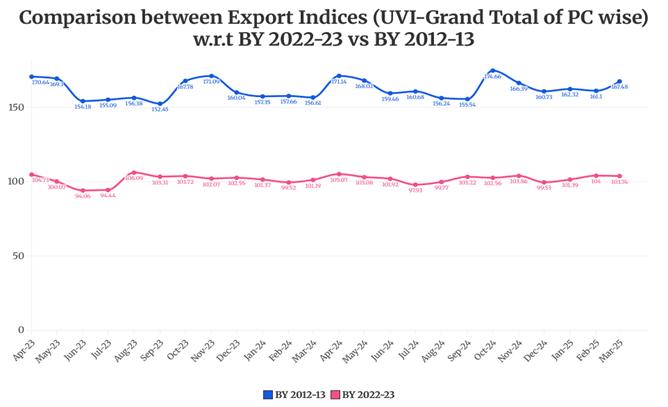
#BY means Base Year.
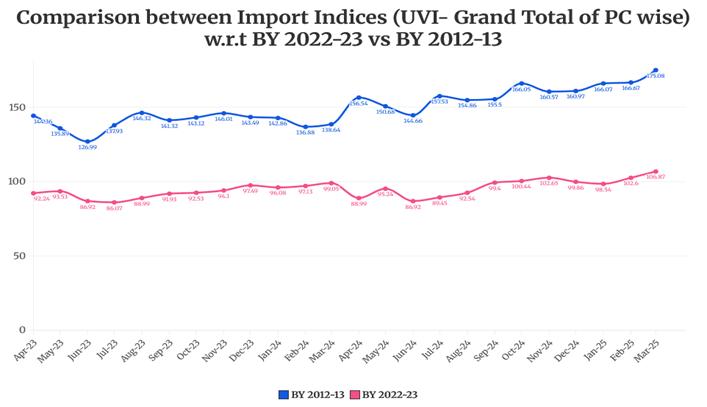
 

#BY means Base Year.

Table: Unit Value Index (UVI) and Quantity Index (QI) during FY 2025-26(Apr-Nov) using FY 2022-23 as base year


Month

Apr_25

May_25

Jun_25

1st Qtr 25-26

Jul_25

Aug_25

Sep_25

2nd Qtr 25-26

Oct_25

Nov_25

Unit Value Index

Export

105.31

99.73

96.31

100.33

99.31

100.55

104.08

101.23

103.78

105.32

Import

92.33

97.97

91.74

94.08

96.34

100.81

108.69

101.93

110.17

106.59

Quantity Index

Export

107.85

104.76

93.88

101.91

103.41

102.64

111.04

105.57

116.19

113.06

Import

138.16

126.61

112.58

125.17

122.47

124.06

126.45

124.32

137.04

121.75

Qtr  means Quarter.

Meaning and interpretation of the Indices

The Unit Value Indices and the Quantity Indices may be interpreted along the following lines.

The Unit Value Index answers the question: What is the growth in the average Unit Value of the items1 traded in the current month with respect to the same month in the Base Year?

So, an Unit Value Index of, say, 120 means that if the items that have been traded in the current month had been traded in the same month of the base year, and if the average price (or unit value) of those items had been Rs.100 in that month of the base year, then the average price (or unit value) of these items in the current month is Rs.120. Or that, there is a 20% increase in the average Unit Value, with respect to the Base Year, of the items that have been traded in the Current Month.

For example, let us suppose 30 items, 10 items each from 3 different Principal Commodities, have been traded in the current month. If these 30 items had been traded in the corresponding month of the base year at an average price of Rs.100, then the average price of these items in the current year is Rs.120.

It is to be noted that there are two successive steps of averaging done here. The first averaging is done over all the items (or ITCHS) of a PC group to arrive at the Index of that PC group. And the second averaging is done over all the PC groups to arrive at the Index at the Grand Total level for all commodities (which is the overall Index for India for a month). In both the stages, a weighted average is taken where the weights are proportional to the importance of the items and the PC groups respectively, and the Laspeyres Formula is used for averaging.

Quantity Indices, say, 200 means that if in the base year on an average 100 units were traded in India in the base year, then in the current year on an average 200 units were traded. However, it must be remembered that averaging quantities are different from averaging prices, since quantities in different units cannot be added directly.

So, the Quantity Indices are calculated by dividing the Value Indices by the Unit Value Indices. For example, if there is an increase in the Value of Export from Rs. 10,000 to Rs. 24,000, then the Value Index is 24000/10000 × 100 = 240. If the Unit Value Index is 120, then the Quantity Index comes to 240/120 × 100 = 200. So, loosely it can be said that, if the value of export has increased 2.4 times and the price of the commodities has increased 1.2 times, then the quantity must have doubled.

However, it may be noted that a very high or low Quantity Index may indicate the presence of Base Effect.

The Interpretation of the Bilateral and Regional Indices can be seen as an extension of the above.

A Unit Value Index of 120 with respect to a country, say Bangladesh, means that if all the items that have been traded with Bangladesh in the current month had been traded in the same month of the base year with the same country, and if the average price (or unit value) of those items had been Rs.100 in that month of the base year, then the average price (or unit value) of these items in the current month is Rs.120.

Similarly, a Quantity Index of 200 with respect to a country, say Bangladesh, means that if in the base year on an average 100 units were traded in India in the base year, then in the current year on an average 200 units were traded.

Comparability of the Indices across time

It is to be noted that the weights in the Index Number formula are fixed across time and there are twelve sets of weights for the twelve months. Hence, comparability of Indices is meaningful only when Indices of same month are compared across years. Different months may attach different weights to the same item, and hence comparing indices of two different months becomes vague and may have little applicability.

Further, the weights of the items that are not present in the trade basket of the current month are distributed to all the items that have been traded in the current month. This distribution is done in proportion to the weights of those items.

For example, let us suppose there are only 3 commodities for trade, say A, B and C. In month May of the Base year, let us suppose that the trade value of A was Rs. 50, B was Rs. 100 and C was Rs. 50. Then the weights assigned to A, B and C in the month of May of the following years would be in the ratio 50 :100 :50. However, in case, C is not traded in the current month, then the weight of C would be distributed proportionately among A and B, again in the ratio 1:2 (since in May the weights of A and B are in the ratio of 50 : 100, i.e., 1 : 2). So, in the current month the weights of A and B would be 3313  and 6623 .

As a result, the weights in any two given months are dependent on exactly the number of items (ITCHS codes) traded in those months. If the items traded are widely different, inference drawn from the comparison of the Indices may be done accordingly. On the other hand, more the similarity in the number of items traded more is the comparability of the two indices.

Net Terms of Trade:

Net Terms of Trade also called commodity Terms of Trade is defined as a ratio of export prices to import prices.

Let say 2022-23 be the base year and 2023-24 be the final year. We express both export and import prices in 2022-23 as 100. Now, suppose that at the end of 2023-24, it is found that the index of export prices decreased to 90 and index of import prices roses to 150. Then the Net Terms of Trade has changed to 90100150100=35 . Then terms of trade as index=35*100=60 . It implies that terms of trade of the country have decreased by about 40% in 2023-24 as compared with 2022-23. It thus shows a deterioration or a worsening of the terms of trade of the country.

If the index of export prices has risen to 150 and that of import prices had risen to 120, then the net terms of trade would have changed to 150120*100=125 . This implies an improvement in the net terms of trade of the country by 25% in 2023-24 over 2022-23.

Gross Terms of Trade:

Gross Terms of Trade is the ratio of physicalquantity of import to physical quantity of export.

Let say 2022-23 be the base year. In that year, the quantities export and import are denoted by 100. Now, suppose that in the year 2023-24, the index of quantity of import was 150 and that of quantity of export was 120. Then the gross terms of trade is given by 150100120100=54,  in terms of percentage =54*100=125 . This implies that there was an improvement of gross terms of trade by 25% in 2023-24 compared to 2022-23.

Income Terms of Trade: Income Terms of Trade is defined as- Net Terms of Trade multiplied by quantity of export.

Topics

Acts Income Tax