

Loading...

Top
Help
×

By creating an account you can:

Logo TaxTMI
Call Us / Help / Feedback

Contact Us At :

E-mail: [email protected]

Call / WhatsApp at: +91 99117 96707

For more information, Check Contact Us

FAQs :

To know Frequently Asked Questions, Check FAQs

Most Asked Video Tutorials :

For more tutorials, Check Video Tutorials

Submit Feedback/Suggestion :

Email :
Please provide your email address so we can follow up on your feedback.
Category :
Description :
Min 15 characters 0/2000
Make Most of Text Search
  1. Checkout this video tutorial: How to search effectively on TaxTMI.
  2. Put words in double quotes for exact word search, eg: "income tax"
  3. Avoid noise words such as : 'and, of, the, a'
  4. Sort by Relevance to get the most relevant document.
  5. Press Enter to add multiple terms/multiple phrases, and then click on Search to Search.
  6. Text Search
  7. The system will try to fetch results that contains ALL your words.
  8. Once you add keywords, you'll see a new 'Search In' filter that makes your results even more precise.
  9. Text Search
Add to...
You have not created any category. Kindly create one to bookmark this item!
Create New Category
Hide
Title :
Description :
❮❮ Hide
Default View
Expand ❯❯
Close ✕
🔎 News - Adv. Search
TEXT SEARCH:

Press 'Enter' to add multiple search terms. Rules for Better Search

Search In:
Main Text + AI Text
  • Main Text
  • Main Text + AI Text
  • AI Text
Category: ?
Categorized by AI
---- All Categories ----
  • ---- All Categories ----
  • Income Tax
  • GST
  • Customs, DGFT & SEZ
  • FEMA & RBI
  • Corp. Laws, SEBI & IBC
  • PMLA, Black Money & ED
  • Budget
  • News and Press Release
  • PTI News
Month:
---- All Months ----
  • ---- All Months ----
  • January
  • February
  • March
  • April
  • May
  • June
  • July
  • August
  • September
  • October
  • November
  • December
Year:
---- All Years ----
  • ---- All Years ----
  • 2026
  • 2025
  • 2024
  • 2023
  • 2022
  • 2021
  • 2020
  • 2019
  • 2018
  • 2017
  • 2016
  • 2015
  • 2014
  • 2013
  • 2012
  • 2011
Sort By: ?
In Sort By 'Default', exact matches for text search are shown at the top, followed by the remaining results in their regular order.
Relevance Default Date
    Modi warns of weaponisation of resources, sea routes; urges energy self-reliance
    Current account deficit widens to USD 6.2 bn in Jun: RBI data
    Concessional swap facility attracts USD 56.85 bn forex inflows: RBI
    DFS Highlights Mechanism for Timely Redressal of Insurance Policyholders’ Grievances
    Forex kitty jumps USD 14.14 bn to USD 707 bn in one of the biggest weekly expansions
    PROVISIONAL ESTIMATES OF WHOLESALE PRICE INDEX, OUTPUT PRODUCER PRICE INDEX, AND TRIAL INPUT PRODUCER PRICE INDEX FOR THE MONTH OF JULY 2026, AND FINA...
    Logistics Data Bank Tracks 10 Crore EXIM Containers, Provides Visibility across Logistics Chain
    APEDA and Government of Tripura Organise International Organic Buyer-Seller Meet to Expand Global Market Linkages
    WPI inflation eases to 9.78 pc in July on softening in fuel prices
    IDFC FIRST Bank secures its first international rating with Investment Grade from S&P Global Ratings
    DRI busts illegal drug manufacturing facility in Jewar, UP; 30 kg drugs seized and two persons arrested
    UCO Bank launches IFSC Banking Unit at GIFT City
    Banking sector has key role to play as India on way to become 3rd largest economy: Gujarat CM
    India's exports to US rise 12.85 pc in Jul; shipments to China jump 64.57 pc: Govt data
    50 tonnes of copper without e-way bills seized by Delhi GST, Railways joint team
    India's exports surge 19.6 pc in Jul; trade deficit widens to six-month high
    CBI ARRESTS CGST SUPERINTENDENT IN BRIBERY CASE
    The cumulative exports (merchandise & services) during April-July 2026-27 is estimated at US$ 316.42 Billion, as compared to US$ 279.63 Billion in Apr...
    Unlimit Mobile Ties Up with ICICI Bank Canada, RBC Royal Bank to Add Mobile Connectivity Benefits to Student GIC Journey
    Standard Chartered Accelerates India's GCC Growth with its Global Banking Expertise and 25 Years of GCC Experience
❯❯
Maximize Maximize Maximize
0 / 200
Expand Note
Add to Folder

No Folders have been created

+

Are you sure you want to delete "My most important" ?

NOTE:

News
Showing Results for :
Reset Filters
Results Found:
Show All Summaries Hide All Summaries
August 15, 2026
Show AI Summary
Energy self-reliance drives diversified fuel sourcing, expanded offshore exploration, and domestic capacity to reduce geopolitical supply vulnerability.
Energy security policy seeks to reduce exposure to geopolitical pressure and supply disruption caused by dependence on overseas fuel and strategic maritime routes. India is diversifying crude oil and LNG sourcing while strengthening domestic hydrocarbon production through offshore exploration, seismic surveys, exploratory drilling and shared infrastructure. Expanded access to sedimentary basins is intended to unlock domestic oil and gas resources. Wider piped natural gas coverage, solar generation, critical-mineral exploration, and nuclear and other non-fossil energy sources support the broader objective of energy self-reliance.
August 14, 2026
Show AI Summary
Current account deficit widened as merchandise trade imbalance expanded, despite stronger services surplus, transfers, and positive capital inflows.
India's current account deficit widened in June 2026, principally because merchandise imports increased faster than exports and expanded the merchandise trade deficit. A higher services surplus, increased net transfers and a narrower net income deficit provided partial offsets. Net capital inflows, including foreign direct investment and foreign portfolio investment, supported a positive overall monthly balance. During the April-June quarter, despite increased services surplus and net transfers, the overall balance shifted to a deficit as the merchandise trade deficit widened.
August 14, 2026
Show AI Summary
Concessional foreign-currency swap facility closes early for new FCNR(B) deposits while ECB and OFCB access remains available.
The concessional swap facility for FCNR(B) deposits encourages foreign-currency inflows and supports foreign-exchange liquidity. New FCNR(B) deposits eligible for the facility must be mobilised by 31 August 2026, while swaps for eligible deposits may be availed until 11 September 2026. The swap arrangement for External Commercial Borrowings and Overseas Foreign Currency Borrowings remains available until 31 December 2026.
August 14, 2026
Show AI Summary
Insurance grievance redressal requires initial insurer complaint, prompt acknowledgement, and escalation through integrated monitoring channels when resolution remains unsatisfactory.
Insurance policyholder grievances must first be raised with the concerned insurer, whose Grievance Redressal Officer and Board-level monitoring committee oversee redressal. Complaints received through digital channels, correspondence or call centres are recorded in the insurer's Complaints Management System, integrated with Bima Bharosa. Insurers must acknowledge complaints immediately and resolve them within 14 days. Where no response is received within a reasonable period or the response is unsatisfactory, policyholders may escalate through Bima Bharosa or designated helplines, email or physical correspondence.
August 14, 2026
Show AI Summary
Foreign exchange reserve growth reflects increases in foreign currency assets, gold holdings, special drawing rights, and IMF reserve position.
India's foreign exchange reserves rose to USD 707.002 billion for the week ended 7 August 2026. The increase comprised higher foreign currency assets, gold reserves, special drawing rights and the reserve position with the IMF. Foreign currency asset valuation incorporates appreciation or depreciation of non-US currencies held in reserve assets. Measures including the FCNR(B) scheme were introduced to attract additional foreign exchange inflows.
August 14, 2026
Show AI Summary
Wholesale and producer price indices show July inflation movements, provisional estimates, final revisions, and manufacturing input-price trends.
Wholesale Price Index, Output Producer Price Index, and trial Input Producer Price Index estimates under the 2022-23 base-year series set out provisional July 2026 measures and final May 2026 revisions. All-commodities WPI stood at 110.0 in July 2026, with year-on-year inflation of 9.78 per cent. The all-commodities Output PPI was unchanged at 109.9, while the trial Input PPI for manufacturing was provisionally estimated at 105.9. Final May WPI, Output PPI and trial Input PPI measures were revised from their respective provisional estimates.
August 14, 2026
Show AI Summary
Logistics data visibility enables EXIM container tracking, operational analytics and multimodal shipment monitoring across India's logistics chain.
Logistics Data Bank provides near real-time visibility of India's EXIM container movement through technology-based tracking and stakeholder monitoring tools. RFID-based coverage extends across ports, terminals, inland logistics facilities, rail networks, industrial zones, borders and highways. The platform uses RFID, Internet of Things, Big Data and Cloud technologies, with analytics on dwell time, transit time, and port and terminal performance to identify logistics bottlenecks. LDB 2.0 adds high-seas tracking of export containers and multimodal shipment visibility.
August 14, 2026
Show AI Summary
International organic buyer-seller linkages support Tripura producers through direct sourcing engagement, market access and sustainable export opportunities.
International Organic Buyer-Seller Meet in Tripura created a direct platform for organic producers, Farmer Producer Organisations, exporters and international buyers to explore sourcing opportunities, market requirements and long-term commercial linkages. Organic and naturally produced goods, including Queen Pineapple, GI-tagged Kalikhasa Rice, organic ginger and turmeric, black sesame, jackfruit and scented lemon, were showcased through product displays and producer interactions. The initiative seeks to strengthen global market access, sourcing partnerships and income opportunities for organic farmers.
August 14, 2026
Show AI Summary
Wholesale price inflation moderation was driven by softer fuel prices, while manufactured goods and primary articles recorded higher inflation.
Wholesale price inflation moderated in July, led by a decline in fuel and power inflation and a marginal easing in food-article inflation. Inflation in manufactured products and primary articles increased, making the moderation uneven across groups. Mineral oils, food articles, basic metals, non-food articles, food products, and chemical products remained significant inflation drivers. The output Producer Price Index remained unchanged year-on-year, with lower manufacturing and mining inflation offset by higher agriculture and electricity producer-price inflation.
August 14, 2026
Show AI Summary
International investment-grade issuer ratings support expanded foreign-currency funding, trade finance, correspondent banking and cross-border financial market access.
IDFC FIRST Bank's inaugural international investment-grade issuer credit ratings, with a stable outlook, are expected to improve access to international funding markets and global financial counterparties. The rating is intended to support standby letter of credit lines, foreign-currency funding through its GIFT City International Banking Unit, mobilisation of FCNR(B) deposits, correspondent banking relationships and cross-border trade finance. Strong capitalisation, improving profitability, stable asset quality and a granular retail funding profile underpin the outlook.
August 14, 2026
Show AI Summary
Clandestine psychotropic drug manufacturing faces enforcement targeting precursor chemicals, concealed laboratories, illicit production networks and trafficking operations.
Enforcement action against clandestine manufacture of psychotropic substances led to the detection of a residential drug-production facility. Searches recovered amphetamine and intermediary forms, precursor chemicals, reagents, raw materials, and manufacturing equipment. Field testing indicated the presence of amphetamine, a psychotropic substance regulated under the Narcotic Drugs and Psychotropic Substances Act, 1985. The recovered apparatus and materials indicated illicit manufacture, while preliminary investigation pointed to short-term, intermittently operated facilities intended to conceal production activities.
August 13, 2026
Show AI Summary
International banking unit expands cross-border financing, trade finance and foreign-currency service access through GIFT City operations.
UCO Bank has launched an International Financial Services Centre Banking Unit at GIFT City to provide permitted international banking services. The unit offers trade finance, external commercial borrowings, foreign-currency loans, loan syndication, treasury services and other permitted financial services. It serves Indian corporates, exporters, importers, financial institutions, overseas businesses and other eligible customers requiring cross-border financing and access to global financial markets. FCNR(B) deposits are also offered through the unit.
August 13, 2026
Show AI Summary
Last-mile credit access is prioritised through timely lending, wider beneficiary coverage, digital support and stronger fraud vigilance.
Banking-sector participation is emphasised through last-mile credit access for MSMEs, women entrepreneurs, rural artisans, small farmers and other underserved beneficiaries. Banks are urged to expedite government-scheme applications, maximise coverage and use technology for timely financial support. Industrial-policy assistance and incentives cover startups, SC/ST entrepreneurs, persons with disabilities and first-generation entrepreneurs. Greater coordination, expanded village banking access, and vigilance against cyber fraud and mule accounts are also prioritised.
August 13, 2026
Show AI Summary
Merchandise trade growth saw rising exports to major markets alongside increased imports and continuing United States trade-pact negotiations.
India's merchandise trade data records increased July exports to the United States and China, alongside growth in imports from both markets. Exports to Singapore, the United Arab Emirates, the Netherlands, Germany, South Africa, Tanzania, Australia, Malaysia, Sri Lanka, Italy and Vietnam showed positive growth, while July exports declined for the United Kingdom, Bangladesh, Saudi Arabia and Nepal. Imports also increased from Russia, Korea, Singapore, Germany, Oman, Malaysia, Taiwan and Brazil. India and the United States are negotiating a trade pact amid an additional United States tariff on India.
August 13, 2026
Show AI Summary
GST transport documentation enforcement addresses freight movement of metals without valid e-way bills and invoices under applicable rules.
GST enforcement action led to the seizure of copper and aluminium ingots transported by freight train without valid e-way bills and invoices. The metals were found in three train wagons during inspection of parcel cargo. Further proceedings are to be undertaken under applicable GST rules concerning movement of goods without prescribed transport documentation.
August 13, 2026
Show AI Summary
Merchandise trade deficit widens as import growth outpaces exports despite strong petroleum, electronics and engineering shipments.
Merchandise trade in July 2026 saw exports rise 19.63 per cent and imports increase 17.52 per cent, widening the trade deficit to a six-month high. Petroleum products, electronics, engineering goods and marine goods supported export growth, while crude oil and several commodity and capital-goods categories increased imports. During April-July 2026-27, faster import growth widened the cumulative merchandise trade deficit compared with the corresponding prior-year period.
August 13, 2026
Show AI Summary
Bribery allegations in GST enforcement prompted arrest after alleged payment demand to avoid a tax-liability notice.
Bribery allegations involving GST enforcement led to the arrest of a CGST Superintendent after a complaint alleged that payment was demanded from a private company to avoid issuance of a tax-liability demand notice and to close the matter. A trap operation resulted in the public servant being apprehended while allegedly accepting part of the demanded bribe, and the amount accepted was recovered. Searches were undertaken, and investigation remained ongoing.
August 13, 2026
Show AI Summary
Trade performance shows rising merchandise and services exports, but faster import growth expands the overall trade deficit.
India's combined merchandise and services exports and imports increased in July 2026 and April-July 2026-27, while the overall trade deficit widened. Cumulative exports were estimated at US$ 316.42 billion and imports at US$ 365.85 billion, resulting in a trade deficit of US$ 49.43 billion. Merchandise exports, non-petroleum exports, and exports excluding petroleum and gems and jewellery grew, led by petroleum products, electronic goods, engineering goods and chemicals. Services trade recorded a cumulative surplus of US$ 69.17 billion.
August 13, 2026
Show AI Summary
Student GIC referral programmes integrate connectivity credits with funding verification and post-arrival banking arrangements for eligible international students.
Referral arrangements connect mobile connectivity benefits with the Student Guaranteed Investment Certificate application journey. Applicants may access an online portal through a referral link, submit documents, complete know-your-customer verification, and fund the GIC from permitted Indian bank accounts in no more than two transactions. After arrival, students may activate the GIC account and open a linked bank account for receipt of GIC transfers. Eligible verified applicants receive non-cash mobile credits usable only against mobile bills, subject to a cap on the bill portion payable through credits.
August 13, 2026
Show AI Summary
Global Capability Centre banking support connects offshore and onshore operations to simplify financial management and enable cross-border expansion.
Global Capability Centre banking support is positioned around connected offshore and onshore banking, international network access, digital banking platforms, and expertise in treasury centres, cross-border corporates, and evolving GCC operating models. The approach seeks to simplify financial operations and support GCC expansion across global markets. India's GCC ecosystem is characterised as a leading global capability hub, with capability centres evolving into strategic enterprise hubs requiring support for operational and financial complexities across markets.

News

Back

All News

Showing Results for :
Reset Filters
No Records Found

News

Back

All News

Showing Results for : Reset Filters
Customs, DGFT & SEZ

Directorate General of Commercial Intelligence and Statistics Revises Base Year of Merchandise Trade Indices to FY 2022–23 to Reflect Current Trade Structure and Global Patterns

February 21, 2026

Contents
Summary
Note

Note

-

Bookmark

Print

Print

Merchandise Trade Indices are compiled and published by the Directorate General of Commercial Intelligence and Statistics (DGCI&S), Ministry of Commerce & Industry, to measure changes in the unit values (prices) of India’s exports and imports over time. These indices serve as important indicators of external sector price movements and are widely used for economic analysis, including national accounts compilation and assessment of terms of trade. Over the years, the base year of the indices has been periodically revised to reflect structural changes in India’s trade composition and evolving global trade patterns. The most recent revision updates the base year to FY 2022–23 (2022–23 = 100), replacing the earlier base of FY 2012–13, thereby ensuring that the indices accurately represent the current structure of India’s merchandise trade.

Revision of Base Year of India’s Merchandise Trade Indices to FY 2022–23

The Directorate General of Commercial Intelligence and Statistics (DGCI&S), Ministry of Commerce & Industry, has revised the base year of India’s Merchandise Trade Indices from FY 2012–13 to FY 2022–23 (2022–23 = 100), in view of the structural changes in the economy, shifts in commodity composition, evolving trade patterns, and the need for improved alignment with contemporary macroeconomic indicators.

The revision has been undertaken on the recommendations of a committee constituted by DGCI&S under the Chairmanship of Prof. Nachiketa Chattopadhyay, Professor, Indian Statistical Institute, Kolkata. The Committee examined the existing methodology, data coverage, weighting structure, and compilation practices, and recommended suitable refinements in line with international best practices.

Key Features of the Revised Series (Base: FY 2022–23)

  1. Updated Base Year:
    The new base year FY 2022–23 makes the Indices reflect the current structure of India’s external trade more accurately.
  2. Revised Commodity Basket:
    The coverage and classification of commodities have been reviewed at the Principal Commodity level to better capture emerging and declining trade items.
  3. Revised Weighting Structure:
    Weights have been updated based on trade values of the new base year to reflect the latest value shares in exports and imports.
  4. Improved Methodology:
    Methodological refinements have been introduced in:
    1. Selection of common commodity basket for base year selection (procedure of selection for common commodity basket explained in detail report of the committee).
    2. Treatment of missing unit values (Imputation of missing unit values in base year selection have been explained in detail in the committee report).
  5. Indices Compiled:
    The revised series includes:
    1. Monthly, Quarterly and Annual Indices (Export Unit Value Index,Import Unit Value Index).
    2. Principal Commodity (PC) Classification wise Trade Indices (Export/Import).
    3. Standard International Trade Classification-wise (SITC) Trade Indices.
    4. Broad economic categories-wise (BEC) Trade Indices.
    5. Bilateral and Region-wise Trade Indices of Top 20 Export and Import partner nations of India.
    6. Terms of Trade (Gross terms of trade, Net terms of trade and Income terms of trade).

Rationale for Revision

Over the past decade, India’s trade basket has undergone substantial changes due to emergence of new commodities, technological advancements, Global supply chain restructuring and changes in relative price structures.

The earlier base year (FY 2012–13) no longer adequately reflected the prevailing trade structure. The revision ensures improved relevance, reliability, and analytical usefulness of the Merchandise Trade Indices for policymakers, researchers, and other stakeholders.

Use of the Revised Series

Merchandise Trade Indices compiled by the Directorate General of Commercial Intelligence and Statistics (DGCI&S) are extensively used by key government institutions for economic analysis and policy formulation. The National Accounts Division (NAD) of the Ministry of Statistics and Programme Implementation uses the Export and Import Unit Value Indices as deflators for estimating real exports and imports in GDP compilation. The Reserve Bank of India (RBI) relies on these indices for external sector assessment, balance of payments analysis, and evaluation of price competitiveness. Various Ministries and Government agencies also use them to frame and review trade-related policies and to assess movements in international prices. In addition, academic institutions, research organizations, and economic analysts utilize Merchandise Trade Indices for empirical research, modelling, and analysis of trade dynamics and terms of trade trendson and economic research.

Availability of Data

The revised Merchandise Trade Indices (Base: FY 2022–23) will be released on the official website of DGCI&S. Detailed methodological documentation is available in the Report of the Committee on Revision of Base Year for Merchandise Trade Indices.

Comparison of the new revised Indices (Base Year: 2022-23) with the already released Indices (Base Year : 2012-13) for 2022-23 and 2023-24 is given below.
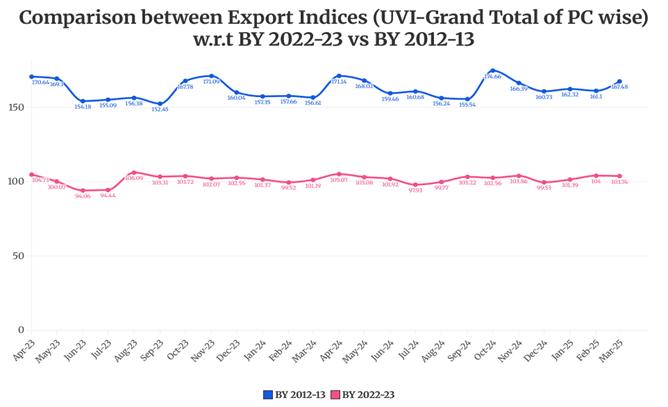
#BY means Base Year.
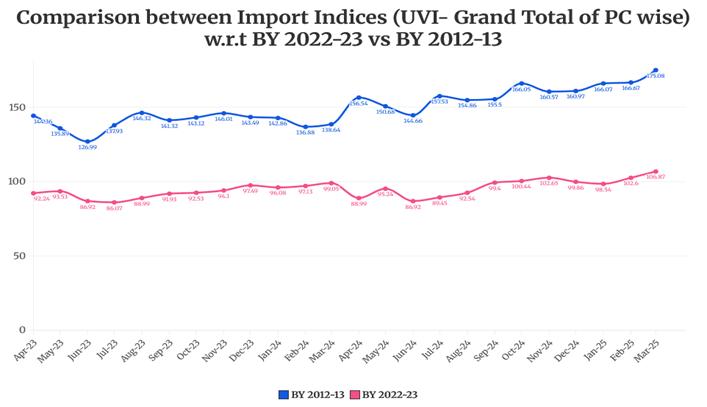
 

#BY means Base Year.

Table: Unit Value Index (UVI) and Quantity Index (QI) during FY 2025-26(Apr-Nov) using FY 2022-23 as base year


Month

Apr_25

May_25

Jun_25

1st Qtr 25-26

Jul_25

Aug_25

Sep_25

2nd Qtr 25-26

Oct_25

Nov_25

Unit Value Index

Export

105.31

99.73

96.31

100.33

99.31

100.55

104.08

101.23

103.78

105.32

Import

92.33

97.97

91.74

94.08

96.34

100.81

108.69

101.93

110.17

106.59

Quantity Index

Export

107.85

104.76

93.88

101.91

103.41

102.64

111.04

105.57

116.19

113.06

Import

138.16

126.61

112.58

125.17

122.47

124.06

126.45

124.32

137.04

121.75

Qtr  means Quarter.

Meaning and interpretation of the Indices

The Unit Value Indices and the Quantity Indices may be interpreted along the following lines.

The Unit Value Index answers the question: What is the growth in the average Unit Value of the items1 traded in the current month with respect to the same month in the Base Year?

So, an Unit Value Index of, say, 120 means that if the items that have been traded in the current month had been traded in the same month of the base year, and if the average price (or unit value) of those items had been Rs.100 in that month of the base year, then the average price (or unit value) of these items in the current month is Rs.120. Or that, there is a 20% increase in the average Unit Value, with respect to the Base Year, of the items that have been traded in the Current Month.

For example, let us suppose 30 items, 10 items each from 3 different Principal Commodities, have been traded in the current month. If these 30 items had been traded in the corresponding month of the base year at an average price of Rs.100, then the average price of these items in the current year is Rs.120.

It is to be noted that there are two successive steps of averaging done here. The first averaging is done over all the items (or ITCHS) of a PC group to arrive at the Index of that PC group. And the second averaging is done over all the PC groups to arrive at the Index at the Grand Total level for all commodities (which is the overall Index for India for a month). In both the stages, a weighted average is taken where the weights are proportional to the importance of the items and the PC groups respectively, and the Laspeyres Formula is used for averaging.

Quantity Indices, say, 200 means that if in the base year on an average 100 units were traded in India in the base year, then in the current year on an average 200 units were traded. However, it must be remembered that averaging quantities are different from averaging prices, since quantities in different units cannot be added directly.

So, the Quantity Indices are calculated by dividing the Value Indices by the Unit Value Indices. For example, if there is an increase in the Value of Export from Rs. 10,000 to Rs. 24,000, then the Value Index is 24000/10000 × 100 = 240. If the Unit Value Index is 120, then the Quantity Index comes to 240/120 × 100 = 200. So, loosely it can be said that, if the value of export has increased 2.4 times and the price of the commodities has increased 1.2 times, then the quantity must have doubled.

However, it may be noted that a very high or low Quantity Index may indicate the presence of Base Effect.

The Interpretation of the Bilateral and Regional Indices can be seen as an extension of the above.

A Unit Value Index of 120 with respect to a country, say Bangladesh, means that if all the items that have been traded with Bangladesh in the current month had been traded in the same month of the base year with the same country, and if the average price (or unit value) of those items had been Rs.100 in that month of the base year, then the average price (or unit value) of these items in the current month is Rs.120.

Similarly, a Quantity Index of 200 with respect to a country, say Bangladesh, means that if in the base year on an average 100 units were traded in India in the base year, then in the current year on an average 200 units were traded.

Comparability of the Indices across time

It is to be noted that the weights in the Index Number formula are fixed across time and there are twelve sets of weights for the twelve months. Hence, comparability of Indices is meaningful only when Indices of same month are compared across years. Different months may attach different weights to the same item, and hence comparing indices of two different months becomes vague and may have little applicability.

Further, the weights of the items that are not present in the trade basket of the current month are distributed to all the items that have been traded in the current month. This distribution is done in proportion to the weights of those items.

For example, let us suppose there are only 3 commodities for trade, say A, B and C. In month May of the Base year, let us suppose that the trade value of A was Rs. 50, B was Rs. 100 and C was Rs. 50. Then the weights assigned to A, B and C in the month of May of the following years would be in the ratio 50 :100 :50. However, in case, C is not traded in the current month, then the weight of C would be distributed proportionately among A and B, again in the ratio 1:2 (since in May the weights of A and B are in the ratio of 50 : 100, i.e., 1 : 2). So, in the current month the weights of A and B would be 3313  and 6623 .

As a result, the weights in any two given months are dependent on exactly the number of items (ITCHS codes) traded in those months. If the items traded are widely different, inference drawn from the comparison of the Indices may be done accordingly. On the other hand, more the similarity in the number of items traded more is the comparability of the two indices.

Net Terms of Trade:

Net Terms of Trade also called commodity Terms of Trade is defined as a ratio of export prices to import prices.

Let say 2022-23 be the base year and 2023-24 be the final year. We express both export and import prices in 2022-23 as 100. Now, suppose that at the end of 2023-24, it is found that the index of export prices decreased to 90 and index of import prices roses to 150. Then the Net Terms of Trade has changed to 90100150100=35 . Then terms of trade as index=35*100=60 . It implies that terms of trade of the country have decreased by about 40% in 2023-24 as compared with 2022-23. It thus shows a deterioration or a worsening of the terms of trade of the country.

If the index of export prices has risen to 150 and that of import prices had risen to 120, then the net terms of trade would have changed to 150120*100=125 . This implies an improvement in the net terms of trade of the country by 25% in 2023-24 over 2022-23.

Gross Terms of Trade:

Gross Terms of Trade is the ratio of physicalquantity of import to physical quantity of export.

Let say 2022-23 be the base year. In that year, the quantities export and import are denoted by 100. Now, suppose that in the year 2023-24, the index of quantity of import was 150 and that of quantity of export was 120. Then the gross terms of trade is given by 150100120100=54,  in terms of percentage =54*100=125 . This implies that there was an improvement of gross terms of trade by 25% in 2023-24 compared to 2022-23.

Income Terms of Trade: Income Terms of Trade is defined as- Net Terms of Trade multiplied by quantity of export.

Topics

Acts Income Tax