

Loading...

Top
Help
×

By creating an account you can:

Logo TaxTMI
Call Us / Help / Feedback

Contact Us At :

E-mail: [email protected]

Call / WhatsApp at: +91 99117 96707

For more information, Check Contact Us

FAQs :

To know Frequently Asked Questions, Check FAQs

Most Asked Video Tutorials :

For more tutorials, Check Video Tutorials

Submit Feedback/Suggestion :

Email :
Please provide your email address so we can follow up on your feedback.
Category :
Description :
Min 15 characters 0/2000
Make Most of Text Search
  1. Checkout this video tutorial: How to search effectively on TaxTMI.
  2. Put words in double quotes for exact word search, eg: "income tax"
  3. Avoid noise words such as : 'and, of, the, a'
  4. Sort by Relevance to get the most relevant document.
  5. Press Enter to add multiple terms/multiple phrases, and then click on Search to Search.
  6. Text Search
  7. The system will try to fetch results that contains ALL your words.
  8. Once you add keywords, you'll see a new 'Search In' filter that makes your results even more precise.
  9. Text Search
Add to...
You have not created any category. Kindly create one to bookmark this item!
Create New Category
Hide
Title :
Description :
❮❮ Hide
Default View
Expand ❯❯
Close ✕
🔎 News - Adv. Search
TEXT SEARCH:

Press 'Enter' to add multiple search terms. Rules for Better Search

Search In:
Main Text + AI Text
  • Main Text
  • Main Text + AI Text
  • AI Text
Category: ?
Categorized by AI
---- All Categories ----
  • ---- All Categories ----
  • Income Tax
  • GST
  • Customs, DGFT & SEZ
  • FEMA & RBI
  • Corp. Laws, SEBI & IBC
  • PMLA, Black Money & ED
  • Budget
  • News and Press Release
  • PTI News
Month:
---- All Months ----
  • ---- All Months ----
  • January
  • February
  • March
  • April
  • May
  • June
  • July
  • August
  • September
  • October
  • November
  • December
Year:
---- All Years ----
  • ---- All Years ----
  • 2026
  • 2025
  • 2024
  • 2023
  • 2022
  • 2021
  • 2020
  • 2019
  • 2018
  • 2017
  • 2016
  • 2015
  • 2014
  • 2013
  • 2012
  • 2011
Sort By: ?
In Sort By 'Default', exact matches for text search are shown at the top, followed by the remaining results in their regular order.
Relevance Default Date
    Union Minister for Finance and Corporate Affairs Smt. Nirmala Sitharaman chairs 3rd Meeting of Apex Monitoring Authority of NICDIT and reviews the pro...
    NBCC moves SC for RERA exemptions to complete 16 stalled Supertech projects
    DFS Hosts PSB Confluence 2026: Day 1 Deliberations focus on Four themes- Deposit Mobilisation, Banking for Youth, Supporting the Investment Cycle and ...
    Govt to soon announce high-level panel on 'Banking for Viksit Bharat': FM
    Rupee falls 19 paise to close at 95.61 against US dollar
    Govt to soon announce high-level panel on 'Banking for Viksit Bharat'
    Union Minister of Finance and Corporate Affairs interacts with interns from PM Internship Scheme in New Delhi
    DRI uncovers large-scale illegal use of SAFTA agreement in areca imports
    Rupee falls 17 paise to 95.59 against US dollar in early trade
    Colombian president asks Trump to suspend tariffs to help earthquake recovery
    Mission Samudra to be launched alongside Vizhinjam’s EXIM operations
    Europe emerges top destination for India's electric car shipments in Q1
    Govt sets LPG production targets for refiners; Reliance gets largest quota
    PM urges MSMEs to tap opportunities from FTAs
    PM urges farmers to adopt 'chemical-free farming' to tap rising global demand for such food items
    Govt rolls out foreign asset disclosure scheme for small taxpayers
    Need one or two Indian pharma firms to be among global top 5: PM Modi
    Small taxpayers with€™ foreign assets to face 30 pc tax plus penalty; disclosure scheme opens till Dec 31
    PM urges MSMEs to tap opportunities from FTAs
    Govt cuts windfall gains tax on petrol, diesel, ATF exports
❯❯
Maximize Maximize Maximize
0 / 200
Expand Note
Add to Folder

No Folders have been created

+

Are you sure you want to delete "My most important" ?

NOTE:

News
Showing Results for :
Reset Filters
Results Found:
Show All Summaries Hide All Summaries
August 18, 2026
Show AI Summary
Industrial corridor development prioritises empowered SPVs, integrated infrastructure and investor-ready parks to accelerate manufacturing investment and operations.
National Industrial Corridor Development Programme implementation prioritises timely infrastructure completion, land allotment, investment mobilisation and commencement of manufacturing. PM GatiShakti-aligned planning requires integrated connectivity, utilities and social infrastructure, while States should resolve land, clearance and SPV-power bottlenecks. BHAVYA proposes investment-ready, plug-and-play industrial parks appraised for ready land, credible demand, connectivity, utilities, realistic phasing and early investor attraction. NICDIT routes Government participation and equity support for BHAVYA project SPVs, and NICDC coordinates implementation and monitoring.
August 17, 2026
Show AI Summary
RERA compliance exemption for stalled housing projects raises whether statutory obligations may be waived to enable phased project completion.
RERA compliance exemption is sought for completion of 16 stalled residential projects by a public sector construction entity appointed under a project-completion arrangement. The appellate insolvency tribunal declined to direct a waiver, considering itself incompetent to exempt compliance with statutory provisions. The arrangement requires phased completion, award and commencement of construction work, and oversight through an apex committee and project-wise committees. The projects remain incomplete owing to the developer's financial crisis.
August 17, 2026
Show AI Summary
Deposit mobilisation and youth banking guide strategies for stronger public financial institutions, investment financing and Global Capability Centre opportunities.
PSB Confluence 2026 considers strategic priorities for Public Sector Banks and Public Financial Institutions across deposit mobilisation, banking for youth, investment-cycle financing and Global Capability Centres. Discussions seek practical, scalable strategies to strengthen customer engagement, youth-responsive banking propositions, institutional financing capabilities and participation in the expanding Global Capability Centre ecosystem. Youth engagement may use the MY Bharat platform to strengthen links with the formal financial system and awareness of education finance, entrepreneurship, internships and financial-sector careers. Further themes include value-chain infrastructure, priority sector lending and credit card business reform.
August 17, 2026
Show AI Summary
Banking-sector reform will guide lender capacity, financial stability, inclusion, consumer protection, deposit growth and responsible credit-card expansion.
Banking-sector reform is proposed through a high-level committee on Banking for Viksit Bharat to review the sector and align it with growth needs while safeguarding financial stability, financial inclusion and consumer protection. Key themes include deposit mobilisation, youth banking, investment support, global capability centres, value-chain infrastructure, credit cards and priority-sector lending. Public-sector banks are expected to improve competitiveness through technology, sectoral expertise, product adaptation and customer-focused deposit growth. Credit-card development must maintain responsible underwriting, customer protection and appropriate risk controls.
August 17, 2026
Show AI Summary
FCNR(B) concessional swap facility availability narrows to timely mobilised deposits amid rupee depreciation and foreign currency inflow concerns.
Foreign-exchange conditions reflected rupee depreciation amid weak domestic equity markets and higher crude oil prices. FCNR(B) concessional swap facility availability is confined to foreign currency deposits mobilised by banks within the revised cut-off period, replacing the previously longer mobilisation window. The facility is intended to encourage foreign currency inflows, while banks use the FCNR(B) scheme to mobilise foreign currency deposits through attractive interest rates.
August 17, 2026
Show AI Summary
Banking sector review panel will align future growth with financial stability, inclusion and consumer protection through government recommendations.
High Level Committee on Banking for Viksit Bharat is proposed to comprehensively review the banking sector and align it with India's next phase of growth. It is intended to safeguard financial stability, financial inclusion and consumer protection, while providing views and recommendations to the Government on banking-sector development and reform.
August 17, 2026
Show AI Summary
Prime Minister Internship Scheme enhances youth employability through paid industry exposure, cross-field learning, workplace readiness and potential full-time employment.
The Prime Minister Internship Scheme provides paid internships with leading companies across India to improve youth employability through practical workplace exposure, industry experience and skills development. It addresses the gap between classroom learning and employers' expectations of workplace readiness. Participation is not confined to academic qualifications, allowing youth to pursue fields of interest and gain hands-on professional learning. Strong internship performance may lead to full-time roles, while the scheme stresses responsible work where errors may affect quality, consumer safety and organisational reputation.
August 17, 2026
Show AI Summary
SAFTA origin fraud in areca imports allegedly enabled improper duty exemption through false Bangladeshi-origin declarations.
SAFTA preferential duty treatment for areca-nut imports was allegedly misused by falsely declaring goods originating in South-East Asian countries as Bangladeshi origin. Since areca nuts normally attract 100% basic customs duty, the scheme sought to obtain the full SAFTA exemption reserved for qualifying Bangladeshi goods meeting Rules of Origin requirements. The alleged mechanism included routing goods through Bangladesh, changing containers and bags, using improperly obtained Certificates of Origin, and facilitating clearance through importers, Customs Brokers and IEC holders. Investigative findings also indicated cash proceeds, hawala channels and dummy entities.
August 17, 2026
Show AI Summary
FCNR(B) concessional swap facility closure may reduce temporary foreign-currency inflow support and heighten rupee weakness concerns.
The Reserve Bank of India restricted its concessional swap facility for FCNR(B) deposits to deposits mobilised by August 31, advancing the earlier cut-off date. The facility was intended to encourage foreign-currency inflows, while banks mobilise such deposits through attractive interest rates. Market commentary indicated that existing inflows may support the rupee in the near term, but the curtailed availability of the facility could reduce this temporary cushion and increase depreciation risk.
August 16, 2026
Show AI Summary
Temporary tariff suspension for earthquake recovery is sought to ease pressure on affected Colombian businesses.
Temporary suspension of high tariffs on Colombian products has been sought to support business recovery following a severe earthquake declared a natural disaster. The request links tariff relief to economic disruption affecting businesses amid extensive destruction, injuries and missing persons. United States emergency assistance has been provided through food, shelter and health supplies, while no response to the tariff-suspension request had been reported.
August 16, 2026
Show AI Summary
Port-led industrial development and direct export operations aim to expand logistics infrastructure, market access and trade connectivity.
Mission Samudra is proposed as a port-led industrial and logistics development programme linked to the commencement of export-import operations at Vizhinjam seaport. It covers industrial clusters, new cities, port connectivity, logistics, development initiatives, programme management and capacity building. Direct export shipments are intended to improve overseas-market access and reduce transit time and logistics costs, particularly for small and medium enterprises. The framework also anticipates growth in warehousing, cold storage, container freight stations and logistics parks, supported by private participation and road and rail connectivity.
August 16, 2026
Show AI Summary
Electric vehicle export diversification strengthens India's presence across European, Asia-Pacific and Latin American markets through expanding overseas demand.
India's electric motor car exports expanded sharply in the first quarter of 2026-27, reflecting increased international acceptance and competitiveness of India-manufactured electric vehicles. Europe became the principal export destination, led by Spain and the United Kingdom, with further demand across several European markets. Exports also reached Asia-Pacific markets, Nepal and emerging Latin American destinations. This wider market presence reflects improving quality and safety standards, stronger integration into global electric-vehicle supply chains, and diversification of India's electric-vehicle export profile.
August 16, 2026
Show AI Summary
LPG production preparedness requires refiners and upstream producers to maintain capacity and increase output during supply constraints.
Government has established a standing LPG production preparedness framework under which refining companies, oil marketing companies and upstream producers may be directed to increase production during supply constraints. Companies must maintain adequate LPG storage, evacuation and transportation infrastructure and pursue technically and economically feasible production-enhancing measures. Written directions may prescribe production quantities and periods, including restrictions on alternative uses of input streams required for LPG. The production schedule is updated twice yearly to reflect new facilities and added capacity from infrastructure, technology and distribution improvements.
August 16, 2026
Show AI Summary
Free trade agreement market access requires MSMEs, farmers and exporters to meet global quality standards.
Free trade agreements expand market-access opportunities for Indian MSMEs, exporters and producers through reduced or eliminated import duties on traded goods. Textiles, machinery, medicines, seafood and agricultural products can access international markets where they meet global standards and remain competitively priced. Farmers and producers are encouraged to develop export-oriented products, including chemical-free agricultural produce, while MSMEs may use preferential trade access to support manufacturing, exports, employment and growth.
August 15, 2026
Show AI Summary
Chemical-free farming can strengthen agricultural exports by meeting global standards and responding to rising international demand.
Chemical-free farming is urged to meet growing global demand and expand agricultural exports. Agricultural products must meet global parameters to facilitate access to international markets, including markets opened through free trade agreements. Food processing, export-oriented farm production, and global branding of traditional cuisine, millets, spices, fruits and flowers are identified as important elements of agriculture and food production policy.
August 15, 2026
Show AI Summary
Voluntary foreign asset disclosure allows eligible taxpayers to regularise overseas holdings with immunity from further tax, penalties and prosecution.
FAST-DS permits eligible taxpayers to disclose specified undisclosed foreign assets, foreign income, and foreign assets omitted from return schedules. Undisclosed assets or income not previously offered to tax may be declared up to Rs 1 crore on payment of an effective 60 per cent levy, based on fair market value as of 31 March 2026. Assets already offered to tax, or acquired during non-resident status but omitted from the return schedule, may be declared up to Rs 5 crore on payment of a fee. Valid declarations provide immunity from further tax, penalty and prosecution, while declared amounts are excluded from total income.
August 15, 2026
Show AI Summary
Global pharmaceutical leadership is urged through Indian firms achieving top-five status, supported by generic manufacturing and export capacity.
Indian pharmaceutical companies are urged to attain representation among the world's five leading pharmaceutical firms, despite India's established position as a major producer of generic medicines. India has a broad manufacturing base, supplies generic medicines across numerous therapeutic categories, and exports to worldwide markets including highly regulated jurisdictions. Although pharmaceutical exports and the domestic market have expanded, Indian firms have not yet secured positions among the largest global companies. Greater international scale may be supported through acquisitions and expanded established-brand and branded-generic operations.
August 15, 2026
Show AI Summary
Foreign asset voluntary disclosure permits eligible small taxpayers to regularise qualifying assets through tax, additional levy, and statutory immunity.
FAST-DS permits eligible small taxpayers to voluntarily disclose specified foreign assets or foreign income. It covers undisclosed foreign assets or income not offered to tax, subject to an aggregate value threshold of Rs 1 crore, and certain foreign assets omitted from the relevant return schedule, subject to a Rs 5 crore threshold and prescribed fee. Payment comprises 30 per cent tax and an additional equal amount. Disclosed income or investment is excluded from total income, with immunity from further tax, penalty and prosecution under the Black Money Act for the disclosed asset or income.
August 15, 2026
Show AI Summary
Free trade agreement opportunities require MSMEs to meet global standards and expand exports across textiles, machinery, medicines and seafood.
Free trade agreements are presented as export-market opportunities for Indian MSMEs because they reduce or eliminate import duties on a substantial range of traded goods. MSMEs are urged to expand exports of textiles, machinery, medicines and seafood, including shrimp, by meeting global quality standards and offering products competitively. Their export role is linked to self-reliance and their significant contribution to manufacturing, exports, GDP and employment.
August 15, 2026
Show AI Summary
Windfall gains tax on petroleum exports was reduced to support domestic fuel availability and limit export price advantages.
Special additional excise duty (windfall gains tax) on exports of petrol, diesel and aviation turbine fuel was reduced from 15 August 2026. Petrol export duty was reduced to nil, and export-duty rates on diesel and ATF were lowered. Duty rates for petrol and diesel cleared for domestic consumption remained unchanged. The export-duty framework seeks to maintain domestic petroleum-product availability and limit export advantages arising from higher global crude oil prices amid West Asia tensions.

News

Back

All News

Showing Results for :
Reset Filters
No Records Found

News

Back

All News

Showing Results for : Reset Filters
Customs, DGFT & SEZ

Directorate General of Commercial Intelligence and Statistics Revises Base Year of Merchandise Trade Indices to FY 2022–23 to Reflect Current Trade Structure and Global Patterns

February 21, 2026

Contents
Summary
Note

Note

-

Bookmark

Print

Print

Merchandise Trade Indices are compiled and published by the Directorate General of Commercial Intelligence and Statistics (DGCI&S), Ministry of Commerce & Industry, to measure changes in the unit values (prices) of India’s exports and imports over time. These indices serve as important indicators of external sector price movements and are widely used for economic analysis, including national accounts compilation and assessment of terms of trade. Over the years, the base year of the indices has been periodically revised to reflect structural changes in India’s trade composition and evolving global trade patterns. The most recent revision updates the base year to FY 2022–23 (2022–23 = 100), replacing the earlier base of FY 2012–13, thereby ensuring that the indices accurately represent the current structure of India’s merchandise trade.

Revision of Base Year of India’s Merchandise Trade Indices to FY 2022–23

The Directorate General of Commercial Intelligence and Statistics (DGCI&S), Ministry of Commerce & Industry, has revised the base year of India’s Merchandise Trade Indices from FY 2012–13 to FY 2022–23 (2022–23 = 100), in view of the structural changes in the economy, shifts in commodity composition, evolving trade patterns, and the need for improved alignment with contemporary macroeconomic indicators.

The revision has been undertaken on the recommendations of a committee constituted by DGCI&S under the Chairmanship of Prof. Nachiketa Chattopadhyay, Professor, Indian Statistical Institute, Kolkata. The Committee examined the existing methodology, data coverage, weighting structure, and compilation practices, and recommended suitable refinements in line with international best practices.

Key Features of the Revised Series (Base: FY 2022–23)

  1. Updated Base Year:
    The new base year FY 2022–23 makes the Indices reflect the current structure of India’s external trade more accurately.
  2. Revised Commodity Basket:
    The coverage and classification of commodities have been reviewed at the Principal Commodity level to better capture emerging and declining trade items.
  3. Revised Weighting Structure:
    Weights have been updated based on trade values of the new base year to reflect the latest value shares in exports and imports.
  4. Improved Methodology:
    Methodological refinements have been introduced in:
    1. Selection of common commodity basket for base year selection (procedure of selection for common commodity basket explained in detail report of the committee).
    2. Treatment of missing unit values (Imputation of missing unit values in base year selection have been explained in detail in the committee report).
  5. Indices Compiled:
    The revised series includes:
    1. Monthly, Quarterly and Annual Indices (Export Unit Value Index,Import Unit Value Index).
    2. Principal Commodity (PC) Classification wise Trade Indices (Export/Import).
    3. Standard International Trade Classification-wise (SITC) Trade Indices.
    4. Broad economic categories-wise (BEC) Trade Indices.
    5. Bilateral and Region-wise Trade Indices of Top 20 Export and Import partner nations of India.
    6. Terms of Trade (Gross terms of trade, Net terms of trade and Income terms of trade).

Rationale for Revision

Over the past decade, India’s trade basket has undergone substantial changes due to emergence of new commodities, technological advancements, Global supply chain restructuring and changes in relative price structures.

The earlier base year (FY 2012–13) no longer adequately reflected the prevailing trade structure. The revision ensures improved relevance, reliability, and analytical usefulness of the Merchandise Trade Indices for policymakers, researchers, and other stakeholders.

Use of the Revised Series

Merchandise Trade Indices compiled by the Directorate General of Commercial Intelligence and Statistics (DGCI&S) are extensively used by key government institutions for economic analysis and policy formulation. The National Accounts Division (NAD) of the Ministry of Statistics and Programme Implementation uses the Export and Import Unit Value Indices as deflators for estimating real exports and imports in GDP compilation. The Reserve Bank of India (RBI) relies on these indices for external sector assessment, balance of payments analysis, and evaluation of price competitiveness. Various Ministries and Government agencies also use them to frame and review trade-related policies and to assess movements in international prices. In addition, academic institutions, research organizations, and economic analysts utilize Merchandise Trade Indices for empirical research, modelling, and analysis of trade dynamics and terms of trade trendson and economic research.

Availability of Data

The revised Merchandise Trade Indices (Base: FY 2022–23) will be released on the official website of DGCI&S. Detailed methodological documentation is available in the Report of the Committee on Revision of Base Year for Merchandise Trade Indices.

Comparison of the new revised Indices (Base Year: 2022-23) with the already released Indices (Base Year : 2012-13) for 2022-23 and 2023-24 is given below.
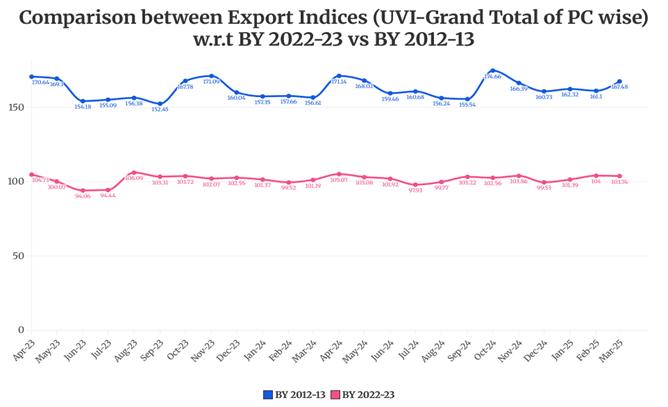
#BY means Base Year.
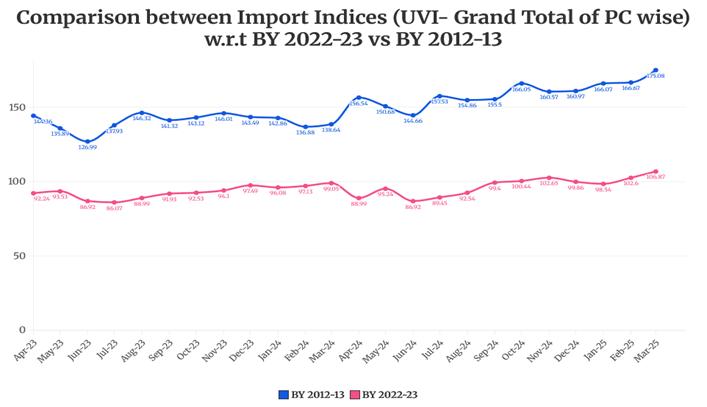
 

#BY means Base Year.

Table: Unit Value Index (UVI) and Quantity Index (QI) during FY 2025-26(Apr-Nov) using FY 2022-23 as base year


Month

Apr_25

May_25

Jun_25

1st Qtr 25-26

Jul_25

Aug_25

Sep_25

2nd Qtr 25-26

Oct_25

Nov_25

Unit Value Index

Export

105.31

99.73

96.31

100.33

99.31

100.55

104.08

101.23

103.78

105.32

Import

92.33

97.97

91.74

94.08

96.34

100.81

108.69

101.93

110.17

106.59

Quantity Index

Export

107.85

104.76

93.88

101.91

103.41

102.64

111.04

105.57

116.19

113.06

Import

138.16

126.61

112.58

125.17

122.47

124.06

126.45

124.32

137.04

121.75

Qtr  means Quarter.

Meaning and interpretation of the Indices

The Unit Value Indices and the Quantity Indices may be interpreted along the following lines.

The Unit Value Index answers the question: What is the growth in the average Unit Value of the items1 traded in the current month with respect to the same month in the Base Year?

So, an Unit Value Index of, say, 120 means that if the items that have been traded in the current month had been traded in the same month of the base year, and if the average price (or unit value) of those items had been Rs.100 in that month of the base year, then the average price (or unit value) of these items in the current month is Rs.120. Or that, there is a 20% increase in the average Unit Value, with respect to the Base Year, of the items that have been traded in the Current Month.

For example, let us suppose 30 items, 10 items each from 3 different Principal Commodities, have been traded in the current month. If these 30 items had been traded in the corresponding month of the base year at an average price of Rs.100, then the average price of these items in the current year is Rs.120.

It is to be noted that there are two successive steps of averaging done here. The first averaging is done over all the items (or ITCHS) of a PC group to arrive at the Index of that PC group. And the second averaging is done over all the PC groups to arrive at the Index at the Grand Total level for all commodities (which is the overall Index for India for a month). In both the stages, a weighted average is taken where the weights are proportional to the importance of the items and the PC groups respectively, and the Laspeyres Formula is used for averaging.

Quantity Indices, say, 200 means that if in the base year on an average 100 units were traded in India in the base year, then in the current year on an average 200 units were traded. However, it must be remembered that averaging quantities are different from averaging prices, since quantities in different units cannot be added directly.

So, the Quantity Indices are calculated by dividing the Value Indices by the Unit Value Indices. For example, if there is an increase in the Value of Export from Rs. 10,000 to Rs. 24,000, then the Value Index is 24000/10000 × 100 = 240. If the Unit Value Index is 120, then the Quantity Index comes to 240/120 × 100 = 200. So, loosely it can be said that, if the value of export has increased 2.4 times and the price of the commodities has increased 1.2 times, then the quantity must have doubled.

However, it may be noted that a very high or low Quantity Index may indicate the presence of Base Effect.

The Interpretation of the Bilateral and Regional Indices can be seen as an extension of the above.

A Unit Value Index of 120 with respect to a country, say Bangladesh, means that if all the items that have been traded with Bangladesh in the current month had been traded in the same month of the base year with the same country, and if the average price (or unit value) of those items had been Rs.100 in that month of the base year, then the average price (or unit value) of these items in the current month is Rs.120.

Similarly, a Quantity Index of 200 with respect to a country, say Bangladesh, means that if in the base year on an average 100 units were traded in India in the base year, then in the current year on an average 200 units were traded.

Comparability of the Indices across time

It is to be noted that the weights in the Index Number formula are fixed across time and there are twelve sets of weights for the twelve months. Hence, comparability of Indices is meaningful only when Indices of same month are compared across years. Different months may attach different weights to the same item, and hence comparing indices of two different months becomes vague and may have little applicability.

Further, the weights of the items that are not present in the trade basket of the current month are distributed to all the items that have been traded in the current month. This distribution is done in proportion to the weights of those items.

For example, let us suppose there are only 3 commodities for trade, say A, B and C. In month May of the Base year, let us suppose that the trade value of A was Rs. 50, B was Rs. 100 and C was Rs. 50. Then the weights assigned to A, B and C in the month of May of the following years would be in the ratio 50 :100 :50. However, in case, C is not traded in the current month, then the weight of C would be distributed proportionately among A and B, again in the ratio 1:2 (since in May the weights of A and B are in the ratio of 50 : 100, i.e., 1 : 2). So, in the current month the weights of A and B would be 3313  and 6623 .

As a result, the weights in any two given months are dependent on exactly the number of items (ITCHS codes) traded in those months. If the items traded are widely different, inference drawn from the comparison of the Indices may be done accordingly. On the other hand, more the similarity in the number of items traded more is the comparability of the two indices.

Net Terms of Trade:

Net Terms of Trade also called commodity Terms of Trade is defined as a ratio of export prices to import prices.

Let say 2022-23 be the base year and 2023-24 be the final year. We express both export and import prices in 2022-23 as 100. Now, suppose that at the end of 2023-24, it is found that the index of export prices decreased to 90 and index of import prices roses to 150. Then the Net Terms of Trade has changed to 90100150100=35 . Then terms of trade as index=35*100=60 . It implies that terms of trade of the country have decreased by about 40% in 2023-24 as compared with 2022-23. It thus shows a deterioration or a worsening of the terms of trade of the country.

If the index of export prices has risen to 150 and that of import prices had risen to 120, then the net terms of trade would have changed to 150120*100=125 . This implies an improvement in the net terms of trade of the country by 25% in 2023-24 over 2022-23.

Gross Terms of Trade:

Gross Terms of Trade is the ratio of physicalquantity of import to physical quantity of export.

Let say 2022-23 be the base year. In that year, the quantities export and import are denoted by 100. Now, suppose that in the year 2023-24, the index of quantity of import was 150 and that of quantity of export was 120. Then the gross terms of trade is given by 150100120100=54,  in terms of percentage =54*100=125 . This implies that there was an improvement of gross terms of trade by 25% in 2023-24 compared to 2022-23.

Income Terms of Trade: Income Terms of Trade is defined as- Net Terms of Trade multiplied by quantity of export.

Topics

Acts Income Tax