

Loading...

โœ•
Top
Help
×

By creating an account you can:

Logo TaxTMI
Call Us / Help / Feedbackโœ•

Contact Us At :

E-mail: [email protected]

Call / WhatsApp at: +91 99117 96707

For more information, Check Contact Us

FAQs :

To know Frequently Asked Questions, Check FAQs

Most Asked Video Tutorials :

For more tutorials, Check Video Tutorials

Submit Feedback/Suggestion :

Email :
Please provide your email address so we can follow up on your feedback.
Category :
Description :
Min 15 characters 0/2000
Make Most of Text Search โœ•
  1. Checkout this video tutorial: How to search effectively on TaxTMI.
  2. Put words in double quotes for exact word search, eg: "income tax"
  3. Avoid noise words such as : 'and, of, the, a'
  4. Sort by Relevance to get the most relevant document.
  5. Press Enter to add multiple terms/multiple phrases, and then click on Search to Search.
  6. Text Search
  7. The system will try to fetch results that contains ALL your words.
  8. Once you add keywords, you'll see a new 'Search In' filter that makes your results even more precise.
  9. Text Search
โ•ณ
Add to...
You have not created any category. Kindly create one to bookmark this item!
โœ•
Create New Category
Hide
Title :
Description :
❮❮ Hide
Default View
Expand ❯❯
Close โœ•
🔎 News - Adv. Search
TEXT SEARCH:

Press 'Enter' to add multiple search terms. Rules for Better Search

Search In:
Main Text + AI Text
  • Main Text
  • Main Text + AI Text
  • AI Text
Category: ?
Categorized by AI
---- All Categories ----
  • ---- All Categories ----
  • Income Tax
  • GST
  • Customs, DGFT & SEZ
  • FEMA & RBI
  • Corp. Laws, SEBI & IBC
  • PMLA, Black Money & ED
  • Budget
  • News and Press Release
  • PTI News
Month:
---- All Months ----
  • ---- All Months ----
  • January
  • February
  • March
  • April
  • May
  • June
  • July
  • August
  • September
  • October
  • November
  • December
Year:
---- All Years ----
  • ---- All Years ----
  • 2026
  • 2025
  • 2024
  • 2023
  • 2022
  • 2021
  • 2020
  • 2019
  • 2018
  • 2017
  • 2016
  • 2015
  • 2014
  • 2013
  • 2012
  • 2011
Sort By: ?
In Sort By 'Default', exact matches for text search are shown at the top, followed by the remaining results in their regular order.
Relevance Default Date
    I-T department officials discuss roadmap for improving services for taxpayers
    India-UK trade agreement to benefit Haryana's industries and services sector: CM Saini
    FM asks banks to keep pace with youth expectation; calls for outreach campaign from Oct 2
    CCI approves acquisition of certain equity shareholding in Bharti Life Insurance Company by Prudential Corporation Holdings
    Suspicious foreign remittances under I-T department scanner
    Delhi tightens rules for ration shops, makes big stock discrepancies an FIR offence
    Regional Rural Banks (RRBs) Record Strong Growth in Credit Delivery during FY 2025โ€“26
    METSTO Delivers Adjustable Pallet Racking System Solutions for Warehouses
    China rolls out new measures to boost consumption in counties, smaller cities
    Strengthening Collaboration to Preserve Sovereignty: Collaborative Cash Ecosystems - Global Strategies to Preserve Trust and Sovereignty - Keynote Add...
    SC asks CBI to examine all six allegations of dubious transactions involving Indiabulls
    Cyber fraudsters invent 'boss' scam to target companies; Ahmedabad cops bust international network
    Personal Loan Prepayment Charges: What RBI Rules Say in 2026
    Zeeba Revamps Packaging and Announces Chef Vikas Khanna as Its Global Brand Ambassador
    Paul Merchants Finance Launches Loan Against Silver, Becomes Indiaโ€™s First NBFC to Set Up Exclusive Silver Loan Branches
    CarePass Launches This Independence Day, Bringing Healthcare Savings Across India's Top and Premium Hospitals
    Keralam CM flags off containers from Vizhinjam, marking start of EXIM operations
    Kerala: Fresh ED raids in CMRL-Exalogic Solutions case
    ED raids KPSC office, ex-chairman in veterinary officers hiring 'scam' case
    Keralam CM reviews operational preparedness at Vizhinjam port
❯❯
Maximize Maximize Maximize
0 / 200
Expand Note
Add to Folder

No Folders have been created

+

Are you sure you want to delete "My most important" ?

NOTE:

News
Showing Results for :
Reset Filters
Results Found:
Show All Summaries Hide All Summaries
August 18, 2026
Show AI Summary
Taxpayer service improvement and litigation reduction guide administrative planning for stronger infrastructure, systems, coordination and future tax department functioning.
Improvement of taxpayer services, reduction of tax litigation, infrastructure strengthening and preparation of an actionable roadmap for future Income Tax Department functioning were considered as operational priorities. Deliberations covered e-HRMS, service matters, reservation policy, systems administration, capacity building, expenditure budgeting, TDS administration, inter-agency coordination, and office infrastructure. Officials identified institutional challenges and priorities for strengthening taxpayer-facing and internal departmental functions.
August 18, 2026
Show AI Summary
Duty-free UK market access strengthens export opportunities for Indian goods and services, supporting MSMEs, agriculture, manufacturing and global value-chain participation.
India-UK Comprehensive Economic and Trade Agreement provides duty-free access to the UK market for nearly all Indian exports and may improve the competitiveness of Haryana's manufacturing, agricultural, MSME and services sectors. Preferential access covers products including textiles, engineering goods, auto parts, processed foods and pharmaceuticals, while agricultural exports remain subject to exceptions for sensitive products. The agreement also provides market access across 137 UK services sub-sectors, supporting IT, digital, professional, financial and technical services and facilitating global value-chain participation.
August 18, 2026
Show AI Summary
Youth banking outreach promotes campus engagement, financial awareness, responsible credit discipline and long-term access to formal banking services.
Public sector banks are urged to conduct a month-long "Banking for Youth" outreach campaign from 2 October 2026 for persons above 16 years of age. Outreach through educational and skill-development campuses should combine account opening, financial awareness and direct engagement. Banks should develop tailored youth strategies to build long-term banking relationships. Proposed measures include online learning content, lifestyle-linked benefits, dedicated youth banking support, and awareness of credit scores, credit products and government credit schemes. A dedicated youth banking-awareness portal may serve as a single access point for appropriate banking services and financial opportunities.
August 18, 2026
Show AI Summary
Competition approval for Prudential's acquisition of equity shareholding in an Indian life insurer supports the proposed insurance-sector combination.
Competition approval has been granted for Prudential Corporation Holdings Limited to acquire certain equity shareholding in Bharti Life Insurance Company Limited. The acquirer is the holding company for its group's insurance and asset-management operations in Asia and supports operations in Asia and Africa. The target is an IRDAI-licensed Indian life insurer.
August 18, 2026
Show AI Summary
Foreign remittance certification due diligence faces nationwide verification targeting shell entities, their controllers, and certifying professionals.
Nationwide verification of suspicious outward foreign remittances targets entities with little or no reported business activity, their controllers, and professionals issuing tax determination certificates. Scrutiny concerns remittances disproportionate to reported turnover, inconsistent with stated purposes, or linked to entities not operating from declared addresses. Form 15CB, or Form 146 under the corresponding framework, requires certifying accountants to assess taxability from books of account and relevant records, supporting tax deduction at source and treaty compliance through due care, diligence and professional judgment.
August 18, 2026
Show AI Summary
Fair Price Shop regulation introduces graded stock-shortage penalties, mandatory FIRs for major discrepancies, and restructured licensing requirements.
Fair Price Shop regulation introduces quantity-based penalties for stock discrepancies, ranging from performance-guarantee forfeiture and replenishment obligations to interim suspension, cancellation-related action and mandatory FIR registration for major shortages. Repeated or deliberate diversion or manipulation of public distribution supplies may lead to cancellation, blacklisting and FIR registration. Licensing now includes continuing regular licences and short-term temporary licences, with wider eligibility, points-based selection, card-linked performance guarantees and compulsory approved e-PoS, weighing-scale and iris-scanner use.
August 18, 2026
Show AI Summary
Priority sector lending strengthened rural credit access through agricultural, micro-enterprise and weaker-section finance, reinforcing financial inclusion and sustainable development.
Regional Rural Banks expanded rural credit delivery while maintaining strong Priority Sector Lending performance during FY 2025-26. Almost all Regional Rural Banks met the prescribed overall priority-sector target. Agriculture and allied activities remained the largest priority-sector component, with farm credit accounting for nearly all agricultural lending. MSME finance predominantly supported micro enterprises, rural entrepreneurs, artisans and small businesses. Lending to weaker sections and finance for housing, education, renewable energy and social infrastructure promoted inclusive access to institutional credit and sustainable rural development.
August 18, 2026
Show AI Summary
Adjustable pallet racking systems support customised, scalable warehouse storage through configurable layouts, safety assessment, installation and lifecycle support.
Adjustable pallet racking systems are configurable warehouse-storage solutions for varied inventory dimensions, weights and product types. They support bulk pallet storage, multi-level picking and high-density configurations through adjustable beams and shelves, load-bearing capacity, structural durability and space-efficient layouts. Storage configurations are customised after assessing inventory dimensions, payload requirements, available space and material-movement frequency, with support for design, installation, inspections and after-sales service.
August 18, 2026
Show AI Summary
Domestic consumption expansion targets lower-tier markets through improved retail channels, distribution networks, employment support and household income opportunities.
China has introduced measures to strengthen domestic consumption in counties, smaller cities, townships and rural areas. The measures include upgrading township commercial centres, rural markets and local fairs; encouraging domestic and international brands to establish regional debut stores; and reusing existing land resources to improve services. They also seek better services for elderly persons and children, stronger urban-rural distribution networks, county-level employment and resident income channels. The strategy supports a shift towards household consumption amid weak domestic demand, property-sector pressures and subdued consumer sentiment.
August 18, 2026
Show AI Summary
Currency management preserves monetary sovereignty through clean notes, secure logistics, decentralised distribution, durable banknotes, and sustainable cash-cycle operations.
Currency management supports trust in cash and monetary sovereignty through demand planning, secure production, distribution, replacement, and disposal. The Clean Note Policy requires good-quality banknotes to be available in required denominations and locations, with unfit notes continuously withdrawn and replaced. A decentralised Currency Chest network distributes fresh currency, processes returned notes, supports linked bank branches, and operates under licensing, real-time reporting, inspection, and audit requirements. Current priorities include managing uncertain cash demand, improving note durability, and reducing the carbon footprint of the cash cycle.
August 18, 2026
Show AI Summary
Independent investigation of alleged dubious transactions requires examination of all six allegations despite prior police conclusions.
Investigation into alleged dubious transactions involving Indiabulls Housing Finance Limited and related entities must cover all six allegations identified by the Enforcement Directorate. The CBI must independently examine five allegations previously reviewed by the Delhi Police Economic Offence Wing, irrespective of its conclusion, and submit a comprehensive report. Further investigation into the sixth allegation depends on the special PMLA court deciding the CBI's pending application, after which the CBI must provide a progress or status report.
August 18, 2026
Show AI Summary
Boss scam prevention requires independent verification of payment requests and avoidance of malicious WhatsApp attachments that enable executive impersonation.
Boss scam, or CEO impersonation fraud, uses malicious WhatsApp attachments and impersonation of regulatory officials or company executives to obtain control of WhatsApp sessions and issue fraudulent payment instructions. The alleged network supplied SIM cards, dummy SIMs, WhatsApp accounts and one-time passwords to cyber-fraud operators, illustrating a Cybercrime as a Service model. Preventive measures include avoiding suspicious ZIP, executable, library and APK files and independently verifying all financial-transfer requests.
August 18, 2026
Show AI Summary
Floating-rate personal loan prepayment protections prohibit charges and compulsory lock-ins for qualifying individual non-business borrowers from 2026.
Prepayment charges are prohibited for part or full repayment of qualifying floating-rate loans availed by individual borrowers for non-business purposes and sanctioned or renewed on or after 1 January 2026. Compulsory lock-in periods cannot restrict prepayment of such loans. Fixed-rate personal loans may still attract prepayment or foreclosure charges under lender policy and contractual terms. Borrowers should check the loan's rate type, sanction letter, loan agreement and key fact statement, where applicable, and compare applicable charges with potential interest savings before early repayment.
August 18, 2026
Show AI Summary
Premium Basmati rice positioning drives Zeeba's packaging refresh and ambassador-led campaign focused on quality, authenticity and domestic expansion.
Zeeba has refreshed its packaging and appointed Chef Vikas Khanna as global brand ambassador to support expansion in India. Its "Aisa Basmati Nahi Dekha" campaign positions the brand around export-quality Basmati rice, consistency, authenticity and a superior culinary experience. Promotional activity will extend across digital, retail and consumer touchpoints. The premium Basmati range is described as carefully sourced, naturally aged and processed according to global quality standards, with emphasis on grain quality, authentic taste, purity and consistency.
August 18, 2026
Show AI Summary
Silver-collateral lending creates a formal secured-credit channel for eligible borrowers, subject to regulatory requirements and lender policies.
Loans against silver collateral have been introduced following the Reserve Bank of India's Lending Against Gold and Silver Collateral Directions, 2025, enabling eligible regulated lenders to accept silver as security. The offering provides a formal and transparent credit channel against eligible silver jewellery, ornaments and approved silver coins. It is intended for individuals, proprietors and MSMEs requiring liquidity for personal, business and other legitimate financial needs, subject to lending policies and applicable regulatory requirements.
August 18, 2026
Show AI Summary
Healthcare discount membership provides instant savings on out-of-pocket care at participating premium providers without insurance claims or paperwork.
CarePass is a healthcare savings membership card providing instant point-of-billing discounts at participating premium healthcare providers across India. It covers out-of-pocket spending on hospital treatment, diagnostics, dental, vision, dermatology, hair and skin care, and IVF and maternity services, without claim processing, waiting periods or paperwork. Members present a digital CarePass at a participating provider to receive the applicable discount. Four membership tiers offer differing benefits, with higher tiers including tele-consultations and annual health checks. CarePass is a discount membership and not an insurance product.
August 18, 2026
Show AI Summary
EXIM operations at Vizhinjam commence with container movement, supported by investor facilitation, infrastructure backing and port-led logistics development.
EXIM operations at Vizhinjam international seaport commenced with the flagging off of two containers after a successful trial export shipment. The state government proposes investor engagement, regulatory facilitation and infrastructure support to expand global export activities through the port. Mission Samudra is to operate as a port-led industrial and logistics development scheme. The deep-water port was developed under a public-private partnership model and had received commercial commissioning certification.
August 18, 2026
Show AI Summary
Money-laundering investigation under PMLA expands through searches into alleged consultancy payments linked to CMRL and Exalogic Solutions.
Money-laundering investigation under the Prevention of Money Laundering Act involves fresh searches connected with Cochin Minerals and Rutile Ltd and Exalogic Solutions. The inquiry concerns alleged fraudulent payments made under the guise of IT consultancy services and a purported money trail involving persons allegedly connected with those transactions. The action follows earlier searches and questioning in relation to the same matter.
August 18, 2026
Show AI Summary
Recruitment examination irregularities trigger money-laundering investigation into alleged bribery, paper leaks, answer-sheet tampering, and preferential veterinary officer selections.
Money-laundering investigation under the Prevention of Money Laundering Act concerns alleged irregularities in veterinary officers' final selection through a public recruitment examination. Searches covered premises linked to commission officials, alleged intermediaries, the digital evaluation entity, and selected candidates. Allegations include bribery demands, examination-paper leakage, OMR answer-sheet tampering, and facilitation of selection for relatives of commission officials.
August 18, 2026
Show AI Summary
Export-import operations advance through operational preparedness review and planned port-led industrial and logistics development initiatives.
Operational preparedness for full land-based export-import operations at Vizhinjam Seaport was reviewed, including the Vehicle Traffic Management System. EXIM cargo operations follow a trial shipment of the port's first export container to Valencia. Mission Samudra is proposed to support port-led industrial and logistics development alongside these operations. The deep-water port was developed through a public-private partnership model and had obtained commercial commissioning certification before its dedication to the nation.

News

Back

All News

Showing Results for :
Reset Filters
No Records Found

News

Back

All News

Showing Results for : Reset Filters
Customs, DGFT & SEZ

Directorate General of Commercial Intelligence and Statistics Revises Base Year of Merchandise Trade Indices to FY 2022โ€“23 to Reflect Current Trade Structure and Global Patterns

February 21, 2026

Contents
Summary
Note

Note

-

Bookmark

Print

Print

Merchandise Trade Indices are compiled and published by the Directorate General of Commercial Intelligence and Statistics (DGCI&S), Ministry of Commerce & Industry, to measure changes in the unit values (prices) of India’s exports and imports over time. These indices serve as important indicators of external sector price movements and are widely used for economic analysis, including national accounts compilation and assessment of terms of trade. Over the years, the base year of the indices has been periodically revised to reflect structural changes in India’s trade composition and evolving global trade patterns. The most recent revision updates the base year to FY 2022–23 (2022–23 = 100), replacing the earlier base of FY 2012–13, thereby ensuring that the indices accurately represent the current structure of India’s merchandise trade.

Revision of Base Year of India’s Merchandise Trade Indices to FY 2022–23

The Directorate General of Commercial Intelligence and Statistics (DGCI&S), Ministry of Commerce & Industry, has revised the base year of India’s Merchandise Trade Indices from FY 2012–13 to FY 2022–23 (2022–23 = 100), in view of the structural changes in the economy, shifts in commodity composition, evolving trade patterns, and the need for improved alignment with contemporary macroeconomic indicators.

The revision has been undertaken on the recommendations of a committee constituted by DGCI&S under the Chairmanship of Prof. Nachiketa Chattopadhyay, Professor, Indian Statistical Institute, Kolkata. The Committee examined the existing methodology, data coverage, weighting structure, and compilation practices, and recommended suitable refinements in line with international best practices.

Key Features of the Revised Series (Base: FY 2022–23)

  1. Updated Base Year:
    The new base year FY 2022–23 makes the Indices reflect the current structure of India’s external trade more accurately.
  2. Revised Commodity Basket:
    The coverage and classification of commodities have been reviewed at the Principal Commodity level to better capture emerging and declining trade items.
  3. Revised Weighting Structure:
    Weights have been updated based on trade values of the new base year to reflect the latest value shares in exports and imports.
  4. Improved Methodology:
    Methodological refinements have been introduced in:
    1. Selection of common commodity basket for base year selection (procedure of selection for common commodity basket explained in detail report of the committee).
    2. Treatment of missing unit values (Imputation of missing unit values in base year selection have been explained in detail in the committee report).
  5. Indices Compiled:
    The revised series includes:
    1. Monthly, Quarterly and Annual Indices (Export Unit Value Index,Import Unit Value Index).
    2. Principal Commodity (PC) Classification wise Trade Indices (Export/Import).
    3. Standard International Trade Classification-wise (SITC) Trade Indices.
    4. Broad economic categories-wise (BEC) Trade Indices.
    5. Bilateral and Region-wise Trade Indices of Top 20 Export and Import partner nations of India.
    6. Terms of Trade (Gross terms of trade, Net terms of trade and Income terms of trade).

Rationale for Revision

Over the past decade, India’s trade basket has undergone substantial changes due to emergence of new commodities, technological advancements, Global supply chain restructuring and changes in relative price structures.

The earlier base year (FY 2012–13) no longer adequately reflected the prevailing trade structure. The revision ensures improved relevance, reliability, and analytical usefulness of the Merchandise Trade Indices for policymakers, researchers, and other stakeholders.

Use of the Revised Series

Merchandise Trade Indices compiled by the Directorate General of Commercial Intelligence and Statistics (DGCI&S) are extensively used by key government institutions for economic analysis and policy formulation. The National Accounts Division (NAD) of the Ministry of Statistics and Programme Implementation uses the Export and Import Unit Value Indices as deflators for estimating real exports and imports in GDP compilation. The Reserve Bank of India (RBI) relies on these indices for external sector assessment, balance of payments analysis, and evaluation of price competitiveness. Various Ministries and Government agencies also use them to frame and review trade-related policies and to assess movements in international prices. In addition, academic institutions, research organizations, and economic analysts utilize Merchandise Trade Indices for empirical research, modelling, and analysis of trade dynamics and terms of trade trendson and economic research.

Availability of Data

The revised Merchandise Trade Indices (Base: FY 2022–23) will be released on the official website of DGCI&S. Detailed methodological documentation is available in the Report of the Committee on Revision of Base Year for Merchandise Trade Indices.

Comparison of the new revised Indices (Base Year: 2022-23) with the already released Indices (Base Year : 2012-13) for 2022-23 and 2023-24 is given below.
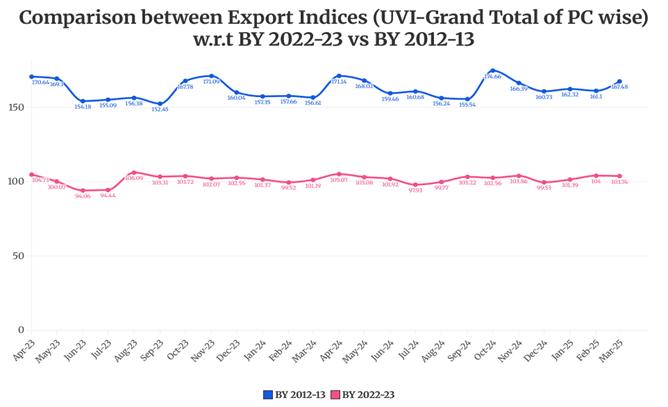
#BY means Base Year.
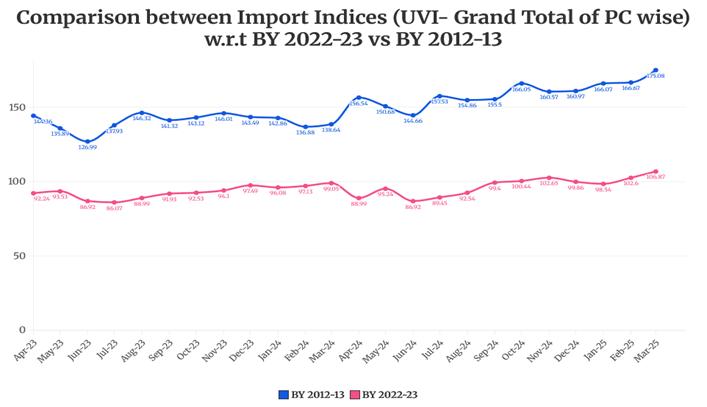
 

#BY means Base Year.

Table: Unit Value Index (UVI) and Quantity Index (QI) during FY 2025-26(Apr-Nov) using FY 2022-23 as base year


Month

Apr_25

May_25

Jun_25

1st Qtr 25-26

Jul_25

Aug_25

Sep_25

2nd Qtr 25-26

Oct_25

Nov_25

Unit Value Index

Export

105.31

99.73

96.31

100.33

99.31

100.55

104.08

101.23

103.78

105.32

Import

92.33

97.97

91.74

94.08

96.34

100.81

108.69

101.93

110.17

106.59

Quantity Index

Export

107.85

104.76

93.88

101.91

103.41

102.64

111.04

105.57

116.19

113.06

Import

138.16

126.61

112.58

125.17

122.47

124.06

126.45

124.32

137.04

121.75

Qtr  means Quarter.

Meaning and interpretation of the Indices

The Unit Value Indices and the Quantity Indices may be interpreted along the following lines.

The Unit Value Index answers the question: What is the growth in the average Unit Value of the items1 traded in the current month with respect to the same month in the Base Year?

So, an Unit Value Index of, say, 120 means that if the items that have been traded in the current month had been traded in the same month of the base year, and if the average price (or unit value) of those items had been Rs.100 in that month of the base year, then the average price (or unit value) of these items in the current month is Rs.120. Or that, there is a 20% increase in the average Unit Value, with respect to the Base Year, of the items that have been traded in the Current Month.

For example, let us suppose 30 items, 10 items each from 3 different Principal Commodities, have been traded in the current month. If these 30 items had been traded in the corresponding month of the base year at an average price of Rs.100, then the average price of these items in the current year is Rs.120.

It is to be noted that there are two successive steps of averaging done here. The first averaging is done over all the items (or ITCHS) of a PC group to arrive at the Index of that PC group. And the second averaging is done over all the PC groups to arrive at the Index at the Grand Total level for all commodities (which is the overall Index for India for a month). In both the stages, a weighted average is taken where the weights are proportional to the importance of the items and the PC groups respectively, and the Laspeyres Formula is used for averaging.

Quantity Indices, say, 200 means that if in the base year on an average 100 units were traded in India in the base year, then in the current year on an average 200 units were traded. However, it must be remembered that averaging quantities are different from averaging prices, since quantities in different units cannot be added directly.

So, the Quantity Indices are calculated by dividing the Value Indices by the Unit Value Indices. For example, if there is an increase in the Value of Export from Rs. 10,000 to Rs. 24,000, then the Value Index is 24000/10000 × 100 = 240. If the Unit Value Index is 120, then the Quantity Index comes to 240/120 × 100 = 200. So, loosely it can be said that, if the value of export has increased 2.4 times and the price of the commodities has increased 1.2 times, then the quantity must have doubled.

However, it may be noted that a very high or low Quantity Index may indicate the presence of Base Effect.

The Interpretation of the Bilateral and Regional Indices can be seen as an extension of the above.

A Unit Value Index of 120 with respect to a country, say Bangladesh, means that if all the items that have been traded with Bangladesh in the current month had been traded in the same month of the base year with the same country, and if the average price (or unit value) of those items had been Rs.100 in that month of the base year, then the average price (or unit value) of these items in the current month is Rs.120.

Similarly, a Quantity Index of 200 with respect to a country, say Bangladesh, means that if in the base year on an average 100 units were traded in India in the base year, then in the current year on an average 200 units were traded.

Comparability of the Indices across time

It is to be noted that the weights in the Index Number formula are fixed across time and there are twelve sets of weights for the twelve months. Hence, comparability of Indices is meaningful only when Indices of same month are compared across years. Different months may attach different weights to the same item, and hence comparing indices of two different months becomes vague and may have little applicability.

Further, the weights of the items that are not present in the trade basket of the current month are distributed to all the items that have been traded in the current month. This distribution is done in proportion to the weights of those items.

For example, let us suppose there are only 3 commodities for trade, say A, B and C. In month May of the Base year, let us suppose that the trade value of A was Rs. 50, B was Rs. 100 and C was Rs. 50. Then the weights assigned to A, B and C in the month of May of the following years would be in the ratio 50 :100 :50. However, in case, C is not traded in the current month, then the weight of C would be distributed proportionately among A and B, again in the ratio 1:2 (since in May the weights of A and B are in the ratio of 50 : 100, i.e., 1 : 2). So, in the current month the weights of A and B would be 3313  and 6623 .

As a result, the weights in any two given months are dependent on exactly the number of items (ITCHS codes) traded in those months. If the items traded are widely different, inference drawn from the comparison of the Indices may be done accordingly. On the other hand, more the similarity in the number of items traded more is the comparability of the two indices.

Net Terms of Trade:

Net Terms of Trade also called commodity Terms of Trade is defined as a ratio of export prices to import prices.

Let say 2022-23 be the base year and 2023-24 be the final year. We express both export and import prices in 2022-23 as 100. Now, suppose that at the end of 2023-24, it is found that the index of export prices decreased to 90 and index of import prices roses to 150. Then the Net Terms of Trade has changed to 90100150100=35 . Then terms of trade as index=35*100=60 . It implies that terms of trade of the country have decreased by about 40% in 2023-24 as compared with 2022-23. It thus shows a deterioration or a worsening of the terms of trade of the country.

If the index of export prices has risen to 150 and that of import prices had risen to 120, then the net terms of trade would have changed to 150120*100=125 . This implies an improvement in the net terms of trade of the country by 25% in 2023-24 over 2022-23.

Gross Terms of Trade:

Gross Terms of Trade is the ratio of physicalquantity of import to physical quantity of export.

Let say 2022-23 be the base year. In that year, the quantities export and import are denoted by 100. Now, suppose that in the year 2023-24, the index of quantity of import was 150 and that of quantity of export was 120. Then the gross terms of trade is given by 150100120100=54,  in terms of percentage =54*100=125 . This implies that there was an improvement of gross terms of trade by 25% in 2023-24 compared to 2022-23.

Income Terms of Trade: Income Terms of Trade is defined as- Net Terms of Trade multiplied by quantity of export.

Topics

Acts Income Tax