

Loading...

Top
Help
×

By creating an account you can:

Logo TaxTMI
Call Us / Help / Feedback

Contact Us At :

E-mail: [email protected]

Call / WhatsApp at: +91 99117 96707

For more information, Check Contact Us

FAQs :

To know Frequently Asked Questions, Check FAQs

Most Asked Video Tutorials :

For more tutorials, Check Video Tutorials

Submit Feedback/Suggestion :

Email :
Please provide your email address so we can follow up on your feedback.
Category :
Description :
Min 15 characters 0/2000
Make Most of Text Search
  1. Checkout this video tutorial: How to search effectively on TaxTMI.
  2. Put words in double quotes for exact word search, eg: "income tax"
  3. Avoid noise words such as : 'and, of, the, a'
  4. Sort by Relevance to get the most relevant document.
  5. Press Enter to add multiple terms/multiple phrases, and then click on Search to Search.
  6. Text Search
  7. The system will try to fetch results that contains ALL your words.
  8. Once you add keywords, you'll see a new 'Search In' filter that makes your results even more precise.
  9. Text Search
Add to...
You have not created any category. Kindly create one to bookmark this item!
Create New Category
Hide
Title :
Description :
❮❮ Hide
Default View
Expand ❯❯
Close ✕
🔎 News - Adv. Search
TEXT SEARCH:

Press 'Enter' to add multiple search terms. Rules for Better Search

Search In:
Main Text + AI Text
  • Main Text
  • Main Text + AI Text
  • AI Text
Category: ?
Categorized by AI
---- All Categories ----
  • ---- All Categories ----
  • Income Tax
  • GST
  • Customs, DGFT & SEZ
  • FEMA & RBI
  • Corp. Laws, SEBI & IBC
  • PMLA, Black Money & ED
  • Budget
  • News and Press Release
  • PTI News
Month:
---- All Months ----
  • ---- All Months ----
  • January
  • February
  • March
  • April
  • May
  • June
  • July
  • August
  • September
  • October
  • November
  • December
Year:
---- All Years ----
  • ---- All Years ----
  • 2026
  • 2025
  • 2024
  • 2023
  • 2022
  • 2021
  • 2020
  • 2019
  • 2018
  • 2017
  • 2016
  • 2015
  • 2014
  • 2013
  • 2012
  • 2011
Sort By: ?
In Sort By 'Default', exact matches for text search are shown at the top, followed by the remaining results in their regular order.
Relevance Default Date
    US is set to impose 50% tariffs on $20 billion worth of Canadian products
    Rupee settles 3 paise higher at 95.71 against US dollar
    29 FDI Investments Worth ₹4,895.65 Crore Reported Under Revised Framework
    India and ADB sign $230 million loan to modernise water supply and sanitation in Chennai
    DGGI unearths clandestine pan masala and tobacco manufacturing network in Uttar Pradesh; 27 undeclared pouch-packing machines seized, evasion of about...
    Mission SAKSHAM: Scaling Capability through Co-operation - Keynote Address by Shri Swaminathan J, Deputy Governor at Mission SAKSHAM Programme for Dir...
    India’s Foreign Exchange Markets: Getting ready for the next Decade [Keynote Address delivered by Deputy Governor Shri Rohit Jain on the Annual Day ...
    Govt rejects ethanol link to sugar price surge, says duty free imports allowed to curb prices
    China moves to wrap up saga of troubled property giant Evergrande after founder gets life sentence
    India's forex kitty swells USD 9.9 bn to USD 716.9 bn
    Bengaluru airport: AERA slashes user development fee to Rs 300 for domestic passengers
    NUMR Inc. helps deliver Axis Bank's data-driven excellence in customer experience
    ED can't add old FIR to Enforcement Case Information Report to sustain PMLA proceedings: Delhi HC
    Rupee settles on flat note, 3 paise higher at 95.71 against US dollar
    VinFast India Partners with Federal Bank to Strengthen Dealer Financing Ecosystem
    Sugar prices soar to Rs 70 per kg ahead of festive season in Bengal, jaggery also dearer
    Rupee gains 9 paise to 95.65 against US dollar in early trade
    Union Minister of State for Finance Shri Pankaj Chaudhary participated virtually in 21st Award Ceremony of Security Printing and Minting Corporation o...
    Over 745 gram gold paste seized at IGI; Customs nab carrier, receiver
    Quebec remains cautious on Canada-US trade deal as Ottawa pushes to restore US alcohol
❯❯
Maximize Maximize Maximize
0 / 200
Expand Note
Add to Folder

No Folders have been created

+

Are you sure you want to delete "My most important" ?

NOTE:

News
Showing Results for :
Reset Filters
Results Found:
Show All Summaries Hide All Summaries
August 22, 2026
Show AI Summary
Import tariffs on Canadian products trigger potential retaliatory levies after bilateral negotiations fail to reach agreement.
Import tariffs on Canadian products are set to be imposed by the United States at a 50% rate after bilateral negotiations did not produce an agreement. The measures cover products including hockey sticks and tongue depressors and affect a limited share of Canada's annual exports to the United States. Canada has indicated possible retaliatory levies, intensifying the bilateral trade dispute.
August 21, 2026
Show AI Summary
Rupee exchange-rate movement reflected geopolitical tensions, crude oil conditions and market intervention, while export payment rules expanded rupee invoicing.
Foreign Trade Policy amendments facilitate export invoicing and receipt of payments in Indian rupees. For exports to countries outside the Asian Clearing Union, export contracts and invoices may be denominated in Indian rupees or any foreign currency. The earlier general requirement that export earnings be received in a freely convertible currency is thereby eased, while applicable rules continue to vary according to destination.
August 21, 2026
Show AI Summary
Non-controlling land-bordering country ownership permits eligible foreign investment through the automatic route, subject to sectoral conditions and reporting.
Foreign direct investment may use the automatic route where non-controlling beneficial ownership from a land-bordering country in the investor entity does not exceed 10%, subject to sectoral caps, entry routes and other applicable conditions. The beneficial ownership test applies at the investor-entity level. Eligible investors need not obtain separate prior Government approval after reporting relevant information to the Government. The framework replaces the earlier approval requirement applicable even to minimal beneficial ownership from land-bordering countries.
August 21, 2026
Show AI Summary
Climate-resilient urban water security modernises Chennai's supply and sanitation systems through ring-main infrastructure, digital monitoring, and safer sewer operations.
Chennai Climate-Resilient Water Security and Sewerage Project modernises and expands water supply and sanitation infrastructure through a loan arrangement between the Government of India and the Asian Development Bank. Measures include new pipelines, upgraded pumping stations, performance-based utility operations, and a comprehensive ring-main system to improve water-pressure balance, distribution efficiency, reliability and climate resilience. Digital monitoring and advanced blockage-detection technology are intended to improve operational decisions, customer responsiveness and worker safety while eliminating hazardous manual sewer inspections.
August 21, 2026
Show AI Summary
Capacity-based taxation targets undeclared pouch-packing machinery used for clandestine pan masala and tobacco production and untaxed clearances.
Capacity-based taxation of pan masala and specified tobacco products is determined by the number, type and capacity of installed pouch-packing machines. Searches at interconnected manufacturing and trading premises detected unregistered operations using undeclared machinery for clandestine manufacture and clearance of pan masala, scented jarda and gutkha without payment of GST, HSNS cess and central excise duty. Finished goods, raw materials, packing materials and machinery were seized. The manufacturing firm's proprietor was prima facie identified as managing the operation and was arrested under the applicable cess and central excise laws.
August 21, 2026
Show AI Summary
Technology risk oversight requires Urban Co-operative Banks to retain accountability while building shared and role-specific capabilities.
Urban Co-operative Banks must strengthen digital and risk-management capabilities as technology dependence exposes them to cyber threats, fraud, service-provider failures and common-platform vulnerabilities. Outsourcing critical systems does not transfer the bank's responsibility for oversight, safeguards and continuity. Boards and senior management must retain sufficient knowledge to supervise external providers effectively. Mission SAKSHAM supports role-specific, continuous capability building through physical and online learning, while collective infrastructure and shared expertise can supplement individual institutional capacity.
August 21, 2026
Show AI Summary
Foreign exchange market modernisation prioritises delegated decisions, customer transparency, digital workflows, local-currency settlement and accountable risk management.
Foreign exchange market modernisation advances a facilitative, principles-based framework based on delegated decision-making by Authorised Dealers, risk-based reporting, and customer-centric service standards. Authorised Dealers must apply clear internal policies, avoid unnecessary documentation, disclose charges, timelines and grievance mechanisms, and ensure consistent treatment of comparable transactions. Local-currency settlement requires viable trade corridors, competitive hedging, correspondent relationships and robust AML/CFT controls. Digital workflows, electronic trading and reporting infrastructure should improve transparency and resilience, while automated tools remain subject to explainability, review and data-protection safeguards.
August 21, 2026
Show AI Summary
Sugar price containment measures restrict stockholding, permit duty-free imports, and strengthen inventory verification to deter hoarding.
Sugar price containment measures include stock limits for dealers, consumption-based inventory restrictions for bulk consumers, duty-free raw sugar imports, and physical verification of mill stocks to prevent hoarding and artificial scarcity. Price increases are attributed to lower domestic output, festive demand, crop damage, tighter global supplies, and speculation rather than sugar diversion for ethanol. Earlier crushing is advised to improve seasonal availability, while the ethanol programme supports management of sugar surpluses, mill liquidity, and timely sugarcane payments.
August 21, 2026
Show AI Summary
Cross-border insolvency enforcement constrains asset recovery as Evergrande liquidation, founder asset confiscation, and audit-related claims continue.
Evergrande's insolvency process involves liquidation proceedings for its mainland property-development unit and its Hong Kong-listed holding company. Cross-border recovery is constrained by separate Hong Kong and mainland China legal systems, particularly because most operational assets are located in mainland China. Liquidators are pursuing asset-tracing and recovery measures against the founder and connected persons, as well as claims concerning pre-collapse audits. Investigations identified revenue overstatement through manipulated financial data. Creditor recoveries are expected to be limited due to substantial liabilities and constraints on asset realisation.
August 21, 2026
Show AI Summary
Foreign exchange reserves rose through higher currency assets and gold holdings amid measures to attract external forex inflows.
India's foreign exchange reserves increased during the reporting week, led by higher foreign currency assets and gold reserves. Foreign currency assets include the dollar-value effects of movements in non-US currencies held as reserves. Special drawing rights declined marginally, while the reserve position with the International Monetary Fund increased marginally. Concessional swap arrangements formed part of measures to attract foreign-exchange inflows, while earlier reserve movements were linked to rupee pressure and dollar-sale intervention in the foreign-exchange market.
August 21, 2026
Show AI Summary
Incremental tariff recovery aligns airport user charges with completed infrastructure, preventing passengers from funding non-operational capital projects prematurely.
User development fees and airport tariffs for Bengaluru International Airport have been revised for the April 2026 to March 2031 control period. The incremental Average Revenue Requirement framework excludes costs of identified high-value capital projects from tariffs until the relevant assets are completed, commissioned and available for users. Incremental tariff recovery may begin only upon operational availability, aligning charges with infrastructure use, reducing premature recovery risk for passengers and airlines, and encouraging timely completion of major capital works.
August 21, 2026
Show AI Summary
Customer experience analytics enables banks to convert real-time feedback into operational improvements across high-value customer journeys.
Customer experience analytics is used in banking to transform customer data and real-time feedback into operational improvements across key customer journeys. Operational teams retain responsibility for strategy and execution, supported by in-house analytics and technology platforms for multi-channel journey mapping, journey analytics and prioritisation of high-value customer segments. AI-driven customer experience management tools capture customer signals, analyse journey performance and operationalise actionable insights across teams.
August 21, 2026
Show AI Summary
Predicate-offence dependency limits retrospective addition of old FIRs to preserve money-laundering proceedings after the original scheduled offence is closed.
Predicate-offence dependency under the Prevention of Money Laundering Act requires an ECIR to rest on a subsisting scheduled offence. Closure of the FIR forming its basis through an accepted cancellation report prevents continuation of money-laundering proceedings unless that closure is overturned. A previously registered FIR cannot be belatedly added merely to preserve an existing ECIR and coercive powers. Where statutory requirements are met, an independently registered ECIR may be required. Expansion of an ECIR cannot rest solely on tenuous factual links between successive disputes.
August 21, 2026
Show AI Summary
Indian rupee export invoicing rules now permit overseas contracts and invoices in rupees or foreign currency for eligible destinations.
Foreign Trade Policy provisions were amended to facilitate invoicing of overseas exports and receipt of export payments in Indian rupees. For exports to countries outside the Asian Clearing Union, export contracts and invoices may be denominated in Indian rupees or any foreign currency, replacing the earlier general requirement that export earnings be received in a freely convertible currency. The applicable requirements vary according to the destination country.
August 21, 2026
Show AI Summary
Dealer inventory financing supports working-capital flexibility, vehicle inventory management and electric-vehicle network expansion for authorised dealers.
Dealer inventory financing is to be provided by Federal Bank to VinFast India's authorised dealer network under a memorandum of understanding. The tailored financing is intended to improve dealers' working-capital flexibility, support maintenance of vehicle inventory, strengthen operational capability, and enable timely response to demand as the electric-vehicle distribution network expands.
August 21, 2026
Show AI Summary
Sugar supply pressures drive festive-season price increases as imports, stockholding limits and ethanol diversion shape market conditions.
Sugar prices in Bengal have risen sharply ahead of the festive season, with higher prices also affecting jaggery and other sugar-derived products. Supply constraints, mill stock releases, lower production in Brazil, ethanol diversion and possible hoarding have been identified as contributing factors. Raw-sugar imports have been permitted to augment availability, while stockholding restrictions limit inventories of specified bulk consumers. Lower projected closing stocks and possible future production effects from El Nino may sustain pressure on sugar availability and increase costs for sweetmeat producers.
August 21, 2026
Show AI Summary
Foreign currency inflows and FCNR(B) deposits supported rupee sentiment, while oil prices and geopolitical risks constrained currency strength.
The rupee strengthened marginally against the US dollar as the dollar index softened, but elevated crude oil prices, geopolitical uncertainty, reduced foreign participation and net foreign equity outflows constrained currency sentiment. RBI measures to attract foreign currency inflows, including FCNR(B) deposits, were expected to generate substantial inflows, although these had not produced meaningful rupee strength. Energy-market disruption and restrictions on fuel exports through the Strait of Hormuz added to external-sector pressures.
August 21, 2026
Show AI Summary
Sovereign security production priorities emphasise compliance, modernisation, employee innovation and operational excellence across currency, passport and coinage manufacturing.
SPMCIL performs a sovereign production mandate covering secure currency, coinage, passports and other products of national importance through its mints, currency presses, security presses and paper mill. Modernisation, compliance, transparency, efficiency, productivity, quality and corporate governance support the fulfilment of sovereign requirements. Individual employees and units were recognised for performance in productivity, environment and safety, energy conservation, knowledge and development, vigilance, and official-language implementation.
August 20, 2026
Show AI Summary
Customs enforcement against suspected gold smuggling leads to baggage seizure and apprehension of the alleged intended receiver.
Customs officers intercepted an arriving passenger at the green channel on intelligence inputs and examined baggage after X-ray screening indicated suspicious images. The examination recovered two oval capsules containing gold paste concealed in the baggage. Interrogation indicated that an alleged receiver was waiting outside the airport to collect the suspected smuggled gold. Customs officers apprehended the alleged receiver, and further investigation remains underway.
August 20, 2026
Show AI Summary
Provincial alcohol sales restrictions remain subject to economic impact assessment under proposed bilateral trade agreement negotiations.
Provincial control over alcohol distribution remains distinct from federal trade-making authority. Quebec retains authority over whether United States alcohol is offered through its government-controlled liquor distribution system, despite lacking a veto over a bilateral trade agreement. Federal requests to restore United States alcohol to retail shelves cannot compel provincial action. Proposed trade commitments also concern restrictions on United States agricultural products and Canada's dairy import regime, which applies lower tariffs within designated import volumes and higher duties beyond those volumes.

News

Back

All News

Showing Results for :
Reset Filters
No Records Found

News

Back

All News

Showing Results for : Reset Filters
Customs, DGFT & SEZ

Directorate General of Commercial Intelligence and Statistics Revises Base Year of Merchandise Trade Indices to FY 2022–23 to Reflect Current Trade Structure and Global Patterns

February 21, 2026

Contents
Summary
Note

Note

-

Bookmark

Print

Print

Merchandise Trade Indices are compiled and published by the Directorate General of Commercial Intelligence and Statistics (DGCI&S), Ministry of Commerce & Industry, to measure changes in the unit values (prices) of India’s exports and imports over time. These indices serve as important indicators of external sector price movements and are widely used for economic analysis, including national accounts compilation and assessment of terms of trade. Over the years, the base year of the indices has been periodically revised to reflect structural changes in India’s trade composition and evolving global trade patterns. The most recent revision updates the base year to FY 2022–23 (2022–23 = 100), replacing the earlier base of FY 2012–13, thereby ensuring that the indices accurately represent the current structure of India’s merchandise trade.

Revision of Base Year of India’s Merchandise Trade Indices to FY 2022–23

The Directorate General of Commercial Intelligence and Statistics (DGCI&S), Ministry of Commerce & Industry, has revised the base year of India’s Merchandise Trade Indices from FY 2012–13 to FY 2022–23 (2022–23 = 100), in view of the structural changes in the economy, shifts in commodity composition, evolving trade patterns, and the need for improved alignment with contemporary macroeconomic indicators.

The revision has been undertaken on the recommendations of a committee constituted by DGCI&S under the Chairmanship of Prof. Nachiketa Chattopadhyay, Professor, Indian Statistical Institute, Kolkata. The Committee examined the existing methodology, data coverage, weighting structure, and compilation practices, and recommended suitable refinements in line with international best practices.

Key Features of the Revised Series (Base: FY 2022–23)

  1. Updated Base Year:
    The new base year FY 2022–23 makes the Indices reflect the current structure of India’s external trade more accurately.
  2. Revised Commodity Basket:
    The coverage and classification of commodities have been reviewed at the Principal Commodity level to better capture emerging and declining trade items.
  3. Revised Weighting Structure:
    Weights have been updated based on trade values of the new base year to reflect the latest value shares in exports and imports.
  4. Improved Methodology:
    Methodological refinements have been introduced in:
    1. Selection of common commodity basket for base year selection (procedure of selection for common commodity basket explained in detail report of the committee).
    2. Treatment of missing unit values (Imputation of missing unit values in base year selection have been explained in detail in the committee report).
  5. Indices Compiled:
    The revised series includes:
    1. Monthly, Quarterly and Annual Indices (Export Unit Value Index,Import Unit Value Index).
    2. Principal Commodity (PC) Classification wise Trade Indices (Export/Import).
    3. Standard International Trade Classification-wise (SITC) Trade Indices.
    4. Broad economic categories-wise (BEC) Trade Indices.
    5. Bilateral and Region-wise Trade Indices of Top 20 Export and Import partner nations of India.
    6. Terms of Trade (Gross terms of trade, Net terms of trade and Income terms of trade).

Rationale for Revision

Over the past decade, India’s trade basket has undergone substantial changes due to emergence of new commodities, technological advancements, Global supply chain restructuring and changes in relative price structures.

The earlier base year (FY 2012–13) no longer adequately reflected the prevailing trade structure. The revision ensures improved relevance, reliability, and analytical usefulness of the Merchandise Trade Indices for policymakers, researchers, and other stakeholders.

Use of the Revised Series

Merchandise Trade Indices compiled by the Directorate General of Commercial Intelligence and Statistics (DGCI&S) are extensively used by key government institutions for economic analysis and policy formulation. The National Accounts Division (NAD) of the Ministry of Statistics and Programme Implementation uses the Export and Import Unit Value Indices as deflators for estimating real exports and imports in GDP compilation. The Reserve Bank of India (RBI) relies on these indices for external sector assessment, balance of payments analysis, and evaluation of price competitiveness. Various Ministries and Government agencies also use them to frame and review trade-related policies and to assess movements in international prices. In addition, academic institutions, research organizations, and economic analysts utilize Merchandise Trade Indices for empirical research, modelling, and analysis of trade dynamics and terms of trade trendson and economic research.

Availability of Data

The revised Merchandise Trade Indices (Base: FY 2022–23) will be released on the official website of DGCI&S. Detailed methodological documentation is available in the Report of the Committee on Revision of Base Year for Merchandise Trade Indices.

Comparison of the new revised Indices (Base Year: 2022-23) with the already released Indices (Base Year : 2012-13) for 2022-23 and 2023-24 is given below.
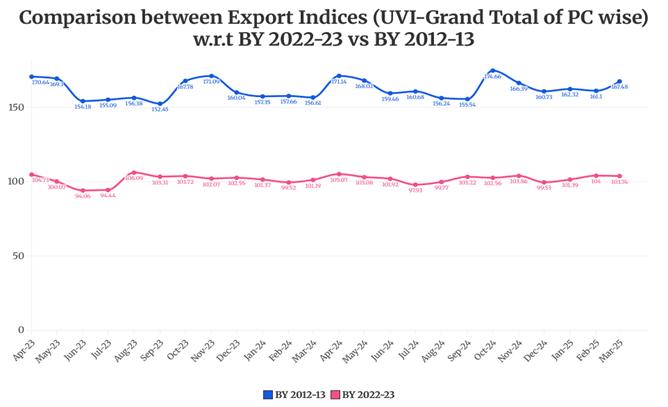
#BY means Base Year.
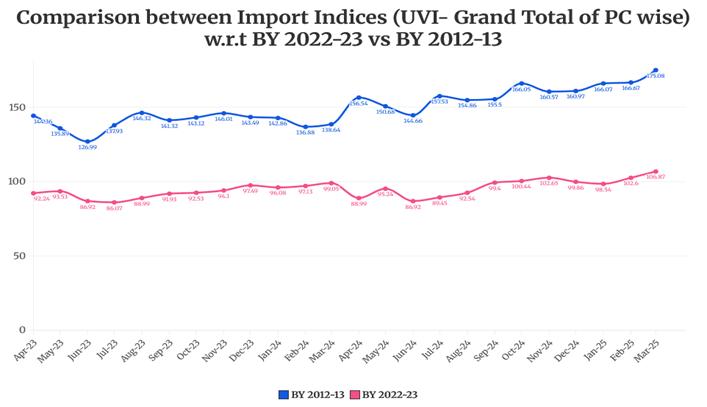
 

#BY means Base Year.

Table: Unit Value Index (UVI) and Quantity Index (QI) during FY 2025-26(Apr-Nov) using FY 2022-23 as base year


Month

Apr_25

May_25

Jun_25

1st Qtr 25-26

Jul_25

Aug_25

Sep_25

2nd Qtr 25-26

Oct_25

Nov_25

Unit Value Index

Export

105.31

99.73

96.31

100.33

99.31

100.55

104.08

101.23

103.78

105.32

Import

92.33

97.97

91.74

94.08

96.34

100.81

108.69

101.93

110.17

106.59

Quantity Index

Export

107.85

104.76

93.88

101.91

103.41

102.64

111.04

105.57

116.19

113.06

Import

138.16

126.61

112.58

125.17

122.47

124.06

126.45

124.32

137.04

121.75

Qtr  means Quarter.

Meaning and interpretation of the Indices

The Unit Value Indices and the Quantity Indices may be interpreted along the following lines.

The Unit Value Index answers the question: What is the growth in the average Unit Value of the items1 traded in the current month with respect to the same month in the Base Year?

So, an Unit Value Index of, say, 120 means that if the items that have been traded in the current month had been traded in the same month of the base year, and if the average price (or unit value) of those items had been Rs.100 in that month of the base year, then the average price (or unit value) of these items in the current month is Rs.120. Or that, there is a 20% increase in the average Unit Value, with respect to the Base Year, of the items that have been traded in the Current Month.

For example, let us suppose 30 items, 10 items each from 3 different Principal Commodities, have been traded in the current month. If these 30 items had been traded in the corresponding month of the base year at an average price of Rs.100, then the average price of these items in the current year is Rs.120.

It is to be noted that there are two successive steps of averaging done here. The first averaging is done over all the items (or ITCHS) of a PC group to arrive at the Index of that PC group. And the second averaging is done over all the PC groups to arrive at the Index at the Grand Total level for all commodities (which is the overall Index for India for a month). In both the stages, a weighted average is taken where the weights are proportional to the importance of the items and the PC groups respectively, and the Laspeyres Formula is used for averaging.

Quantity Indices, say, 200 means that if in the base year on an average 100 units were traded in India in the base year, then in the current year on an average 200 units were traded. However, it must be remembered that averaging quantities are different from averaging prices, since quantities in different units cannot be added directly.

So, the Quantity Indices are calculated by dividing the Value Indices by the Unit Value Indices. For example, if there is an increase in the Value of Export from Rs. 10,000 to Rs. 24,000, then the Value Index is 24000/10000 × 100 = 240. If the Unit Value Index is 120, then the Quantity Index comes to 240/120 × 100 = 200. So, loosely it can be said that, if the value of export has increased 2.4 times and the price of the commodities has increased 1.2 times, then the quantity must have doubled.

However, it may be noted that a very high or low Quantity Index may indicate the presence of Base Effect.

The Interpretation of the Bilateral and Regional Indices can be seen as an extension of the above.

A Unit Value Index of 120 with respect to a country, say Bangladesh, means that if all the items that have been traded with Bangladesh in the current month had been traded in the same month of the base year with the same country, and if the average price (or unit value) of those items had been Rs.100 in that month of the base year, then the average price (or unit value) of these items in the current month is Rs.120.

Similarly, a Quantity Index of 200 with respect to a country, say Bangladesh, means that if in the base year on an average 100 units were traded in India in the base year, then in the current year on an average 200 units were traded.

Comparability of the Indices across time

It is to be noted that the weights in the Index Number formula are fixed across time and there are twelve sets of weights for the twelve months. Hence, comparability of Indices is meaningful only when Indices of same month are compared across years. Different months may attach different weights to the same item, and hence comparing indices of two different months becomes vague and may have little applicability.

Further, the weights of the items that are not present in the trade basket of the current month are distributed to all the items that have been traded in the current month. This distribution is done in proportion to the weights of those items.

For example, let us suppose there are only 3 commodities for trade, say A, B and C. In month May of the Base year, let us suppose that the trade value of A was Rs. 50, B was Rs. 100 and C was Rs. 50. Then the weights assigned to A, B and C in the month of May of the following years would be in the ratio 50 :100 :50. However, in case, C is not traded in the current month, then the weight of C would be distributed proportionately among A and B, again in the ratio 1:2 (since in May the weights of A and B are in the ratio of 50 : 100, i.e., 1 : 2). So, in the current month the weights of A and B would be 3313  and 6623 .

As a result, the weights in any two given months are dependent on exactly the number of items (ITCHS codes) traded in those months. If the items traded are widely different, inference drawn from the comparison of the Indices may be done accordingly. On the other hand, more the similarity in the number of items traded more is the comparability of the two indices.

Net Terms of Trade:

Net Terms of Trade also called commodity Terms of Trade is defined as a ratio of export prices to import prices.

Let say 2022-23 be the base year and 2023-24 be the final year. We express both export and import prices in 2022-23 as 100. Now, suppose that at the end of 2023-24, it is found that the index of export prices decreased to 90 and index of import prices roses to 150. Then the Net Terms of Trade has changed to 90100150100=35 . Then terms of trade as index=35*100=60 . It implies that terms of trade of the country have decreased by about 40% in 2023-24 as compared with 2022-23. It thus shows a deterioration or a worsening of the terms of trade of the country.

If the index of export prices has risen to 150 and that of import prices had risen to 120, then the net terms of trade would have changed to 150120*100=125 . This implies an improvement in the net terms of trade of the country by 25% in 2023-24 over 2022-23.

Gross Terms of Trade:

Gross Terms of Trade is the ratio of physicalquantity of import to physical quantity of export.

Let say 2022-23 be the base year. In that year, the quantities export and import are denoted by 100. Now, suppose that in the year 2023-24, the index of quantity of import was 150 and that of quantity of export was 120. Then the gross terms of trade is given by 150100120100=54,  in terms of percentage =54*100=125 . This implies that there was an improvement of gross terms of trade by 25% in 2023-24 compared to 2022-23.

Income Terms of Trade: Income Terms of Trade is defined as- Net Terms of Trade multiplied by quantity of export.

Topics

Acts Income Tax