

Loading...

Top
Help
×

By creating an account you can:

Logo TaxTMI
Call Us / Help / Feedback

Contact Us At :

E-mail: [email protected]

Call / WhatsApp at: +91 99117 96707

For more information, Check Contact Us

FAQs :

To know Frequently Asked Questions, Check FAQs

Most Asked Video Tutorials :

For more tutorials, Check Video Tutorials

Submit Feedback/Suggestion :

Email :
Please provide your email address so we can follow up on your feedback.
Category :
Description :
Min 15 characters 0/2000
Make Most of Text Search
  1. Checkout this video tutorial: How to search effectively on TaxTMI.
  2. Put words in double quotes for exact word search, eg: "income tax"
  3. Avoid noise words such as : 'and, of, the, a'
  4. Sort by Relevance to get the most relevant document.
  5. Press Enter to add multiple terms/multiple phrases, and then click on Search to Search.
  6. Text Search
  7. The system will try to fetch results that contains ALL your words.
  8. Once you add keywords, you'll see a new 'Search In' filter that makes your results even more precise.
  9. Text Search
Add to...
You have not created any category. Kindly create one to bookmark this item!
Create New Category
Hide
Title :
Description :
❮❮ Hide
Default View
Expand ❯❯
Close ✕
🔎 News - Adv. Search
TEXT SEARCH:

Press 'Enter' to add multiple search terms. Rules for Better Search

Search In:
Main Text + AI Text
  • Main Text
  • Main Text + AI Text
  • AI Text
Category: ?
Categorized by AI
---- All Categories ----
  • ---- All Categories ----
  • Income Tax
  • GST
  • Customs, DGFT & SEZ
  • FEMA & RBI
  • Corp. Laws, SEBI & IBC
  • PMLA, Black Money & ED
  • Budget
  • News and Press Release
  • PTI News
Month:
---- All Months ----
  • ---- All Months ----
  • January
  • February
  • March
  • April
  • May
  • June
  • July
  • August
  • September
  • October
  • November
  • December
Year:
---- All Years ----
  • ---- All Years ----
  • 2026
  • 2025
  • 2024
  • 2023
  • 2022
  • 2021
  • 2020
  • 2019
  • 2018
  • 2017
  • 2016
  • 2015
  • 2014
  • 2013
  • 2012
  • 2011
Sort By: ?
In Sort By 'Default', exact matches for text search are shown at the top, followed by the remaining results in their regular order.
Relevance Default Date
    Dubai International Airport handled a record 95.2 million passengers in 2025
    'No deal but US steal': Cong's dig at govt over Indo-US trade agreement
    White House drops reference to 'certain pulses' in revised fact sheet on trade deal with India
    Important cases listed in the Supreme Court on Wednesday
    Puducherry Assembly to pass interim budget on Feb 12
    Actress Tamannaah assumes roles as KSDL brand ambassador amidst 'non-Kannadiga' row
    Budget 2026-27 to lay strong foundation for Viksit Bharat-2047 and new Uttar Pradesh: Adityanath
    USTR removes X post that showed PoK and Aksai Chin part of Indian territory
    Process to regularise daily wagers to be initiated this year: J-K CM Abdullah
    Bal Jogi Pargat Nath appointed chairman of advisory board of Bhagwan Valmiki Ji Tirath Sthal
    J-K CM Abdullah expresses concerns over Indo-US trade deal, defends Budget in Assembly
    DRI busts gold melting unit in Mumbai, seizes smuggled yellow metal worth Rs 9.22cr; 2 held
    Unlike Cong, BJP does not do votebank politics, says Haryana CM
    Mundhwa land deal: No bail for Shital Tejwani
    India has already started winding down purchases of Russian energy products: USTR
    New expressway to connect Nepal's Pashupatinath to Baidyanath Dham in Jharkhand: Bihar minister
    Parli Thermal Power Station asked to stop operation of 2 units for non-compliance of CPCB order
    Potash exploration project approved: Barinder Goyal
    J-K CM Abdullah defends SASCI, calls Rs 3,000 cr interest-free loan ‘big achievement’
    XLRI concludes recruitment process with highest offer of Rs 1.1 cr
❯❯
Maximize Maximize Maximize
0 / 200
Expand Note
Add to Folder

No Folders have been created

+

Are you sure you want to delete "My most important" ?

NOTE:

News
Showing Results for :
Reset Filters
Results Found:
Show All Summaries Hide All Summaries
February 11, 2026
Show AI Summary
Dubai International Airport hit 95.2M passengers and will shift operations to Al Maktoum after a $35B upgrade by 2032.
Dubai International Airport, run by state owned and state linked entities, reached 95.2 million passengers in 2025 and faces urban and cost pressures from rapid aviation driven growth. Authorities plan to transfer operations to Al Maktoum International Airport after an estimated $35 billion upgrade, targeting a 2032 operational move to leverage larger expansion capacity and reconfigure long term aviation infrastructure.
February 11, 2026
Show AI Summary
India US interim trade agreement cuts tariffs to 18% but is criticised as asymmetrical and harmful to textile competitiveness.
The interim Indo US trade agreement reduces reciprocal tariffs on Indian goods from 25% to 18% and eliminates a prior punitive 25% tariff on Indian crude; opposition commentary characterises the pact as asymmetrical, a "coerced opening" that concedes more than India gains and undermines textile export competitiveness relative to Bangladesh.
February 11, 2026
Show AI Summary
White House revises trade fact sheet: removes 'pulses' and softens India purchase commitments language.
The White House revised its interim US-India trade fact sheet to remove "pulses" from the list of US agricultural products on which India will eliminate or reduce tariffs and to change wording from India "committed" to buy over $500 billion of US goods to India "intends" to buy more American products and purchase over $500 billion of specified US goods.
February 11, 2026
Show AI Summary
Supreme Court to hear challenges on detention of activist, money laundering case, service pay and police reforms.
The Supreme Court will hear petitions challenging the detention of climate activist Sonam Wangchuk; a state chief minister's challenge to Enforcement Directorate money laundering proceedings; a petition concerning pay and allowances of members of the Uttar Pradesh State Consumer Dispute Redressal Commission; and a petition concerning police reform.
February 11, 2026
Show AI Summary
Puducherry interim budget to be tabled Feb 12, Vote on Account to fund departments pending a full budget.
An interim budget will be tabled on February 12 by the Chief Minister acting as finance minister via a Vote on Account to authorize departmental expenditures for the initial months of fiscal 2026-2027; the Assembly will also pass supplementary grants for the current fiscal year because imminent elections prevent presentation of a full budget, with the House comprising thirty elected and three nominated members.
February 11, 2026
Show AI Summary
KSDL appoints Tamannaah as brand ambassador, sparking debate over non-Kannada selection and business-driven committee choice.
KSDL's selection committee appointed Tamannaah Bhatia as a two-year brand ambassador for a reported Rs 6.20 crore fee, defending the merit-based, market-oriented choice because several Kannada actors were ineligible due to other endorsements and Mysore Sandal sales are concentrated outside Karnataka (approx. 8-12% in-state), prompting both political and social-media criticism framed as an attack on local talent and counter-arguments stressing commercial strategy and export-oriented expansion.
February 11, 2026
Show AI Summary
2026 27 state budget to prioritize inclusive development, poverty welfare, youth empowerment, farmer prosperity and women's dignity.
The 2026-27 state Budget is positioned as a policy instrument to found long term economic transformation toward Viksit Bharat 2047 and a USD 1 trillion state economy, offering a coordinated action plan emphasizing poverty alleviation, youth empowerment, farmer prosperity, women's dignity, and targeted public investment within the routine legislative budget presentation process.
February 11, 2026
Show AI Summary
USTR deletes X post after map depicted Pakistan-occupied Kashmir and Aksai Chin as part of India.
The US Trade Representative removed an X post that displayed a map showing Jammu and Kashmir, including Pakistan-occupied Kashmir, and Aksai Chin as part of India; the map accompanied a bilateral interim trade framework announcement and the deletion reflects sensitivities about depicting disputed territories in official social media communications.
February 11, 2026
Show AI Summary
Regularisation of daily wagers to be initiated this year; Budget ties industrial incentives to local employment and funds key welfare locally.
The government will initiate regularisation of daily wagers this year and has prioritised job creation, infrastructure, targeted welfare across agriculture, animal husbandry, fisheries and dairy, and youth entrepreneurship through Mission YUVA. The administration will fund six free LPG cylinders from its own resources, extend free bus travel to persons with disabilities, promote EV bus services, and require industrial beneficiaries of subsidies, land and power concessions to prioritise employment for local youth.
February 11, 2026
Show AI Summary
Appointment of Bal Jogi Pargat Nath to lead advisory board to develop Ram Tirath as an international Dalit heritage centre.
The Punjab government appointed Bal Jogi Pargat Nath as chairman of the advisory board of the Bhagwan Valmiki Ji Tirath Sthal shrine board and signalled a policy to develop Ram Tirath as an international centre of Dalit faith, heritage and spiritual philosophy to promote recognition of Dalit contributions and the values of equality, dignity and social justice.
February 11, 2026
Show AI Summary
Indo-US trade deal could harm J-K dry fruit and horticulture economy, and CM defends the pro-people Budget.
Omar Abdullah warned that the India-US interim trade deal allowing duty-free imports of tree nuts could harm Jammu and Kashmir's dry fruit and horticulture economy and urged protection for local walnuts, almonds and apples. He defended the Budget as pro-people and growth-oriented, noting capital expenditure at 36% (rising by March 31), distinguishing prior higher revenue spending due to loan settlements, assuring salaries and pensions are safe, and highlighting investments in agriculture, horticulture, dairying and rural economic strengthening.
February 10, 2026
Show AI Summary
Smuggled gold seized and two arrested after airport wax-capsule concealment and linked melting facility exposed.
Directorate of Revenue Intelligence seized 5.8 kg of smuggled gold worth about Rs 9.22 crore and arrested two syndicate members after surveillance linked intercepted passengers carrying wax-capsule gold to a South Mumbai melting facility where authorities recovered melting and casting equipment, foreign bullion marking dies, record books of smuggled-gold transactions and sale proceeds, and currency notes used as tokens for illegal receipt and delivery; the arrested were booked under the Customs Act and further probe is underway.
February 10, 2026
Show AI Summary
Old-age pension discontinuations were administrative safeguards pending verification; valid proof will prompt immediate restoration.
The Haryana government says old-age pensions were administratively discontinued where eligibility could not be verified: cases of recorded deaths identified after Registrar General data arrived in November 2025; beneficiaries under the qualifying age due to manipulated Aadhaar age data, with action initiated for tampering; and cases lacking verified income-based eligibility pending income certificate submission. Valid proof of eligibility will trigger immediate restoration; discontinuations are described as temporary safeguards against ineligible payments.
February 10, 2026
Show AI Summary
Mundhwa land deal: accused alleged to have facilitated illegal sale of protected government land at undervalue.
Allegations assert that the accused facilitated illegal regularisation and sale of protected government land in Mundhwa at a substantial undervalue, involved waiver of large stamp duty, execution of documents purportedly on behalf of deceased persons, and connivance with revenue officials, raising serious economic offence concerns and investigative risks from absconding co-accused and potential witness influence.
February 10, 2026
Show AI Summary
India-US trade pact: India winding down Russian oil purchases and cutting tariffs on US industrial and agricultural goods.
An interim trade framework establishes reciprocal commitments: the US agreed to remove a punitive 25 per cent tariff on Indian imports in recognition of India's commitment to reduce Russian oil purchases; India has begun winding down Russian energy purchases and increasing American and other energy imports. India will eliminate or reduce tariffs on all US industrial goods and a wide range of US food and agricultural products, while also moving down digital services taxes and other tariffs.
February 10, 2026
Show AI Summary
New expressway linking Pashupatinath to Baidyanath Dham proposed, seeking central approval to boost religious tourism.
A 250-km Pashupatinath-Baidyanath Dham high-speed corridor has been proposed, with a detailed proposal sent to the Centre for approval; the project aims to promote religious tourism, cultural exchange and economic activity along a route entering India at Supaul and passing through several Bihar districts, and is presented alongside other expressway initiatives and ongoing India-Nepal border road works totaling 554.08 km.
February 10, 2026
Show AI Summary
Parli Thermal Power Station ordered closed for exceeding emission limits and failing pollution control and safety measures.
The Central Pollution Control Board directed the state regulator to immediately stop operation of Parli Thermal Power Station units 6 and 8 for non compliance: units 6-8 operated without a valid Consent to Operate and exhibited PM emissions (87, 85, 91 mg/Nm3) above the 50 mg/Nm3 limit, lacked required online emission and effluent monitoring, discharged untreated sewage and ash into a drain, had effluent pump leakages, missing ash dyke safety audits, no dust suppression at coal yards, and inadequate waste oil management.
February 10, 2026
Show AI Summary
Potash exploration in Fazilka approved with Rs 19.03 crore outlay, 21-month timeline and nine-month review.
Approval was granted for a reconnaissance survey potash exploration project in Choharianwali, Fazilka, covering 48 sq km with an approved outlay of Rs 19.03 crore and a 21 month completion period, subject to a programmatic review after nine months and execution by a designated mineral exploration agency under the Trust's sanctioning process.
February 10, 2026
Show AI Summary
SASCI scheme: J-K to take Rs 3,000 crore interest-free loan over 50 years; government defends move.
Jammu and Kashmir has secured Rs 3,000 crore under the SASCI scheme as an interest free loan repayable over 50 years; the Chief Minister contends internal financial assessment and the time value of money demonstrate limited present fiscal burden, while opponents urge legislative scrutiny and a committee to examine long term fiscal risks.
February 10, 2026
Show AI Summary
XLRI concluded recruitment with highest offer Rs 1.1 crore and average salary Rs 31.4 lakh for the 2024-26 batch.
XLRI concluded its 2024-26 batch recruitment with a highest offer of Rs 1.1 crore per annum, 578 offers from 145 recruiters across Jamshedpur and Delhi NCR, an average salary of Rs 31.40 lakh, a median of Rs 29 lakh for 576 PGDM students, and top roles in consulting, BFSI, and sales and marketing.

News

Back

All News

Showing Results for :
Reset Filters
No Records Found

News

Back

All News

Showing Results for : Reset Filters
Customs, DGFT & SEZ

Directorate General of Commercial Intelligence and Statistics Revises Base Year of Merchandise Trade Indices to FY 2022–23 to Reflect Current Trade Structure and Global Patterns

February 21, 2026

Contents
Summary
Note

Note

-

Bookmark

Print

Print

Merchandise Trade Indices are compiled and published by the Directorate General of Commercial Intelligence and Statistics (DGCI&S), Ministry of Commerce & Industry, to measure changes in the unit values (prices) of India’s exports and imports over time. These indices serve as important indicators of external sector price movements and are widely used for economic analysis, including national accounts compilation and assessment of terms of trade. Over the years, the base year of the indices has been periodically revised to reflect structural changes in India’s trade composition and evolving global trade patterns. The most recent revision updates the base year to FY 2022–23 (2022–23 = 100), replacing the earlier base of FY 2012–13, thereby ensuring that the indices accurately represent the current structure of India’s merchandise trade.

Revision of Base Year of India’s Merchandise Trade Indices to FY 2022–23

The Directorate General of Commercial Intelligence and Statistics (DGCI&S), Ministry of Commerce & Industry, has revised the base year of India’s Merchandise Trade Indices from FY 2012–13 to FY 2022–23 (2022–23 = 100), in view of the structural changes in the economy, shifts in commodity composition, evolving trade patterns, and the need for improved alignment with contemporary macroeconomic indicators.

The revision has been undertaken on the recommendations of a committee constituted by DGCI&S under the Chairmanship of Prof. Nachiketa Chattopadhyay, Professor, Indian Statistical Institute, Kolkata. The Committee examined the existing methodology, data coverage, weighting structure, and compilation practices, and recommended suitable refinements in line with international best practices.

Key Features of the Revised Series (Base: FY 2022–23)

  1. Updated Base Year:
    The new base year FY 2022–23 makes the Indices reflect the current structure of India’s external trade more accurately.
  2. Revised Commodity Basket:
    The coverage and classification of commodities have been reviewed at the Principal Commodity level to better capture emerging and declining trade items.
  3. Revised Weighting Structure:
    Weights have been updated based on trade values of the new base year to reflect the latest value shares in exports and imports.
  4. Improved Methodology:
    Methodological refinements have been introduced in:
    1. Selection of common commodity basket for base year selection (procedure of selection for common commodity basket explained in detail report of the committee).
    2. Treatment of missing unit values (Imputation of missing unit values in base year selection have been explained in detail in the committee report).
  5. Indices Compiled:
    The revised series includes:
    1. Monthly, Quarterly and Annual Indices (Export Unit Value Index,Import Unit Value Index).
    2. Principal Commodity (PC) Classification wise Trade Indices (Export/Import).
    3. Standard International Trade Classification-wise (SITC) Trade Indices.
    4. Broad economic categories-wise (BEC) Trade Indices.
    5. Bilateral and Region-wise Trade Indices of Top 20 Export and Import partner nations of India.
    6. Terms of Trade (Gross terms of trade, Net terms of trade and Income terms of trade).

Rationale for Revision

Over the past decade, India’s trade basket has undergone substantial changes due to emergence of new commodities, technological advancements, Global supply chain restructuring and changes in relative price structures.

The earlier base year (FY 2012–13) no longer adequately reflected the prevailing trade structure. The revision ensures improved relevance, reliability, and analytical usefulness of the Merchandise Trade Indices for policymakers, researchers, and other stakeholders.

Use of the Revised Series

Merchandise Trade Indices compiled by the Directorate General of Commercial Intelligence and Statistics (DGCI&S) are extensively used by key government institutions for economic analysis and policy formulation. The National Accounts Division (NAD) of the Ministry of Statistics and Programme Implementation uses the Export and Import Unit Value Indices as deflators for estimating real exports and imports in GDP compilation. The Reserve Bank of India (RBI) relies on these indices for external sector assessment, balance of payments analysis, and evaluation of price competitiveness. Various Ministries and Government agencies also use them to frame and review trade-related policies and to assess movements in international prices. In addition, academic institutions, research organizations, and economic analysts utilize Merchandise Trade Indices for empirical research, modelling, and analysis of trade dynamics and terms of trade trendson and economic research.

Availability of Data

The revised Merchandise Trade Indices (Base: FY 2022–23) will be released on the official website of DGCI&S. Detailed methodological documentation is available in the Report of the Committee on Revision of Base Year for Merchandise Trade Indices.

Comparison of the new revised Indices (Base Year: 2022-23) with the already released Indices (Base Year : 2012-13) for 2022-23 and 2023-24 is given below.
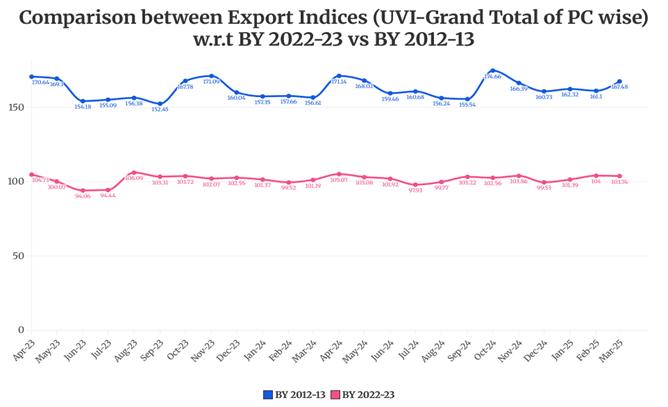
#BY means Base Year.
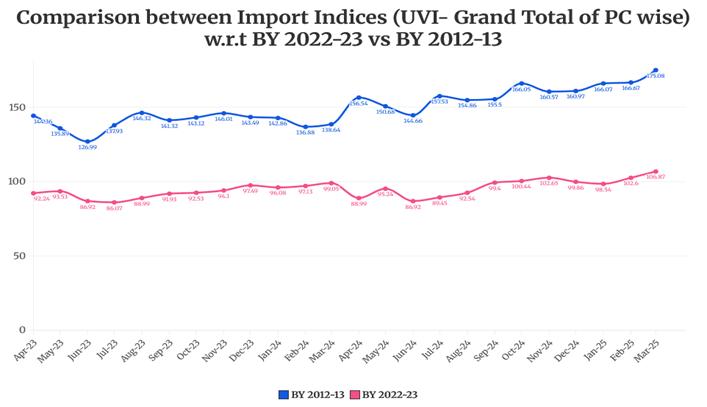
 

#BY means Base Year.

Table: Unit Value Index (UVI) and Quantity Index (QI) during FY 2025-26(Apr-Nov) using FY 2022-23 as base year


Month

Apr_25

May_25

Jun_25

1st Qtr 25-26

Jul_25

Aug_25

Sep_25

2nd Qtr 25-26

Oct_25

Nov_25

Unit Value Index

Export

105.31

99.73

96.31

100.33

99.31

100.55

104.08

101.23

103.78

105.32

Import

92.33

97.97

91.74

94.08

96.34

100.81

108.69

101.93

110.17

106.59

Quantity Index

Export

107.85

104.76

93.88

101.91

103.41

102.64

111.04

105.57

116.19

113.06

Import

138.16

126.61

112.58

125.17

122.47

124.06

126.45

124.32

137.04

121.75

Qtr  means Quarter.

Meaning and interpretation of the Indices

The Unit Value Indices and the Quantity Indices may be interpreted along the following lines.

The Unit Value Index answers the question: What is the growth in the average Unit Value of the items1 traded in the current month with respect to the same month in the Base Year?

So, an Unit Value Index of, say, 120 means that if the items that have been traded in the current month had been traded in the same month of the base year, and if the average price (or unit value) of those items had been Rs.100 in that month of the base year, then the average price (or unit value) of these items in the current month is Rs.120. Or that, there is a 20% increase in the average Unit Value, with respect to the Base Year, of the items that have been traded in the Current Month.

For example, let us suppose 30 items, 10 items each from 3 different Principal Commodities, have been traded in the current month. If these 30 items had been traded in the corresponding month of the base year at an average price of Rs.100, then the average price of these items in the current year is Rs.120.

It is to be noted that there are two successive steps of averaging done here. The first averaging is done over all the items (or ITCHS) of a PC group to arrive at the Index of that PC group. And the second averaging is done over all the PC groups to arrive at the Index at the Grand Total level for all commodities (which is the overall Index for India for a month). In both the stages, a weighted average is taken where the weights are proportional to the importance of the items and the PC groups respectively, and the Laspeyres Formula is used for averaging.

Quantity Indices, say, 200 means that if in the base year on an average 100 units were traded in India in the base year, then in the current year on an average 200 units were traded. However, it must be remembered that averaging quantities are different from averaging prices, since quantities in different units cannot be added directly.

So, the Quantity Indices are calculated by dividing the Value Indices by the Unit Value Indices. For example, if there is an increase in the Value of Export from Rs. 10,000 to Rs. 24,000, then the Value Index is 24000/10000 × 100 = 240. If the Unit Value Index is 120, then the Quantity Index comes to 240/120 × 100 = 200. So, loosely it can be said that, if the value of export has increased 2.4 times and the price of the commodities has increased 1.2 times, then the quantity must have doubled.

However, it may be noted that a very high or low Quantity Index may indicate the presence of Base Effect.

The Interpretation of the Bilateral and Regional Indices can be seen as an extension of the above.

A Unit Value Index of 120 with respect to a country, say Bangladesh, means that if all the items that have been traded with Bangladesh in the current month had been traded in the same month of the base year with the same country, and if the average price (or unit value) of those items had been Rs.100 in that month of the base year, then the average price (or unit value) of these items in the current month is Rs.120.

Similarly, a Quantity Index of 200 with respect to a country, say Bangladesh, means that if in the base year on an average 100 units were traded in India in the base year, then in the current year on an average 200 units were traded.

Comparability of the Indices across time

It is to be noted that the weights in the Index Number formula are fixed across time and there are twelve sets of weights for the twelve months. Hence, comparability of Indices is meaningful only when Indices of same month are compared across years. Different months may attach different weights to the same item, and hence comparing indices of two different months becomes vague and may have little applicability.

Further, the weights of the items that are not present in the trade basket of the current month are distributed to all the items that have been traded in the current month. This distribution is done in proportion to the weights of those items.

For example, let us suppose there are only 3 commodities for trade, say A, B and C. In month May of the Base year, let us suppose that the trade value of A was Rs. 50, B was Rs. 100 and C was Rs. 50. Then the weights assigned to A, B and C in the month of May of the following years would be in the ratio 50 :100 :50. However, in case, C is not traded in the current month, then the weight of C would be distributed proportionately among A and B, again in the ratio 1:2 (since in May the weights of A and B are in the ratio of 50 : 100, i.e., 1 : 2). So, in the current month the weights of A and B would be 3313  and 6623 .

As a result, the weights in any two given months are dependent on exactly the number of items (ITCHS codes) traded in those months. If the items traded are widely different, inference drawn from the comparison of the Indices may be done accordingly. On the other hand, more the similarity in the number of items traded more is the comparability of the two indices.

Net Terms of Trade:

Net Terms of Trade also called commodity Terms of Trade is defined as a ratio of export prices to import prices.

Let say 2022-23 be the base year and 2023-24 be the final year. We express both export and import prices in 2022-23 as 100. Now, suppose that at the end of 2023-24, it is found that the index of export prices decreased to 90 and index of import prices roses to 150. Then the Net Terms of Trade has changed to 90100150100=35 . Then terms of trade as index=35*100=60 . It implies that terms of trade of the country have decreased by about 40% in 2023-24 as compared with 2022-23. It thus shows a deterioration or a worsening of the terms of trade of the country.

If the index of export prices has risen to 150 and that of import prices had risen to 120, then the net terms of trade would have changed to 150120*100=125 . This implies an improvement in the net terms of trade of the country by 25% in 2023-24 over 2022-23.

Gross Terms of Trade:

Gross Terms of Trade is the ratio of physicalquantity of import to physical quantity of export.

Let say 2022-23 be the base year. In that year, the quantities export and import are denoted by 100. Now, suppose that in the year 2023-24, the index of quantity of import was 150 and that of quantity of export was 120. Then the gross terms of trade is given by 150100120100=54,  in terms of percentage =54*100=125 . This implies that there was an improvement of gross terms of trade by 25% in 2023-24 compared to 2022-23.

Income Terms of Trade: Income Terms of Trade is defined as- Net Terms of Trade multiplied by quantity of export.

Topics

Acts Income Tax