

Loading...

Top
Help
×

By creating an account you can:

Logo TaxTMI
Call Us / Help / Feedback

Contact Us At :

E-mail: [email protected]

Call / WhatsApp at: +91 99117 96707

For more information, Check Contact Us

FAQs :

To know Frequently Asked Questions, Check FAQs

Most Asked Video Tutorials :

For more tutorials, Check Video Tutorials

Submit Feedback/Suggestion :

Email :
Please provide your email address so we can follow up on your feedback.
Category :
Description :
Min 15 characters 0/2000
Make Most of Text Search
  1. Checkout this video tutorial: How to search effectively on TaxTMI.
  2. Put words in double quotes for exact word search, eg: "income tax"
  3. Avoid noise words such as : 'and, of, the, a'
  4. Sort by Relevance to get the most relevant document.
  5. Press Enter to add multiple terms/multiple phrases, and then click on Search to Search.
  6. Text Search
  7. The system will try to fetch results that contains ALL your words.
  8. Once you add keywords, you'll see a new 'Search In' filter that makes your results even more precise.
  9. Text Search
Add to...
You have not created any category. Kindly create one to bookmark this item!
Create New Category
Hide
Title :
Description :
❮❮ Hide
Default View
Expand ❯❯
Close ✕
🔎 News - Adv. Search
TEXT SEARCH:

Press 'Enter' to add multiple search terms. Rules for Better Search

Search In:
Main Text + AI Text
  • Main Text
  • Main Text + AI Text
  • AI Text
Category: ?
Categorized by AI
---- All Categories ----
  • ---- All Categories ----
  • Income Tax
  • GST
  • Customs, DGFT & SEZ
  • FEMA & RBI
  • Corp. Laws, SEBI & IBC
  • PMLA, Black Money & ED
  • Budget
  • News and Press Release
  • PTI News
Month:
---- All Months ----
  • ---- All Months ----
  • January
  • February
  • March
  • April
  • May
  • June
  • July
  • August
  • September
  • October
  • November
  • December
Year:
---- All Years ----
  • ---- All Years ----
  • 2026
  • 2025
  • 2024
  • 2023
  • 2022
  • 2021
  • 2020
  • 2019
  • 2018
  • 2017
  • 2016
  • 2015
  • 2014
  • 2013
  • 2012
  • 2011
Sort By: ?
In Sort By 'Default', exact matches for text search are shown at the top, followed by the remaining results in their regular order.
Relevance Default Date
    Firestorm and Orqa Partner to Pioneer High-Tech Industrial Manufacturing on Front Lines
    Neutrinos Named a Technology Standout in Claims Administration by Celent
    OTM 2026 Concludes in Mumbai, Reinforcing India's Rise as a Priority Market for Global Tourism
    New BrowserStack Report Finds 94% of Teams Use AI in Testing, but Only 12% Have Reached Full Autonomy
    Sonata Software Achieves AWS Premier Tier Status in the AWS Partner Network
    40 world chefs' broke bread and boundaries at the IIHM International Young Chef Olympiad
    BML Munjal University Turns the Spotlight on India's Next Startup Wave with Propel Pitchfest26
    CGI looks ahead after 50 years: 'Building what's next' for an evolving world
    Quora Survey Reveals How Indians Research, Compare, and Decide on Financial Products
    Second Edition of Art de Vivre à la française to be unveiled at India Design ID 2026
    New Research by TeachBetter.ai Reveals How Teachers Are Using AI to Redefine Education
    Handle differences from strategic, long term perspective, China on talks between Misri, Ma Zhaoxu
    Best Crypto Presale: DeepSnitch AI Positioned for 100x Gains With USD 1.53M Raised, HEXY and HYPER Attract New Traders
    All key sensitive sectors protected under India-US Interim trade pact: Commerce Secy
    Markets open higher; turn choppy amid mixed global trends
    Asian shares advance after weak US retail data weigh on Wall Street
    After Cong nudge, DMK announces seat-sharing committee for talks with allies
    Rupee falls 6 paise to 90.62 against US dollar in early trade
    RBI invites public comments on the draft Reserve Bank of India (Non-Banking Financial Companies – Registration, Exemptions and Framework for Scale B...
    Review of Lending norms for UCBs
❯❯
Maximize Maximize Maximize
0 / 200
Expand Note
Add to Folder

No Folders have been created

+

Are you sure you want to delete "My most important" ?

NOTE:

News
Showing Results for :
Reset Filters
Results Found:
Show All Summaries Hide All Summaries
February 11, 2026
Show AI Summary
Firestorm and Orqa will mass-produce an NDAA-compliant FPV quadcopter using expeditionary manufacturing and sovereign supply chains.
The partnership will manufacture and distribute the U.S.-built Firestorm Squall using NDAA-compliant components, combining Orqa's in-house, China-free component production and high-volume manufacturing capacity with Firestorm's containerized expeditionary additive-manufacturing platforms to enable scaled production, sustainment, and in-theater platform development for Department of War customers and allies.
February 11, 2026
Show AI Summary
Neutrinos life insurance claims automation named Technology Standout; emphasizes AI decisioning, auditability, and structured human review.
Neutrinos' life insurance claims automation platform offers configurable AI decisioning, adjudication logic, complex benefit calculations, cross-platform orchestration and full auditability, with AI-driven document processing, data validation and streamlined correspondence; the platform emphasizes structured decision support and clear handoffs to human review as insurers adopt generative AI in claims.
February 11, 2026
Show AI Summary
OTM 2026 showcased India's rise as a priority outbound travel market, driving global B2B engagement and connectivity.
OTM 2026 in Mumbai confirmed India's status as a priority outbound travel market by bringing together 2,200+ exhibitors, 45+ national tourism organisations, 50,000+ trade visitors and 1,000+ hosted buyers, delivering 50,000+ pre-scheduled B2B meetings and serving as a launch platform for destination campaigns, airline product updates and India-focused commercial strategies across leisure, corporate travel, MICE and weddings.
February 11, 2026
Show AI Summary
AI in software testing is widely adopted but struggles with integration; budgets and ROI are rising as automation use cases expand.
AI is central to modern software testing but operational maturity trails adoption: integration is the primary barrier, budget increases for AI testing are widely planned, and reported ROI-especially among longer tenured users-is strong. Teams prioritize test case generation, test data creation, and automated maintenance to reduce manual effort and accelerate releases; the report correlates ROI with maturity and outlines industry and regional breakdowns and near term predictions for AI testing evolution.
February 11, 2026
Show AI Summary
Sonata Software achieves AWS Premier Tier status, validating its AWS cloud migration, modernization, and AI deployment capabilities.
Sonata Software attained AWS Premier Tier Services Partner status, recognizing its expertise in designing, architecting, building, migrating, and managing AWS workloads and validating a strong pool of AWS-trained and certified consultants with capabilities across professional services, program delivery, complex cloud transformations, and deployment of customer solutions on AWS.
February 11, 2026
Show AI Summary
IIHM Young Chef Olympiad integrates AI heritage preservation with global student exchanges and institutional MOUs for culinary education.
The Young Chef Olympiad 2026 was a student first global competition that integrated AI enabled heritage preservation with formalised international collaboration, producing country specific Culinary Heritage GPTs, an AI literacy programme (AI LEAP), and Global MOUs and a Global Culinary Knowledge Declaration to support student and faculty exchanges, shared research, and structured documentation of culinary traditions.
February 11, 2026
Show AI Summary
BML Munjal University hosts Propel Pitchfest26 to showcase startups and connect founders with investors, mentors, and accelerators.
BML Munjal University will host Propel Pitchfest26 and EIS 4.0 on 11-12 February 2026 as a launchpad for early-stage and growth-ready ventures, providing access to investor funding, acceleration programmes, mentorship and ecosystem partnerships; selected startups may enter ACIC-BMU accelerator programmes to support long-term scale-up, with emphasis on AI and deep-tech, sustainability, healthcare and med-tech, manufacturing innovation, women-led startups and social entrepreneurship.
February 11, 2026
Show AI Summary
CGI outlines a 50th anniversary strategy prioritising AI, cloud, global delivery and employee ownership to drive long term client value.
CGI announces a 50th anniversary strategy focused on a client proximate global delivery model delivering AI, cloud, cybersecurity, data and digital transformation services; expansion of Global Capability Centers for digital engineering, cloud and AI; reinforcement of an employee ownership governance model (CGI Partners) to ensure accountability and talent development; and commitments to community engagement, education and digital access while highlighting planned 2026 initiatives to demonstrate continued evolution and long term value creation.
February 11, 2026
Show AI Summary
Quora users in India rely on peer and expert content, with 38% influenced by platform answers in financial decisions.
Survey of Quora users in India shows extended pre-decision research (56% >1 week; 26% >1 month), strong preference for real-person perspectives (82%), and platform influence (38% influenced by Quora answers; 35% find Quora more valuable than other sources). Users trust experience-driven and expert content (73% trust similar-life respondents; 71% trust independent experts), combining technical facts with social proof, creating actionable opportunities for early-stage marketer engagement.
February 11, 2026
Show AI Summary
Art de Vivre a la franc aise showcases French design excellence and fosters Indo French collaboration and innovation.
The second edition of Art de Vivre a la franc aise at India Design ID 2026 presents a 350m2 exhibition of 16 French houses across design and lifestyle categories, paired with an Indian guest designer and the Indo French Design Dialogues to promote creative collaboration, material innovation, and bilateral commercial and cultural partnerships within the India France Year of Innovation.
February 11, 2026
Show AI Summary
Teachers are using AI to redesign lesson planning and assessments, recovering time for mentoring and real-time classroom feedback.
TeachBetter.ai's research shows teachers are embedding AI into core instructional workflows-notably lesson planning (55%) and assessment design (48%)-and that platform use recovers an average of 4.7 hours weekly which is reinvested into mentoring and differentiated instruction. Version 4.0's Live Quiz & Poll Generator enables instant creation, sharing, response capture, auto-grading, and immediate feedback, positioning the platform as integrated teaching infrastructure that reduces technical overhead and supports a transition from automation to pedagogical transformation.
February 11, 2026
Show AI Summary
India-China ties: focus on an updated air services agreement, visa facilitation, export control concerns, and border tranquillity.
The dialogue recognised the need for early conclusion of an updated air services agreement, continued practical steps for visa facilitation and people-to-people contacts, and efforts to address concerns on export control measures affecting critical minerals, all framed within a strategic, long-term approach to deepen trust, expand cooperation and maintain peace and tranquillity in border areas.
February 11, 2026
Show AI Summary
DeepSnitch AI presale raises $1.53M offering AI analytics tokens, amid MicroStrategy Bitcoin purchase and investor risk warnings.
DeepSnitch AI raised approximately $1.53 million at a presale price of $0.03906, promoted for its five agent AI analytics suite that provides contract analysis, risk scoring, scam flags, breakout spotting and sentiment/FUD alerts, with tiered presale bonus incentives (30% on $2K+; 300% on $30K+). The article also reports Strategy's reported purchase of ~1,140 BTC for $90 million at an average ~$78,800 per coin and includes an explicit investor risk disclaimer advising independent financial advice and disavowing liability.
February 11, 2026
Show AI Summary
India-US interim trade pact protects sensitive agricultural and dairy sectors while reducing reciprocal tariffs to 18%.
India has preserved full non concessional treatment for specified sensitive agricultural and dairy goods - maize, wheat, rice, soya, poultry, milk, cheese, ethanol, tobacco, certain vegetables and meat - by not granting duty concessions under the interim trade pact with the US, and where limited access exists it is constrained by tariff rate quota mechanisms; reciprocal tariffs for labour intensive exports are reduced to 18% to enhance competitiveness.
February 11, 2026
Show AI Summary
Equity markets open higher then turn choppy as Sensex gains about 213 points and investors book profits.
Equity benchmarks opened higher but turned volatile as investors booked profits after early gains; the Sensex rose about 213 points to 84,487.34 and the Nifty reached 26,009.40. Early sector movers included Mahindra & Mahindra, Titan, Tata Steel and others as gainers, with HCL Technologies, Trent, Bharat Electronics, ITC and major industrial names lagging. Brent crude rose to USD 69.32 and institutional flows showed FIIs net buyers of about Rs 69.45 crore while DIIs bought around Rs 1,174.21 crore.
February 11, 2026
Show AI Summary
Asian markets rose as weak US retail data weighed on yields and raised prospects of future monetary easing.
Asian equities rose after disappointing US retail sales reduced Treasury yields and raised prospects of US monetary easing; forthcoming US labour and inflation reports were flagged as key for rate decisions. Company earnings and a revised takeover offer in the media sector caused stock-specific moves, while oil, precious metals and currency fluctuations accompanied the market response.
February 11, 2026
Show AI Summary
DMK announces seat-sharing committee to start talks with allies from Feb 22 and election preparations continue.
DMK will form a seat-sharing committee, to be constituted by party president M. K. Stalin, and begin talks with allies from February 22 after the Assembly session ends. The move responds to Congress concerns about delay; DMK cited ongoing election operations-voter list revision, cadre mobilization, polling agent training, manifesto committee tours and the interim budget on February 17-as reasons for the timing.
February 11, 2026
Show AI Summary
Rupee weakens as India-US trade fact sheet on tariff cuts and large US purchases fuels importer dollar demand and commodity risk.
The rupee fell to 90.62 driven by importer dollar demand and geopolitical tensions after an India-US trade fact sheet outlined tariff reductions on US industrial and agricultural goods and large purchase commitments; analysts identify 90.00-90.20 as key support with 91.00-91.20 as potential upside, while rising Brent crude threatens to widen India's import bill and exert pressure on the currency.
February 11, 2026
Show AI Summary
RBI draft exempts certain NBFCs with under Rs1000 crore assets from registration, subject to conditions, and invites comments.
The Reserve Bank proposes that NBFCs not availing public funds and without customer interface with asset size below Rs.1000 crore be exempted from registration, subject to conditions specified by the RBI; the draft also prescribes procedures for deregistration or conversion of existing registered entities, including Type I NBFCs, and is accompanied by FAQs and a public consultation process.
February 11, 2026
Show AI Summary
Urban Cooperative Banks: draft rules raise unsecured-advance limits, increase aggregate ceiling, deregulate certain housing loan terms, comments invited.
The draft Amendment Directions rationalise the definition of unsecured advances, increase individual loan limits and raise the aggregate ceiling for such advances to 20% of total advances, enhance the consumer durable lending limit to nominal members to Rs.2.5 lakh, deregulate housing loan tenor and moratorium for Tier 3 and Tier 4 UCBs, and impose additional disclosure requirements, with public comments invited by March 4, 2026 via Connect 2 Regulate or email.

News

Back

All News

Showing Results for :
Reset Filters
No Records Found

News

Back

All News

Showing Results for : Reset Filters
Customs, DGFT & SEZ

Directorate General of Commercial Intelligence and Statistics Revises Base Year of Merchandise Trade Indices to FY 2022–23 to Reflect Current Trade Structure and Global Patterns

February 21, 2026

Contents
Summary
Note

Note

-

Bookmark

Print

Print

Merchandise Trade Indices are compiled and published by the Directorate General of Commercial Intelligence and Statistics (DGCI&S), Ministry of Commerce & Industry, to measure changes in the unit values (prices) of India’s exports and imports over time. These indices serve as important indicators of external sector price movements and are widely used for economic analysis, including national accounts compilation and assessment of terms of trade. Over the years, the base year of the indices has been periodically revised to reflect structural changes in India’s trade composition and evolving global trade patterns. The most recent revision updates the base year to FY 2022–23 (2022–23 = 100), replacing the earlier base of FY 2012–13, thereby ensuring that the indices accurately represent the current structure of India’s merchandise trade.

Revision of Base Year of India’s Merchandise Trade Indices to FY 2022–23

The Directorate General of Commercial Intelligence and Statistics (DGCI&S), Ministry of Commerce & Industry, has revised the base year of India’s Merchandise Trade Indices from FY 2012–13 to FY 2022–23 (2022–23 = 100), in view of the structural changes in the economy, shifts in commodity composition, evolving trade patterns, and the need for improved alignment with contemporary macroeconomic indicators.

The revision has been undertaken on the recommendations of a committee constituted by DGCI&S under the Chairmanship of Prof. Nachiketa Chattopadhyay, Professor, Indian Statistical Institute, Kolkata. The Committee examined the existing methodology, data coverage, weighting structure, and compilation practices, and recommended suitable refinements in line with international best practices.

Key Features of the Revised Series (Base: FY 2022–23)

  1. Updated Base Year:
    The new base year FY 2022–23 makes the Indices reflect the current structure of India’s external trade more accurately.
  2. Revised Commodity Basket:
    The coverage and classification of commodities have been reviewed at the Principal Commodity level to better capture emerging and declining trade items.
  3. Revised Weighting Structure:
    Weights have been updated based on trade values of the new base year to reflect the latest value shares in exports and imports.
  4. Improved Methodology:
    Methodological refinements have been introduced in:
    1. Selection of common commodity basket for base year selection (procedure of selection for common commodity basket explained in detail report of the committee).
    2. Treatment of missing unit values (Imputation of missing unit values in base year selection have been explained in detail in the committee report).
  5. Indices Compiled:
    The revised series includes:
    1. Monthly, Quarterly and Annual Indices (Export Unit Value Index,Import Unit Value Index).
    2. Principal Commodity (PC) Classification wise Trade Indices (Export/Import).
    3. Standard International Trade Classification-wise (SITC) Trade Indices.
    4. Broad economic categories-wise (BEC) Trade Indices.
    5. Bilateral and Region-wise Trade Indices of Top 20 Export and Import partner nations of India.
    6. Terms of Trade (Gross terms of trade, Net terms of trade and Income terms of trade).

Rationale for Revision

Over the past decade, India’s trade basket has undergone substantial changes due to emergence of new commodities, technological advancements, Global supply chain restructuring and changes in relative price structures.

The earlier base year (FY 2012–13) no longer adequately reflected the prevailing trade structure. The revision ensures improved relevance, reliability, and analytical usefulness of the Merchandise Trade Indices for policymakers, researchers, and other stakeholders.

Use of the Revised Series

Merchandise Trade Indices compiled by the Directorate General of Commercial Intelligence and Statistics (DGCI&S) are extensively used by key government institutions for economic analysis and policy formulation. The National Accounts Division (NAD) of the Ministry of Statistics and Programme Implementation uses the Export and Import Unit Value Indices as deflators for estimating real exports and imports in GDP compilation. The Reserve Bank of India (RBI) relies on these indices for external sector assessment, balance of payments analysis, and evaluation of price competitiveness. Various Ministries and Government agencies also use them to frame and review trade-related policies and to assess movements in international prices. In addition, academic institutions, research organizations, and economic analysts utilize Merchandise Trade Indices for empirical research, modelling, and analysis of trade dynamics and terms of trade trendson and economic research.

Availability of Data

The revised Merchandise Trade Indices (Base: FY 2022–23) will be released on the official website of DGCI&S. Detailed methodological documentation is available in the Report of the Committee on Revision of Base Year for Merchandise Trade Indices.

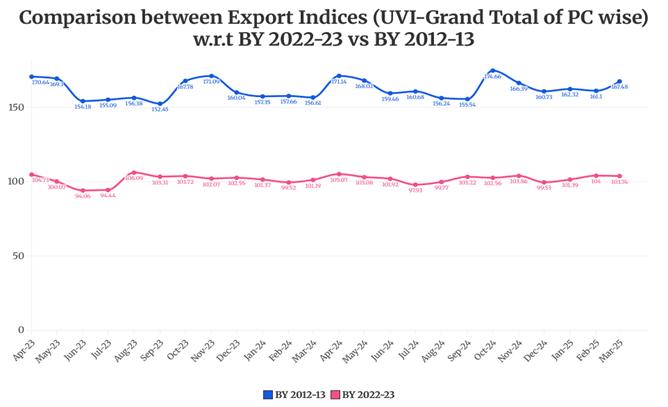
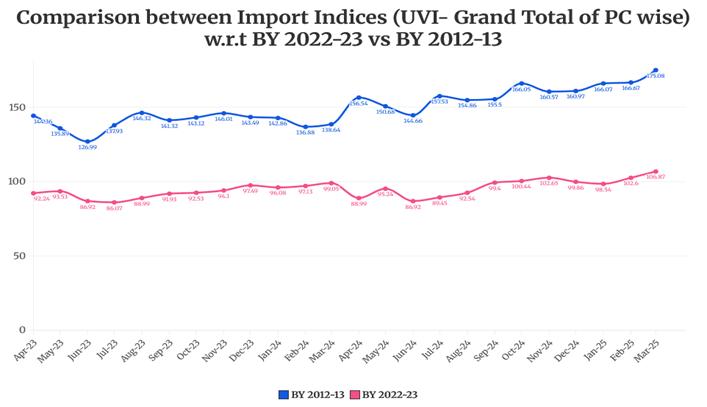
Comparison of the new revised Indices (Base Year: 2022-23) with the already released Indices (Base Year : 2012-13) for 2022-23 and 2023-24 is given below.
#BY means Base Year.
 

#BY means Base Year.

Table: Unit Value Index (UVI) and Quantity Index (QI) during FY 2025-26(Apr-Nov) using FY 2022-23 as base year


Month

Apr_25

May_25

Jun_25

1st Qtr 25-26

Jul_25

Aug_25

Sep_25

2nd Qtr 25-26

Oct_25

Nov_25

Unit Value Index

Export

105.31

99.73

96.31

100.33

99.31

100.55

104.08

101.23

103.78

105.32

Import

92.33

97.97

91.74

94.08

96.34

100.81

108.69

101.93

110.17

106.59

Quantity Index

Export

107.85

104.76

93.88

101.91

103.41

102.64

111.04

105.57

116.19

113.06

Import

138.16

126.61

112.58

125.17

122.47

124.06

126.45

124.32

137.04

121.75

Qtr  means Quarter.

Meaning and interpretation of the Indices

The Unit Value Indices and the Quantity Indices may be interpreted along the following lines.

The Unit Value Index answers the question: What is the growth in the average Unit Value of the items1 traded in the current month with respect to the same month in the Base Year?

So, an Unit Value Index of, say, 120 means that if the items that have been traded in the current month had been traded in the same month of the base year, and if the average price (or unit value) of those items had been Rs.100 in that month of the base year, then the average price (or unit value) of these items in the current month is Rs.120. Or that, there is a 20% increase in the average Unit Value, with respect to the Base Year, of the items that have been traded in the Current Month.

For example, let us suppose 30 items, 10 items each from 3 different Principal Commodities, have been traded in the current month. If these 30 items had been traded in the corresponding month of the base year at an average price of Rs.100, then the average price of these items in the current year is Rs.120.

It is to be noted that there are two successive steps of averaging done here. The first averaging is done over all the items (or ITCHS) of a PC group to arrive at the Index of that PC group. And the second averaging is done over all the PC groups to arrive at the Index at the Grand Total level for all commodities (which is the overall Index for India for a month). In both the stages, a weighted average is taken where the weights are proportional to the importance of the items and the PC groups respectively, and the Laspeyres Formula is used for averaging.

Quantity Indices, say, 200 means that if in the base year on an average 100 units were traded in India in the base year, then in the current year on an average 200 units were traded. However, it must be remembered that averaging quantities are different from averaging prices, since quantities in different units cannot be added directly.

So, the Quantity Indices are calculated by dividing the Value Indices by the Unit Value Indices. For example, if there is an increase in the Value of Export from Rs. 10,000 to Rs. 24,000, then the Value Index is 24000/10000 × 100 = 240. If the Unit Value Index is 120, then the Quantity Index comes to 240/120 × 100 = 200. So, loosely it can be said that, if the value of export has increased 2.4 times and the price of the commodities has increased 1.2 times, then the quantity must have doubled.

However, it may be noted that a very high or low Quantity Index may indicate the presence of Base Effect.

The Interpretation of the Bilateral and Regional Indices can be seen as an extension of the above.

A Unit Value Index of 120 with respect to a country, say Bangladesh, means that if all the items that have been traded with Bangladesh in the current month had been traded in the same month of the base year with the same country, and if the average price (or unit value) of those items had been Rs.100 in that month of the base year, then the average price (or unit value) of these items in the current month is Rs.120.

Similarly, a Quantity Index of 200 with respect to a country, say Bangladesh, means that if in the base year on an average 100 units were traded in India in the base year, then in the current year on an average 200 units were traded.

Comparability of the Indices across time

It is to be noted that the weights in the Index Number formula are fixed across time and there are twelve sets of weights for the twelve months. Hence, comparability of Indices is meaningful only when Indices of same month are compared across years. Different months may attach different weights to the same item, and hence comparing indices of two different months becomes vague and may have little applicability.

Further, the weights of the items that are not present in the trade basket of the current month are distributed to all the items that have been traded in the current month. This distribution is done in proportion to the weights of those items.

For example, let us suppose there are only 3 commodities for trade, say A, B and C. In month May of the Base year, let us suppose that the trade value of A was Rs. 50, B was Rs. 100 and C was Rs. 50. Then the weights assigned to A, B and C in the month of May of the following years would be in the ratio 50 :100 :50. However, in case, C is not traded in the current month, then the weight of C would be distributed proportionately among A and B, again in the ratio 1:2 (since in May the weights of A and B are in the ratio of 50 : 100, i.e., 1 : 2). So, in the current month the weights of A and B would be 3313  and 6623 .

As a result, the weights in any two given months are dependent on exactly the number of items (ITCHS codes) traded in those months. If the items traded are widely different, inference drawn from the comparison of the Indices may be done accordingly. On the other hand, more the similarity in the number of items traded more is the comparability of the two indices.

Net Terms of Trade:

Net Terms of Trade also called commodity Terms of Trade is defined as a ratio of export prices to import prices.

Let say 2022-23 be the base year and 2023-24 be the final year. We express both export and import prices in 2022-23 as 100. Now, suppose that at the end of 2023-24, it is found that the index of export prices decreased to 90 and index of import prices roses to 150. Then the Net Terms of Trade has changed to 90100150100=35 . Then terms of trade as index=35*100=60 . It implies that terms of trade of the country have decreased by about 40% in 2023-24 as compared with 2022-23. It thus shows a deterioration or a worsening of the terms of trade of the country.

If the index of export prices has risen to 150 and that of import prices had risen to 120, then the net terms of trade would have changed to 150120*100=125 . This implies an improvement in the net terms of trade of the country by 25% in 2023-24 over 2022-23.

Gross Terms of Trade:

Gross Terms of Trade is the ratio of physicalquantity of import to physical quantity of export.

Let say 2022-23 be the base year. In that year, the quantities export and import are denoted by 100. Now, suppose that in the year 2023-24, the index of quantity of import was 150 and that of quantity of export was 120. Then the gross terms of trade is given by 150100120100=54,  in terms of percentage =54*100=125 . This implies that there was an improvement of gross terms of trade by 25% in 2023-24 compared to 2022-23.

Income Terms of Trade: Income Terms of Trade is defined as- Net Terms of Trade multiplied by quantity of export.

Topics

Acts Income Tax