

Loading...

✕
Top
Help
×

By creating an account you can:

Logo TaxTMI
Call Us / Help / Feedback✕

Contact Us At :

E-mail: [email protected]

Call / WhatsApp at: +91 99117 96707

For more information, Check Contact Us

FAQs :

To know Frequently Asked Questions, Check FAQs

Most Asked Video Tutorials :

For more tutorials, Check Video Tutorials

Submit Feedback/Suggestion :

Email :
Please provide your email address so we can follow up on your feedback.
Category :
Description :
Min 15 characters 0/2000
Make Most of Text Search ✕
  1. Checkout this video tutorial: How to search effectively on TaxTMI.
  2. Put words in double quotes for exact word search, eg: "income tax"
  3. Avoid noise words such as : 'and, of, the, a'
  4. Sort by Relevance to get the most relevant document.
  5. Press Enter to add multiple terms/multiple phrases, and then click on Search to Search.
  6. Text Search
  7. The system will try to fetch results that contains ALL your words.
  8. Once you add keywords, you'll see a new 'Search In' filter that makes your results even more precise.
  9. Text Search
╳
Add to...
You have not created any category. Kindly create one to bookmark this item!
✕
Create New Category
Hide
Title :
Description :
❮❮ Hide
Default View
Expand ❯❯
Close ✕
🔎 News - Adv. Search
TEXT SEARCH:

Press 'Enter' to add multiple search terms. Rules for Better Search

Search In:
Main Text + AI Text
  • Main Text
  • Main Text + AI Text
  • AI Text
Category: ?
Categorized by AI
---- All Categories ----
  • ---- All Categories ----
  • Income Tax
  • GST
  • Customs, DGFT & SEZ
  • FEMA & RBI
  • Corp. Laws, SEBI & IBC
  • PMLA, Black Money & ED
  • Budget
  • News and Press Release
  • PTI News
Month:
---- All Months ----
  • ---- All Months ----
  • January
  • February
  • March
  • April
  • May
  • June
  • July
  • August
  • September
  • October
  • November
  • December
Year:
---- All Years ----
  • ---- All Years ----
  • 2026
  • 2025
  • 2024
  • 2023
  • 2022
  • 2021
  • 2020
  • 2019
  • 2018
  • 2017
  • 2016
  • 2015
  • 2014
  • 2013
  • 2012
  • 2011
Sort By: ?
In Sort By 'Default', exact matches for text search are shown at the top, followed by the remaining results in their regular order.
Relevance Default Date
    Akasa Air Co-founder Praveen Iyer resigns
    All necessary arrangements in place to comply with FDTL norms: IndiGo tells DGCA
    PFMS ensuring timely release of funds, Transparency significantly enhanced by PFMS
    Rajasthan Budget proposes Rs 6,800 cr to provide tap water, Rs 3,000 cr for solar parks
    Lok Sabha takes up Question Hour amid Opposition din
    Envoys of India, US meet in Beijing
    The USD 58B Strategic Reset: Space Matrix Delivers 5.98 Million Sq. Ft. as the Office Becomes India’s New Innovation Engine
    4th Federal Bank Kochi Marathon: Ranjit Singh and Abhilasha Sanjeev emerge champions
    iHub-Data at IIIT Hyderabad Launches Six-Month AI/ML Training Program for Women Graduate Engineers
    Birla asks LS secretariat to get 'faulty' notice to remove him 'rectified' to prevent its rejection
    UP presents Rs 9.13 lakh crore Budget for 2026-27, outlay up 12.2 pc
    Balers' association opposes IJMA's proposal to ban jute stockholding, writes to Centre
    How Zurich Kotak General Insurance Ensures Secure & Hassle-Free Online Policy Issuance?
    BPTP Capital City Recognized as 'Iconic Brand of the Year - Commercial' at Realty+ India Brand Leadership (IBL) Conclave & Awards 2026
    ICC T20 World Cup 2026: Defending Champions India Start as Favourites at Home
    Philip Morris India Reinforces Its Commitment to Collective Action and Government Collaboration to Restrict Illicit Tobacco Trade
    Zoho Reignites CRM for Acme Brick Company
    Hexaware Launches Zero License to Help Enterprises Replace SaaS with Agentic AI in Months, Not Years
    Xumane Launches Xumane Recruit to Bring AI Precision to Hiring
❯❯
Maximize Maximize Maximize
0 / 200
Expand Note
Add to Folder

No Folders have been created

+

Are you sure you want to delete "My most important" ?

NOTE:

News
Showing Results for :
Reset Filters
Results Found:
Show All Summaries Hide All Summaries
February 11, 2026
Show AI Summary
Akasa Air co-founder Praveen Iyer resigns and will assist leadership in a structured transition through April 30, 2026.
Akasa Air co-founder and Chief Commercial Officer Praveen Iyer has resigned after five years and will partner with the leadership team to ensure a smooth, structured transition through April 30, 2026; he is an Executive Committee member and his departure follows an earlier co-founder exit, with the airline operating 33 Boeing 737 MAX aircraft.
February 11, 2026
Show AI Summary
IndiGo will implement the approved FDTL scheme and put rostering and monitoring arrangements in place to comply.
Following operational disruptions and time-limited FDTL exemptions, the carrier advised the regulator it will implement the approved FDTL scheme and fully comply with statutory provisions, placing operational, rostering and monitoring arrangements in effect from February 11, 2026, while the regulator imposed financial penalties, required a bank guarantee, directed management accountability measures and maintained real-time oversight during the exemption period.
February 11, 2026
Show AI Summary
National Song protocol, publisher notice, and UAPA report requirement highlight administrative directives and investigative review.
The Home Ministry directed that all six stanzas of Vande Mataram must be sung before the National Anthem when both are performed. The Lok Sabha Speaker ordered the secretariat to amend a defective notice to remove the Speaker to prevent its rejection. Delhi Police issued a notice to a publisher for clarifications about circulation of an unpublished manuscript. The Supreme Court required the National Investigation Agency to file a sealed report justifying invocation of stringent unlawful-activities provisions in a case linked to district-level violence.
February 11, 2026
Show AI Summary
Public Financial Management System (PFMS) upgrades mandate single platform payments, enable just in time DBT and add CRM grievance redressal.
PFMS is mandated as the single platform for government payment, accounting and reconciliation, integrating cash management modules including TSA and SNA and enabling real time tracking. SNA SPARSH and SPARSH DBT ensure just in time releases and direct crediting to beneficiaries. System enhancements to DBT include partial acceptance of claim files and advance sharing of Aadhaar data. A CRM based Grievance Redressal System provides ticketing, automated acknowledgements, status tracking and FAQs, supplemented by regular Open House sessions for user support and feedback.
February 11, 2026
Show AI Summary
Budget proposal allocates funds for tap water expansion, solar parks, youth interest-free loans, and road upgrades.
The budget allocates Rs 6,800 crore for tap water-Rs 4,500 crore for village household connections under CM Jal Jeevan Mission and Rs 2,300 crore for urban drinking water-and Rs 2,950 crore for new solar parks in Bikaner and Jaisalmer; it also provides interest-free loans and grants up to Rs 10 lakh for 30,000 youth under the CM Self-Employment Scheme and designates Rs 1,400 crore for non-patchable roads and Rs 600 crore for missing-link roads.
February 11, 2026
Show AI Summary
Lok Sabha proceedings disrupted by Opposition protests during Question Hour, prompting walkout, suspensions and Speaker's nonattendance.
Opposition disruptions during Question Hour led to a walkout after the Chair curtailed attempts to raise questions; thirteen questions and supplementaries were taken up. Ministers addressed renewable energy and railway land acquisition in replies. The Speaker has refrained from attending until a no-confidence motion notice against him is settled, and recent unruly behaviour resulted in multiple member suspensions for the Budget session, which also prevented the Prime Minister from responding to the Motion of Thanks on the President's address.
February 11, 2026
Show AI Summary
India and US envoys meet in Beijing to discuss defence, energy, critical minerals and Quad cooperation.
India and US envoys met in Beijing to emphasise cooperation on defence, energy, critical minerals and Quad engagement, following an interim trade deal and marking their second meeting since December when they had met alongside the Japanese ambassador.
February 11, 2026
Show AI Summary
Office transformation: 5.98M sq. ft. delivered, design standards boosting engagement, flexibility, wellness and sustainability.
Space Matrix reports delivery of 5.98 million sq. ft. in FY25, asserting the office as a strategic asset that transforms GCCs into innovation hubs. It emphasizes adoption rates for design interventions-50-75% unassigned seating and 95-97% certified wellness rooms-linking these to improved engagement, cognitive performance, talent strategy, and a 67% construction-waste recycling rate under its Re-source programme.
February 11, 2026
Show AI Summary
Kochi Marathon: Ranjit Singh and Abhilasha Sanjeev won the full marathon; prizes totaling Rs. 15 lakh were distributed.
The 4th Federal Bank Kochi Marathon saw Ranjit Singh and Abhilasha Sanjeev win the men's and women's full marathon titles with times of 2:28:53 and 3:10:26 respectively; top-three finishers received cash prizes of Rs. 1,25,000, Rs. 1,00,000 and Rs. 75,000 and medals, and prizes totaling Rs. 15 lakh were distributed across multiple distance and age-group events.
February 11, 2026
Show AI Summary
iHub-Data launches six-month AI/ML training for women engineers with internship opportunities; apply by Feb 20.
iHub-Data at IIIT Hyderabad will run a six-month intensive AI/ML training program for recent women engineering graduates, combining theory and hands-on applied learning with weekly on-campus classes. The curriculum spans classical and contemporary techniques to build industry- and research-relevant problem-solving skills. Selected graduates may receive a three-month online internship placement at iHub-Data to work on real-world projects; participation is cohort-based and subject to an application deadline.
February 11, 2026
Show AI Summary
Lok Sabha Speaker removal notice found defective; amendment ordered to prevent rejection and motion will be listed after reconvening.
Notice to remove the Lok Sabha Speaker was found defective due to incorrect dates, and the Speaker directed the secretariat to amend the notice to prevent rejection; upon receipt of the revised notice a speedy review will be conducted and the motion will be listed after the House reconvenes. The removal notice was filed under the constitutional removal procedure, the Speaker will not sit in the chair until the motion is resolved, and the constitution grants the Speaker an opportunity to defend in the House while limiting his casting of a deciding vote in a tie.
February 11, 2026
Show AI Summary
Uttar Pradesh Budget 2026-27 sets fiscal deficit at 3% and boosts education, health and skill programs.
Uttar Pradesh presented a Rs 9.13 lakh crore Budget for 2026-27, adopting the 16th Central Finance Commission recommendation that sets the fiscal deficit limit at three per cent through 2030-31. The Budget allocates 12.4% to education, 6% to health and 9% to agriculture, prioritises capital investment and infrastructure, and mandates mission-mode, employment-oriented skill development with expanded training centres, women-specific centres, and public private partnership arrangements for job placement.
February 11, 2026
Show AI Summary
Jute stockholding ban proposal may disrupt procurement and risk farmer distress; balers call for stakeholder consultations.
The IJMA proposed a ban on private stockholding of raw jute to curb rising prices, while the Jute Balers' Association argues such a ban would disrupt balers' procurement, grading and storage roles, risk distress sales by farmers, concentrate control with mills, and undermine price stability and uninterrupted supply; it asks the textile ministry to hold stakeholder consultations rather than accept an immediate prohibition.
February 11, 2026
Show AI Summary
Online car insurance issuance uses verified vehicle data, mandatory e KYC, secure payment gating and instant digital policy delivery.
Real-time vehicle data validation via official registries and industry databases verifies vehicle details and prior insurance; mandatory e KYC using Aadhaar or PAN plus electronic consent are required; secure payment confirmation is a precondition to policy generation; automated consistency checks block issuance until discrepancies are corrected; and a Customer Self Service portal provides 24/7 access to issued policy documents and service functions.
February 11, 2026
Show AI Summary
BPTP Capital City named Iconic Brand of the Year - Commercial, highlighting sustainability and institutional-grade commercial design.
BPTP Capital City was recognised as Iconic Brand of the Year - Commercial for its integrated master planning, institutional-grade infrastructure, and sustainability-focused design. The mixed-use development offers Grade-A offices and curated retail and holds IGBC and LEED Platinum certifications as well as WELL Core Platinum Certification, supported by energy-efficient systems, smart water management, green mobility features, and people-centric public spaces.
February 11, 2026
Show AI Summary
India enter the ICC T20 World Cup 2026 as favourites with a settled squad, new captaincy and strong pre tournament form.
India enter the ICC T20 World Cup 2026 as defending champions and co hosts with Gambhir as coach and Suryakumar Yadav as T20I captain; a settled core (Abhishek Sharma, Tilak Varma, Varun Chakravarthy et al.) and strong recent series results underpin their status as favourites in Group A alongside Pakistan, the USA, Namibia and the Netherlands, with squad balance and venue conditions cited as key operational determinants of tournament prospects.
February 11, 2026
Show AI Summary
Illicit tobacco trade: industry urges Track & Trace, enforcement support, and joint action to protect supply chains and revenue.
Philip Morris India urges a coordinated industry-government response to curb illicit tobacco by supporting enforcement, information sharing, and capacity building, advocating a Track & Trace mechanism to distinguish illegal from legal products, and providing market intelligence-via retail surveys-and training to customs and tax officials to identify contraband, while highlighting seizures and transnational smuggling techniques that underline the systemic nature of the illegal cigarette market.
February 11, 2026
Show AI Summary
Zoho CRM deployment at Acme Brick enhances customization, integration with legacy systems, adoption, and ongoing vendor support.
Zoho implemented Zoho CRM at Acme Brick, completing a full migration and delivering custom functions, deep legacy integration, and ongoing vendor support across 40+ locations; integration with the third party business intelligence platform enabled in CRM reporting and increased user adoption, while Zoho emphasizes data privacy controls through ownership of its data centres and a privacy pledge.
February 11, 2026
Show AI Summary
Zero License: AI agents replace low value SaaS to cut license costs and automate enterprise workflows.
Zero License positions AI agents as the primary execution layer over existing systems of record to replace low-value SaaS, reduce software license costs, cut integration overhead, and accelerate workflows by handling intake, data capture, routing, execution, and follow ups across enterprise processes.
February 11, 2026
Show AI Summary
Xumane Recruit: an AI-powered hiring platform using structured, bias-reduced interviews, automated screening, scheduling, and real-time analytics.
Xumane Recruit is an AI-powered recruitment platform that embeds an AI-led interview engine to centralize screening, automated scheduling, structured bias-reduced interviews, scoring, and real-time analytics, enabling consistent, data-backed candidate evaluation at scale and reducing recruitment time, cost, and operational overhead.

News

Back

All News

Showing Results for :
Reset Filters
No Records Found

News

Back

All News

Showing Results for : Reset Filters
Customs, DGFT & SEZ

Directorate General of Commercial Intelligence and Statistics Revises Base Year of Merchandise Trade Indices to FY 2022–23 to Reflect Current Trade Structure and Global Patterns

February 21, 2026

Contents
Summary
Note

Note

-

Bookmark

Print

Print

Merchandise Trade Indices are compiled and published by the Directorate General of Commercial Intelligence and Statistics (DGCI&S), Ministry of Commerce & Industry, to measure changes in the unit values (prices) of India’s exports and imports over time. These indices serve as important indicators of external sector price movements and are widely used for economic analysis, including national accounts compilation and assessment of terms of trade. Over the years, the base year of the indices has been periodically revised to reflect structural changes in India’s trade composition and evolving global trade patterns. The most recent revision updates the base year to FY 2022–23 (2022–23 = 100), replacing the earlier base of FY 2012–13, thereby ensuring that the indices accurately represent the current structure of India’s merchandise trade.

Revision of Base Year of India’s Merchandise Trade Indices to FY 2022–23

The Directorate General of Commercial Intelligence and Statistics (DGCI&S), Ministry of Commerce & Industry, has revised the base year of India’s Merchandise Trade Indices from FY 2012–13 to FY 2022–23 (2022–23 = 100), in view of the structural changes in the economy, shifts in commodity composition, evolving trade patterns, and the need for improved alignment with contemporary macroeconomic indicators.

The revision has been undertaken on the recommendations of a committee constituted by DGCI&S under the Chairmanship of Prof. Nachiketa Chattopadhyay, Professor, Indian Statistical Institute, Kolkata. The Committee examined the existing methodology, data coverage, weighting structure, and compilation practices, and recommended suitable refinements in line with international best practices.

Key Features of the Revised Series (Base: FY 2022–23)

  1. Updated Base Year:
    The new base year FY 2022–23 makes the Indices reflect the current structure of India’s external trade more accurately.
  2. Revised Commodity Basket:
    The coverage and classification of commodities have been reviewed at the Principal Commodity level to better capture emerging and declining trade items.
  3. Revised Weighting Structure:
    Weights have been updated based on trade values of the new base year to reflect the latest value shares in exports and imports.
  4. Improved Methodology:
    Methodological refinements have been introduced in:
    1. Selection of common commodity basket for base year selection (procedure of selection for common commodity basket explained in detail report of the committee).
    2. Treatment of missing unit values (Imputation of missing unit values in base year selection have been explained in detail in the committee report).
  5. Indices Compiled:
    The revised series includes:
    1. Monthly, Quarterly and Annual Indices (Export Unit Value Index,Import Unit Value Index).
    2. Principal Commodity (PC) Classification wise Trade Indices (Export/Import).
    3. Standard International Trade Classification-wise (SITC) Trade Indices.
    4. Broad economic categories-wise (BEC) Trade Indices.
    5. Bilateral and Region-wise Trade Indices of Top 20 Export and Import partner nations of India.
    6. Terms of Trade (Gross terms of trade, Net terms of trade and Income terms of trade).

Rationale for Revision

Over the past decade, India’s trade basket has undergone substantial changes due to emergence of new commodities, technological advancements, Global supply chain restructuring and changes in relative price structures.

The earlier base year (FY 2012–13) no longer adequately reflected the prevailing trade structure. The revision ensures improved relevance, reliability, and analytical usefulness of the Merchandise Trade Indices for policymakers, researchers, and other stakeholders.

Use of the Revised Series

Merchandise Trade Indices compiled by the Directorate General of Commercial Intelligence and Statistics (DGCI&S) are extensively used by key government institutions for economic analysis and policy formulation. The National Accounts Division (NAD) of the Ministry of Statistics and Programme Implementation uses the Export and Import Unit Value Indices as deflators for estimating real exports and imports in GDP compilation. The Reserve Bank of India (RBI) relies on these indices for external sector assessment, balance of payments analysis, and evaluation of price competitiveness. Various Ministries and Government agencies also use them to frame and review trade-related policies and to assess movements in international prices. In addition, academic institutions, research organizations, and economic analysts utilize Merchandise Trade Indices for empirical research, modelling, and analysis of trade dynamics and terms of trade trendson and economic research.

Availability of Data

The revised Merchandise Trade Indices (Base: FY 2022–23) will be released on the official website of DGCI&S. Detailed methodological documentation is available in the Report of the Committee on Revision of Base Year for Merchandise Trade Indices.

Comparison of the new revised Indices (Base Year: 2022-23) with the already released Indices (Base Year : 2012-13) for 2022-23 and 2023-24 is given below.
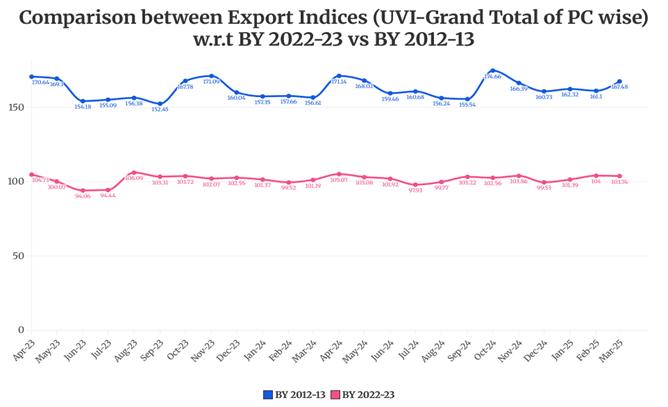
#BY means Base Year.
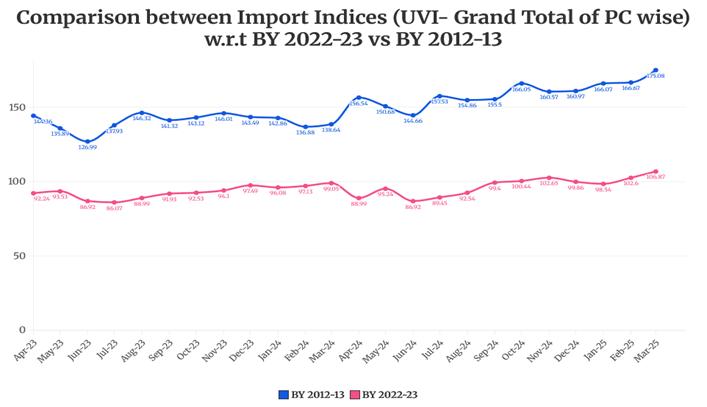
 

#BY means Base Year.

Table: Unit Value Index (UVI) and Quantity Index (QI) during FY 2025-26(Apr-Nov) using FY 2022-23 as base year


Month

Apr_25

May_25

Jun_25

1st Qtr 25-26

Jul_25

Aug_25

Sep_25

2nd Qtr 25-26

Oct_25

Nov_25

Unit Value Index

Export

105.31

99.73

96.31

100.33

99.31

100.55

104.08

101.23

103.78

105.32

Import

92.33

97.97

91.74

94.08

96.34

100.81

108.69

101.93

110.17

106.59

Quantity Index

Export

107.85

104.76

93.88

101.91

103.41

102.64

111.04

105.57

116.19

113.06

Import

138.16

126.61

112.58

125.17

122.47

124.06

126.45

124.32

137.04

121.75

Qtr  means Quarter.

Meaning and interpretation of the Indices

The Unit Value Indices and the Quantity Indices may be interpreted along the following lines.

The Unit Value Index answers the question: What is the growth in the average Unit Value of the items1 traded in the current month with respect to the same month in the Base Year?

So, an Unit Value Index of, say, 120 means that if the items that have been traded in the current month had been traded in the same month of the base year, and if the average price (or unit value) of those items had been Rs.100 in that month of the base year, then the average price (or unit value) of these items in the current month is Rs.120. Or that, there is a 20% increase in the average Unit Value, with respect to the Base Year, of the items that have been traded in the Current Month.

For example, let us suppose 30 items, 10 items each from 3 different Principal Commodities, have been traded in the current month. If these 30 items had been traded in the corresponding month of the base year at an average price of Rs.100, then the average price of these items in the current year is Rs.120.

It is to be noted that there are two successive steps of averaging done here. The first averaging is done over all the items (or ITCHS) of a PC group to arrive at the Index of that PC group. And the second averaging is done over all the PC groups to arrive at the Index at the Grand Total level for all commodities (which is the overall Index for India for a month). In both the stages, a weighted average is taken where the weights are proportional to the importance of the items and the PC groups respectively, and the Laspeyres Formula is used for averaging.

Quantity Indices, say, 200 means that if in the base year on an average 100 units were traded in India in the base year, then in the current year on an average 200 units were traded. However, it must be remembered that averaging quantities are different from averaging prices, since quantities in different units cannot be added directly.

So, the Quantity Indices are calculated by dividing the Value Indices by the Unit Value Indices. For example, if there is an increase in the Value of Export from Rs. 10,000 to Rs. 24,000, then the Value Index is 24000/10000 × 100 = 240. If the Unit Value Index is 120, then the Quantity Index comes to 240/120 × 100 = 200. So, loosely it can be said that, if the value of export has increased 2.4 times and the price of the commodities has increased 1.2 times, then the quantity must have doubled.

However, it may be noted that a very high or low Quantity Index may indicate the presence of Base Effect.

The Interpretation of the Bilateral and Regional Indices can be seen as an extension of the above.

A Unit Value Index of 120 with respect to a country, say Bangladesh, means that if all the items that have been traded with Bangladesh in the current month had been traded in the same month of the base year with the same country, and if the average price (or unit value) of those items had been Rs.100 in that month of the base year, then the average price (or unit value) of these items in the current month is Rs.120.

Similarly, a Quantity Index of 200 with respect to a country, say Bangladesh, means that if in the base year on an average 100 units were traded in India in the base year, then in the current year on an average 200 units were traded.

Comparability of the Indices across time

It is to be noted that the weights in the Index Number formula are fixed across time and there are twelve sets of weights for the twelve months. Hence, comparability of Indices is meaningful only when Indices of same month are compared across years. Different months may attach different weights to the same item, and hence comparing indices of two different months becomes vague and may have little applicability.

Further, the weights of the items that are not present in the trade basket of the current month are distributed to all the items that have been traded in the current month. This distribution is done in proportion to the weights of those items.

For example, let us suppose there are only 3 commodities for trade, say A, B and C. In month May of the Base year, let us suppose that the trade value of A was Rs. 50, B was Rs. 100 and C was Rs. 50. Then the weights assigned to A, B and C in the month of May of the following years would be in the ratio 50 :100 :50. However, in case, C is not traded in the current month, then the weight of C would be distributed proportionately among A and B, again in the ratio 1:2 (since in May the weights of A and B are in the ratio of 50 : 100, i.e., 1 : 2). So, in the current month the weights of A and B would be 3313  and 6623 .

As a result, the weights in any two given months are dependent on exactly the number of items (ITCHS codes) traded in those months. If the items traded are widely different, inference drawn from the comparison of the Indices may be done accordingly. On the other hand, more the similarity in the number of items traded more is the comparability of the two indices.

Net Terms of Trade:

Net Terms of Trade also called commodity Terms of Trade is defined as a ratio of export prices to import prices.

Let say 2022-23 be the base year and 2023-24 be the final year. We express both export and import prices in 2022-23 as 100. Now, suppose that at the end of 2023-24, it is found that the index of export prices decreased to 90 and index of import prices roses to 150. Then the Net Terms of Trade has changed to 90100150100=35 . Then terms of trade as index=35*100=60 . It implies that terms of trade of the country have decreased by about 40% in 2023-24 as compared with 2022-23. It thus shows a deterioration or a worsening of the terms of trade of the country.

If the index of export prices has risen to 150 and that of import prices had risen to 120, then the net terms of trade would have changed to 150120*100=125 . This implies an improvement in the net terms of trade of the country by 25% in 2023-24 over 2022-23.

Gross Terms of Trade:

Gross Terms of Trade is the ratio of physicalquantity of import to physical quantity of export.

Let say 2022-23 be the base year. In that year, the quantities export and import are denoted by 100. Now, suppose that in the year 2023-24, the index of quantity of import was 150 and that of quantity of export was 120. Then the gross terms of trade is given by 150100120100=54,  in terms of percentage =54*100=125 . This implies that there was an improvement of gross terms of trade by 25% in 2023-24 compared to 2022-23.

Income Terms of Trade: Income Terms of Trade is defined as- Net Terms of Trade multiplied by quantity of export.

Topics

Acts Income Tax