

Loading...

Top
Help
×

By creating an account you can:

Logo TaxTMI
Call Us / Help / Feedback

Contact Us At :

E-mail: [email protected]

Call / WhatsApp at: +91 99117 96707

For more information, Check Contact Us

FAQs :

To know Frequently Asked Questions, Check FAQs

Most Asked Video Tutorials :

For more tutorials, Check Video Tutorials

Submit Feedback/Suggestion :

Email :
Please provide your email address so we can follow up on your feedback.
Category :
Description :
Min 15 characters 0/2000
Make Most of Text Search
  1. Checkout this video tutorial: How to search effectively on TaxTMI.
  2. Put words in double quotes for exact word search, eg: "income tax"
  3. Avoid noise words such as : 'and, of, the, a'
  4. Sort by Relevance to get the most relevant document.
  5. Press Enter to add multiple terms/multiple phrases, and then click on Search to Search.
  6. Text Search
  7. The system will try to fetch results that contains ALL your words.
  8. Once you add keywords, you'll see a new 'Search In' filter that makes your results even more precise.
  9. Text Search
Add to...
You have not created any category. Kindly create one to bookmark this item!
Create New Category
Hide
Title :
Description :
❮❮ Hide
Default View
Expand ❯❯
Close ✕
🔎 News - Adv. Search
TEXT SEARCH:

Press 'Enter' to add multiple search terms. Rules for Better Search

Search In:
Main Text + AI Text
  • Main Text
  • Main Text + AI Text
  • AI Text
Category: ?
Categorized by AI
---- All Categories ----
  • ---- All Categories ----
  • Income Tax
  • GST
  • Customs, DGFT & SEZ
  • FEMA & RBI
  • Corp. Laws, SEBI & IBC
  • PMLA, Black Money & ED
  • Budget
  • News and Press Release
  • PTI News
Month:
---- All Months ----
  • ---- All Months ----
  • January
  • February
  • March
  • April
  • May
  • June
  • July
  • August
  • September
  • October
  • November
  • December
Year:
---- All Years ----
  • ---- All Years ----
  • 2026
  • 2025
  • 2024
  • 2023
  • 2022
  • 2021
  • 2020
  • 2019
  • 2018
  • 2017
  • 2016
  • 2015
  • 2014
  • 2013
  • 2012
  • 2011
Sort By: ?
In Sort By 'Default', exact matches for text search are shown at the top, followed by the remaining results in their regular order.
Relevance Default Date
    UP Budget 2026-27: Rs 43,565 crore earmarked for new schemes
    UP Budget: Hike in allocations to health, education and AYUSH for boosting healthcare infra, services
    SC dismisses plea alleging absence of mechanism to make people aware of TDS obligation
    Delhi: Occultist held for killing 3 people with poison-laced 'ladoos' in name of 'dhanvarsha'
    UP Budget 2026-27: Rs 150 cr for Ayodhya infra, Rs 500 for CM tourism development scheme
    Punjab: Opposition slams Bhagwant Mann over shooting at migrant labourers in Moga
    UP has moved from 'policy paralysis' to a land of 'unlimited potential' in 9 years: CM Yogi
    Jupiter Inter commissions 1 GW solar cell unit in Himachal, doubles capacity
    UP Budget 2026-27 earmarks Rs 27,103 crore for infra, 5-fold hike for textiles
    UP Budget: Employment generation, youth empowerment, key focus areas
    Govt sold Bharat Mata, it's a wholesale surrender: Rahul on India-US trade deal
    Interim trade agreement with US one-sided; govt sold Bharat Mata: Rahul in LS
    UP Budget 2026-27: Push for women empowerment, police infra in pre-poll outlay
    UP presents record Rs 9.12 lakh cr budget for 2026-27 ahead of assembly polls next year
    Indo-US deal: Some J&K fruit growers on edge, others call it opportunity to better their produce
    Akasa Air Co-founder Praveen Iyer resigns
    All necessary arrangements in place to comply with FDTL norms: IndiGo tells DGCA
    PFMS ensuring timely release of funds, Transparency significantly enhanced by PFMS
    Rajasthan Budget proposes Rs 6,800 cr to provide tap water, Rs 3,000 cr for solar parks
❯❯
Maximize Maximize Maximize
0 / 200
Expand Note
Add to Folder

No Folders have been created

+

Are you sure you want to delete "My most important" ?

NOTE:

News
Showing Results for :
Reset Filters
Results Found:
Show All Summaries Hide All Summaries
February 11, 2026
Show AI Summary
Uttar Pradesh budget 2026-27: Rs 43,565 crore earmarked for new development and social sector schemes.
The Uttar Pradesh 2026-27 budget earmarks Rs 43,565 crore for new initiatives including Rs 575 crore for an MSME-focused industrial zone, Rs 3,500 crore for urban expansion and new city promotion, sectoral infrastructure such as a dairy plant and fish processing facilities, Rs 580 crore for residential girls' schools where Kasturba Gandhi Balika Vidyalayas are absent, and significant allocations for cashless medical coverage for school staff and conversion of primary schools into smart schools under Samagra Shiksha Abhiyan.
February 11, 2026
Show AI Summary
UP budget increases health and medical education allocations to expand healthcare infrastructure and insurance coverage.
The state budget increases health-sector funding, raising the Medical, Health and Family Welfare allocation by 15% and assigning funds to major programmes: cashless maternal deliveries under Janani Shishu Suraksha Karyakram, block-level child health teams, Pulse Polio and Japanese Encephalitis vaccination drives, Integrated Disease Surveillance reporting, Ayushman Bharat insurance schemes, the National Rural Health Mission, and district mental health services. It also funds expansion of medical education-including 14 new colleges and a PPP approach for underserved districts-and allocates capital for cancer care, incurable-disease treatment, and AYUSH infrastructure and drug production.
February 11, 2026
Show AI Summary
TDS on property purchases: buyers currently bear the deduction liability; petitioner sought institutional safeguards for buyer awareness.
The petitioner argued that buyers of property over Rs. 50 lakh are placed solely liable for TDS despite many purchasers lacking knowledge of the obligation and that no registrar-level verification or administrative awareness mechanism exists; he sought limited procedural directions to establish institutional safeguards at registration to prevent inadvertent defaults, improve voluntary compliance, and protect revenue, without challenging the statutory tax liability.
February 11, 2026
Show AI Summary
Occultist accused of killing three people by giving poison-laced ladoos during a ritual and stealing their cash.
An occult practitioner was arrested for allegedly killing three persons by administering poison-laced sweets and drinks during a ritual promising dhanvarsha. Investigators say he instructed the victims to bring cash and refreshments, fed them poisoned ladoos and drinks, took their money after they lost consciousness, and fled. Technical surveillance, call detail records, CCTV and location data placed the accused with the victims; personal effects and cash were recovered and a criminal case was registered while inquiries continue to identify accomplices.
February 11, 2026
Show AI Summary
Tourism budget proposes Rs 150 crore for Ayodhya infrastructure and Rs 500 crore for a tourism development scheme.
The budget designates Rs 150 crore for Ayodhya-region tourism infrastructure and Rs 500 crore for a tourism places development scheme, funding specific projects such as completion of the Ram Path approach road, upgrades linking a proposed Vedic wellness precinct to the temple, and allocations for parikrama paths, temple renovation, and tourist facilities at multiple pilgrimage and heritage sites, with initial phases of a Vedic Science Centre completed and increased tourist footfall cited as rationale.
February 11, 2026
Show AI Summary
Shooting of migrant labourers in Moga prompts demands for urgent investigation and action against communal targeting.
A shooting injured two migrant workers in Moga; an unverified social media post claimed responsibility and justified the attack. Police are tracing the assailants and probing the incident from all angles. The matter raises issues of targeted violence against migrant workers, potential online incitement, evidentiary questions regarding posted video material, and calls from political leaders for urgent investigation, accountability, and measures to protect migrants and maintain public order.
February 11, 2026
Show AI Summary
State budget increases outlays, prioritises social and tech investment, and claims revenue surplus achieved without new taxes.
The Rs 9,12,696.35 crore 2026-27 budget increases outlays by about 12.2 percent, highlights priorities of women's safety, youth employment, farmer welfare and technological investment, and asserts that no new taxes have been imposed. The executive credits improved financial management and plugging tax leakages for transforming the fiscal position from a historically weak classification to a revenue surplus state, indicating reliance on compliance and administrative reform for revenue growth rather than tax increases.
February 11, 2026
Show AI Summary
Jupiter International commissions 1 GW mono PERC solar cell unit, doubling capacity to about 2 GW and expanding tech lineup.
Commissioning of a new 1 GW mono PERC solar cell unit at Baddi raised Jupiter International's installed capacity from 959 MW to about 2 GW through its subsidiary Jupiter Solartech Pvt Ltd; the facility targets high efficiency mono PERC production, aims to double the local skilled workforce, and the company plans a further 1.25 GW TOPCon line to strengthen its technology portfolio and support national renewable energy goals.
February 11, 2026
Show AI Summary
UP Budget 2026-27 boosts infrastructure and textiles with major allocations and targeted employment and MSME support.
UP Budget 2026-27 designates Rs 27,103 crore for infrastructure and industrial development and over Rs 5,041 crore for handloom and textiles, with targeted scheme outlays including Rs 5,000 crore for industrial area expansion, Rs 2,000 crore for the Atal Infrastructure Mission, Rs 1,000 crore to implement the 2023 incentive policy, and Rs 4,423 crore for the powerloom weavers electricity scheme to support industrial expansion, MSME growth and job creation.
February 11, 2026
Show AI Summary
Uttar Pradesh budget focuses on employment generation, youth empowerment and large-scale public recruitment across departments.
State budget prioritizes employment generation and youth empowerment through skill training, device distribution, coaching centres, fellowships, and financial support for entrepreneurship. Recruitment initiatives include over 2.19 lakh police hires since 2017 with ongoing training and further non-gazetted recruitment, Mission Rozgar school appointments and aided-school selections, while MGNREGA person-days exceeded targets, benefiting over 47 lakh families.
February 11, 2026
Show AI Summary
India US interim trade deal alleged to cede energy control and harm farmers and textiles; calls to protect data and food.
The India US interim trade deal is alleged to cede control over energy security, permit foreign influence on oil procurement, expose domestic agriculture to American imports that compromise farmers' interests, and threaten the textile sector, prompting calls to protect the population, national data, food supply and the energy system.
February 11, 2026
Show AI Summary
India US interim trade agreement criticized as one-sided, risking farmers and the textile sector by opening markets to US imports.
The Opposition alleges the interim trade agreement with the United States is one-sided, allowing increased US agricultural imports that threaten farmer livelihoods and undermining the Indian textile sector, framing the government's action as having sold national interests.
February 11, 2026
Show AI Summary
State budget 2026-27 prioritises women empowerment and major police infrastructure and safety funding for working women.
The 2026-27 budget prioritises women centric welfare and law and order infrastructure with a Rs 9.12 lakh crore outlay. Key women's measures include Rs 25 crore for Mission Shakti vehicles for women beat personnel, working women hostels, continued Mukhyamantri Kanya Sumangala payments, BC Sakhi financial activities, milk producer companies under Mahila Samarthya Yojana, and priority cane slips for 60,000 women farmers. Police and safety allocations comprise Rs 1,374 crore for non residential police buildings, Rs 1,243 crore for residential police buildings, Rs 346 crore for new districts, Rs 200 crore for fire station buildings and Rs 190 crore for fire safety and operationalisation of centres.
February 11, 2026
Show AI Summary
Uttar Pradesh budget focuses on employment, infrastructure, health and a three percent fiscal deficit cap under prudent debt management.
A record Rs 9.12 lakh crore budget emphasises capital spending (19.5% of outlay), a three per cent fiscal deficit ceiling, and commitments to prudent debt management. Major sectoral allocations include education (12.4%), health (6%) and agriculture (9%), with detailed appropriations for medical education, new medical colleges, rural health mission funding, national health protection and AYUSH. Economic measures fund infrastructure and industrial promotion, an investment incentive pool, defence corridor projects, MSME support, IT and AI initiatives, and expanded skill-development and PPP employment centres.
February 11, 2026
Show AI Summary
India-US trade deal reducing tariffs raises fears for Kashmir's horticulture while some see competition improving quality.
The interim India-US trade agreement reduces tariffs and permits duty-free imports of tree nuts and apples, raising concerns that tariff reductions will disadvantage Jammu and Kashmir producers, intensify financial stress on marginal farmers, and threaten horticulture-linked livelihoods; some stakeholders counter that competition may improve quality and stabilize prices, while growers' groups call for protective duties to preserve local agriculture.
February 11, 2026
Show AI Summary
Akasa Air co-founder Praveen Iyer resigns and will assist leadership in a structured transition through April 30, 2026.
Akasa Air co-founder and Chief Commercial Officer Praveen Iyer has resigned after five years and will partner with the leadership team to ensure a smooth, structured transition through April 30, 2026; he is an Executive Committee member and his departure follows an earlier co-founder exit, with the airline operating 33 Boeing 737 MAX aircraft.
February 11, 2026
Show AI Summary
IndiGo will implement the approved FDTL scheme and put rostering and monitoring arrangements in place to comply.
Following operational disruptions and time-limited FDTL exemptions, the carrier advised the regulator it will implement the approved FDTL scheme and fully comply with statutory provisions, placing operational, rostering and monitoring arrangements in effect from February 11, 2026, while the regulator imposed financial penalties, required a bank guarantee, directed management accountability measures and maintained real-time oversight during the exemption period.
February 11, 2026
Show AI Summary
National Song protocol, publisher notice, and UAPA report requirement highlight administrative directives and investigative review.
The Home Ministry directed that all six stanzas of Vande Mataram must be sung before the National Anthem when both are performed. The Lok Sabha Speaker ordered the secretariat to amend a defective notice to remove the Speaker to prevent its rejection. Delhi Police issued a notice to a publisher for clarifications about circulation of an unpublished manuscript. The Supreme Court required the National Investigation Agency to file a sealed report justifying invocation of stringent unlawful-activities provisions in a case linked to district-level violence.
February 11, 2026
Show AI Summary
Public Financial Management System (PFMS) upgrades mandate single platform payments, enable just in time DBT and add CRM grievance redressal.
PFMS is mandated as the single platform for government payment, accounting and reconciliation, integrating cash management modules including TSA and SNA and enabling real time tracking. SNA SPARSH and SPARSH DBT ensure just in time releases and direct crediting to beneficiaries. System enhancements to DBT include partial acceptance of claim files and advance sharing of Aadhaar data. A CRM based Grievance Redressal System provides ticketing, automated acknowledgements, status tracking and FAQs, supplemented by regular Open House sessions for user support and feedback.
February 11, 2026
Show AI Summary
Budget proposal allocates funds for tap water expansion, solar parks, youth interest-free loans, and road upgrades.
The budget allocates Rs 6,800 crore for tap water-Rs 4,500 crore for village household connections under CM Jal Jeevan Mission and Rs 2,300 crore for urban drinking water-and Rs 2,950 crore for new solar parks in Bikaner and Jaisalmer; it also provides interest-free loans and grants up to Rs 10 lakh for 30,000 youth under the CM Self-Employment Scheme and designates Rs 1,400 crore for non-patchable roads and Rs 600 crore for missing-link roads.

News

Back

All News

Showing Results for :
Reset Filters
No Records Found

News

Back

All News

Showing Results for : Reset Filters
Customs, DGFT & SEZ

Directorate General of Commercial Intelligence and Statistics Revises Base Year of Merchandise Trade Indices to FY 2022–23 to Reflect Current Trade Structure and Global Patterns

February 21, 2026

Contents
Summary
Note

Note

-

Bookmark

Print

Print

Merchandise Trade Indices are compiled and published by the Directorate General of Commercial Intelligence and Statistics (DGCI&S), Ministry of Commerce & Industry, to measure changes in the unit values (prices) of India’s exports and imports over time. These indices serve as important indicators of external sector price movements and are widely used for economic analysis, including national accounts compilation and assessment of terms of trade. Over the years, the base year of the indices has been periodically revised to reflect structural changes in India’s trade composition and evolving global trade patterns. The most recent revision updates the base year to FY 2022–23 (2022–23 = 100), replacing the earlier base of FY 2012–13, thereby ensuring that the indices accurately represent the current structure of India’s merchandise trade.

Revision of Base Year of India’s Merchandise Trade Indices to FY 2022–23

The Directorate General of Commercial Intelligence and Statistics (DGCI&S), Ministry of Commerce & Industry, has revised the base year of India’s Merchandise Trade Indices from FY 2012–13 to FY 2022–23 (2022–23 = 100), in view of the structural changes in the economy, shifts in commodity composition, evolving trade patterns, and the need for improved alignment with contemporary macroeconomic indicators.

The revision has been undertaken on the recommendations of a committee constituted by DGCI&S under the Chairmanship of Prof. Nachiketa Chattopadhyay, Professor, Indian Statistical Institute, Kolkata. The Committee examined the existing methodology, data coverage, weighting structure, and compilation practices, and recommended suitable refinements in line with international best practices.

Key Features of the Revised Series (Base: FY 2022–23)

  1. Updated Base Year:
    The new base year FY 2022–23 makes the Indices reflect the current structure of India’s external trade more accurately.
  2. Revised Commodity Basket:
    The coverage and classification of commodities have been reviewed at the Principal Commodity level to better capture emerging and declining trade items.
  3. Revised Weighting Structure:
    Weights have been updated based on trade values of the new base year to reflect the latest value shares in exports and imports.
  4. Improved Methodology:
    Methodological refinements have been introduced in:
    1. Selection of common commodity basket for base year selection (procedure of selection for common commodity basket explained in detail report of the committee).
    2. Treatment of missing unit values (Imputation of missing unit values in base year selection have been explained in detail in the committee report).
  5. Indices Compiled:
    The revised series includes:
    1. Monthly, Quarterly and Annual Indices (Export Unit Value Index,Import Unit Value Index).
    2. Principal Commodity (PC) Classification wise Trade Indices (Export/Import).
    3. Standard International Trade Classification-wise (SITC) Trade Indices.
    4. Broad economic categories-wise (BEC) Trade Indices.
    5. Bilateral and Region-wise Trade Indices of Top 20 Export and Import partner nations of India.
    6. Terms of Trade (Gross terms of trade, Net terms of trade and Income terms of trade).

Rationale for Revision

Over the past decade, India’s trade basket has undergone substantial changes due to emergence of new commodities, technological advancements, Global supply chain restructuring and changes in relative price structures.

The earlier base year (FY 2012–13) no longer adequately reflected the prevailing trade structure. The revision ensures improved relevance, reliability, and analytical usefulness of the Merchandise Trade Indices for policymakers, researchers, and other stakeholders.

Use of the Revised Series

Merchandise Trade Indices compiled by the Directorate General of Commercial Intelligence and Statistics (DGCI&S) are extensively used by key government institutions for economic analysis and policy formulation. The National Accounts Division (NAD) of the Ministry of Statistics and Programme Implementation uses the Export and Import Unit Value Indices as deflators for estimating real exports and imports in GDP compilation. The Reserve Bank of India (RBI) relies on these indices for external sector assessment, balance of payments analysis, and evaluation of price competitiveness. Various Ministries and Government agencies also use them to frame and review trade-related policies and to assess movements in international prices. In addition, academic institutions, research organizations, and economic analysts utilize Merchandise Trade Indices for empirical research, modelling, and analysis of trade dynamics and terms of trade trendson and economic research.

Availability of Data

The revised Merchandise Trade Indices (Base: FY 2022–23) will be released on the official website of DGCI&S. Detailed methodological documentation is available in the Report of the Committee on Revision of Base Year for Merchandise Trade Indices.

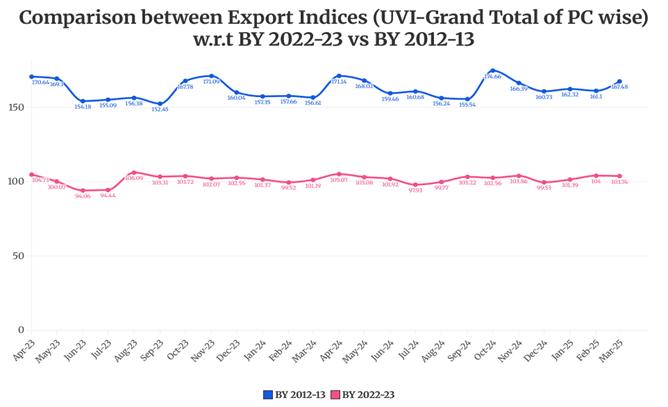
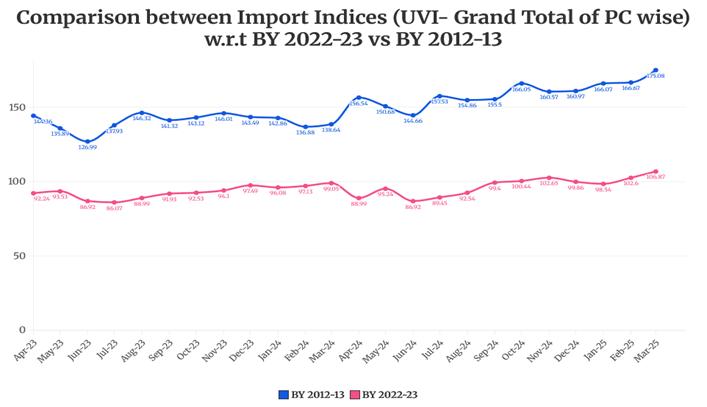
Comparison of the new revised Indices (Base Year: 2022-23) with the already released Indices (Base Year : 2012-13) for 2022-23 and 2023-24 is given below.
#BY means Base Year.
 

#BY means Base Year.

Table: Unit Value Index (UVI) and Quantity Index (QI) during FY 2025-26(Apr-Nov) using FY 2022-23 as base year


Month

Apr_25

May_25

Jun_25

1st Qtr 25-26

Jul_25

Aug_25

Sep_25

2nd Qtr 25-26

Oct_25

Nov_25

Unit Value Index

Export

105.31

99.73

96.31

100.33

99.31

100.55

104.08

101.23

103.78

105.32

Import

92.33

97.97

91.74

94.08

96.34

100.81

108.69

101.93

110.17

106.59

Quantity Index

Export

107.85

104.76

93.88

101.91

103.41

102.64

111.04

105.57

116.19

113.06

Import

138.16

126.61

112.58

125.17

122.47

124.06

126.45

124.32

137.04

121.75

Qtr  means Quarter.

Meaning and interpretation of the Indices

The Unit Value Indices and the Quantity Indices may be interpreted along the following lines.

The Unit Value Index answers the question: What is the growth in the average Unit Value of the items1 traded in the current month with respect to the same month in the Base Year?

So, an Unit Value Index of, say, 120 means that if the items that have been traded in the current month had been traded in the same month of the base year, and if the average price (or unit value) of those items had been Rs.100 in that month of the base year, then the average price (or unit value) of these items in the current month is Rs.120. Or that, there is a 20% increase in the average Unit Value, with respect to the Base Year, of the items that have been traded in the Current Month.

For example, let us suppose 30 items, 10 items each from 3 different Principal Commodities, have been traded in the current month. If these 30 items had been traded in the corresponding month of the base year at an average price of Rs.100, then the average price of these items in the current year is Rs.120.

It is to be noted that there are two successive steps of averaging done here. The first averaging is done over all the items (or ITCHS) of a PC group to arrive at the Index of that PC group. And the second averaging is done over all the PC groups to arrive at the Index at the Grand Total level for all commodities (which is the overall Index for India for a month). In both the stages, a weighted average is taken where the weights are proportional to the importance of the items and the PC groups respectively, and the Laspeyres Formula is used for averaging.

Quantity Indices, say, 200 means that if in the base year on an average 100 units were traded in India in the base year, then in the current year on an average 200 units were traded. However, it must be remembered that averaging quantities are different from averaging prices, since quantities in different units cannot be added directly.

So, the Quantity Indices are calculated by dividing the Value Indices by the Unit Value Indices. For example, if there is an increase in the Value of Export from Rs. 10,000 to Rs. 24,000, then the Value Index is 24000/10000 × 100 = 240. If the Unit Value Index is 120, then the Quantity Index comes to 240/120 × 100 = 200. So, loosely it can be said that, if the value of export has increased 2.4 times and the price of the commodities has increased 1.2 times, then the quantity must have doubled.

However, it may be noted that a very high or low Quantity Index may indicate the presence of Base Effect.

The Interpretation of the Bilateral and Regional Indices can be seen as an extension of the above.

A Unit Value Index of 120 with respect to a country, say Bangladesh, means that if all the items that have been traded with Bangladesh in the current month had been traded in the same month of the base year with the same country, and if the average price (or unit value) of those items had been Rs.100 in that month of the base year, then the average price (or unit value) of these items in the current month is Rs.120.

Similarly, a Quantity Index of 200 with respect to a country, say Bangladesh, means that if in the base year on an average 100 units were traded in India in the base year, then in the current year on an average 200 units were traded.

Comparability of the Indices across time

It is to be noted that the weights in the Index Number formula are fixed across time and there are twelve sets of weights for the twelve months. Hence, comparability of Indices is meaningful only when Indices of same month are compared across years. Different months may attach different weights to the same item, and hence comparing indices of two different months becomes vague and may have little applicability.

Further, the weights of the items that are not present in the trade basket of the current month are distributed to all the items that have been traded in the current month. This distribution is done in proportion to the weights of those items.

For example, let us suppose there are only 3 commodities for trade, say A, B and C. In month May of the Base year, let us suppose that the trade value of A was Rs. 50, B was Rs. 100 and C was Rs. 50. Then the weights assigned to A, B and C in the month of May of the following years would be in the ratio 50 :100 :50. However, in case, C is not traded in the current month, then the weight of C would be distributed proportionately among A and B, again in the ratio 1:2 (since in May the weights of A and B are in the ratio of 50 : 100, i.e., 1 : 2). So, in the current month the weights of A and B would be 3313  and 6623 .

As a result, the weights in any two given months are dependent on exactly the number of items (ITCHS codes) traded in those months. If the items traded are widely different, inference drawn from the comparison of the Indices may be done accordingly. On the other hand, more the similarity in the number of items traded more is the comparability of the two indices.

Net Terms of Trade:

Net Terms of Trade also called commodity Terms of Trade is defined as a ratio of export prices to import prices.

Let say 2022-23 be the base year and 2023-24 be the final year. We express both export and import prices in 2022-23 as 100. Now, suppose that at the end of 2023-24, it is found that the index of export prices decreased to 90 and index of import prices roses to 150. Then the Net Terms of Trade has changed to 90100150100=35 . Then terms of trade as index=35*100=60 . It implies that terms of trade of the country have decreased by about 40% in 2023-24 as compared with 2022-23. It thus shows a deterioration or a worsening of the terms of trade of the country.

If the index of export prices has risen to 150 and that of import prices had risen to 120, then the net terms of trade would have changed to 150120*100=125 . This implies an improvement in the net terms of trade of the country by 25% in 2023-24 over 2022-23.

Gross Terms of Trade:

Gross Terms of Trade is the ratio of physicalquantity of import to physical quantity of export.

Let say 2022-23 be the base year. In that year, the quantities export and import are denoted by 100. Now, suppose that in the year 2023-24, the index of quantity of import was 150 and that of quantity of export was 120. Then the gross terms of trade is given by 150100120100=54,  in terms of percentage =54*100=125 . This implies that there was an improvement of gross terms of trade by 25% in 2023-24 compared to 2022-23.

Income Terms of Trade: Income Terms of Trade is defined as- Net Terms of Trade multiplied by quantity of export.

Topics

Acts Income Tax