

Loading...

Top
Help
×

By creating an account you can:

Logo TaxTMI
Call Us / Help / Feedback

Contact Us At :

E-mail: [email protected]

Call / WhatsApp at: +91 99117 96707

For more information, Check Contact Us

FAQs :

To know Frequently Asked Questions, Check FAQs

Most Asked Video Tutorials :

For more tutorials, Check Video Tutorials

Submit Feedback/Suggestion :

Email :
Please provide your email address so we can follow up on your feedback.
Category :
Description :
Min 15 characters 0/2000
Make Most of Text Search
  1. Checkout this video tutorial: How to search effectively on TaxTMI.
  2. Put words in double quotes for exact word search, eg: "income tax"
  3. Avoid noise words such as : 'and, of, the, a'
  4. Sort by Relevance to get the most relevant document.
  5. Press Enter to add multiple terms/multiple phrases, and then click on Search to Search.
  6. Text Search
  7. The system will try to fetch results that contains ALL your words.
  8. Once you add keywords, you'll see a new 'Search In' filter that makes your results even more precise.
  9. Text Search
Add to...
You have not created any category. Kindly create one to bookmark this item!
Create New Category
Hide
Title :
Description :
❮❮ Hide
Default View
Expand ❯❯
Close ✕
🔎 News - Adv. Search
TEXT SEARCH:

Press 'Enter' to add multiple search terms. Rules for Better Search

Search In:
Main Text + AI Text
  • Main Text
  • Main Text + AI Text
  • AI Text
Category: ?
Categorized by AI
---- All Categories ----
  • ---- All Categories ----
  • Income Tax
  • GST
  • Customs, DGFT & SEZ
  • FEMA & RBI
  • Corp. Laws, SEBI & IBC
  • PMLA, Black Money & ED
  • Budget
  • News and Press Release
  • PTI News
Month:
---- All Months ----
  • ---- All Months ----
  • January
  • February
  • March
  • April
  • May
  • June
  • July
  • August
  • September
  • October
  • November
  • December
Year:
---- All Years ----
  • ---- All Years ----
  • 2026
  • 2025
  • 2024
  • 2023
  • 2022
  • 2021
  • 2020
  • 2019
  • 2018
  • 2017
  • 2016
  • 2015
  • 2014
  • 2013
  • 2012
  • 2011
Sort By: ?
In Sort By 'Default', exact matches for text search are shown at the top, followed by the remaining results in their regular order.
Relevance Default Date
    EC-Council Expands AI Certification Portfolio to Support India''s AI Workforce Readiness and Secure Adoption
    Ahead of IPO, Cars24 Unveils New Brand Identity as It Grows into a More Mature, Human Company
    JBCN Education Reaffirms its Reputation as a Premier Workplace with Great Place to Work Certification for Three Consecutive Years
    His Holiness The Dalai Lama Launches Ekya School's Book on Inquiry Based Education
    LTIMindtree Introduces New Brand Identity and Positioning: LTM — The Business Creativity Partner
    Govt to release January inflation data based on new CPI series on Thursday
    SSC Wallah Records 101 Selections in SSC GD 2025, Empowering Aspirants Across India
    'Yield', 'authenticate' and 'leave': Jargons swell Parliament's 'Well'
    Rs 172 crore fake input tax credit racket busted; chemical company owner held
    Sensex, Nifty close almost unchanged in choppy trade; IT shares decline
    'Fine tandoori' India FTA gives UK first mover advantage, UK Parliament told
    Grounded Jet Airways to sell 3 aircraft frames, 6 engines for USD 46 mln
    World shares are mixed ahead of update on US employment
    Jharkhand Assembly to go paperless, CM inaugurates NeVA Seva Kendra
    Crypto Market News Today: Binance Adds $300M in Bitcoin for SAFU Reserve as DeepSnitch AI Crushes $1.5M in Presale
    Rupee falls 14 paise to close at 90.70 against US dollar
    Next Crypto to Explode: SBF Seeks New Trial While LayerZero Pumps and AVAX Dumps, But DeepSnitch AI Is the Project Offering a Potential Path to Turn $...
    Himanta hints at increase in tea workers’ daily wages; hikes orthodox tea subsidy
    Alliance with Congress intact: M K Stalin
    Bhupender Yadav slams TMC govt over 'poor governance, corruption' in Bengal
❯❯
Maximize Maximize Maximize
0 / 200
Expand Note
Add to Folder

No Folders have been created

+

Are you sure you want to delete "My most important" ?

NOTE:

News
Showing Results for :
Reset Filters
Results Found:
Show All Summaries Hide All Summaries
February 11, 2026
Show AI Summary
Enterprise AI credential suite launched to build role aligned AI skills and secure adoption at scale.
Enterprise AI Credential Suite introduces a baseline foundational credential plus three specialised certifications-program management, offensive AI security, and responsible AI governance-structured under the Adopt. Defend. Govern. framework to operationalise AI adoption with safeguards, technical defenses against prompt injection, data poisoning, model exploitation and supply chain compromise, and embedded accountability; Certified CISO v4 updates executive leadership preparedness for AI driven risk and references NIST/ISO compliance for governance.
February 11, 2026
Show AI Summary
Cars24 unveils refreshed brand identity ahead of IPO, shifting to sentence case with an open-circle logo and new blue.
Cars24 shifted its identity from all-caps to sentence case to reflect maturity and an ongoing car ownership ecosystem, adopting an open circular logo to signal continuity and flexibility and a brighter "younger blue" to convey presence and warmth; the redesign followed extensive iteration and is intended to remain adaptive to evolving products and to support the company's long-term vision around buying, selling and owning vehicles.
February 11, 2026
Show AI Summary
JBCN Education earns Great Place To Work certification third year, highlighting safety, fairness, onboarding and a people-first culture.
JBCN Education has received Great Place To Work certification for a third consecutive year, scoring above 90% on parameters including physical safety practices and compliance, gender fairness, celebration of special events, and onboarding experience, reflecting a people-first approach focused on open communication, continuous learning, holistic well-being, innovation, and collaboration.
February 11, 2026
Show AI Summary
Ekya Schools launches book on inquiry-based education detailing 15-year NEP-aligned school transformation, ACE framework and assessment reform.
Book documents Ekya Schools' fifteen year move from recall based teaching to NEP 2020 aligned inquiry based education, featuring the ACE Framework that integrates awareness, compassion and engagement into curriculum, assessment, and school culture, supported by in house research informed curricula, continuous educator development through a Professional Development Institute, and multiple campus operations offering CBSE, ICSE and Cambridge IGCSE.
February 11, 2026
Show AI Summary
LTIMindtree rebrands as LTM, adopting 'Business Creativity partner' positioning and proposing a name change subject to approvals.
The Board approved a proposal to change the corporate name to 'LTM Limited', conditional on shareholder and regulatory approvals, and unveiled a new brand identity positioning the company as the Business Creativity partner that combines human insights with intelligent systems to deliver AI centric services, integrated operations, transformation, and business AI to drive new productivity paradigms and business outcomes.
February 11, 2026
Show AI Summary
January retail inflation will be released under a new CPI series capturing airfares, e commerce and OTT subscription prices.
The government will publish January retail inflation using the new Consumer Price Index (CPI) (2024=100) series, which expands the basket to 358 items and increases price collection to 1,465 rural and 1,395 urban markets to capture airfares, e commerce and OTT subscription price movements; this release follows December's figure under the old series. The base year revision program also updates GDP and IIP base years, with scheduled release dates and the central bank pausing a fiscal year inflation projection pending the new CPI.
February 11, 2026
Show AI Summary
SSC Wallah reports 101 selections in SSC GD 2025, highlighting accessible coaching and technology-enabled exam preparation.
SSC Wallah reported 101 selections in SSC GD 2025 across CRPF, CISF, BSF, SSB, SSF and ITBP, highlighting cohort-wide success, individual high-rank achievers, and a felicitation event including a podcast on preparation strategies. The announcement stresses SSC Wallah's model of focused teaching, experienced faculty, and technology-enabled learning to expand accessibility and provide sustained support to students from resource-limited backgrounds.
February 11, 2026
Show AI Summary
Parliamentary jargon clarified: authentication, leave of the House, yield, zero hour and division defined and procedural effects noted.
Authentication requires a member to provide in writing any quoted document to the Speaker or Table of the House, affirming and verifying its contents; the presiding officer may admit or reject it and the government may act later if the authenticated document is incorrect. The Table of the House is the formal place for papers to be laid. Leave of the House permits moving or withdrawing a motion only after the Speaker's permission, while yielding the floor allows orderly interruptions subject to the Chair's discretion.
February 11, 2026
Show AI Summary
Fake input tax credit scheme using non-existent suppliers exposed, alleging Rs 172 crore in fraudulent ITC claims.
Investigators allege the director orchestrated systematic availment and passing of ineligible input tax credit using non-existent and cancelled supplier registrations, with searches and recovered documents evidencing no actual receipt or supply of goods and purported fraudulent ITC claims of Rs 172 crore and fabricated credits of Rs 952 crore.
February 11, 2026
Show AI Summary
Sensex and Nifty ended nearly flat as gains in banks and autos offset IT losses amid choppy trade.
Benchmark indices finished flat amid sectoral divergence: PSU banks and autos gained while IT stocks declined, causing modest underperformance in midcap and smallcap segments. Market consolidation followed a recent rally, driven by mixed earnings, forthcoming inflation data, and evolving details of a US-India trade agreement. Institutional flows showed net FII purchases with larger domestic institutional buying, and global factors including weak US retail sales, AI-related tech volatility, and rising Brent crude tempered risk appetite.
February 11, 2026
Show AI Summary
India UK trade deal secures tariff cuts, procurement access and a double contributions convention to ease temporary worker levies.
The India-UK Comprehensive Economic and Trade Agreement will eliminate tariffs on 90% of lines covering 92% of current UK exports, reduce average tariffs from 15% to 3%, deliver immediate and rising tariff savings, secure UK access to India's federal procurement market, and include a Double Contributions Convention preventing duplicate social levy payments for temporary highly skilled workers; parliamentary ratification and committee review are required before entry into force.
February 11, 2026
Show AI Summary
Jet Airways sale of three aircraft frames and six engines for USD 46 million amid liquidation process.
Sale of three Boeing 777 frames and six engines to a Malta based buyer for USD 46 million executed by Jet Airways under liquidation pursuant to the Insolvency and Bankruptcy Code; the agreement specifies separate prices for each frame engine grouping and identifies the purchaser as Ace Aviation as part of asset realisation in the liquidation estate.
February 11, 2026
Show AI Summary
Global markets mixed ahead of US jobs data, with commodities up, major earnings affecting stocks, and currencies shifting.
Global equity markets traded mixed ahead of US employment data, with European benchmarks down and select Asian markets up; US futures near flat. The report links softer consumer spending and cooling wage growth to weaker corporate profits and notes that worsening labour-market data could prompt faster central bank rate cuts, whereas persistent inflation might delay them. Corporate earnings and merger developments moved individual stocks, while oil and precious metals rose, bitcoin fell, and major currency pairs shifted as markets positioned for upcoming US economic releases.
February 11, 2026
Show AI Summary
NeVA rollout enables paperless assembly proceedings with mobile access for legislators and staged implementation.
Jharkhand Assembly launched a NeVA Seva Kendra, issued tablets with the National e-Vidhan Application, and trained members to enable partial adoption in the budget session and full implementation in the Monsoon session; NeVA allows online submission and tracking of questions, notices, private member bills, and access to session documents via mobile devices.
February 11, 2026
Show AI Summary
Binance's $300M Bitcoin buy framed as institutional accumulation; DeepSnitch AI presale claims 150% gains and large bonus offers.
Reportedly, Binance purchased about $300 million of Bitcoin for its SAFU reserve, which the text presents as institutional dip buying validating an accumulation phase; concurrently, the DeepSnitch AI presale is promoted with claimed 150% launch gains, operational surveillance tools, and large bonus incentives (150% on $10,000+ and 300% on $30,000+ entries), while a risk disclaimer states the material is not investment advice and was published under a press arrangement without editorial responsibility.
February 11, 2026
Show AI Summary
Indian rupee falls to 90.70 as importer dollar demand, geopolitical tensions and rising oil prices pressure markets.
The rupee fell 14 paise to 90.70 against the US dollar due to importer dollar demand, geopolitical tensions and higher crude oil prices, while foreign portfolio inflows and a softer dollar limited further declines; market uncertainty was compounded by the India-US trade fact sheet outlining tariff reductions and large US purchase commitments.
February 11, 2026
Show AI Summary
Sam Bankman Fried seeks a new trial while DeepSnitch AI presale claims large upside amid mixed crypto market performance.
Sam Bankman Fried has filed a motion for a new trial claiming newly available witness testimony could undermine the evidence supporting his 2023 fraud conviction. Separately, the document contrasts rapid token market movements-highlighting LayerZero's volume surge and Avalanche's bearish outlook-and promotes DeepSnitch AI's postponed token generation event and presale mechanics as conferring an informational advantage to early purchasers while providing explicit purchase examples and a general trading risk disclaimer.
February 11, 2026
Show AI Summary
Assam tea industry: subsidy for orthodox tea raised and workers urged to receive higher daily wages.
Increase in the state subsidy for orthodox tea production from Rs 10 to Rs 15 per kg is intended to promote exports and production; the government has directed garden managements and tea associations to pass benefits to workers by increasing daily wages and committed to consult workers' organisations. The state also couples this subsidy policy with worker-focused measures including a one-time grant programme and an administrative plan to distribute land pattas to tea garden residents.
February 11, 2026
Show AI Summary
DMK-Congress alliance intact; Stalin rules out power sharing and coalition government while highlighting Thozhi hostels policy.
The DMK chief affirms the DMK-Congress alliance is intact and rejects formal power sharing or a coalition government, attributing seat sharing delays and public disputes to isolated intra party issues rather than alliance collapse; he emphasizes that the DMK will retain executive leadership and notes the Thozhi hostels scheme as a key welfare policy.
February 11, 2026
Show AI Summary
West Bengal governance criticized for alleged misuse of central scheme funds and failure to submit required utilisation certificates.
Allegations of regulatory non compliance and misuse of centrally sponsored schemes are raised against the West Bengal government, citing irregularities in MGNREGA, non submission of utilisation certificates for PM Awas Yojana, and corruption in PM Poshan Yojana, plus failures to hold mandated Disha meetings and fully implement PM Kisan; the minister also criticised the vote on account for low capital expenditure, continuing borrowing, and skewed allocations while highlighting central budget proposals for infrastructure, SME support, and jute upgradation.

News

Back

All News

Showing Results for :
Reset Filters
No Records Found

News

Back

All News

Showing Results for : Reset Filters
Customs, DGFT & SEZ

Directorate General of Commercial Intelligence and Statistics Revises Base Year of Merchandise Trade Indices to FY 2022–23 to Reflect Current Trade Structure and Global Patterns

February 21, 2026

Contents
Summary
Note

Note

-

Bookmark

Print

Print

Merchandise Trade Indices are compiled and published by the Directorate General of Commercial Intelligence and Statistics (DGCI&S), Ministry of Commerce & Industry, to measure changes in the unit values (prices) of India’s exports and imports over time. These indices serve as important indicators of external sector price movements and are widely used for economic analysis, including national accounts compilation and assessment of terms of trade. Over the years, the base year of the indices has been periodically revised to reflect structural changes in India’s trade composition and evolving global trade patterns. The most recent revision updates the base year to FY 2022–23 (2022–23 = 100), replacing the earlier base of FY 2012–13, thereby ensuring that the indices accurately represent the current structure of India’s merchandise trade.

Revision of Base Year of India’s Merchandise Trade Indices to FY 2022–23

The Directorate General of Commercial Intelligence and Statistics (DGCI&S), Ministry of Commerce & Industry, has revised the base year of India’s Merchandise Trade Indices from FY 2012–13 to FY 2022–23 (2022–23 = 100), in view of the structural changes in the economy, shifts in commodity composition, evolving trade patterns, and the need for improved alignment with contemporary macroeconomic indicators.

The revision has been undertaken on the recommendations of a committee constituted by DGCI&S under the Chairmanship of Prof. Nachiketa Chattopadhyay, Professor, Indian Statistical Institute, Kolkata. The Committee examined the existing methodology, data coverage, weighting structure, and compilation practices, and recommended suitable refinements in line with international best practices.

Key Features of the Revised Series (Base: FY 2022–23)

  1. Updated Base Year:
    The new base year FY 2022–23 makes the Indices reflect the current structure of India’s external trade more accurately.
  2. Revised Commodity Basket:
    The coverage and classification of commodities have been reviewed at the Principal Commodity level to better capture emerging and declining trade items.
  3. Revised Weighting Structure:
    Weights have been updated based on trade values of the new base year to reflect the latest value shares in exports and imports.
  4. Improved Methodology:
    Methodological refinements have been introduced in:
    1. Selection of common commodity basket for base year selection (procedure of selection for common commodity basket explained in detail report of the committee).
    2. Treatment of missing unit values (Imputation of missing unit values in base year selection have been explained in detail in the committee report).
  5. Indices Compiled:
    The revised series includes:
    1. Monthly, Quarterly and Annual Indices (Export Unit Value Index,Import Unit Value Index).
    2. Principal Commodity (PC) Classification wise Trade Indices (Export/Import).
    3. Standard International Trade Classification-wise (SITC) Trade Indices.
    4. Broad economic categories-wise (BEC) Trade Indices.
    5. Bilateral and Region-wise Trade Indices of Top 20 Export and Import partner nations of India.
    6. Terms of Trade (Gross terms of trade, Net terms of trade and Income terms of trade).

Rationale for Revision

Over the past decade, India’s trade basket has undergone substantial changes due to emergence of new commodities, technological advancements, Global supply chain restructuring and changes in relative price structures.

The earlier base year (FY 2012–13) no longer adequately reflected the prevailing trade structure. The revision ensures improved relevance, reliability, and analytical usefulness of the Merchandise Trade Indices for policymakers, researchers, and other stakeholders.

Use of the Revised Series

Merchandise Trade Indices compiled by the Directorate General of Commercial Intelligence and Statistics (DGCI&S) are extensively used by key government institutions for economic analysis and policy formulation. The National Accounts Division (NAD) of the Ministry of Statistics and Programme Implementation uses the Export and Import Unit Value Indices as deflators for estimating real exports and imports in GDP compilation. The Reserve Bank of India (RBI) relies on these indices for external sector assessment, balance of payments analysis, and evaluation of price competitiveness. Various Ministries and Government agencies also use them to frame and review trade-related policies and to assess movements in international prices. In addition, academic institutions, research organizations, and economic analysts utilize Merchandise Trade Indices for empirical research, modelling, and analysis of trade dynamics and terms of trade trendson and economic research.

Availability of Data

The revised Merchandise Trade Indices (Base: FY 2022–23) will be released on the official website of DGCI&S. Detailed methodological documentation is available in the Report of the Committee on Revision of Base Year for Merchandise Trade Indices.

Comparison of the new revised Indices (Base Year: 2022-23) with the already released Indices (Base Year : 2012-13) for 2022-23 and 2023-24 is given below.
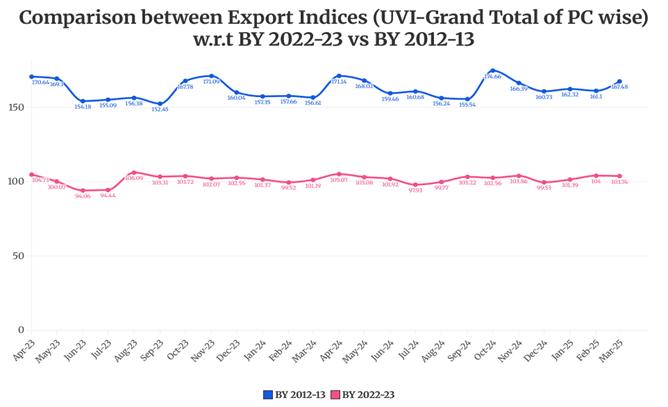
#BY means Base Year.
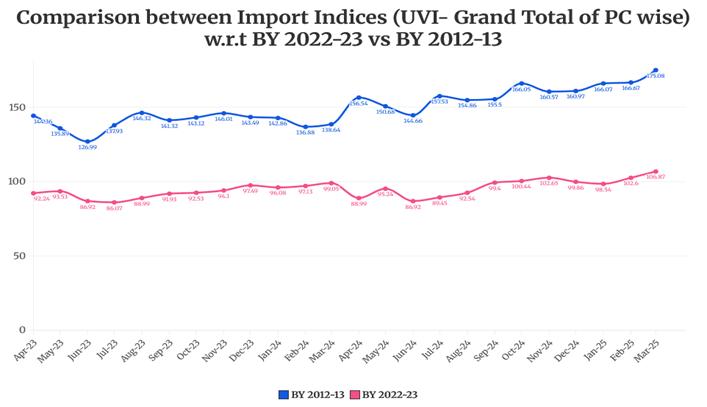
 

#BY means Base Year.

Table: Unit Value Index (UVI) and Quantity Index (QI) during FY 2025-26(Apr-Nov) using FY 2022-23 as base year


Month

Apr_25

May_25

Jun_25

1st Qtr 25-26

Jul_25

Aug_25

Sep_25

2nd Qtr 25-26

Oct_25

Nov_25

Unit Value Index

Export

105.31

99.73

96.31

100.33

99.31

100.55

104.08

101.23

103.78

105.32

Import

92.33

97.97

91.74

94.08

96.34

100.81

108.69

101.93

110.17

106.59

Quantity Index

Export

107.85

104.76

93.88

101.91

103.41

102.64

111.04

105.57

116.19

113.06

Import

138.16

126.61

112.58

125.17

122.47

124.06

126.45

124.32

137.04

121.75

Qtr  means Quarter.

Meaning and interpretation of the Indices

The Unit Value Indices and the Quantity Indices may be interpreted along the following lines.

The Unit Value Index answers the question: What is the growth in the average Unit Value of the items1 traded in the current month with respect to the same month in the Base Year?

So, an Unit Value Index of, say, 120 means that if the items that have been traded in the current month had been traded in the same month of the base year, and if the average price (or unit value) of those items had been Rs.100 in that month of the base year, then the average price (or unit value) of these items in the current month is Rs.120. Or that, there is a 20% increase in the average Unit Value, with respect to the Base Year, of the items that have been traded in the Current Month.

For example, let us suppose 30 items, 10 items each from 3 different Principal Commodities, have been traded in the current month. If these 30 items had been traded in the corresponding month of the base year at an average price of Rs.100, then the average price of these items in the current year is Rs.120.

It is to be noted that there are two successive steps of averaging done here. The first averaging is done over all the items (or ITCHS) of a PC group to arrive at the Index of that PC group. And the second averaging is done over all the PC groups to arrive at the Index at the Grand Total level for all commodities (which is the overall Index for India for a month). In both the stages, a weighted average is taken where the weights are proportional to the importance of the items and the PC groups respectively, and the Laspeyres Formula is used for averaging.

Quantity Indices, say, 200 means that if in the base year on an average 100 units were traded in India in the base year, then in the current year on an average 200 units were traded. However, it must be remembered that averaging quantities are different from averaging prices, since quantities in different units cannot be added directly.

So, the Quantity Indices are calculated by dividing the Value Indices by the Unit Value Indices. For example, if there is an increase in the Value of Export from Rs. 10,000 to Rs. 24,000, then the Value Index is 24000/10000 × 100 = 240. If the Unit Value Index is 120, then the Quantity Index comes to 240/120 × 100 = 200. So, loosely it can be said that, if the value of export has increased 2.4 times and the price of the commodities has increased 1.2 times, then the quantity must have doubled.

However, it may be noted that a very high or low Quantity Index may indicate the presence of Base Effect.

The Interpretation of the Bilateral and Regional Indices can be seen as an extension of the above.

A Unit Value Index of 120 with respect to a country, say Bangladesh, means that if all the items that have been traded with Bangladesh in the current month had been traded in the same month of the base year with the same country, and if the average price (or unit value) of those items had been Rs.100 in that month of the base year, then the average price (or unit value) of these items in the current month is Rs.120.

Similarly, a Quantity Index of 200 with respect to a country, say Bangladesh, means that if in the base year on an average 100 units were traded in India in the base year, then in the current year on an average 200 units were traded.

Comparability of the Indices across time

It is to be noted that the weights in the Index Number formula are fixed across time and there are twelve sets of weights for the twelve months. Hence, comparability of Indices is meaningful only when Indices of same month are compared across years. Different months may attach different weights to the same item, and hence comparing indices of two different months becomes vague and may have little applicability.

Further, the weights of the items that are not present in the trade basket of the current month are distributed to all the items that have been traded in the current month. This distribution is done in proportion to the weights of those items.

For example, let us suppose there are only 3 commodities for trade, say A, B and C. In month May of the Base year, let us suppose that the trade value of A was Rs. 50, B was Rs. 100 and C was Rs. 50. Then the weights assigned to A, B and C in the month of May of the following years would be in the ratio 50 :100 :50. However, in case, C is not traded in the current month, then the weight of C would be distributed proportionately among A and B, again in the ratio 1:2 (since in May the weights of A and B are in the ratio of 50 : 100, i.e., 1 : 2). So, in the current month the weights of A and B would be 3313  and 6623 .

As a result, the weights in any two given months are dependent on exactly the number of items (ITCHS codes) traded in those months. If the items traded are widely different, inference drawn from the comparison of the Indices may be done accordingly. On the other hand, more the similarity in the number of items traded more is the comparability of the two indices.

Net Terms of Trade:

Net Terms of Trade also called commodity Terms of Trade is defined as a ratio of export prices to import prices.

Let say 2022-23 be the base year and 2023-24 be the final year. We express both export and import prices in 2022-23 as 100. Now, suppose that at the end of 2023-24, it is found that the index of export prices decreased to 90 and index of import prices roses to 150. Then the Net Terms of Trade has changed to 90100150100=35 . Then terms of trade as index=35*100=60 . It implies that terms of trade of the country have decreased by about 40% in 2023-24 as compared with 2022-23. It thus shows a deterioration or a worsening of the terms of trade of the country.

If the index of export prices has risen to 150 and that of import prices had risen to 120, then the net terms of trade would have changed to 150120*100=125 . This implies an improvement in the net terms of trade of the country by 25% in 2023-24 over 2022-23.

Gross Terms of Trade:

Gross Terms of Trade is the ratio of physicalquantity of import to physical quantity of export.

Let say 2022-23 be the base year. In that year, the quantities export and import are denoted by 100. Now, suppose that in the year 2023-24, the index of quantity of import was 150 and that of quantity of export was 120. Then the gross terms of trade is given by 150100120100=54,  in terms of percentage =54*100=125 . This implies that there was an improvement of gross terms of trade by 25% in 2023-24 compared to 2022-23.

Income Terms of Trade: Income Terms of Trade is defined as- Net Terms of Trade multiplied by quantity of export.

Topics

Acts Income Tax