

Loading...

Top
Help
×

By creating an account you can:

Logo TaxTMI
Call Us / Help / Feedback

Contact Us At :

E-mail: [email protected]

Call / WhatsApp at: +91 99117 96707

For more information, Check Contact Us

FAQs :

To know Frequently Asked Questions, Check FAQs

Most Asked Video Tutorials :

For more tutorials, Check Video Tutorials

Submit Feedback/Suggestion :

Email :
Please provide your email address so we can follow up on your feedback.
Category :
Description :
Min 15 characters 0/2000
Make Most of Text Search
  1. Checkout this video tutorial: How to search effectively on TaxTMI.
  2. Put words in double quotes for exact word search, eg: "income tax"
  3. Avoid noise words such as : 'and, of, the, a'
  4. Sort by Relevance to get the most relevant document.
  5. Press Enter to add multiple terms/multiple phrases, and then click on Search to Search.
  6. Text Search
  7. The system will try to fetch results that contains ALL your words.
  8. Once you add keywords, you'll see a new 'Search In' filter that makes your results even more precise.
  9. Text Search
Add to...
You have not created any category. Kindly create one to bookmark this item!
Create New Category
Hide
Title :
Description :
❮❮ Hide
Default View
Expand ❯❯
Close ✕
🔎 News - Adv. Search
TEXT SEARCH:

Press 'Enter' to add multiple search terms. Rules for Better Search

Search In:
Main Text + AI Text
  • Main Text
  • Main Text + AI Text
  • AI Text
Category: ?
Categorized by AI
---- All Categories ----
  • ---- All Categories ----
  • Income Tax
  • GST
  • Customs, DGFT & SEZ
  • FEMA & RBI
  • Corp. Laws, SEBI & IBC
  • PMLA, Black Money & ED
  • Budget
  • News and Press Release
  • PTI News
Month:
---- All Months ----
  • ---- All Months ----
  • January
  • February
  • March
  • April
  • May
  • June
  • July
  • August
  • September
  • October
  • November
  • December
Year:
---- All Years ----
  • ---- All Years ----
  • 2026
  • 2025
  • 2024
  • 2023
  • 2022
  • 2021
  • 2020
  • 2019
  • 2018
  • 2017
  • 2016
  • 2015
  • 2014
  • 2013
  • 2012
  • 2011
Sort By: ?
In Sort By 'Default', exact matches for text search are shown at the top, followed by the remaining results in their regular order.
Relevance Default Date
    Loan recovery tightening: RBI proposes mandatory agent training, call recordings
    Sensex falls 558 points on sell-off in IT shares; TCS tumbles over 5 pc
    New CPI series to improve basis for formulating monetary, fiscal policies: CEA Nageswaran
    CCI imposes penalty on Intel Corp. for its India Specific Warranty Policy in respect of Boxed Microprocessors
    Samsung Galaxy F70e – Redefining Everyday Performance
    India to receive same garment duty benefits as Bangladesh under US trade pact: Goyal
    SPJIMR PGPDM Batch 27: Building leaders for the development sector
    ICAR–IIMR and Gourmet Popcornica Collaboration Paves the Way for an Aatmanirbhar Popcorn Maize Ecosystem
    Revised Kisan Credit Card (KCC) Scheme
    Union Minister of Commerce and Industry Shri Piyush Goyal Calls on MedTech Startups to Go Global, Leverage Trade Pacts Covering 70% of World GDP
    Rupee rises 17 paise to close at 90.61 against US dollar
    Kiteskraft unveils their latest publication, The Power List to announce the mentors and change-makers that are shaping progress in India
    Gold Price Outlook 2026: What Rising Gold Prices Mean for Gold Loan Borrowers
    Green Pulse Update: MSMEs Accelerate Environmental Action and Strengthen Implementation Momentum
    IRS (Retd.) Deepak Pandit Nominated as Representative of Indian Cricketer’s Association to MCA Governing Council
    Will not hear plea against fugitive tag if Vijay Mallya does not return to India, warns HC
    Commerce and Industry Minister Piyush Goyal urges Export Promotion Councils and Industry bodies to utilize FTAs to gain greater presence in world mark...
    Secretary, DFS Chairs Meeting to Prepare Roadmap for Financial Inclusion 2.0
    National Statistical Systems Training Academy, MoSPI to Celebrate 18th Foundation Day on 13th February 2026
❯❯
Maximize Maximize Maximize
0 / 200
Expand Note
Add to Folder

No Folders have been created

+

Are you sure you want to delete "My most important" ?

NOTE:

News
Showing Results for :
Reset Filters
Results Found:
Show All Summaries Hide All Summaries
February 12, 2026
Show AI Summary
Loan recovery rules require agent training, call recording, respectful conduct, background checks and restrictions on contact timing.
The Reserve Bank proposes mandating recorded phone calls and civil conduct by recovery agents, prohibiting abusive language and inappropriate messaging, and banning contact at inopportune occasions. Banks must adopt internal guidelines, protect customer information held by agents, require completion of formal debt recovery training, and conduct pre engagement and periodic background verifications of agent representatives. Banks must exercise utmost caution before involving agents in matters that are subjudice and ensure recovery agencies comply with verification, training, and conduct standards.
February 12, 2026
Show AI Summary
Sensex falls amid IT sell-off and AI concerns; TCS drops below Rs10 lakh crore market capitalisation.
Benchmark indices fell on heavy selling in IT stocks as AI-related disruption fears and diminished expectations of a near-term Fed rate cut following strong US jobs data drove volatility; TCS tumbled over 5%, pushing its market capitalisation below the Rs 10 lakh crore mark, while foreign institutional investor inflows in February provided limited offsetting support.
February 12, 2026
Show AI Summary
New CPI series recalibrates weights and expands services and digital coverage to improve inflation measurement for policy use.
The National Statistics Office released a redesigned Consumer Price Index with base 2024=100 that recalibrates item weights using the Household Consumption Expenditure Survey 2023-24, expands coverage of goods, services and digital channels, reduces the food and beverages weight, and aims to provide more accurate inflation signals to aid monetary policy calibration and stabilize CPI-linked fiscal items.
February 12, 2026
Show AI Summary
Intel's India-specific warranty policy deemed abusive of dominance; fined INR 27.38 crore and ordered to publicise withdrawal.
CCI held Intel dominant in the boxed desktop microprocessor market and found its India-specific warranty policy discriminatory and limiting of parallel imports, causing an appreciable adverse effect on competition under Section 4. The Commission imposed a reduced penalty of INR 27.38 crores after considering mitigation including policy withdrawal and directed Intel to publicise the withdrawal and submit a compliance report.
February 12, 2026
Show AI Summary
Samsung Galaxy F70e 5G available with Bajaj Finserv Easy EMIs offering flexible tenures and zero down payment.
Samsung launched the Galaxy F70e 5G and promotes purchase via Bajaj Finserv Easy EMIs offering quick approvals, customised payment terms, zero down payment on select models, and flexible tenures (3-60 months). Bajaj Finance Limited is identified as a deposit taking NBFC registered with the Reserve Bank of India and classified as an NBFC Investment and Credit Company that engages in lending and acceptance of deposits, with a diversified lending portfolio and published credit ratings.
February 12, 2026
Show AI Summary
India garment duty access: apparel made with US yarn or cotton to qualify for duty concessions under an interim trade pact.
India will receive apparel duty concessions under an interim India US trade agreement when garments meet yarn forward or cotton forward rules of origin by procuring yarn and/or cotton from the US, mirroring benefits extended to Bangladesh; the arrangement, contingent on signing the legal agreement by mid March, includes no quotas on raw material imports and aims to preserve protections for most Indian agricultural products.
February 12, 2026
Show AI Summary
Nationwide strike contests labour codes and protest limits; courts question RERA functioning and expressive boundaries.
Trade unions held a nationwide strike opposing labour codes and the proposed Industrial Relations Code, alleging it favours employers and curtails protest rights. The Supreme Court criticised state RERA bodies for facilitating defaulting builders and urged reconsideration of their constitution and enforcement. The government approved a government to government purchase of 114 combat aircraft, while a defence contractor proposed co development of an aero engine with full intellectual property transfer, raising procurement and IP compliance issues.
February 12, 2026
Show AI Summary
SPJIMR launches PGPDM Batch 27 to build development sector leaders with diverse, practice focused training and RBI emphasis on intermediaries.
SPJIMR launched Batch 27 of its PGPDM, a 37 member, gender balanced cohort emphasizing practice oriented learning and capacity building for development sector leadership. The programme highlights the importance of capable intermediaries to bridge government, business and society-critical to MSME promotion and entrepreneurial support-and is positioned as the only Indian development management programme with triple international accreditation.
February 12, 2026
Show AI Summary
Popcorn maize collaboration boosts domestic production via hybrid agreements, contract farming, export readiness, and aatmanirbhar goals.
ICAR-IIMR and Gourmet Popcornica entered formal agreements for IIMR-bred popcorn hybrids to translate research into commercial cultivation, improving yields, kernel quality and pest resistance. Through structured contract farming, capacity building for over 17,500 farmers, mechanisation and responsible sourcing across tens of thousands of acres, the partnership reduced import dependence (domestic production now ~65% of demand) and aims to develop export readiness and an aatmanirbhar popcorn maize value chain.
February 12, 2026
Show AI Summary
Kisan Credit Card scheme revised to standardize crop seasons, extend tenures, align drawing limits, and add tech expense eligibility.
Revised Directions propose an updated Kisan Credit Card (KCC) Scheme consolidating guidelines for multiple bank types, standardizing crop seasons into short (12 months) and long (18 months) durations, extending KCC tenure to six years, aligning drawing limits with the scale of finance for each crop season, and adding specified technological and certification expenses within a 20% additional component as eligible. The draft is open for public and regulated entity comments by March 6, 2026 through prescribed online and email channels.
February 12, 2026
Show AI Summary
MedTech startups urged to go global leveraging trade pacts and 80% IP fee rebate to scale affordable exports.
MedTech startups are urged to capitalise on India's trade agreements that secure market access to about 70% of global GDP, with support including an 80% rebate on IP fees, 24x7 Startup India assistance, facilitation of delegations and mission support, regulatory progress enabling exports, expansion of NIPERs and a new NID, infrastructure plans for manufacturing clusters, and public-private grant and incubation awards to accelerate commercialization.
February 12, 2026
Show AI Summary
Rupee rises on foreign fund inflows and RBI liquidity support while equities fall amid trade-deal concerns.
The rupee appreciated to 90.61 against the US dollar as foreign fund inflows and RBI liquidity support lifted sentiment, while concerns over India-US trade fact sheet terms and sector sensitivities coincided with equity market declines and continued foreign institutional purchases.
February 12, 2026
Show AI Summary
Kiteskraft's The Power List spotlights mentors and change makers driving ethical leadership, innovation, and community impact.
Kiteskraft Productions LLP published The Power List, a compendium recognizing mentors and change makers across education, healthcare, arts, finance, and social enterprise, highlighting their leadership, ethical practices, mentorship roles, public service initiatives, professional achievements, and contributions to community empowerment; the release frames Kiteskraft as an events and recognition organiser and presents the profiles descriptively under a PRNewswire arrangement.
February 12, 2026
Show AI Summary
Gold price surge boosts borrowers' collateral value; lenders advise leveraging higher LTV for debt consolidation.
Rising gold prices have increased the collateral value of pledged jewellery, raising the absolute loan amount available within the RBI Loan-to-Value cap. Borrowers may leverage higher valuations for liquidity needs such as debt consolidation or business expansion. Lenders should ensure transparent, real-time appraisal processes and borrowers are advised to use RBI-regulated lenders and bank-grade custody standards to secure peak market valuation and potentially access improved credit terms and lower long-term borrowing costs.
February 12, 2026
Show AI Summary
MSMEs sustainability adoption rises: willingness and implementation increase despite awareness dip, but funding and technical gaps persist.
The SPeX Q3 2025 shows an overall score of 62 driven down by falling awareness while willingness and implementation rose-especially recycling and sustainable packaging-with 54% of MSMEs now classed as integrators. Implementation improved 18% QoQ led by medium and 10-25 year firms, but funding, technical expertise and limited sustainability budgets remain key constraints. SIDBI and Dun & Bradstreet stress targeted finance, policy and capacity support to scale MSME green transitions. The index tracks Awareness, Willingness and Implementation across a 0-100 scale based on a survey of MSMEs in 22 states.
February 12, 2026
Show AI Summary
Deepak Pandit nominated as ICA representative to MCA Governing Council to liaise on player welfare and contracts.
Deepak Pandit has been nominated as the Representative of the Indian Cricketers' Association to the Mumbai Cricket Association Governing Council, tasked with acting as the primary liaison between players and the MCA, participating in policy formulation affecting contracts, playing conditions, welfare schemes and grievance redressal, and promoting transparency, accountability and the ICA's constitutional and ethical framework within MCA governance.
February 12, 2026
Show AI Summary
Vijay Mallya must state whether he will return before his challenge to the fugitive economic offender tag is heard.
The admissibility of a challenge to the Fugitive Economic Offender designation and the constitutional validity of the FEO Act is made contingent on a petitioner's clear affidavit stating whether he will return to the jurisdiction; the court treated this return requirement as essential to prevent abuse of process while extradition and enforcement actions, including property attachment under money laundering and loan default proceedings, are pending.
February 12, 2026
Show AI Summary
Free Trade Agreements encourage exporters to expand markets; tariff rollback and Export Promotion Mission boost export competitiveness.
FTAs are presented as the primary tool to expand exporters' access to developed markets, with industry urged to improve quality and competitiveness to use preferential access. The recent elimination of an additional 25% US tariff is identified as restoring competitive market access for priority sectors. The Export Promotion Mission provides operational support through Interest Subvention for export credit, Collateral Guarantee for MSME export credit and targeted market access measures, with further trade finance, logistics, compliance and branding interventions to be phased in.
February 12, 2026
Show AI Summary
Financial inclusion roadmap to expand banking access, formal credit, insurance and pensions, and boost digital payments nationwide.
A national roadmap, Financial Inclusion 2.0, will expand banking access, augment village banking infrastructure, extend formal credit to women and vulnerable groups, and achieve insurance and pension coverage for all by 2047, while promoting digital financial products and transactions and strengthening financial/digital literacy and fraud awareness.
February 12, 2026
Show AI Summary
NSSTA celebrates 18th Foundation Day focused on reimagining capacity building for official statistics, AI readiness, and data harmonization.
NSSTA will celebrate its 18th Foundation Day on 13 February 2026 under the theme Reimagining Capacity Building for Official Statistics to achieve Viksit Bharat@2047, emphasizing institutional capacity building, AI/ML and big data adoption, data harmonization for AI readiness, and training for Central, State/UT and international participants to strengthen evidence-based governance.

News

Back

All News

Showing Results for :
Reset Filters
No Records Found

News

Back

All News

Showing Results for : Reset Filters
Customs, DGFT & SEZ

Directorate General of Commercial Intelligence and Statistics Revises Base Year of Merchandise Trade Indices to FY 2022–23 to Reflect Current Trade Structure and Global Patterns

February 21, 2026

Contents
Summary
Note

Note

-

Bookmark

Print

Print

Merchandise Trade Indices are compiled and published by the Directorate General of Commercial Intelligence and Statistics (DGCI&S), Ministry of Commerce & Industry, to measure changes in the unit values (prices) of India’s exports and imports over time. These indices serve as important indicators of external sector price movements and are widely used for economic analysis, including national accounts compilation and assessment of terms of trade. Over the years, the base year of the indices has been periodically revised to reflect structural changes in India’s trade composition and evolving global trade patterns. The most recent revision updates the base year to FY 2022–23 (2022–23 = 100), replacing the earlier base of FY 2012–13, thereby ensuring that the indices accurately represent the current structure of India’s merchandise trade.

Revision of Base Year of India’s Merchandise Trade Indices to FY 2022–23

The Directorate General of Commercial Intelligence and Statistics (DGCI&S), Ministry of Commerce & Industry, has revised the base year of India’s Merchandise Trade Indices from FY 2012–13 to FY 2022–23 (2022–23 = 100), in view of the structural changes in the economy, shifts in commodity composition, evolving trade patterns, and the need for improved alignment with contemporary macroeconomic indicators.

The revision has been undertaken on the recommendations of a committee constituted by DGCI&S under the Chairmanship of Prof. Nachiketa Chattopadhyay, Professor, Indian Statistical Institute, Kolkata. The Committee examined the existing methodology, data coverage, weighting structure, and compilation practices, and recommended suitable refinements in line with international best practices.

Key Features of the Revised Series (Base: FY 2022–23)

  1. Updated Base Year:
    The new base year FY 2022–23 makes the Indices reflect the current structure of India’s external trade more accurately.
  2. Revised Commodity Basket:
    The coverage and classification of commodities have been reviewed at the Principal Commodity level to better capture emerging and declining trade items.
  3. Revised Weighting Structure:
    Weights have been updated based on trade values of the new base year to reflect the latest value shares in exports and imports.
  4. Improved Methodology:
    Methodological refinements have been introduced in:
    1. Selection of common commodity basket for base year selection (procedure of selection for common commodity basket explained in detail report of the committee).
    2. Treatment of missing unit values (Imputation of missing unit values in base year selection have been explained in detail in the committee report).
  5. Indices Compiled:
    The revised series includes:
    1. Monthly, Quarterly and Annual Indices (Export Unit Value Index,Import Unit Value Index).
    2. Principal Commodity (PC) Classification wise Trade Indices (Export/Import).
    3. Standard International Trade Classification-wise (SITC) Trade Indices.
    4. Broad economic categories-wise (BEC) Trade Indices.
    5. Bilateral and Region-wise Trade Indices of Top 20 Export and Import partner nations of India.
    6. Terms of Trade (Gross terms of trade, Net terms of trade and Income terms of trade).

Rationale for Revision

Over the past decade, India’s trade basket has undergone substantial changes due to emergence of new commodities, technological advancements, Global supply chain restructuring and changes in relative price structures.

The earlier base year (FY 2012–13) no longer adequately reflected the prevailing trade structure. The revision ensures improved relevance, reliability, and analytical usefulness of the Merchandise Trade Indices for policymakers, researchers, and other stakeholders.

Use of the Revised Series

Merchandise Trade Indices compiled by the Directorate General of Commercial Intelligence and Statistics (DGCI&S) are extensively used by key government institutions for economic analysis and policy formulation. The National Accounts Division (NAD) of the Ministry of Statistics and Programme Implementation uses the Export and Import Unit Value Indices as deflators for estimating real exports and imports in GDP compilation. The Reserve Bank of India (RBI) relies on these indices for external sector assessment, balance of payments analysis, and evaluation of price competitiveness. Various Ministries and Government agencies also use them to frame and review trade-related policies and to assess movements in international prices. In addition, academic institutions, research organizations, and economic analysts utilize Merchandise Trade Indices for empirical research, modelling, and analysis of trade dynamics and terms of trade trendson and economic research.

Availability of Data

The revised Merchandise Trade Indices (Base: FY 2022–23) will be released on the official website of DGCI&S. Detailed methodological documentation is available in the Report of the Committee on Revision of Base Year for Merchandise Trade Indices.

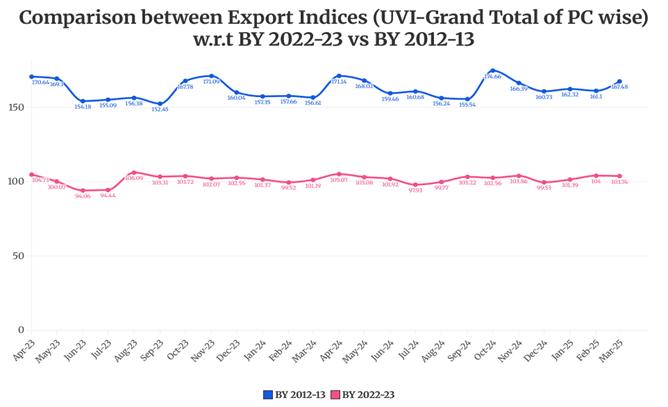
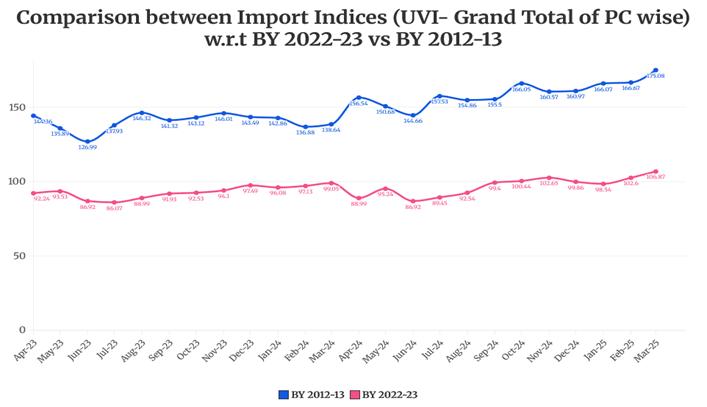
Comparison of the new revised Indices (Base Year: 2022-23) with the already released Indices (Base Year : 2012-13) for 2022-23 and 2023-24 is given below.
#BY means Base Year.
 

#BY means Base Year.

Table: Unit Value Index (UVI) and Quantity Index (QI) during FY 2025-26(Apr-Nov) using FY 2022-23 as base year


Month

Apr_25

May_25

Jun_25

1st Qtr 25-26

Jul_25

Aug_25

Sep_25

2nd Qtr 25-26

Oct_25

Nov_25

Unit Value Index

Export

105.31

99.73

96.31

100.33

99.31

100.55

104.08

101.23

103.78

105.32

Import

92.33

97.97

91.74

94.08

96.34

100.81

108.69

101.93

110.17

106.59

Quantity Index

Export

107.85

104.76

93.88

101.91

103.41

102.64

111.04

105.57

116.19

113.06

Import

138.16

126.61

112.58

125.17

122.47

124.06

126.45

124.32

137.04

121.75

Qtr  means Quarter.

Meaning and interpretation of the Indices

The Unit Value Indices and the Quantity Indices may be interpreted along the following lines.

The Unit Value Index answers the question: What is the growth in the average Unit Value of the items1 traded in the current month with respect to the same month in the Base Year?

So, an Unit Value Index of, say, 120 means that if the items that have been traded in the current month had been traded in the same month of the base year, and if the average price (or unit value) of those items had been Rs.100 in that month of the base year, then the average price (or unit value) of these items in the current month is Rs.120. Or that, there is a 20% increase in the average Unit Value, with respect to the Base Year, of the items that have been traded in the Current Month.

For example, let us suppose 30 items, 10 items each from 3 different Principal Commodities, have been traded in the current month. If these 30 items had been traded in the corresponding month of the base year at an average price of Rs.100, then the average price of these items in the current year is Rs.120.

It is to be noted that there are two successive steps of averaging done here. The first averaging is done over all the items (or ITCHS) of a PC group to arrive at the Index of that PC group. And the second averaging is done over all the PC groups to arrive at the Index at the Grand Total level for all commodities (which is the overall Index for India for a month). In both the stages, a weighted average is taken where the weights are proportional to the importance of the items and the PC groups respectively, and the Laspeyres Formula is used for averaging.

Quantity Indices, say, 200 means that if in the base year on an average 100 units were traded in India in the base year, then in the current year on an average 200 units were traded. However, it must be remembered that averaging quantities are different from averaging prices, since quantities in different units cannot be added directly.

So, the Quantity Indices are calculated by dividing the Value Indices by the Unit Value Indices. For example, if there is an increase in the Value of Export from Rs. 10,000 to Rs. 24,000, then the Value Index is 24000/10000 × 100 = 240. If the Unit Value Index is 120, then the Quantity Index comes to 240/120 × 100 = 200. So, loosely it can be said that, if the value of export has increased 2.4 times and the price of the commodities has increased 1.2 times, then the quantity must have doubled.

However, it may be noted that a very high or low Quantity Index may indicate the presence of Base Effect.

The Interpretation of the Bilateral and Regional Indices can be seen as an extension of the above.

A Unit Value Index of 120 with respect to a country, say Bangladesh, means that if all the items that have been traded with Bangladesh in the current month had been traded in the same month of the base year with the same country, and if the average price (or unit value) of those items had been Rs.100 in that month of the base year, then the average price (or unit value) of these items in the current month is Rs.120.

Similarly, a Quantity Index of 200 with respect to a country, say Bangladesh, means that if in the base year on an average 100 units were traded in India in the base year, then in the current year on an average 200 units were traded.

Comparability of the Indices across time

It is to be noted that the weights in the Index Number formula are fixed across time and there are twelve sets of weights for the twelve months. Hence, comparability of Indices is meaningful only when Indices of same month are compared across years. Different months may attach different weights to the same item, and hence comparing indices of two different months becomes vague and may have little applicability.

Further, the weights of the items that are not present in the trade basket of the current month are distributed to all the items that have been traded in the current month. This distribution is done in proportion to the weights of those items.

For example, let us suppose there are only 3 commodities for trade, say A, B and C. In month May of the Base year, let us suppose that the trade value of A was Rs. 50, B was Rs. 100 and C was Rs. 50. Then the weights assigned to A, B and C in the month of May of the following years would be in the ratio 50 :100 :50. However, in case, C is not traded in the current month, then the weight of C would be distributed proportionately among A and B, again in the ratio 1:2 (since in May the weights of A and B are in the ratio of 50 : 100, i.e., 1 : 2). So, in the current month the weights of A and B would be 3313  and 6623 .

As a result, the weights in any two given months are dependent on exactly the number of items (ITCHS codes) traded in those months. If the items traded are widely different, inference drawn from the comparison of the Indices may be done accordingly. On the other hand, more the similarity in the number of items traded more is the comparability of the two indices.

Net Terms of Trade:

Net Terms of Trade also called commodity Terms of Trade is defined as a ratio of export prices to import prices.

Let say 2022-23 be the base year and 2023-24 be the final year. We express both export and import prices in 2022-23 as 100. Now, suppose that at the end of 2023-24, it is found that the index of export prices decreased to 90 and index of import prices roses to 150. Then the Net Terms of Trade has changed to 90100150100=35 . Then terms of trade as index=35*100=60 . It implies that terms of trade of the country have decreased by about 40% in 2023-24 as compared with 2022-23. It thus shows a deterioration or a worsening of the terms of trade of the country.

If the index of export prices has risen to 150 and that of import prices had risen to 120, then the net terms of trade would have changed to 150120*100=125 . This implies an improvement in the net terms of trade of the country by 25% in 2023-24 over 2022-23.

Gross Terms of Trade:

Gross Terms of Trade is the ratio of physicalquantity of import to physical quantity of export.

Let say 2022-23 be the base year. In that year, the quantities export and import are denoted by 100. Now, suppose that in the year 2023-24, the index of quantity of import was 150 and that of quantity of export was 120. Then the gross terms of trade is given by 150100120100=54,  in terms of percentage =54*100=125 . This implies that there was an improvement of gross terms of trade by 25% in 2023-24 compared to 2022-23.

Income Terms of Trade: Income Terms of Trade is defined as- Net Terms of Trade multiplied by quantity of export.

Topics

Acts Income Tax