

Loading...

Top
Help
×

By creating an account you can:

Logo TaxTMI
Call Us / Help / Feedback

Contact Us At :

E-mail: [email protected]

Call / WhatsApp at: +91 99117 96707

For more information, Check Contact Us

FAQs :

To know Frequently Asked Questions, Check FAQs

Most Asked Video Tutorials :

For more tutorials, Check Video Tutorials

Submit Feedback/Suggestion :

Email :
Please provide your email address so we can follow up on your feedback.
Category :
Description :
Min 15 characters 0/2000
Make Most of Text Search
  1. Checkout this video tutorial: How to search effectively on TaxTMI.
  2. Put words in double quotes for exact word search, eg: "income tax"
  3. Avoid noise words such as : 'and, of, the, a'
  4. Sort by Relevance to get the most relevant document.
  5. Press Enter to add multiple terms/multiple phrases, and then click on Search to Search.
  6. Text Search
  7. The system will try to fetch results that contains ALL your words.
  8. Once you add keywords, you'll see a new 'Search In' filter that makes your results even more precise.
  9. Text Search
Add to...
You have not created any category. Kindly create one to bookmark this item!
Create New Category
Hide
Title :
Description :
❮❮ Hide
Default View
Expand ❯❯
Close ✕
🔎 News - Adv. Search
TEXT SEARCH:

Press 'Enter' to add multiple search terms. Rules for Better Search

Search In:
Main Text + AI Text
  • Main Text
  • Main Text + AI Text
  • AI Text
Category: ?
Categorized by AI
---- All Categories ----
  • ---- All Categories ----
  • Income Tax
  • GST
  • Customs, DGFT & SEZ
  • FEMA & RBI
  • Corp. Laws, SEBI & IBC
  • PMLA, Black Money & ED
  • Budget
  • News and Press Release
  • PTI News
Month:
---- All Months ----
  • ---- All Months ----
  • January
  • February
  • March
  • April
  • May
  • June
  • July
  • August
  • September
  • October
  • November
  • December
Year:
---- All Years ----
  • ---- All Years ----
  • 2026
  • 2025
  • 2024
  • 2023
  • 2022
  • 2021
  • 2020
  • 2019
  • 2018
  • 2017
  • 2016
  • 2015
  • 2014
  • 2013
  • 2012
  • 2011
Sort By: ?
In Sort By 'Default', exact matches for text search are shown at the top, followed by the remaining results in their regular order.
Relevance Default Date
    Startup India Recognises 2.07 Lakh Ventures, Creates 21.9 Lakh Jobs; Govt Expands Funding Push Through Flagship Schemes
    Work Advances on 12 New Greenfield Industrial Cities: SPVs Formed for All, EPC Contractors Appointed for 9; Environment Clearances Secured for 11
    RBI invites public comments on the Draft Circular on Lead Bank Scheme (LBS)
    RBI Issues Draft Amendment Directions for ‘Conduct of Regulated Entities in Recovery of Loans and Engagement of Recovery Agents’
    India's forex reserves drop USD 6.7 bln to USD 717.06 bln
    Stable Money Leads Gold & Silver ETF Surge on ONDC as Investors Turn to Safe, Regulated Products
    BJP got 82 pc of Rs 3,826 crore disbursed by electoral trusts in 2024-25: ADR
    Govt approves 25 lakh tons of wheat exports
    68th Foundation Day of NPC Marks Commencement of National Productivity Week 2026
    Reset Ambitions for Trillion-Dollar Tech Future by 2035, Embrace AI and Clean Energy: Union Minister of Commerce and Industry Shri Piyush Goyal to Ind...
    Central Board of Indirect Taxes & Customs organises post-Budget interactive session with stakeholders in Mumbai
    CCI approves acquisition of low voltage motor business of Siemens Ltd. by Innomotics India Pvt Ltd.
    CCI approves proposed acquisition of minority shareholding of ~6.63% of Valuedrive Technologies Pvt Ltd by Fidelity Funds
    CCI approves proposed combination involving Amundi Asset Management S.A.S. (Acquirer) and ICG Plc (Target)
    Jharkhand HC directs Centre, state to formulate SOP for accessing Aadhaar card details by police
    KELTRON secures Rs 18 crore export deal for Passive Sonar Systems
    India-US joint statement remains basis for interim trade agreement: New Delhi
    India unveils new CPI series with 2024 base; Jan inflation at 2.75 pc
    ED arrests ex-director of Lodha Developers Ltd in Rs 85 crore money laundering case
    India unveils new CPI series with 2024 base, wider basket; Jan retail inflation at 2.75%
❯❯
Maximize Maximize Maximize
0 / 200
Expand Note
Add to Folder

No Folders have been created

+

Are you sure you want to delete "My most important" ?

NOTE:

News
Showing Results for :
Reset Filters
Results Found:
Show All Summaries Hide All Summaries
February 13, 2026
Show AI Summary
Startup India expands funding, tax reliefs and compliance relaxations to boost venture financing, ESOP flexibility and GST ease.
Startup India recognises over 2.07 lakh startups and deploys three principal funding mechanisms-Fund of Funds for Startups (FFS) via SIDBI backed AIFs (Rs. 25,547.98 crore invested), Startup India Seed Fund Scheme (SISFS) providing grants/convertible/debt through incubators (Rs. 590.93 crore approved), and a Credit Guarantee Scheme for Startups (CGSS) guaranteeing loans (circa Rs. 808.18 crore). Concurrent regulatory and tax easements include profit linked tax deductions, ESOP TDS deferral, carry forward/set off relaxations, GST procedural reforms (simplified registration, QRMP, provisional refunds, interest/penalty waivers, reduced pre deposits) and Companies Act compliance relaxations (optional cash flow, deposit exemptions, reduced board meeting frequency, ESOP and convertible note flexibilities).
February 13, 2026
Show AI Summary
Greenfield industrial cities: SPVs formed for 12 projects, EPCs appointed for nine, environment clearances for eleven.
All twelve greenfield industrial city projects have incorporated Special Purpose Vehicles; equity released to nine SPVs; Programme Managers for New Cities appointed for nine projects; EPC contractors appointed for nine projects with one additional contractor finalised; eight EPC contracts had been awarded for internal trunk infrastructure as of January 2026 with one further award thereafter; environment clearances secured for eleven projects and foundation stones laid at two projects.
February 13, 2026
Show AI Summary
Lead Bank Scheme draft revises governance, roles, and committee structures; public comments invited by March 6, 2026.
Draft circular revising the Lead Bank Scheme aims to refine Scheme objectives, clarify governance by specifying structure, membership and agenda of fora, and delineate roles and responsibilities of key functionaries. It also proposes measures to strengthen the State Level Bankers' Committee and Lead District Manager offices. Public comments are invited by email using a prescribed subject line within the stated deadline.
February 13, 2026
Show AI Summary
RBI draft directions on loan recovery require fair treatment, due diligence, training, and codes for recovery agents.
The Reserve Bank of India has issued draft Amendment Directions extending responsible business conduct requirements on loan recovery and engagement of recovery agents to all regulated entities, specifying safeguards on fair treatment of borrowers, conduct of lender employees and agents, due diligence, training, and a code of conduct for recovery agents, and inviting public comments through prescribed channels.
February 13, 2026
Show AI Summary
India's forex reserves fell $6.7bn to $717.06bn; foreign currency assets rose while gold and SDRs declined.
India's foreign exchange reserves fell USD 6.711 billion to USD 717.064 billion for the week ended February 6. Foreign currency assets increased by USD 7.661 billion to USD 570.053 billion, gold reserves dropped by USD 14.208 billion to USD 123.476 billion, SDRs declined by USD 132 million to USD 18.821 billion, and the reserve position with the IMF fell by USD 32 million to USD 4.715 billion.
February 13, 2026
Show AI Summary
Gold and silver ETFs see increased investor flows as platforms use open ONDC infrastructure to offer SEBI-regulated products.
Record transaction volumes in gold and silver ETFs reflect investor shifts from physical holdings to SEBI-regulated products; Stable Money's early integration with the Open Network for Digital Commerce enables distribution of regulated mutual funds and ETFs via an open, interoperable infrastructure, increasing reach without closed ecosystems and concentrating mutual fund transactions on the network.
February 13, 2026
Show AI Summary
Electoral trusts disbursed Rs 3,826 crore in FY25, with one party receiving 82.5%-report calls for greater transparency.
Electoral trusts received Rs 3,826.34 crore in FY2024-25 and disbursed Rs 3,826.35 crore, with one party receiving 82.52% of distributed funds; ten of twenty trusts reported receipts, five trusts' reports were unavailable, and instances of nil reporting and accounting anomalies were noted. The report identified concentration among top donors and sectors, significant undisclosed donor addresses, and called for enhanced transparency and enforcement under the Electoral Trusts Scheme, 2013.
February 13, 2026
Show AI Summary
Wheat and sugar exports authorised with pro-rata quotas for mills and a 70% export fulfilment condition by June 30, 2026.
The government authorised export of 25 lakh tonnes of wheat and an additional 5 lakh tonnes each of wheat products and sugar to manage domestic supply and prices, relying on current private-stock estimates and projected central-pool availability. Additional sugar exports will be allocated on a pro-rata basis to willing mills that declare willingness within 15 days and must export at least 70% of their allocation by June 30, 2026; allocated quotas are non-transferable.
February 13, 2026
Show AI Summary
National Productivity Week highlights MSME cluster productivity, Industry 4.0 readiness assessment, and proposed productivity rating systems.
NPC advanced cluster-based strategies to boost MSME competitiveness and global integration, advocating shared infrastructure and knowledge exchange. It proposed an Industry 4.0 Readiness Assessment Framework, an Indian Productivity Rating System, a 5S Assessment Framework for export readiness, sector-specific benchmarks, and a Learning & Development Centre to embed productivity tools. Energy efficiency, sustainable production, youth engagement, and international collaboration were presented as complementary measures to translate productivity gains into cost efficiency and competitiveness.
February 13, 2026
Show AI Summary
Technology sector urged to pursue trillion-dollar ambition by 2035 with tax incentives, clean energy and AI focus.
The minister urged the technology sector to pursue a trillion-dollar ambition by 2035 through applied AI, a 10 GW data centre capacity target by 2030, and strengthened clean energy integration, backed by income tax benefits for qualifying investments through 2047 to boost FDI, jobs and the data centre ecosystem, while emphasizing cybersecurity, data integrity, AI education, industry-led engagement with government facilitation, and coordinated action with states to streamline approvals and electricity access.
February 13, 2026
Show AI Summary
Customs reforms introduce trust-based governance and an integrated digital ecosystem to simplify clearances and aid trade.
Reforms introduced in the Union Budget 2026-27 emphasise trust-based governance, simplification of customs procedures, and implementation through staff sensitisation across Mumbai Customs operations; a single integrated digital ecosystem connecting export-import stakeholders and participating agencies is being pursued to accelerate clearances, strengthen business planning, and improve ease of doing business, with FAQs released for public facilitation and ongoing stakeholder consultations to address industry queries.
February 13, 2026
Show AI Summary
Low voltage motor business acquisition approved; Innomotics to acquire Siemens' unit in India through a slump sale.
The Competition Commission of India approved a proposed combination for the slump sale of the low voltage motor business of Siemens Limited to Innomotics India Private Limited. The Target Business sells low voltage motors for industrial applications in India and exports under an outsourced manufacturing model. Innomotics, part of KPS Capital Partners, is an industrial motors manufacturer supplying high and medium voltage motors and large drive systems to sectors including oil and gas, metals, cement, power and marine. A detailed order will follow.
February 13, 2026
Show AI Summary
Acquisition of ~6.63% stake in Valuedrive by Fidelity Funds via CCPS subscription and secondary purchase.
The proposed transaction involves acquisition of approximately 6.63% minority shareholding in Valuedrive Technologies Private Limited by Fidelity group investment funds through a mix of primary subscription and secondary acquisition of compulsory convertible preference shares, with Fidelity Funds acting as diversified investment vehicles. Valuedrive is an operating-cum-holding company in the Spinny Group operating an electronic wholesale motor-vehicle platform and owning subsidiaries in lending, insurance broking, automotive publishing/events, and ancillary services.
February 13, 2026
Show AI Summary
Amundi ICG proposed combination approved: Acquirer to buy 4.64% voting shares, nominate a director and subscribe to non voting instruments.
CCI approved Amundi's acquisition of 4.64% voting share capital of ICG via on-market purchases, a right to nominate a director, and subsequent subscription to non voting instruments up to 5.26% of ICG's capital. The Acquirer lacks direct Indian operations but is indirectly present through a minority joint venture that offers asset management services in India. The Target operates globally as an alternative asset manager across structured capital, private equity, real assets, private debt, and credit markets.
February 12, 2026
Show AI Summary
Aadhaar card tracing: High Court directs Centre and state to create an SOP for faster police access.
The High Court directed central and state governments to formulate an SOP for police access to Aadhaar card details to enable faster tracing of victims, stressing expedited procedures for missing children and suspected human trafficking; it ordered the Unique Identification Authority director be made a party, received a report from the state legal services authority on action taken after an alleged assault, and scheduled further hearing.
February 12, 2026
Show AI Summary
KELTRON secures Rs18 crore export deal to supply Passive Sonar systems; KS Smart to buy 40% stake in Kokonix.
KELTRON signed an Rs 18 crore export agreement, via Neo Power, to supply Passive Sonar systems to navies in the South Asia-North Africa region-its largest single export order following a successful 2025 shipment of 300 sonar elements that met delivery and quality standards. Concurrently, Kokonix will transfer a 40 percent stake to KS Smart to revive laptop manufacturing and bolster its smart-device production capacity.
February 12, 2026
Show AI Summary
India-US trade framework remains the basis for an interim agreement; fact sheet amended to reflect shared understandings.
The India-US joint statement is the binding framework for an interim trade agreement; amendments to the White House fact sheet were made to reflect shared understandings, removing references to pulses and digital services taxes and reframing commitments as intentions to reduce tariffs on specified US industrial and agricultural goods and to increase purchases of US energy and technology products.
February 12, 2026
Show AI Summary
New CPI series shows January inflation at 2.75%, revises basket and weights, impacting monetary policy signals.
The new CPI series rebased to 2024 (HCES 2023-24) expands the basket to 358 items, reweights components-notably lowering Food & Beverages to 36.75% and enlarging Housing to 17.67%-widens price collection across rural, urban and online markets, and reclassifies groups into a 12-category COICOP-aligned framework. Index values begin January 2025 with year on year comparability from January 2026 and a linking factor enables back-calculation; methodological changes aim to align inflation signals with current expenditure patterns and refine the basis for monetary and fiscal policy calibration.
February 12, 2026
Show AI Summary
Money laundering probe alleges director diverted company funds through front entities, benami deals and forged documents causing large losses.
The director allegedly exceeded limited authority to generate and conceal proceeds of crime by diverting company funds through front entities, reselling land to the company at inflated prices, transferring land and TDRs at undervalued rates, executing benami transactions, fabricating MoUs to create bogus possession claims, and facilitating fraudulent allotment of flats, causing over Rs 85 crore wrongful loss; the money laundering probe proceeds under PMLA with the accused produced and arrested during production proceedings.
February 12, 2026
Show AI Summary
New CPI series updates base year to 2024, widens basket and recalibrates weights to better measure inflation.
India introduced a new Consumer Price Index series with base year 2024=100, expanding coverage to 358 items and 12 classification groups, recalibrating weights using the Household Consumption Expenditure Survey 2023 24, reducing the food and beverages weight to 36.75%, and updating price collection across extensive rural, urban and online markets to provide more contemporaneous inflation signals for policy calibration.

News

Back

All News

Showing Results for :
Reset Filters
No Records Found

News

Back

All News

Showing Results for : Reset Filters
Customs, DGFT & SEZ

Directorate General of Commercial Intelligence and Statistics Revises Base Year of Merchandise Trade Indices to FY 2022–23 to Reflect Current Trade Structure and Global Patterns

February 21, 2026

Contents
Summary
Note

Note

-

Bookmark

Print

Print

Merchandise Trade Indices are compiled and published by the Directorate General of Commercial Intelligence and Statistics (DGCI&S), Ministry of Commerce & Industry, to measure changes in the unit values (prices) of India’s exports and imports over time. These indices serve as important indicators of external sector price movements and are widely used for economic analysis, including national accounts compilation and assessment of terms of trade. Over the years, the base year of the indices has been periodically revised to reflect structural changes in India’s trade composition and evolving global trade patterns. The most recent revision updates the base year to FY 2022–23 (2022–23 = 100), replacing the earlier base of FY 2012–13, thereby ensuring that the indices accurately represent the current structure of India’s merchandise trade.

Revision of Base Year of India’s Merchandise Trade Indices to FY 2022–23

The Directorate General of Commercial Intelligence and Statistics (DGCI&S), Ministry of Commerce & Industry, has revised the base year of India’s Merchandise Trade Indices from FY 2012–13 to FY 2022–23 (2022–23 = 100), in view of the structural changes in the economy, shifts in commodity composition, evolving trade patterns, and the need for improved alignment with contemporary macroeconomic indicators.

The revision has been undertaken on the recommendations of a committee constituted by DGCI&S under the Chairmanship of Prof. Nachiketa Chattopadhyay, Professor, Indian Statistical Institute, Kolkata. The Committee examined the existing methodology, data coverage, weighting structure, and compilation practices, and recommended suitable refinements in line with international best practices.

Key Features of the Revised Series (Base: FY 2022–23)

  1. Updated Base Year:
    The new base year FY 2022–23 makes the Indices reflect the current structure of India’s external trade more accurately.
  2. Revised Commodity Basket:
    The coverage and classification of commodities have been reviewed at the Principal Commodity level to better capture emerging and declining trade items.
  3. Revised Weighting Structure:
    Weights have been updated based on trade values of the new base year to reflect the latest value shares in exports and imports.
  4. Improved Methodology:
    Methodological refinements have been introduced in:
    1. Selection of common commodity basket for base year selection (procedure of selection for common commodity basket explained in detail report of the committee).
    2. Treatment of missing unit values (Imputation of missing unit values in base year selection have been explained in detail in the committee report).
  5. Indices Compiled:
    The revised series includes:
    1. Monthly, Quarterly and Annual Indices (Export Unit Value Index,Import Unit Value Index).
    2. Principal Commodity (PC) Classification wise Trade Indices (Export/Import).
    3. Standard International Trade Classification-wise (SITC) Trade Indices.
    4. Broad economic categories-wise (BEC) Trade Indices.
    5. Bilateral and Region-wise Trade Indices of Top 20 Export and Import partner nations of India.
    6. Terms of Trade (Gross terms of trade, Net terms of trade and Income terms of trade).

Rationale for Revision

Over the past decade, India’s trade basket has undergone substantial changes due to emergence of new commodities, technological advancements, Global supply chain restructuring and changes in relative price structures.

The earlier base year (FY 2012–13) no longer adequately reflected the prevailing trade structure. The revision ensures improved relevance, reliability, and analytical usefulness of the Merchandise Trade Indices for policymakers, researchers, and other stakeholders.

Use of the Revised Series

Merchandise Trade Indices compiled by the Directorate General of Commercial Intelligence and Statistics (DGCI&S) are extensively used by key government institutions for economic analysis and policy formulation. The National Accounts Division (NAD) of the Ministry of Statistics and Programme Implementation uses the Export and Import Unit Value Indices as deflators for estimating real exports and imports in GDP compilation. The Reserve Bank of India (RBI) relies on these indices for external sector assessment, balance of payments analysis, and evaluation of price competitiveness. Various Ministries and Government agencies also use them to frame and review trade-related policies and to assess movements in international prices. In addition, academic institutions, research organizations, and economic analysts utilize Merchandise Trade Indices for empirical research, modelling, and analysis of trade dynamics and terms of trade trendson and economic research.

Availability of Data

The revised Merchandise Trade Indices (Base: FY 2022–23) will be released on the official website of DGCI&S. Detailed methodological documentation is available in the Report of the Committee on Revision of Base Year for Merchandise Trade Indices.

Comparison of the new revised Indices (Base Year: 2022-23) with the already released Indices (Base Year : 2012-13) for 2022-23 and 2023-24 is given below.
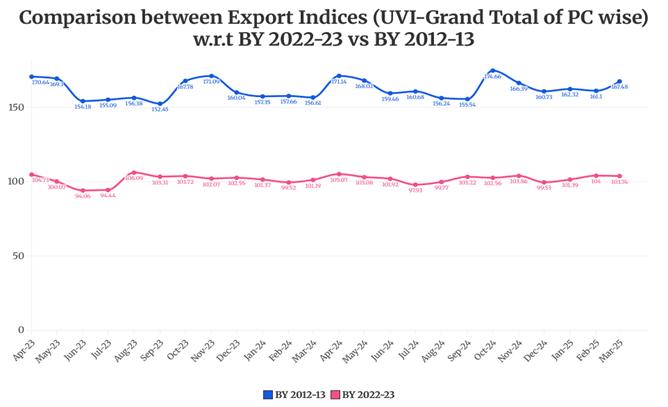
#BY means Base Year.
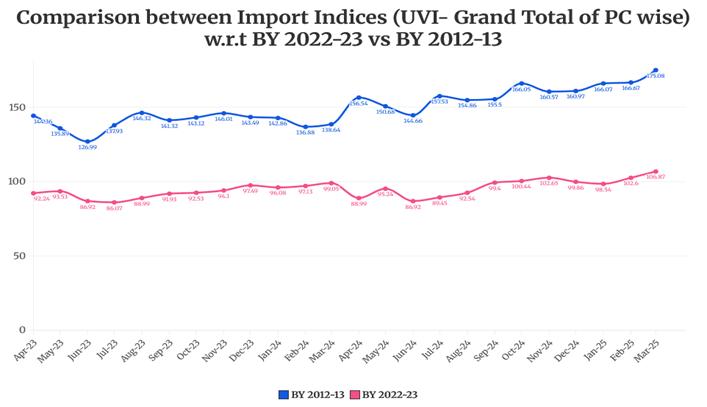
 

#BY means Base Year.

Table: Unit Value Index (UVI) and Quantity Index (QI) during FY 2025-26(Apr-Nov) using FY 2022-23 as base year


Month

Apr_25

May_25

Jun_25

1st Qtr 25-26

Jul_25

Aug_25

Sep_25

2nd Qtr 25-26

Oct_25

Nov_25

Unit Value Index

Export

105.31

99.73

96.31

100.33

99.31

100.55

104.08

101.23

103.78

105.32

Import

92.33

97.97

91.74

94.08

96.34

100.81

108.69

101.93

110.17

106.59

Quantity Index

Export

107.85

104.76

93.88

101.91

103.41

102.64

111.04

105.57

116.19

113.06

Import

138.16

126.61

112.58

125.17

122.47

124.06

126.45

124.32

137.04

121.75

Qtr  means Quarter.

Meaning and interpretation of the Indices

The Unit Value Indices and the Quantity Indices may be interpreted along the following lines.

The Unit Value Index answers the question: What is the growth in the average Unit Value of the items1 traded in the current month with respect to the same month in the Base Year?

So, an Unit Value Index of, say, 120 means that if the items that have been traded in the current month had been traded in the same month of the base year, and if the average price (or unit value) of those items had been Rs.100 in that month of the base year, then the average price (or unit value) of these items in the current month is Rs.120. Or that, there is a 20% increase in the average Unit Value, with respect to the Base Year, of the items that have been traded in the Current Month.

For example, let us suppose 30 items, 10 items each from 3 different Principal Commodities, have been traded in the current month. If these 30 items had been traded in the corresponding month of the base year at an average price of Rs.100, then the average price of these items in the current year is Rs.120.

It is to be noted that there are two successive steps of averaging done here. The first averaging is done over all the items (or ITCHS) of a PC group to arrive at the Index of that PC group. And the second averaging is done over all the PC groups to arrive at the Index at the Grand Total level for all commodities (which is the overall Index for India for a month). In both the stages, a weighted average is taken where the weights are proportional to the importance of the items and the PC groups respectively, and the Laspeyres Formula is used for averaging.

Quantity Indices, say, 200 means that if in the base year on an average 100 units were traded in India in the base year, then in the current year on an average 200 units were traded. However, it must be remembered that averaging quantities are different from averaging prices, since quantities in different units cannot be added directly.

So, the Quantity Indices are calculated by dividing the Value Indices by the Unit Value Indices. For example, if there is an increase in the Value of Export from Rs. 10,000 to Rs. 24,000, then the Value Index is 24000/10000 × 100 = 240. If the Unit Value Index is 120, then the Quantity Index comes to 240/120 × 100 = 200. So, loosely it can be said that, if the value of export has increased 2.4 times and the price of the commodities has increased 1.2 times, then the quantity must have doubled.

However, it may be noted that a very high or low Quantity Index may indicate the presence of Base Effect.

The Interpretation of the Bilateral and Regional Indices can be seen as an extension of the above.

A Unit Value Index of 120 with respect to a country, say Bangladesh, means that if all the items that have been traded with Bangladesh in the current month had been traded in the same month of the base year with the same country, and if the average price (or unit value) of those items had been Rs.100 in that month of the base year, then the average price (or unit value) of these items in the current month is Rs.120.

Similarly, a Quantity Index of 200 with respect to a country, say Bangladesh, means that if in the base year on an average 100 units were traded in India in the base year, then in the current year on an average 200 units were traded.

Comparability of the Indices across time

It is to be noted that the weights in the Index Number formula are fixed across time and there are twelve sets of weights for the twelve months. Hence, comparability of Indices is meaningful only when Indices of same month are compared across years. Different months may attach different weights to the same item, and hence comparing indices of two different months becomes vague and may have little applicability.

Further, the weights of the items that are not present in the trade basket of the current month are distributed to all the items that have been traded in the current month. This distribution is done in proportion to the weights of those items.

For example, let us suppose there are only 3 commodities for trade, say A, B and C. In month May of the Base year, let us suppose that the trade value of A was Rs. 50, B was Rs. 100 and C was Rs. 50. Then the weights assigned to A, B and C in the month of May of the following years would be in the ratio 50 :100 :50. However, in case, C is not traded in the current month, then the weight of C would be distributed proportionately among A and B, again in the ratio 1:2 (since in May the weights of A and B are in the ratio of 50 : 100, i.e., 1 : 2). So, in the current month the weights of A and B would be 3313  and 6623 .

As a result, the weights in any two given months are dependent on exactly the number of items (ITCHS codes) traded in those months. If the items traded are widely different, inference drawn from the comparison of the Indices may be done accordingly. On the other hand, more the similarity in the number of items traded more is the comparability of the two indices.

Net Terms of Trade:

Net Terms of Trade also called commodity Terms of Trade is defined as a ratio of export prices to import prices.

Let say 2022-23 be the base year and 2023-24 be the final year. We express both export and import prices in 2022-23 as 100. Now, suppose that at the end of 2023-24, it is found that the index of export prices decreased to 90 and index of import prices roses to 150. Then the Net Terms of Trade has changed to 90100150100=35 . Then terms of trade as index=35*100=60 . It implies that terms of trade of the country have decreased by about 40% in 2023-24 as compared with 2022-23. It thus shows a deterioration or a worsening of the terms of trade of the country.

If the index of export prices has risen to 150 and that of import prices had risen to 120, then the net terms of trade would have changed to 150120*100=125 . This implies an improvement in the net terms of trade of the country by 25% in 2023-24 over 2022-23.

Gross Terms of Trade:

Gross Terms of Trade is the ratio of physicalquantity of import to physical quantity of export.

Let say 2022-23 be the base year. In that year, the quantities export and import are denoted by 100. Now, suppose that in the year 2023-24, the index of quantity of import was 150 and that of quantity of export was 120. Then the gross terms of trade is given by 150100120100=54,  in terms of percentage =54*100=125 . This implies that there was an improvement of gross terms of trade by 25% in 2023-24 compared to 2022-23.

Income Terms of Trade: Income Terms of Trade is defined as- Net Terms of Trade multiplied by quantity of export.

Topics

Acts Income Tax