

Loading...

Top
Help
×

By creating an account you can:

Logo TaxTMI
Call Us / Help / Feedback

Contact Us At :

E-mail: [email protected]

Call / WhatsApp at: +91 99117 96707

For more information, Check Contact Us

FAQs :

To know Frequently Asked Questions, Check FAQs

Most Asked Video Tutorials :

For more tutorials, Check Video Tutorials

Submit Feedback/Suggestion :

Email :
Please provide your email address so we can follow up on your feedback.
Category :
Description :
Min 15 characters 0/2000
Make Most of Text Search
  1. Checkout this video tutorial: How to search effectively on TaxTMI.
  2. Put words in double quotes for exact word search, eg: "income tax"
  3. Avoid noise words such as : 'and, of, the, a'
  4. Sort by Relevance to get the most relevant document.
  5. Press Enter to add multiple terms/multiple phrases, and then click on Search to Search.
  6. Text Search
  7. The system will try to fetch results that contains ALL your words.
  8. Once you add keywords, you'll see a new 'Search In' filter that makes your results even more precise.
  9. Text Search
Add to...
You have not created any category. Kindly create one to bookmark this item!
Create New Category
Hide
Title :
Description :
❮❮ Hide
Default View
Expand ❯❯
Close ✕
🔎 News - Adv. Search
TEXT SEARCH:

Press 'Enter' to add multiple search terms. Rules for Better Search

Search In:
Main Text + AI Text
  • Main Text
  • Main Text + AI Text
  • AI Text
Category: ?
Categorized by AI
---- All Categories ----
  • ---- All Categories ----
  • Income Tax
  • GST
  • Customs, DGFT & SEZ
  • FEMA & RBI
  • Corp. Laws, SEBI & IBC
  • PMLA, Black Money & ED
  • Budget
  • News and Press Release
  • PTI News
Month:
---- All Months ----
  • ---- All Months ----
  • January
  • February
  • March
  • April
  • May
  • June
  • July
  • August
  • September
  • October
  • November
  • December
Year:
---- All Years ----
  • ---- All Years ----
  • 2026
  • 2025
  • 2024
  • 2023
  • 2022
  • 2021
  • 2020
  • 2019
  • 2018
  • 2017
  • 2016
  • 2015
  • 2014
  • 2013
  • 2012
  • 2011
Sort By: ?
In Sort By 'Default', exact matches for text search are shown at the top, followed by the remaining results in their regular order.
Relevance Default Date
❯❯
Maximize Maximize Maximize
0 / 200
Expand Note
Add to Folder

No Folders have been created

+

Are you sure you want to delete "My most important" ?

NOTE:

News
Showing Results for :
Reset Filters
Results Found:
Show All Summaries Hide All Summaries
February 15, 2026
Show AI Summary
Agricultural sovereignty under threat from interim trade deal; questions raised over GM imports, market access, and procurement safeguards.
Allegations that the India-US interim trade deal compromises agricultural sovereignty by allowing imports such as DDG from GM corn and GM soy oil, potentially displacing domestic producers and creating dependency. The statement questions vague references to "additional products" and removal of "non trade barriers," warning these could open pulses and other crops to imports and pressure India to relax positions on GM crops, procurement, MSPs and bonuses. It also asserts the deal disadvantages cotton farmers and textile exporters and demands clarity and safeguards on covered products and protections.
February 15, 2026
Show AI Summary
Trade agreement protections reassure farmers and dairy sectors amid tariff reductions and EU FTA negotiations.
Government statements assert that recent trade agreements and tariff adjustments include agricultural safeguards and explicit protections for the dairy sector, assuring farmers, cattle rearers and fishermen that their interests are preserved. The summary notes completed negotiations on a proposed free trade agreement with a major trading bloc and a contemporaneous tariff reduction as components of the trade policy framework, amid political dispute over the agreements' implications.
February 14, 2026
Show AI Summary
Political hypocrisy over communal representation: attack on a Muslim mayor criticized as incitement and double standards.
Shiv Sena (UBT) calls the BJP's attack on Syed Iqbal's election as Parbhani mayor political hypocrisy and communal bias, asserting Iqbal attained office through loyalty and noting Muslim officeholders within BJP-led bodies to rebut claims that his mayoralty threatens communal balance.
February 14, 2026
Show AI Summary
Investor verification promoted through mobile auto-rickshaw campaign to encourage routine SEBI Check before securities-related payments.
SEBI, with NSDL, launched a multi-city auto-rickshaw campaign urging routine Investor Verification via a SEBI Check before securities-related payments, focusing on verification of UPI IDs, bank details and intermediary registration credentials and providing QR access to the SEBI Check portal, SEBI Saathi app and SEBI Investor website for authentication and investor education.
February 14, 2026
Show AI Summary
Tariff discrimination threatens cotton farmers and textile exporters by conditioning zero-duty access on importing US cotton.
Allegations concern an interim India-US trade arrangement that gives a third country conditional zero duty access for garments if they import American cotton while Indian exporters face a higher tariff, creating a tariff differential that may pressure Indian textile firms to source foreign cotton, undermine domestic cotton producers, and risk market diversion away from Indian cotton.
February 14, 2026
Show AI Summary
Interim trade agreement expands energy coverage to secure competitive crude supplies and reduces tariffs to boost bilateral trade.
An interim trade agreement framework between India and the United States will include India's energy requirements and tariff adjustments to diversify suppliers, enhance supply security and obtain more competitive pricing. The framework contemplates US tariff reductions on specified Indian goods and India cutting or eliminating import duties on US industrial and agricultural products to expand market access, support infrastructure and distribution procurement, secure coking coal supplies for steel expansion, and facilitate growth in the information technology sector through access to advanced equipment.
February 14, 2026
Show AI Summary
Trade agreement benefits: tariff reductions and market access touted as boosting textile exports and supporting cotton growers.
The minister defended recent trade engagement as opening market access for Indian textiles, asserting reciprocal tariff reductions under recent agreements will enhance export competitiveness and grant zero-duty access to several markets, thereby benefiting the textile sector and cotton growers; he characterised processing imported material for export as an established global trade practice and said national cotton demand and cultivation capacity will expand.
February 14, 2026
Show AI Summary
Labour standards under free trade agreement debated at international moot to build trade law advocacy and capacity.
An international moot organised by CTIL and Bennett University under the WTO Chairs Programme focused on alleged violations of labour standards and occupational safety obligations under a Free Trade Agreement following an industrial accident, with evaluations by legal, academic and policy experts and emphasis on capacity building in international trade law.
February 14, 2026
Show AI Summary
Tribunal leadership change: president demits office amid administrative reforms credited with substantially improved case resolution.
Chief Justice (Retd.) Ramalingam Sudhakar demitted office as President of the National Company Law Tribunal after a tenure that advanced administrative and infrastructural reforms; during this period the Tribunal disposed of over 48,000 of approximately 54,800 instituted matters, yielding a reported resolution rate exceeding eighty five percent and reflecting improved case management in corporate and insolvency proceedings.
February 14, 2026
Show AI Summary
Input tax credit fraud exposed; director arrested after probe finds bogus suppliers and inadmissible credits used to discharge tax liabilities.
Investigation by the Anti Evasion Branch found that the company availed inadmissible Input Tax Credit on the basis of invoices from bogus or non functional suppliers, and without actual receipt of goods, using those credits to discharge GST liabilities in contravention of the Central Goods and Services Tax Act, 2017; a company director was arrested and remanded while the probe to trace fund flows and other beneficiaries continues.
February 13, 2026
Show AI Summary
India-US interim trade deal provoked uproar; Speaker faced removal notice and MPs were suspended during Budget session.
India-US interim trade agreement and the unpublished memoir dispute triggered disruptions in the first leg of the Budget session, leading to eight MPs being suspended, a notice to remove the Speaker and the Speaker's refusal to occupy the chair until that notice is disposed of; the Lok Sabha adopted the Motion of Thanks without the prime minister's reply while the Rajya Sabha completed debate and adopted the Motion amid an opposition walkout, and Parliament passed an amendment to the Industrial Relations Code.
February 13, 2026
Show AI Summary
Retail liquor prices to rise as Uttar Pradesh raises licence fees, reforms MRP and launches an excise export policy.
The excise policy raises the minimum guaranteed revenue (MGR)/licence fee for retail liquor shops and bhang shops, adjusts special additional excise duty on IMFL, and reforms MRP by rounding most country liquor and UPML to the next multiple of Rs 10 while introducing a new 100 ml UPML pack; it also creates a standalone excise export policy to promote distilling and logistics investment and requires retail allotments primarily by renewal with district collectors authorised to approve relocations.
February 13, 2026
Show AI Summary
Iridium scam network using fake central bank IDs defrauded investors of crores; six arrested, investigation ongoing.
An inter-state fraud operation used a fake commodity investment scheme claiming funds held with the central bank to obtain payments via staged interviews, counterfeit identity cards, biometric collection and forged documents. The facts give rise to allegations of impersonation, forgery, cheating and criminal conspiracy. Law enforcement conducted coordinated arrests across jurisdictions, seized mobile phones and laptops, and is investigating further victims and participants while advising potential victims to file complaints to assist evidence collection and tracing.
February 13, 2026
Show AI Summary
Spectrum allocation ruled not an asset and therefore not subject to insolvency proceedings under applicable insolvency rules.
Allocation of electromagnetic spectrum to telecom service providers was held not to constitute an asset capable of being brought into insolvency proceedings, limiting the scope of creditor remedies under the insolvency regime. The NIA was granted an additional 45 days to continue its probe into a blast, and an individual was released on bail in a decades-old criminal case, illustrating ongoing judicial oversight of investigations and pretrial liberty decisions.
February 13, 2026
Show AI Summary
Lodha Developers ex-director accused of laundering over Rs 85 crore using front entities, forged MOUs and benami land deals.
Allegations state a former director exceeded limited authority to orchestrate unauthorized transactions that generated, concealed and laundered proceeds of crime exceeding Rs 85 crore by using front entities, benami arrangements, forged MOUs, diversion of company funds through controlled entities, cash withdrawals, undervalued alienation of company land and Transferable Development Rights, and fraudulent allotment of residential units to benefit associates.
February 13, 2026
Show AI Summary
Rupee falls to 90.66 as forex reserves decline and a new CPI series is introduced, weighing on markets.
The rupee weakened to 90.66 per US dollar amid a firmer dollar, weak domestic equities, and foreign institutional investor outflows, while RBI data showed a notable weekly decline in forex reserves. Authorities introduced a new Consumer Price Index series with expanded coverage and re-weighted constituents to better inform monetary and fiscal policy.
February 13, 2026
Show AI Summary
Supreme Court updates: spectrum ruled non IBC asset; Himachal local polls deadline extended; directions on probes and enforcement.
The Court extended the Himachal Pradesh deadline for local body elections to May 31, required an investigative agency to file a status report on multiple FIRs arising from ethnic violence, ordered a rusticated minor be permitted to sit Class 10 exams with the examination council issuing an admit card, signalled that substantial security may be required in enforcement of a foreign civil judgment if contested, and held that telecom spectrum allocations are not assets subject to proceedings under the Insolvency and Bankruptcy Code.
February 13, 2026
Show AI Summary
Spectrum allocated to telecom providers is not an IBC asset; licensing rights do not create proprietary title for insolvency.
Spectrum allocated to telecom service providers is not susceptible to IBC proceedings because the Union retains ownership and the telecommunications statutes and regulatory framework govern administration, use, transfer, and licensing; recognition of spectrum licensing rights as an intangible asset in financial statements does not create proprietary title, and absent transfer of title such licensing rights are not part of the insolvency asset pool.
February 13, 2026
Show AI Summary
Priority sector lending potential estimated at Rs 4.88 lakh crore for FY27, with major allocations to agriculture and MSMEs.
NABARD's State Focus Paper projects a priority sector credit potential of Rs 4.88 lakh crore for FY27, allocating Rs 2.24 lakh crore to agriculture and allied activities and Rs 2.27 lakh crore to MSMEs, with block level sub sector estimates to inform the annual credit plan and align financial institutions with development priorities.
February 13, 2026
Show AI Summary
Andaman bank fraud: Enforcement Directorate attaches Rs 200 crore in properties under PMLA, linking assets to shell companies.
The Enforcement Directorate, by a provisional order under the Prevention of Money Laundering Act, attached 51 immovable properties worth Rs 200.02 crore allegedly derived from a Rs 500 crore fraud at the Andaman and Nicobar State Cooperative Bank; assets are held in names of accused persons, relatives, associates and controlled firms. The ED alleges use of 23 shell companies, dummy directors and powers of attorney to conceal consideration and that over 100 high-value loans were sanctioned in violation of NABARD, RBI and internal bank directives; a chargesheet against 39 entities was filed in November 2025.

News

Back

All News

Showing Results for :
Reset Filters
No Records Found

News

Back

All News

Showing Results for : Reset Filters
Customs, DGFT & SEZ

Directorate General of Commercial Intelligence and Statistics Revises Base Year of Merchandise Trade Indices to FY 2022–23 to Reflect Current Trade Structure and Global Patterns

February 21, 2026

Contents
Summary
Note

Note

-

Bookmark

Print

Print

Merchandise Trade Indices are compiled and published by the Directorate General of Commercial Intelligence and Statistics (DGCI&S), Ministry of Commerce & Industry, to measure changes in the unit values (prices) of India’s exports and imports over time. These indices serve as important indicators of external sector price movements and are widely used for economic analysis, including national accounts compilation and assessment of terms of trade. Over the years, the base year of the indices has been periodically revised to reflect structural changes in India’s trade composition and evolving global trade patterns. The most recent revision updates the base year to FY 2022–23 (2022–23 = 100), replacing the earlier base of FY 2012–13, thereby ensuring that the indices accurately represent the current structure of India’s merchandise trade.

Revision of Base Year of India’s Merchandise Trade Indices to FY 2022–23

The Directorate General of Commercial Intelligence and Statistics (DGCI&S), Ministry of Commerce & Industry, has revised the base year of India’s Merchandise Trade Indices from FY 2012–13 to FY 2022–23 (2022–23 = 100), in view of the structural changes in the economy, shifts in commodity composition, evolving trade patterns, and the need for improved alignment with contemporary macroeconomic indicators.

The revision has been undertaken on the recommendations of a committee constituted by DGCI&S under the Chairmanship of Prof. Nachiketa Chattopadhyay, Professor, Indian Statistical Institute, Kolkata. The Committee examined the existing methodology, data coverage, weighting structure, and compilation practices, and recommended suitable refinements in line with international best practices.

Key Features of the Revised Series (Base: FY 2022–23)

  1. Updated Base Year:
    The new base year FY 2022–23 makes the Indices reflect the current structure of India’s external trade more accurately.
  2. Revised Commodity Basket:
    The coverage and classification of commodities have been reviewed at the Principal Commodity level to better capture emerging and declining trade items.
  3. Revised Weighting Structure:
    Weights have been updated based on trade values of the new base year to reflect the latest value shares in exports and imports.
  4. Improved Methodology:
    Methodological refinements have been introduced in:
    1. Selection of common commodity basket for base year selection (procedure of selection for common commodity basket explained in detail report of the committee).
    2. Treatment of missing unit values (Imputation of missing unit values in base year selection have been explained in detail in the committee report).
  5. Indices Compiled:
    The revised series includes:
    1. Monthly, Quarterly and Annual Indices (Export Unit Value Index,Import Unit Value Index).
    2. Principal Commodity (PC) Classification wise Trade Indices (Export/Import).
    3. Standard International Trade Classification-wise (SITC) Trade Indices.
    4. Broad economic categories-wise (BEC) Trade Indices.
    5. Bilateral and Region-wise Trade Indices of Top 20 Export and Import partner nations of India.
    6. Terms of Trade (Gross terms of trade, Net terms of trade and Income terms of trade).

Rationale for Revision

Over the past decade, India’s trade basket has undergone substantial changes due to emergence of new commodities, technological advancements, Global supply chain restructuring and changes in relative price structures.

The earlier base year (FY 2012–13) no longer adequately reflected the prevailing trade structure. The revision ensures improved relevance, reliability, and analytical usefulness of the Merchandise Trade Indices for policymakers, researchers, and other stakeholders.

Use of the Revised Series

Merchandise Trade Indices compiled by the Directorate General of Commercial Intelligence and Statistics (DGCI&S) are extensively used by key government institutions for economic analysis and policy formulation. The National Accounts Division (NAD) of the Ministry of Statistics and Programme Implementation uses the Export and Import Unit Value Indices as deflators for estimating real exports and imports in GDP compilation. The Reserve Bank of India (RBI) relies on these indices for external sector assessment, balance of payments analysis, and evaluation of price competitiveness. Various Ministries and Government agencies also use them to frame and review trade-related policies and to assess movements in international prices. In addition, academic institutions, research organizations, and economic analysts utilize Merchandise Trade Indices for empirical research, modelling, and analysis of trade dynamics and terms of trade trendson and economic research.

Availability of Data

The revised Merchandise Trade Indices (Base: FY 2022–23) will be released on the official website of DGCI&S. Detailed methodological documentation is available in the Report of the Committee on Revision of Base Year for Merchandise Trade Indices.

Comparison of the new revised Indices (Base Year: 2022-23) with the already released Indices (Base Year : 2012-13) for 2022-23 and 2023-24 is given below.
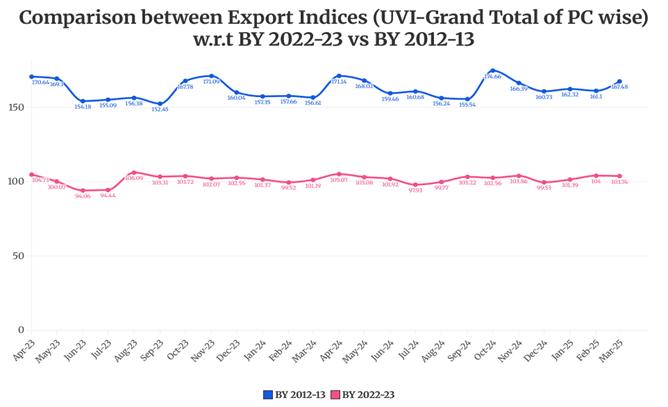
#BY means Base Year.
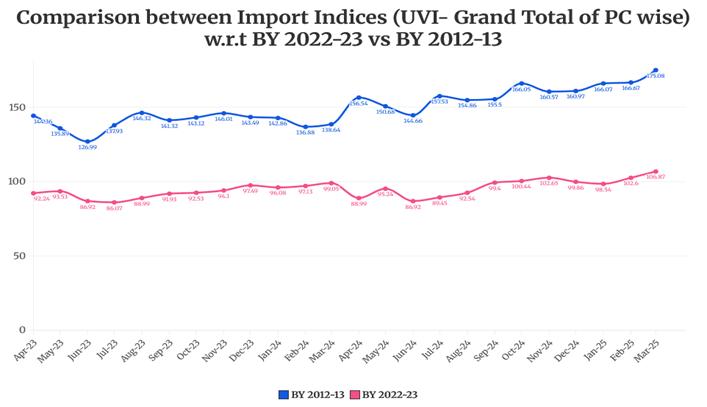
 

#BY means Base Year.

Table: Unit Value Index (UVI) and Quantity Index (QI) during FY 2025-26(Apr-Nov) using FY 2022-23 as base year


Month

Apr_25

May_25

Jun_25

1st Qtr 25-26

Jul_25

Aug_25

Sep_25

2nd Qtr 25-26

Oct_25

Nov_25

Unit Value Index

Export

105.31

99.73

96.31

100.33

99.31

100.55

104.08

101.23

103.78

105.32

Import

92.33

97.97

91.74

94.08

96.34

100.81

108.69

101.93

110.17

106.59

Quantity Index

Export

107.85

104.76

93.88

101.91

103.41

102.64

111.04

105.57

116.19

113.06

Import

138.16

126.61

112.58

125.17

122.47

124.06

126.45

124.32

137.04

121.75

Qtr  means Quarter.

Meaning and interpretation of the Indices

The Unit Value Indices and the Quantity Indices may be interpreted along the following lines.

The Unit Value Index answers the question: What is the growth in the average Unit Value of the items1 traded in the current month with respect to the same month in the Base Year?

So, an Unit Value Index of, say, 120 means that if the items that have been traded in the current month had been traded in the same month of the base year, and if the average price (or unit value) of those items had been Rs.100 in that month of the base year, then the average price (or unit value) of these items in the current month is Rs.120. Or that, there is a 20% increase in the average Unit Value, with respect to the Base Year, of the items that have been traded in the Current Month.

For example, let us suppose 30 items, 10 items each from 3 different Principal Commodities, have been traded in the current month. If these 30 items had been traded in the corresponding month of the base year at an average price of Rs.100, then the average price of these items in the current year is Rs.120.

It is to be noted that there are two successive steps of averaging done here. The first averaging is done over all the items (or ITCHS) of a PC group to arrive at the Index of that PC group. And the second averaging is done over all the PC groups to arrive at the Index at the Grand Total level for all commodities (which is the overall Index for India for a month). In both the stages, a weighted average is taken where the weights are proportional to the importance of the items and the PC groups respectively, and the Laspeyres Formula is used for averaging.

Quantity Indices, say, 200 means that if in the base year on an average 100 units were traded in India in the base year, then in the current year on an average 200 units were traded. However, it must be remembered that averaging quantities are different from averaging prices, since quantities in different units cannot be added directly.

So, the Quantity Indices are calculated by dividing the Value Indices by the Unit Value Indices. For example, if there is an increase in the Value of Export from Rs. 10,000 to Rs. 24,000, then the Value Index is 24000/10000 × 100 = 240. If the Unit Value Index is 120, then the Quantity Index comes to 240/120 × 100 = 200. So, loosely it can be said that, if the value of export has increased 2.4 times and the price of the commodities has increased 1.2 times, then the quantity must have doubled.

However, it may be noted that a very high or low Quantity Index may indicate the presence of Base Effect.

The Interpretation of the Bilateral and Regional Indices can be seen as an extension of the above.

A Unit Value Index of 120 with respect to a country, say Bangladesh, means that if all the items that have been traded with Bangladesh in the current month had been traded in the same month of the base year with the same country, and if the average price (or unit value) of those items had been Rs.100 in that month of the base year, then the average price (or unit value) of these items in the current month is Rs.120.

Similarly, a Quantity Index of 200 with respect to a country, say Bangladesh, means that if in the base year on an average 100 units were traded in India in the base year, then in the current year on an average 200 units were traded.

Comparability of the Indices across time

It is to be noted that the weights in the Index Number formula are fixed across time and there are twelve sets of weights for the twelve months. Hence, comparability of Indices is meaningful only when Indices of same month are compared across years. Different months may attach different weights to the same item, and hence comparing indices of two different months becomes vague and may have little applicability.

Further, the weights of the items that are not present in the trade basket of the current month are distributed to all the items that have been traded in the current month. This distribution is done in proportion to the weights of those items.

For example, let us suppose there are only 3 commodities for trade, say A, B and C. In month May of the Base year, let us suppose that the trade value of A was Rs. 50, B was Rs. 100 and C was Rs. 50. Then the weights assigned to A, B and C in the month of May of the following years would be in the ratio 50 :100 :50. However, in case, C is not traded in the current month, then the weight of C would be distributed proportionately among A and B, again in the ratio 1:2 (since in May the weights of A and B are in the ratio of 50 : 100, i.e., 1 : 2). So, in the current month the weights of A and B would be 3313  and 6623 .

As a result, the weights in any two given months are dependent on exactly the number of items (ITCHS codes) traded in those months. If the items traded are widely different, inference drawn from the comparison of the Indices may be done accordingly. On the other hand, more the similarity in the number of items traded more is the comparability of the two indices.

Net Terms of Trade:

Net Terms of Trade also called commodity Terms of Trade is defined as a ratio of export prices to import prices.

Let say 2022-23 be the base year and 2023-24 be the final year. We express both export and import prices in 2022-23 as 100. Now, suppose that at the end of 2023-24, it is found that the index of export prices decreased to 90 and index of import prices roses to 150. Then the Net Terms of Trade has changed to 90100150100=35 . Then terms of trade as index=35*100=60 . It implies that terms of trade of the country have decreased by about 40% in 2023-24 as compared with 2022-23. It thus shows a deterioration or a worsening of the terms of trade of the country.

If the index of export prices has risen to 150 and that of import prices had risen to 120, then the net terms of trade would have changed to 150120*100=125 . This implies an improvement in the net terms of trade of the country by 25% in 2023-24 over 2022-23.

Gross Terms of Trade:

Gross Terms of Trade is the ratio of physicalquantity of import to physical quantity of export.

Let say 2022-23 be the base year. In that year, the quantities export and import are denoted by 100. Now, suppose that in the year 2023-24, the index of quantity of import was 150 and that of quantity of export was 120. Then the gross terms of trade is given by 150100120100=54,  in terms of percentage =54*100=125 . This implies that there was an improvement of gross terms of trade by 25% in 2023-24 compared to 2022-23.

Income Terms of Trade: Income Terms of Trade is defined as- Net Terms of Trade multiplied by quantity of export.

Topics

Acts Income Tax