

Loading...

Top
Help
×

By creating an account you can:

Logo TaxTMI
Call Us / Help / Feedback

Contact Us At :

E-mail: [email protected]

Call / WhatsApp at: +91 99117 96707

For more information, Check Contact Us

FAQs :

To know Frequently Asked Questions, Check FAQs

Most Asked Video Tutorials :

For more tutorials, Check Video Tutorials

Submit Feedback/Suggestion :

Email :
Please provide your email address so we can follow up on your feedback.
Category :
Description :
Min 15 characters 0/2000
Make Most of Text Search
  1. Checkout this video tutorial: How to search effectively on TaxTMI.
  2. Put words in double quotes for exact word search, eg: "income tax"
  3. Avoid noise words such as : 'and, of, the, a'
  4. Sort by Relevance to get the most relevant document.
  5. Press Enter to add multiple terms/multiple phrases, and then click on Search to Search.
  6. Text Search
  7. The system will try to fetch results that contains ALL your words.
  8. Once you add keywords, you'll see a new 'Search In' filter that makes your results even more precise.
  9. Text Search
Add to...
You have not created any category. Kindly create one to bookmark this item!
Create New Category
Hide
Title :
Description :
❮❮ Hide
Default View
Expand ❯❯
Close ✕
🔎 News - Adv. Search
TEXT SEARCH:

Press 'Enter' to add multiple search terms. Rules for Better Search

Search In:
Main Text + AI Text
  • Main Text
  • Main Text + AI Text
  • AI Text
Category: ?
Categorized by AI
---- All Categories ----
  • ---- All Categories ----
  • Income Tax
  • GST
  • Customs, DGFT & SEZ
  • FEMA & RBI
  • Corp. Laws, SEBI & IBC
  • PMLA, Black Money & ED
  • Budget
  • News and Press Release
  • PTI News
Month:
---- All Months ----
  • ---- All Months ----
  • January
  • February
  • March
  • April
  • May
  • June
  • July
  • August
  • September
  • October
  • November
  • December
Year:
---- All Years ----
  • ---- All Years ----
  • 2026
  • 2025
  • 2024
  • 2023
  • 2022
  • 2021
  • 2020
  • 2019
  • 2018
  • 2017
  • 2016
  • 2015
  • 2014
  • 2013
  • 2012
  • 2011
Sort By: ?
In Sort By 'Default', exact matches for text search are shown at the top, followed by the remaining results in their regular order.
Relevance Default Date
    Cabinet approves upgradation of Dhamasiya–Bitada/ Movi and Nasarpore–Malotha Sections of National Highway-56 to Four-Lane Standard in Gujarat at a...
    Cabinet approves the Widening of National Highway-167 from Gudebellur to Mahabubnagar on the Hyderabad-Panaji Economic Corridor to 4-Lane Standard in ...
    Cabinet approves construction of Twin Tube TBM road Underwater tunnel 2 Lane each under River Brahmaputra along with provision of Railway infrastructu...
    Rupee slips 1 paisa to 90.67 against US dollar in early session
    Cabinet approves three multitracking projects covering 12 Districts across the states of Delhi, Haryana, Maharashtra and Karnataka, increasing the exi...
    Cabinet approves Startup India Fund of Funds 2.0 to Mobilize Venture Capital for India’s Startup Ecosystem
    Two-day Chintan Shivir of DFS, M/o Finance organised at Coorg, Karnataka concludes successfully
    K'taka minister Priyank Kharge accuses RSS of indulging in money laundering
    International Customs Day: Importers, exporters, officers honoured in Kochi
    Witnessing betrayal of India's farmers in name of US trade deal: Rahul
    PM Modi says Viksit Bharat in sight, urges pvt sector to do its bit
    Tea industry seeks policy support as rising costs, labour shortage strain margins
    Bhu-Aadhaar to assign unique 14-digit identifier to every land parcel in Delhi; end boundary disputes: CMO
    Witnessing betrayal of Indian farmers in name of US trade deal: Rahul Gandhi
    Rahul Gandhi spreading lies over India's trade deals with US, EU; farmers fully protected: Shah
    BJP's attack on Sena (UBT) over Parbhani's Muslim mayor reflects its mental bankruptcy: Saamana
    SEBI, NSDL Launch Auto Rickshaw Awareness Drive to Promote Investor Verification
    Govt cheating cotton farmers, textile exporters over tariffs in India-US trade deal
    India-US trade pact to cover energy needs, ensure competitive crude prices: Goyal
    Rahul Gandhi immature, lacks understanding of economy, says Goyal on Cong leader's textile remarks
❯❯
Maximize Maximize Maximize
0 / 200
Expand Note
Add to Folder

No Folders have been created

+

Are you sure you want to delete "My most important" ?

NOTE:

News
Showing Results for :
Reset Filters
Results Found:
Show All Summaries Hide All Summaries
February 16, 2026
Show AI Summary
Four-lane upgradation of NH-56 sections approved to improve regional connectivity and reduce travel time substantially.
Cabinet approval authorises upgradation of two NH-56 sections in Gujarat to four-lane standard under the HAM Mode, totaling 107.67 km at a Total Capital Cost of Rs.4583.64 crore. Designed for 100 km/h (70 km/h average), the works aim to cut travel time by about 40%. The alignment passes through aspirational and tribal districts, enhances access to the Statue of Unity, links to major highways and the Delhi-Mumbai Expressway, began partial construction in November 2025 with a two-year completion target, and is projected to generate significant direct and indirect employment.
February 16, 2026
Show AI Summary
Highway widening approval advances NH 167 to four lanes under Hybrid Annuity Mode, enhancing regional connectivity and employment.
The Cabinet approved widening NH 167 from Gudebellur to Mahabubnagar to a four lane access controlled standard over 80.01 km on Hybrid Annuity Mode (HAM) under the NH (O) scheme, covering bypasses, realignments and utility shifting. The alignment connects with NH 150 and NH 167N and links multiple economic, social and logistic nodes, aiming to reduce congestion and travel time, enhance freight efficiency and multimodal integration, and generate substantial direct and indirect construction period employment.
February 16, 2026
Show AI Summary
Project approval for underwater road rail tunnel enabling 4 lane greenfield connectivity between Gohpur and Numaligarh under EPC.
Cabinet approved a 33.7 km 4 lane access controlled greenfield corridor between Gohpur (NH 15) and Numaligarh (NH 715) including a 15.79 km twin tube TBM underwater Road cum Rail tunnel with rail provision in one tube, implemented on an EPC basis. The scope covers civil works, land acquisition, short road and rail cut and cover sections, and integration with existing highways and railway sections to deliver multimodal connectivity to airports, inland waterways, railway stations and economic, social and tourist nodes, with estimated traffic and employment implications.
February 16, 2026
Show AI Summary
Currency depreciation driven by FII outflows and a stronger dollar, pressured further by declining forex reserves.
The rupee weakened to 90.67 against the US dollar amid FII outflows and a stronger dollar, with rising crude prices and a notable weekly decline in forex reserves cited as contributing factors; market commentary noted narrow intraday trading and flagged impending trade balance data as potentially influential.
February 16, 2026
Show AI Summary
Rail network expansion approved to add multitrack capacity, boost freight movement and reduce emissions while improving regional connectivity.
Cabinet approved three multitracking projects (Kasara-Manmad, Delhi-Ambala, Ballari-Hosapete) under PM Gati Shakti to add third and fourth lines across 12 districts, increasing the rail network by about 389 km at an estimated combined cost of Rs 18,509 crore through 2030-31. The works are projected to generate about 265 lakh human days of construction employment, augment freight capacity by 96 MTPA, improve connectivity to roughly 3,902 villages (population ~97 lakh), reduce logistics costs and oil imports, and lower CO2 emissions for more sustainable rail operations.
February 16, 2026
Show AI Summary
Venture capital mobilisation for startups to prioritise deep tech, early growth support, and regional investment across the country.
The Startup India Fund of Funds 2.0 establishes a government-backed corpus to mobilize long-term domestic venture capital, strengthen the domestic venture capital base by supporting smaller funds and AIFs, and address capital gaps. The Scheme prioritises deep tech and tech-driven innovative manufacturing, supports early-growth stage founders to reduce funding shortfalls, and promotes national reach to crowd in private investment beyond major metropolitan centres.
February 16, 2026
Show AI Summary
Credit to G.D.P. ratio reform to expand financing and make financial institutions more agile for national development.
The Department of Financial Services convened a policy shivir to solicit strategic reforms to align banking and financial services with Viksit Bharat@2047, focusing on enhancing the Credit to G.D.P. ratio, increasing agility of public financial institutions, deploying new large scale financing mechanisms, deepening the bond market, reducing intermediation costs, strengthening banks' role in MSME financing, and promoting insurance and pension product innovation alongside financial inclusion and cyber security to build a more resilient financial system.
February 15, 2026
Show AI Summary
Tax accountability: Allegations of fundraising and money laundering prompt calls to apply law and constitutional obligations to unregistered organisations.
Allegations focus on tax accountability and potential money laundering by an unregistered organisation receiving funds via a broad domestic and international network; the commentator demands that law and the Constitution apply equally, questions the source and treatment of donations described as "guru dakshina," and urges registration, disclosure and tax compliance along with scrutiny of cross border fundraising.
February 15, 2026
Show AI Summary
Customs enforcement underscores trade facilitation, regulatory compliance and protection of taxpayers' rights amid vigilance-driven awards and recognition.
Customs enforcement in Kerala was emphasised as combining trade facilitation with statutory compliance, transparency, and protection of taxpayers' rights, with priorities including anti-smuggling vigilance, modernisation, export promotion, and international cooperation to support lawful cross-border trade.
February 15, 2026
Show AI Summary
Trade deal transparency: interim agreement may expose agricultural sovereignty and pressure policy on imports, GM crops, and procurement.
The India-US interim trade deal is criticised for risks to agricultural sovereignty through import liberalisation of DDGs and potential GM soy oil, which may increase feed dependence and expose soy and pulse producers to price shocks; concerns also target non-trade barrier concessions and quota-based duty relief as mechanisms that could pressure relaxation of GM regulations, procurement policies, and MSPs, while alleged tariff asymmetries may harm cotton farmers and the textile export sector.
February 15, 2026
Show AI Summary
Trade agreements and Budget incentives seek to expand market access and compel private investment in innovation and capacity.
The policy framework relies on expanded free trade agreements to improve exporters' access and on a Budget focused on productive capital outlays and incentives to strengthen manufacturing, value addition, skills and scale. The state provides tariff preferences and fiscal incentives, while explicit expectations are placed on the private sector to invest aggressively in R&D, frontier technologies, supply-chain capabilities and productivity. Equitable sharing of productivity gains-through rising real wages, skill upgrading and stable employment-is presented as essential to sustain domestic demand and long-term investment. Budget incentives for digital infrastructure and data centres aim to position the country as a global hub for AI and data.
February 15, 2026
Show AI Summary
Minimum sustainable price mechanism sought to align tea production costs with prices; calls for subsidies, tariff relief, import monitoring.
Planters seek a minimum sustainable price mechanism to align production costs and price realisation, expedited release of pending Tea Board subsidies, interest subvention on working capital loans, and access to agricultural schemes. They also request lower power tariffs and implementation of West Bengal solar provisions, financial incentives for specialty production and machinery upgrades, and stricter monitoring of cheap imports and mislabelling to protect quality and export credibility.
February 15, 2026
Show AI Summary
Unique land parcel identifier to standardize property records and reduce boundary disputes through georeferenced mapping.
The Delhi government is assigning a Unique Land Parcel Identification Number (ULPIN or Bhu Aadhaar) to each land parcel using drone surveys and high resolution geospatial imaging to produce geo referenced identifiers for accurate parcel delineation. The revenue department's IT branch, supported by the Survey of India, will implement the system in phased rollouts under a standard operating procedure to centralise land records, enhance transparency, prevent fraudulent transactions and simplify citizen access to property information.
February 15, 2026
Show AI Summary
Agricultural sovereignty under threat from interim trade deal; questions raised over GM imports, market access, and procurement safeguards.
Allegations that the India-US interim trade deal compromises agricultural sovereignty by allowing imports such as DDG from GM corn and GM soy oil, potentially displacing domestic producers and creating dependency. The statement questions vague references to "additional products" and removal of "non trade barriers," warning these could open pulses and other crops to imports and pressure India to relax positions on GM crops, procurement, MSPs and bonuses. It also asserts the deal disadvantages cotton farmers and textile exporters and demands clarity and safeguards on covered products and protections.
February 15, 2026
Show AI Summary
Trade agreement protections reassure farmers and dairy sectors amid tariff reductions and EU FTA negotiations.
Government statements assert that recent trade agreements and tariff adjustments include agricultural safeguards and explicit protections for the dairy sector, assuring farmers, cattle rearers and fishermen that their interests are preserved. The summary notes completed negotiations on a proposed free trade agreement with a major trading bloc and a contemporaneous tariff reduction as components of the trade policy framework, amid political dispute over the agreements' implications.
February 14, 2026
Show AI Summary
Political hypocrisy over communal representation: attack on a Muslim mayor criticized as incitement and double standards.
Shiv Sena (UBT) calls the BJP's attack on Syed Iqbal's election as Parbhani mayor political hypocrisy and communal bias, asserting Iqbal attained office through loyalty and noting Muslim officeholders within BJP-led bodies to rebut claims that his mayoralty threatens communal balance.
February 14, 2026
Show AI Summary
Investor verification promoted through mobile auto-rickshaw campaign to encourage routine SEBI Check before securities-related payments.
SEBI, with NSDL, launched a multi-city auto-rickshaw campaign urging routine Investor Verification via a SEBI Check before securities-related payments, focusing on verification of UPI IDs, bank details and intermediary registration credentials and providing QR access to the SEBI Check portal, SEBI Saathi app and SEBI Investor website for authentication and investor education.
February 14, 2026
Show AI Summary
Tariff discrimination threatens cotton farmers and textile exporters by conditioning zero-duty access on importing US cotton.
Allegations concern an interim India-US trade arrangement that gives a third country conditional zero duty access for garments if they import American cotton while Indian exporters face a higher tariff, creating a tariff differential that may pressure Indian textile firms to source foreign cotton, undermine domestic cotton producers, and risk market diversion away from Indian cotton.
February 14, 2026
Show AI Summary
Interim trade agreement expands energy coverage to secure competitive crude supplies and reduces tariffs to boost bilateral trade.
An interim trade agreement framework between India and the United States will include India's energy requirements and tariff adjustments to diversify suppliers, enhance supply security and obtain more competitive pricing. The framework contemplates US tariff reductions on specified Indian goods and India cutting or eliminating import duties on US industrial and agricultural products to expand market access, support infrastructure and distribution procurement, secure coking coal supplies for steel expansion, and facilitate growth in the information technology sector through access to advanced equipment.
February 14, 2026
Show AI Summary
Trade agreement benefits: tariff reductions and market access touted as boosting textile exports and supporting cotton growers.
The minister defended recent trade engagement as opening market access for Indian textiles, asserting reciprocal tariff reductions under recent agreements will enhance export competitiveness and grant zero-duty access to several markets, thereby benefiting the textile sector and cotton growers; he characterised processing imported material for export as an established global trade practice and said national cotton demand and cultivation capacity will expand.

News

Back

All News

Showing Results for :
Reset Filters
No Records Found

News

Back

All News

Showing Results for : Reset Filters
Customs, DGFT & SEZ

Directorate General of Commercial Intelligence and Statistics Revises Base Year of Merchandise Trade Indices to FY 2022–23 to Reflect Current Trade Structure and Global Patterns

February 21, 2026

Contents
Summary
Note

Note

-

Bookmark

Print

Print

Merchandise Trade Indices are compiled and published by the Directorate General of Commercial Intelligence and Statistics (DGCI&S), Ministry of Commerce & Industry, to measure changes in the unit values (prices) of India’s exports and imports over time. These indices serve as important indicators of external sector price movements and are widely used for economic analysis, including national accounts compilation and assessment of terms of trade. Over the years, the base year of the indices has been periodically revised to reflect structural changes in India’s trade composition and evolving global trade patterns. The most recent revision updates the base year to FY 2022–23 (2022–23 = 100), replacing the earlier base of FY 2012–13, thereby ensuring that the indices accurately represent the current structure of India’s merchandise trade.

Revision of Base Year of India’s Merchandise Trade Indices to FY 2022–23

The Directorate General of Commercial Intelligence and Statistics (DGCI&S), Ministry of Commerce & Industry, has revised the base year of India’s Merchandise Trade Indices from FY 2012–13 to FY 2022–23 (2022–23 = 100), in view of the structural changes in the economy, shifts in commodity composition, evolving trade patterns, and the need for improved alignment with contemporary macroeconomic indicators.

The revision has been undertaken on the recommendations of a committee constituted by DGCI&S under the Chairmanship of Prof. Nachiketa Chattopadhyay, Professor, Indian Statistical Institute, Kolkata. The Committee examined the existing methodology, data coverage, weighting structure, and compilation practices, and recommended suitable refinements in line with international best practices.

Key Features of the Revised Series (Base: FY 2022–23)

  1. Updated Base Year:
    The new base year FY 2022–23 makes the Indices reflect the current structure of India’s external trade more accurately.
  2. Revised Commodity Basket:
    The coverage and classification of commodities have been reviewed at the Principal Commodity level to better capture emerging and declining trade items.
  3. Revised Weighting Structure:
    Weights have been updated based on trade values of the new base year to reflect the latest value shares in exports and imports.
  4. Improved Methodology:
    Methodological refinements have been introduced in:
    1. Selection of common commodity basket for base year selection (procedure of selection for common commodity basket explained in detail report of the committee).
    2. Treatment of missing unit values (Imputation of missing unit values in base year selection have been explained in detail in the committee report).
  5. Indices Compiled:
    The revised series includes:
    1. Monthly, Quarterly and Annual Indices (Export Unit Value Index,Import Unit Value Index).
    2. Principal Commodity (PC) Classification wise Trade Indices (Export/Import).
    3. Standard International Trade Classification-wise (SITC) Trade Indices.
    4. Broad economic categories-wise (BEC) Trade Indices.
    5. Bilateral and Region-wise Trade Indices of Top 20 Export and Import partner nations of India.
    6. Terms of Trade (Gross terms of trade, Net terms of trade and Income terms of trade).

Rationale for Revision

Over the past decade, India’s trade basket has undergone substantial changes due to emergence of new commodities, technological advancements, Global supply chain restructuring and changes in relative price structures.

The earlier base year (FY 2012–13) no longer adequately reflected the prevailing trade structure. The revision ensures improved relevance, reliability, and analytical usefulness of the Merchandise Trade Indices for policymakers, researchers, and other stakeholders.

Use of the Revised Series

Merchandise Trade Indices compiled by the Directorate General of Commercial Intelligence and Statistics (DGCI&S) are extensively used by key government institutions for economic analysis and policy formulation. The National Accounts Division (NAD) of the Ministry of Statistics and Programme Implementation uses the Export and Import Unit Value Indices as deflators for estimating real exports and imports in GDP compilation. The Reserve Bank of India (RBI) relies on these indices for external sector assessment, balance of payments analysis, and evaluation of price competitiveness. Various Ministries and Government agencies also use them to frame and review trade-related policies and to assess movements in international prices. In addition, academic institutions, research organizations, and economic analysts utilize Merchandise Trade Indices for empirical research, modelling, and analysis of trade dynamics and terms of trade trendson and economic research.

Availability of Data

The revised Merchandise Trade Indices (Base: FY 2022–23) will be released on the official website of DGCI&S. Detailed methodological documentation is available in the Report of the Committee on Revision of Base Year for Merchandise Trade Indices.

Comparison of the new revised Indices (Base Year: 2022-23) with the already released Indices (Base Year : 2012-13) for 2022-23 and 2023-24 is given below.
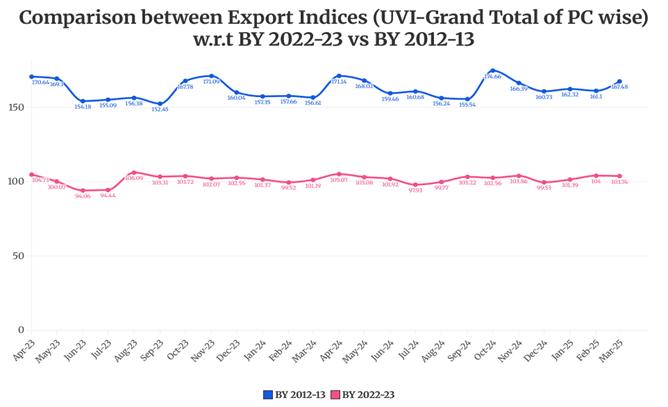
#BY means Base Year.
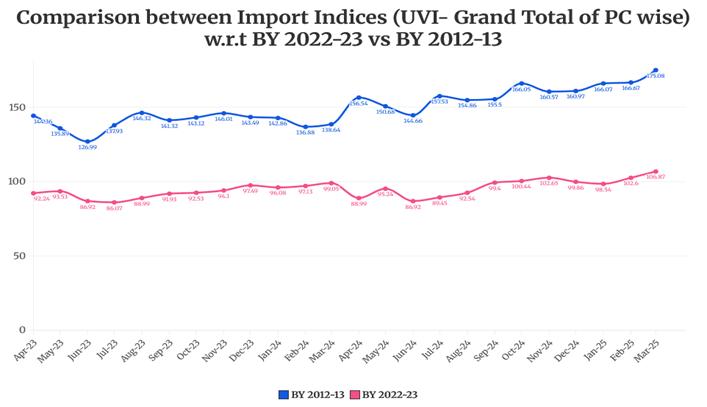
 

#BY means Base Year.

Table: Unit Value Index (UVI) and Quantity Index (QI) during FY 2025-26(Apr-Nov) using FY 2022-23 as base year


Month

Apr_25

May_25

Jun_25

1st Qtr 25-26

Jul_25

Aug_25

Sep_25

2nd Qtr 25-26

Oct_25

Nov_25

Unit Value Index

Export

105.31

99.73

96.31

100.33

99.31

100.55

104.08

101.23

103.78

105.32

Import

92.33

97.97

91.74

94.08

96.34

100.81

108.69

101.93

110.17

106.59

Quantity Index

Export

107.85

104.76

93.88

101.91

103.41

102.64

111.04

105.57

116.19

113.06

Import

138.16

126.61

112.58

125.17

122.47

124.06

126.45

124.32

137.04

121.75

Qtr  means Quarter.

Meaning and interpretation of the Indices

The Unit Value Indices and the Quantity Indices may be interpreted along the following lines.

The Unit Value Index answers the question: What is the growth in the average Unit Value of the items1 traded in the current month with respect to the same month in the Base Year?

So, an Unit Value Index of, say, 120 means that if the items that have been traded in the current month had been traded in the same month of the base year, and if the average price (or unit value) of those items had been Rs.100 in that month of the base year, then the average price (or unit value) of these items in the current month is Rs.120. Or that, there is a 20% increase in the average Unit Value, with respect to the Base Year, of the items that have been traded in the Current Month.

For example, let us suppose 30 items, 10 items each from 3 different Principal Commodities, have been traded in the current month. If these 30 items had been traded in the corresponding month of the base year at an average price of Rs.100, then the average price of these items in the current year is Rs.120.

It is to be noted that there are two successive steps of averaging done here. The first averaging is done over all the items (or ITCHS) of a PC group to arrive at the Index of that PC group. And the second averaging is done over all the PC groups to arrive at the Index at the Grand Total level for all commodities (which is the overall Index for India for a month). In both the stages, a weighted average is taken where the weights are proportional to the importance of the items and the PC groups respectively, and the Laspeyres Formula is used for averaging.

Quantity Indices, say, 200 means that if in the base year on an average 100 units were traded in India in the base year, then in the current year on an average 200 units were traded. However, it must be remembered that averaging quantities are different from averaging prices, since quantities in different units cannot be added directly.

So, the Quantity Indices are calculated by dividing the Value Indices by the Unit Value Indices. For example, if there is an increase in the Value of Export from Rs. 10,000 to Rs. 24,000, then the Value Index is 24000/10000 × 100 = 240. If the Unit Value Index is 120, then the Quantity Index comes to 240/120 × 100 = 200. So, loosely it can be said that, if the value of export has increased 2.4 times and the price of the commodities has increased 1.2 times, then the quantity must have doubled.

However, it may be noted that a very high or low Quantity Index may indicate the presence of Base Effect.

The Interpretation of the Bilateral and Regional Indices can be seen as an extension of the above.

A Unit Value Index of 120 with respect to a country, say Bangladesh, means that if all the items that have been traded with Bangladesh in the current month had been traded in the same month of the base year with the same country, and if the average price (or unit value) of those items had been Rs.100 in that month of the base year, then the average price (or unit value) of these items in the current month is Rs.120.

Similarly, a Quantity Index of 200 with respect to a country, say Bangladesh, means that if in the base year on an average 100 units were traded in India in the base year, then in the current year on an average 200 units were traded.

Comparability of the Indices across time

It is to be noted that the weights in the Index Number formula are fixed across time and there are twelve sets of weights for the twelve months. Hence, comparability of Indices is meaningful only when Indices of same month are compared across years. Different months may attach different weights to the same item, and hence comparing indices of two different months becomes vague and may have little applicability.

Further, the weights of the items that are not present in the trade basket of the current month are distributed to all the items that have been traded in the current month. This distribution is done in proportion to the weights of those items.

For example, let us suppose there are only 3 commodities for trade, say A, B and C. In month May of the Base year, let us suppose that the trade value of A was Rs. 50, B was Rs. 100 and C was Rs. 50. Then the weights assigned to A, B and C in the month of May of the following years would be in the ratio 50 :100 :50. However, in case, C is not traded in the current month, then the weight of C would be distributed proportionately among A and B, again in the ratio 1:2 (since in May the weights of A and B are in the ratio of 50 : 100, i.e., 1 : 2). So, in the current month the weights of A and B would be 3313  and 6623 .

As a result, the weights in any two given months are dependent on exactly the number of items (ITCHS codes) traded in those months. If the items traded are widely different, inference drawn from the comparison of the Indices may be done accordingly. On the other hand, more the similarity in the number of items traded more is the comparability of the two indices.

Net Terms of Trade:

Net Terms of Trade also called commodity Terms of Trade is defined as a ratio of export prices to import prices.

Let say 2022-23 be the base year and 2023-24 be the final year. We express both export and import prices in 2022-23 as 100. Now, suppose that at the end of 2023-24, it is found that the index of export prices decreased to 90 and index of import prices roses to 150. Then the Net Terms of Trade has changed to 90100150100=35 . Then terms of trade as index=35*100=60 . It implies that terms of trade of the country have decreased by about 40% in 2023-24 as compared with 2022-23. It thus shows a deterioration or a worsening of the terms of trade of the country.

If the index of export prices has risen to 150 and that of import prices had risen to 120, then the net terms of trade would have changed to 150120*100=125 . This implies an improvement in the net terms of trade of the country by 25% in 2023-24 over 2022-23.

Gross Terms of Trade:

Gross Terms of Trade is the ratio of physicalquantity of import to physical quantity of export.

Let say 2022-23 be the base year. In that year, the quantities export and import are denoted by 100. Now, suppose that in the year 2023-24, the index of quantity of import was 150 and that of quantity of export was 120. Then the gross terms of trade is given by 150100120100=54,  in terms of percentage =54*100=125 . This implies that there was an improvement of gross terms of trade by 25% in 2023-24 compared to 2022-23.

Income Terms of Trade: Income Terms of Trade is defined as- Net Terms of Trade multiplied by quantity of export.

Topics

Acts Income Tax